
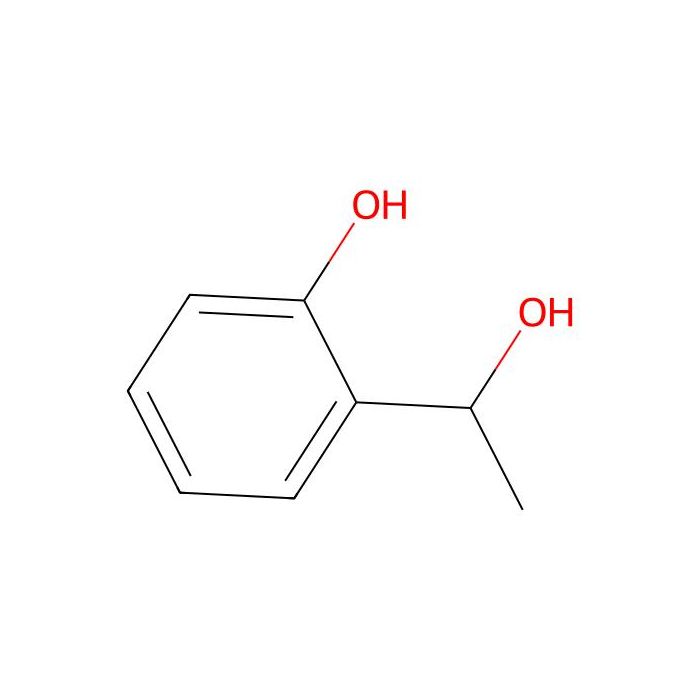
Determine the necessary mass, volume, or concentration for preparing a solution.
2-(1-Hydroxyethyl)phenol - ≥95% , CAS No.62019-23-2
AVAILABLE TO ORDER
GRADE & PURITY ≥95%
Storage
Room temperature
≥95% for sensitive chromatographic and analytical workflows requiring minimal baseline interference.
Room temperature Ships Check lot-specific COA for exact specifications.
SDS, COA, datasheet, and spec sheet available for download. Lot-specific COA accessible via lot number lookup.
Cited in 0 peer-reviewed publications across chromatography, organic synthesis, and cross-coupling reactions.
Comprehensive hazard, handling, storage, and regulatory compliance document.
<<<<<<< HEAD Download SDS → ======= Download SDS → >>>>>>> release248-p3Lot-specific quality data. Enter your lot number to retrieve the exact COA.
Look up COA →Full quality attributes and acceptance criteria for this grade.
View spec sheet →Taxonomy Tree
| Kingdom | Organic compounds |
|---|---|
| Superclass | Benzenoids |
| Class | Phenols |
| Subclass | 1-hydroxy-4-unsubstituted benzenoids |
| Intermediate Tree Nodes | Not available |
| Direct Parent | 1-hydroxy-4-unsubstituted benzenoids |
| Alternative Parents | 1-hydroxy-2-unsubstituted benzenoids Benzene and substituted derivatives Secondary alcohols Hydrocarbon derivatives Aromatic alcohols |
| Molecular Framework | Aromatic homomonocyclic compounds |
| Substituents | 1-hydroxy-4-unsubstituted benzenoid - 1-hydroxy-2-unsubstituted benzenoid - Monocyclic benzene moiety - Secondary alcohol - Organic oxygen compound - Hydrocarbon derivative - Aromatic alcohol - Organooxygen compound - Alcohol - Aromatic homomonocyclic compound |
| Description | This compound belongs to the class of organic compounds known as 1-hydroxy-4-unsubstituted benzenoids. These are phenols that are unsubstituted at the 4-position. |
| External Descriptors | Not available |
| Molecular Weight | 138.160 g/mol |
|---|---|
| XLogP3 | 1.600 |
| Hydrogen Bond Donor Count | 2 |
| Hydrogen Bond Acceptor Count | 2 |
| Rotatable Bond Count | 1 |
| Exact Mass | 138.068 Da |
| Monoisotopic Mass | 138.068 Da |
| Topological Polar Surface Area | 40.500 Ų |
| Heavy Atom Count | 10 |
| Formal Charge | 0 |
| Complexity | 103.000 |
| Isotope Atom Count | 0 |
| Defined Atom Stereocenter Count | 0 |
| Undefined Atom Stereocenter Count | 1 |
| Defined Bond Stereocenter Count | 0 |
| Undefined Bond Stereocenter Count | 0 |
| The total count of all stereochemical bonds | 0 |
| Covalently-Bonded Unit Count | 1 |
No assay or immunoassay protocols are specified for this small-molecule reagent.
General laboratory usage suggestions (non-binding, literature-based):
For any validated, method-specific protocols, please refer to publications or develop internal SOPs. Item- and lot-specific instructions are not provided for this SKU.
Scope: This product is intended for research use only. No clinical or therapeutic claims are made.
General biochemical context (literature-based):
Laboratory considerations:
Note: Any biological activity assays should be designed and interpreted within a basic research framework. Verify purity and absence of interfering phenolic impurities (which can have disproportionate redox effects) using appropriate analytical methods (HPLC, LC–MS).
Not typically applicable. 2-(1-Hydroxyethyl)phenol is not a standard buffering reagent. While phenolic pKa values are around ~10 (literature), making conjugate phenoxide/phenol pairs in principle usable near alkaline pH, this compound is rarely, if ever, employed as a buffer component due to reactivity, potential oxidative instability, and lack of defined buffering capacity data.
Practical guidance for laboratory use:
For specifications on solution stability, pH-dependent solubility, or extinction coefficients, consult literature data or generate internal characterization under your exact conditions.
Although this product is a reagent/building block (not a solvent), greener choices can be made in processing and transformations involving 2-(1-hydroxyethyl)phenol.
Solvent selection (comparative, literature-based):
Example comparison (general):
Workup and purification:
Tradeoffs: Greener choices may affect selectivity (phenol vs. secondary alcohol), reaction rate, and isolation efficiency. Pilot small-scale experiments to confirm equivalence before scale-up.
Formulation/excipient role: Not a common pharmaceutical excipient. No pharmacopeial monograph is known for 2-(1-hydroxyethyl)phenol.
Relevant context for drug discovery and process chemistry (literature-based, non-clinical):
All uses are limited to research and development. This product is not intended for human or veterinary use, diagnostic procedures, or as a drug substance/excipient in marketed products.
Item-specific specifications (this lot):
Literature/computed properties (reference only; not product specifications):
Note: For authoritative values such as mp/bp, density, refractive index, water content, and UV cutoff, refer to the CoA/Spec Sheet for this specific SKU.
Item-specific grade/purity and stabilizers:
Context for professional users:
Recommendation: For reproducibility in synthesis or assay development, archive the CoA specific to SKU H1023984 and lot, and reference it in methods. If enantiopurity is critical, confirm optical activity or enantiomeric ratio on the CoA; otherwise assume racemic material.
This ortho-phenolic benzylic secondary alcohol is a versatile synthon for aromatic construction and fine-chemical research. Typical applications (literature-based; expand from the compound’s functional profile):
Practical tips:
General literature guidance for common transformations of 2-(1-hydroxyethyl)phenol (not product specifications):
Oxidation to o-hydroxyacetophenone:
Phenolic O‑acylation/alkylation:
Benzylic alcohol derivatization:
Intramolecular cyclization (to benzofurans):
Analysis and control:
Reported yields vary with substitution/protecting strategy; consult primary literature for substrate-matched optimization.
Item-specific hazard information:
General safety considerations for phenolic secondary alcohols (literature-based; not a substitute for the SDS):
Always consult the product SDS for definitive hazard and response information.
Applicability: This product is a bifunctional aromatic alcohol (not a solvent). Solvent selection guidance below pertains to dissolving/processing this compound in reactions or preparations.
Polarity class and interactions (general):
Practical choices by task (literature-based):
Comparison (typical):
Item-specific storage conditions:
General guidance for this class of compounds (literature-based):
Reconstitution/solution preparation:
Always consult the CoA and SDS for lot-specific guidance.
Brief overview: 2-(1-Hydroxyethyl)phenol is an ortho-disubstituted phenolic building block bearing a phenolic OH and a benzylic secondary alcohol at the 2-position (–CH(OH)–CH3), creating a single stereogenic center (typically supplied as racemate unless otherwise noted).
Item-specific identifiers (from Product Data):
Computed/literature structural information (for reference; not item-specific):
2D structural description (general):
Key functional features enabling synthesis (literature-based):
Representative transformations:
Retrosynthetic value:
Practical notes:
Not applicable. This product is a small-molecule reagent and is not an antibody, enzyme, or affinity reagent. No target specificity data (antigen/epitope, species reactivity, clone, isotype) are associated with this item.