This compound belongs to the class of organic compounds known as alkyl-phenylketones. These are aromatic compounds containing a ketone substituted by one alkyl group, and a phenyl group.
External Descriptors
Not available
1. Djoumbou Feunang Y, Eisner R, Knox C, Chepelev L, Hastings J, Owen G, Fahy E, Steinbeck C, Subramanian S, Bolton E, Greiner R, and Wishart DS. ClassyFire: Automated Chemical Classification With A Comprehensive, Computable Taxonomy. Journal of Cheminformatics, 2016, 8:61.
Determine the necessary mass, volume, or concentration for preparing a solution.
Dilution Calculator
Determine the dilution needed to prepare a stock solution.
Reconstitution Calculator
Reviews
Customer Reviews
Application Protocols
Not applicable. No immunoassay or bioassay application protocols (e.g., WB, IHC, IF, FC) are associated with this small-molecule reagent. For laboratory use, follow standard synthetic/analytical protocols relevant to aryl ketones.
Biological Roles
This compound is a synthetic aromatic ketone used as a research chemical and building block. It does not have a known endogenous biological role.
General biochemistry context (literature)
Aryl ketones can undergo phase I metabolism (reduction of the carbonyl to secondary alcohols; oxidative hydroxylation on the aromatic ring) and phase II conjugation (glucuronidation/sulfation), increasing polarity for excretion.
Methyl substituents on the ring are susceptible to benzylic oxidation in biological systems, potentially yielding benzyl alcohols/acids.
The carbonyl moiety can form Schiff base-like adducts only after derivatization (e.g., oximes/hydrazones) and thus is less reactive toward biomacromolecules than aldehydes.
Photochemical considerations
Aromatic ketones can access triplet states upon UV irradiation; some exhibit photosensitizing behavior in vitro. Substituents modulate triplet energies and intersystem crossing.
Toxicology note
Specific toxicological thresholds, exposure limits, and hazard classifications for this item are Not specified for this item; refer to SDS.
Use is restricted to laboratory research. No clinical, diagnostic, or therapeutic use is implied or recommended.
Buffer Applications
Not typically applicable. 2′,4′-Dimethylacetophenone is a hydrophobic aromatic ketone and is not used as a buffering agent. For aqueous work, select appropriate biological or inorganic buffer systems (e.g., phosphate, HEPES) independent of this reagent.
Green Alternatives
While 2′,4′-dimethylacetophenone itself is a target/intermediate rather than a solvent, greener choices can be made in its synthesis and use.
Solvent swaps (literature-guided)
Replace chlorinated solvents (e.g., DCM) with ethyl acetate, 2-MeTHF, or cyclopentyl methyl ether (CPME) where compatible (comparable polarity with improved EHS profiles, better recyclability).
Substitute toluene or xylene with anisole or p-cymene for high-temperature reactions (higher boiling, improved safety metrics).
Reagents and conditions
For carbonyl reductions, favor catalytic hydrogenation (H2/Pd, H2/Ru) or transfer hydrogenation (iPrOH, formate) over stoichiometric metal hydrides when chemoselectivity allows.
For α-oxidations, consider Oxone, hypervalent iodine (IBX/DMP), or H2O2 with organocatalysts in place of chromium(VI) reagents.
For acylation routes, explore biobased acyl donors or acyltransfer catalysts and avoid stoichiometric AlCl3 by using solid acids, zeolites, or HFIP-promoted methodologies.
Energy and waste
Employ flow chemistry for hazardous steps (halogenations, nitrations) to improve heat/mass transfer and reduce inventory.
Utilize microwave or photoredox catalysis to lower temperatures and shorten cycle times where mechanistically justified.
Comparison snapshot (general)
DCM vs EtOAc/CPME/2-MeTHF: lower toxicity/ozone impact and often similar solvating ability, but different evaporation rates and water miscibility profiles.
Cr(VI) oxidants vs Oxone/H2O2/I(III): greener oxidants decrease hazardous waste but may require optimized catalysts and may alter selectivity.
Always verify reaction performance and purity with greener substitutions; document changes in impurity profiles.
Pharmaceutical Uses
Role
Primarily a synthetic intermediate for discovery chemistry and process development. It may be used to construct 2,4-dimethylphenyl motifs in candidate molecules via condensations, reductions, or cross-couplings.
Excipients/compendial status
There is no indication of compendial excipient status. Item-specific pharmacopeial listings: Not specified for this item; refer to CoA/Spec Sheet.
Formulation relevance (general)
As an aromatic ketone, it is not typically employed as an excipient. If present in formulated materials (e.g., impurities, intermediates), it should be controlled per ICH Q3A/B guidelines.
Manufacturing considerations
Residual levels after use as a process intermediate should be monitored by validated analytical methods (e.g., GC/LC with UV/MS detection). UV absorbance near 240–280 nm can assist in detection.
For research use only. No clinical or therapeutic applications are claimed or supported.
Physical Properties
Item-specific values are not supplied in the Product Data. The following are typical literature values for 2′,4′-dimethylacetophenone and are provided for reference only (not specifications for this item).
Phase at ambient conditions (literature): colorless to pale yellow liquid or low-melting solid, depending on purity and temperature
Boiling point (literature): ~242–246 °C at 1 atm
Melting point (literature): often below room temperature (liquid); specific MP values vary in literature
Density (literature): on the order of ~0.98–1.01 g/mL at 20–25 °C
Refractive index n20/D (literature): typically ~1.530–1.540
LogP (XlogP3, literature): ~2.5–2.8 (increased hydrophobicity vs. acetophenone)
Vapor pressure (literature): low at room temperature (consistent with high BP)
Solubility (literature):
Water: very low (sub-mM range)
Organic solvents: miscible with common organics (Et2O, DCM, THF, hexanes, toluene, MeOH/EtOH to varying extents)
UV–vis (literature): aromatic ketone π→π* band ~240–280 nm; n→π* shoulder at longer wavelength; exact cutoff varies with solvent
Item-specific specifications such as exact BP/MP/density/refractive index, water content, residual solvents, or metal limits: Not specified for this item; refer to CoA/Spec Sheet.
Quality & Grades
Item-specific grade/purity: Not specified for this item; refer to CoA/Spec Sheet.
Interpreting typical grades for aryl ketones (general guidance)
Analytical/AR grade: tight purity range and low non-volatile residue; suitable for quantitative analysis and synthesis where impurities affect stoichiometry.
Synthesis grade: adequate purity for routine transformations; may contain trace isomers or residual solvents.
GC/HPLC grade solvents/reagents (if offered): low UV absorbance/background and controlled volatiles beneficial for trace analysis or spectroscopic monitoring.
Stabilizers/inhibitors
None are typically required for simple aryl ketones; any use of stabilizers would be declared. For this item: Not specified for this item; refer to CoA/Spec Sheet.
Trace-level specifications
Water content, residual solvents, metals, and UV cutoff are critical for sensitive applications (e.g., photochemistry, catalysis). For this item: Not specified for this item; refer to CoA/Spec Sheet.
Documentation and release
Each lot’s CoA should define identification (e.g., GC/MS, NMR), purity assay and major impurity profile (e.g., regioisomer content), and appearance. Where relevant, GC retention index or qNMR can be used to confirm assay.
Fit-for-use remarks
For photochemical or catalytic applications, confirm UV absorbance and trace metals.
For kinetic or mechanistic studies, verify isomeric purity (2,4- vs. potential 2,5-/3,4-dimethyl isomers).
Reaction & Applications
As a disubstituted aryl methyl ketone, 2′,4′-dimethylacetophenone is a versatile synthon and probe substrate in mechanistic and catalytic chemistry.
Representative applications (literature examples)
Electrophilic aromatic acylation product: model for regioselectivity studies in Friedel–Crafts acylation and subsequent ring transformations.
α-Functionalization of methyl ketones: enol/enolate routes enable halogenation, alkylation, and oxidative α-oxygenation; useful for installing handles for further cross-coupling (via α-halo ketones).
Condensation chemistry: formation of oximes/hydrazones (Beckmann/Wolff–Kishner/Zn reductions), imines (for transfer hydrogenation studies), or Claisen–Schmidt condensations with aromatic aldehydes to give chalcones bearing 2,4-dimethyl-phenyl motifs.
Reductions: selective carbonyl reduction to the corresponding benzylic alcohol (NaBH4, catalytic hydrogenation) or decarbonylative/deoxygenative reductions (Clemmensen, Wolff–Kishner) to 1,3-dimethyl-substituted benzenes.
Baeyer–Villiger oxidation: ring-retentive oxidation affords aryl acetates/phenyl methyl esters, enabling access to substituted anisoles after solvolysis.
Haloform-type oxidations: under basic halogenation, methyl ketones can be cleaved to give the corresponding substituted benzoates (useful for mapping substituent effects on kinetics).
Photochemistry: aromatic ketones act as triplet sensitizers or undergo Norrish reactions; methyl substitution modulates triplet energies and ISC rates.
Practical notes
Carbonyl is electrophilic but deactivated toward further SEAr; ring methyls are weakly activating and direct ortho/para in subsequent reactions.
Enolate generation: LDA (–78 to –20 °C in THF), NaH (THF/DMSO), or weaker bases for thermodynamic enolization; regioselectivity at the α-methyl is typically straightforward.
Workup often benefits from bisulfite quench avoidance (can form adducts with carbonyls) and from buffered extractions to minimize aldol side reactions.
Reaction Conditions
General literature guidance for common transformations of 2′,4′-dimethylacetophenone (optimize per your system; not item-specific specifications):
Enolate alkylation
Base/solvent: LDA (1.1–1.5 equiv) in dry THF at –78 to –20 °C; quench with alkyl halide (1.2–2.0 equiv). Typical times: 0.5–2 h for enolization, then 1–4 h after electrophile addition. Inert atmosphere and anhydrous technique recommended.
α-Halogenation
Reagents: NBS (1.05–1.2 equiv) or Br2 with acid or base catalysis; solvent DCM/AcOH or MeCN; 0–25 °C. Monitor by TLC/GC; avoid overbromination by limiting equivalents and light.
Carbonyl reduction
NaBH4 (1.1–1.5 equiv) in MeOH/EtOH at 0–25 °C, 0.5–2 h to benzylic alcohol. Alternatively, H2 (1–5 bar)/Pd-C in EtOH/EtOAc/THF at RT–50 °C for 2–12 h.
Baeyer–Villiger oxidation
mCPBA (1.2–1.5 equiv) in DCM at 0–25 °C; or H2O2/Urea (UHP) with catalytic acids in MeCN; 2–24 h depending on conditions. Buffering minimizes over-oxidation.
Condensation (chalcone formation)
Base-catalyzed aldol with benzaldehyde derivatives: NaOH (10–30 mol%) in EtOH/H2O (or K2CO3 in MeOH) at 0–25 °C, 1–6 h. Dehydration follows under basic/thermal conditions.
Clemmensen/Wolff–Kishner (deoxygenation)
Clemmensen: Zn(Hg)/HCl, refluxing EtOH/AcOH; Wolff–Kishner: hydrazine/KOH in diethylene glycol at 180–200 °C. Choose based on functional group tolerance.
Workup and purification
Standard aqueous quench; extract with DCM/EtOAc; wash, dry (MgSO4/Na2SO4), and purify by silica gel chromatography (hexanes/EtOAc). Verify identity by NMR/GC–MS.
Expected yields vary widely (40–90% typical) depending on reagents, electronics, and sterics; consult primary literature for specific substrates.
Safety & Handling
Authoritative safety governance is the SDS. The Product Data do not provide GHS details for this item; the following are general considerations for aryl methyl ketones like 2′,4′-dimethylacetophenone.
GHS/Classification
Item-specific GHS classification, signal word, hazard and precautionary statements: Not specified for this item; refer to SDS.
Anticipated hazards (general/literature-based)
May cause skin and eye irritation; vapors or mists may irritate respiratory tract.
Combustible organic liquid; forms flammable mixtures at elevated temperature.
PPE and engineering controls
Wear safety glasses, lab coat, and appropriate chemical-resistant gloves (e.g., nitrile). Use in a fume hood to control vapors/aerosols.
Handling
Avoid breathing vapors; prevent contact with skin/eyes.
Keep away from ignition sources and hot surfaces. Ground/bond containers when transferring large quantities.
Incompatibilities (general)
Strong oxidizers (risk of exotherm), strong bases/halogens under conditions that promote haloform-type reactions (for methyl ketones), strong reducing agents.
First aid (general)
Eyes: Rinse cautiously with water for several minutes; remove contact lenses if present and easy to do; seek medical attention.
Skin: Wash with soap and water; remove contaminated clothing.
Inhalation: Move to fresh air; monitor breathing; seek medical attention if symptoms persist.
Ingestion: Rinse mouth; do not induce vomiting; seek medical attention.
Always consult the product’s SDS for definitive hazard, exposure limits, spill response, and firefighting guidance.
Solvent Selection
This product is primarily a building block/intermediate rather than a working solvent. However, understanding its solubility and polarity helps choose reaction media and purification strategies.
Polarity/solvation (literature)
Moderately hydrophobic aromatic ketone; logP ~2.5–2.8. Exhibits good solubility in nonpolar to moderately polar organics (hexanes, toluene, EtOAc, DCM, THF) and limited solubility in alcohols/water.
Typical solvent choices by operation
Electrophilic aromatic substitution on related systems: halogenated solvents (DCM), aromatic solvents (toluene), or nitrobenzene/sulfones for high-temp conditions.
α-Functionalization (enol/enolate chemistry): polar aprotics (THF, DME, 2-MeTHF, DCM) for halogenation, acylation, or Michael chemistry; careful base selection controls regiochemistry and rate.
Reductions/oxidations: alcoholic solvents (MeOH/EtOH) for catalytic hydrogenation or MPV reductions; DCM/AcOH for selective oxidations (e.g., CrO3, hypervalent iodine).
Purification
Frequently amenable to normal-phase flash chromatography (hexanes/EtOAc or hexanes/DCM gradients). Crystallization may be feasible from hexanes or MeOH if solid at low temperature.
When to choose alternatives
If high UV transparency is required (photolysis), prefer solvents with known deep-UV cutoffs (e.g., MeCN) and verify analyte’s absorbance.
For greener operations, see Green Alternatives regarding solvent swaps (2-MeTHF, CPME) vs. classical ethers.
Storage & Reconstitution
Storage (from Product Data)
Conditions: Protect from light; store at room temperature.
Shipped: Normal conditions (ambient).
Container and environment
Store in a tightly closed, light-resistant container. Minimize headspace to reduce oxidative discoloration over time. Keep away from strong oxidizers.
Stability considerations (general)
Aromatic ketones are generally stable under dry, ambient conditions away from light. Prolonged exposure to strong light or heat can promote side reactions (e.g., slow oxidation or photochemical changes).
Reconstitution
Supplied neat. If preparing solutions, use dry, oxygen-free solvents when moisture/oxygen sensitivity matters (e.g., for base-catalyzed reactions). Filter solutions (0.2 μm PTFE) for analytical use if particulate is present.
Shelf life, assay, and impurities
Item-specific shelf life and impurity limits: Not specified for this item; refer to CoA/Spec Sheet. Periodic verification by GC/1H NMR is recommended for long-stored materials.
Research use note
For research use only. Not for human or animal therapeutic or diagnostic use.
Structure & Identity
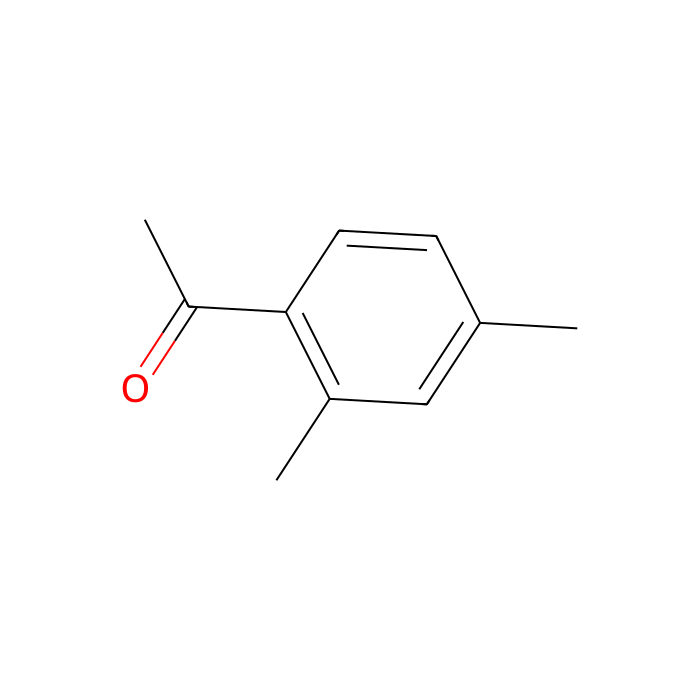
A ring-disubstituted aryl methyl ketone; the acetyl group is para to one methyl and ortho to the other on a benzene ring (2′,4′-dimethyl substitution relative to the carbonyl).
Item identifiers (from Product Data)
CAS: 89-74-7
SKU: D108574
InChIKey: 129591 (as provided)
Category: Chemical and biochemical reagents (research use only)
Literature identifiers and descriptors (for reference; not item-specific specifications)
SMILES (literature): CC(=O)c1cc(C)ccc1C (represents an aryl methyl ketone bearing methyl groups at 2- and 4-positions)
InChIKey (literature): commonly reported for 2,4-dimethylacetophenone in databases; consult literature/SDS for authoritative key
Structural features (general)
Functional groups: aryl ketone (acetyl), two aryl methyl substituents (ortho and para to the carbonyl)
Aromaticity: benzene ring conjugated with the carbonyl (enone-like delocalization across Ar–CO)
Reactivity handles: activated methyl ketone (α-position to C=O), electrophilic carbonyl carbon, aromatic ring amenable to SEAr under appropriate conditions.
2D description
A benzene ring bearing an acetyl (–COCH3) at position 1; a methyl at position 2 (ortho) and another methyl at position 4 (para) relative to the acetyl.
Synthetic Utility
2′,4′-Dimethylacetophenone serves as a robust platform for transformations at the carbonyl, α-carbon, and aromatic ring.
Carbonyl-centered chemistry
Nucleophilic additions/reductions: NaBH4, catalytic hydrogenation, or Meerwein–Ponndorf–Verley reduce to the benzylic alcohol; selectivity tuned by solvent and catalyst.
Imine/oxime/hydrazone formation: precursors to Beckmann rearrangement or reductive amination, enabling access to substituted anilides and benzylic amines.
Enolate generation (LDA, NaHMDS in THF/2-MeTHF; –78 to 0 °C) permits alkylation or acylation; α-halogenation (NBS/NCS/Br2/Cl2) yields versatile α-halo ketones.
Haloform/oxidative cleavage under basic halogenation converts the methyl ketone to the corresponding substituted benzoate/carboxylate.
Aromatic ring manipulation
SEAr (nitration, sulfonylation, halogenation) guided by the weakly activating methyls; carbonyl is deactivating/meta-directing—combined directing effects influence regioselectivity.
Cross-coupling after preliminary halogenation (e.g., ipso-bromination) enables Suzuki/Heck/Sonogashira elaboration of the ring.
Retrosynthetic value
A convenient Friedel–Crafts acylation endpoint from 1,3-dimethylbenzene or via directed ortho acylation strategies; useful for building 2,4-dimethylphenyl-containing scaffolds (chalcones, diaryl ethanols, benzoates).
Purification/analytics
Typically amenable to GC and LC–MS; diagnostic 1H NMR features include an acetyl CH3 singlet (~2.5–2.7 ppm) and two aryl CH3 singlets (~2.2–2.4 ppm), with aromatic multiplets 6.8–7.8 ppm (solvent dependent).
Target Specificity
Not applicable. This product is a small-molecule chemical reagent, not a biological targeting agent (no antigen/epitope, clone, or isotype). Item-specific targeting data are not provided.
Frequently Asked Questions
What is the purity of this product?
This product is supplied at ≥95% purity (chemical assay). Lot-specific values are stated on the Certificate of Analysis.
How should this product be stored?
Store at room temperature, protected from light. The material is light-sensitive — keep it in its original opaque or amber container.
How is this product shipped?
This product ships under standard ambient conditions. No temperature-controlled packaging is required.
What are the CAS number, molecular formula and molecular weight?
The CAS Number is 89-74-7, the molecular formula is C10H12O, and the molecular weight is 148.2 g/mol. InChIKey HSDSKVWQTONQBJ-UHFFFAOYSA-N.
What documentation is provided?
Available product documentation, including Certificates of Analysis (COA), Safety Data Sheets (SDS), and specification sheets, is shown in the product document area. Document availability and access follow the current site policy.
We use cookies to ensure the website functions properly and, where permitted, to improve your experience. You can manage your preferences at any time in Settings. Learn more in our Cookie Policy.
Shall we send you a message when we have discounts available?
Remind me later
Thank you! Please check your email inbox to confirm.
Products are supplied to verified businesses, institutions, and qualified professionals for research and development use only. Not for use in humans, animals, diagnosis, or therapy.

 G2103140