This compound belongs to the class of organic compounds known as dichlorobenzenes. These are compounds containing a benzene with exactly two chlorine atoms attached to it.
External Descriptors
Not available
1. Djoumbou Feunang Y, Eisner R, Knox C, Chepelev L, Hastings J, Owen G, Fahy E, Steinbeck C, Subramanian S, Bolton E, Greiner R, and Wishart DS. ClassyFire: Automated Chemical Classification With A Comprehensive, Computable Taxonomy. Journal of Cheminformatics, 2016, 8:61.
Determine the necessary mass, volume, or concentration for preparing a solution.
Dilution Calculator
Determine the dilution needed to prepare a stock solution.
Reconstitution Calculator
Reviews
Customer Reviews
Application Protocols
No tested bioassay or immunoassay application protocols are provided for this item. As a synthetic building block, typical protocols involve standard organic transformations such as:
Amide coupling (e.g., EDC/Oxyma or HATU): dissolve the acid and amine in DMF or DCM, add coupling reagent and base, stir at ambient temperature until complete by TLC/LC–MS, work up and purify by silica gel chromatography.
Esterification (Steglich): dissolve acid and alcohol in DCM, cool to 0 °C, add DCC and catalytic DMAP, stir to completion, filter DCU, concentrate, and purify.
Oxidation to sulfone: dissolve substrate in MeCN/H2O, add Oxone in portions at 0–10 °C, then warm to rt; quench excess oxidant with sodium sulfite, extract, and purify.
These are generic literature procedures intended as starting points. Adjust stoichiometry, temperature, and solvent to your specific substrates. For analytical preparation, develop an HPLC method with UV detection <275 nm exploiting the aryl chromophore. Always consult primary literature and perform small-scale trials to validate feasibility.
Biological Roles
Item-specific biological data: Not specified for this item; for research use only.
General considerations (literature/background):
2,5-Dichlorophenylthioglycolic acid is a synthetic small molecule. It is not a natural metabolite and has no established endogenous biological role.
As a building block, the carboxylic acid can be incorporated into amides/esters that modulate hydrophobicity and electronic properties in medicinal chemistry campaigns. The 2,5-dichloro substitution increases lipophilicity and can influence metabolic stability, while the thioether can be oxidized in biological systems to sulfoxides/sulfones.
In bioconjugation contexts, the acid can be used to install a 2,5-dichlorophenylthioacetyl moiety onto amines (e.g., on peptides/proteins after appropriate activation), altering overall hydrophobic character. Any such applications must be validated case-by-case for stability and compatibility.
Protein binding: aromatic thioethers and dichloroaryl motifs may engage in hydrophobic and halogen-bonding interactions in protein sites; however, there is no target specificity inherent to this compound.
Caveat:
No pharmacology, toxicity thresholds, or ADME properties are established here for this specific compound. Avoid any in vivo use; all handling and experimentation should remain within research laboratory settings with appropriate approvals.
Buffer Applications
Not typically applicable. 2,5-Dichlorophenylthioglycolic acid is a hydrophobic aryl thioether–containing carboxylic acid and is not used as a buffering agent.
Practical notes for lab handling instead:
For aqueous manipulations, dissolve first in a water-miscible organic co-solvent (e.g., DMSO, MeOH) or convert to a soluble salt by neutralization with NaHCO3/NaOH, then back-extract and acidify as needed.
If pH control is required during reactions, use an appropriate external buffer system (e.g., phosphate, acetate, HEPES) rather than relying on this compound’s intrinsic acidity.
Green Alternatives
Context: This product is a specialized building block rather than a process solvent. Green considerations focus on choice of reagents, solvents, and synthetic pathways when using it.
Opportunities (literature/guidance):
Solvent selection: prefer greener solvents (EtOAc, 2-MeTHF, MeOH, CPME) over DMF/DCM where feasible. For amide couplings, EtOAc or MeCN can sometimes replace DCM; 2-MeTHF can substitute for THF.
Coupling reagents: use EDC·HCl with OxymaPure in aqueous-organic media to reduce urea waste from DCC. Enzymatic esterifications/amidations in greener solvents are options for certain substrates.
Oxidations: choose H2O2/AcOH or Oxone in water/MeCN over halogenated peracids when selectivity allows; control temperature to limit over-oxidation.
Workup/waste: isolate products by crystallization where possible to minimize chromatography. Neutralize and capture chlorinated organic waste separately.
Trade-offs:
Greener solvents may reduce solubility of halogenated aryl thioethers; modest heating or co-solvents may be required.
EDC-based couplings can be slower than HATU/HBTU but avoid PF6−/BF4− salts and reduce hazardous byproducts.
Illustrative comparison (general):
DCM vs EtOAc for workup/chromatography: EtOAc has a preferable environmental profile; start with EtOAc/hexanes gradients and only revert to DCM if resolution is inadequate.
Note: No item-specific environmental certifications are provided; refer to your organization’s green chemistry metrics to quantify improvements.
Pharmaceutical Uses
No pharmacopeial designation or excipient status is specified for this item; refer to CoA/Spec Sheet. This product is supplied strictly for research use only.
General formulation/manufacturing context (literature/background):
As a synthetic intermediate, 2,5-dichlorophenylthioglycolic acid can be used to prepare amide or ester derivatives for structure–activity relationship (SAR) exploration in medicinal chemistry.
The dichloroaryl thioether motif can serve as a lipophilic pharmacophore fragment; conversion to the corresponding acid chloride facilitates rapid parallel synthesis with amines/alcohols.
For any development beyond research scale, impurity profiling (especially residual chlorinated aromatics and sulfoxide/sulfone byproducts) should be established and controlled.
Caveats:
No therapeutic indications, dosing, or clinical uses are claimed or implied. Not for human or veterinary use.
If used in pre-formulation studies, ensure compatibility testing with excipients and analytical method development (stability-indicating LC) considering potential sulfur oxidations.
Physical Properties
Item-specific specifications: Not specified for this item; refer to CoA/Spec Sheet for any lot-specific values (mp, residual solvents, assay, etc.).
Literature/general reference values (for context; not product specifications):
Physical state/appearance: typically a crystalline solid or solid powder for analogous arylthioacetic acids.
Molecular weight: ~237.10 g/mol (for C8H6Cl2O2S; literature calculation).
Acidic functionality: carboxylic acid expected pKa ~3–4 (literature range for substituted arylacetic acids; electron-withdrawing Cl substituents can slightly lower pKa relative to phenylacetic acid).
LogP: expected moderate (literature expectation for dichloroaryl–thioether–acetic acids), leading to low water solubility in the protonated form and good solubility in polar aprotic solvents when deprotonated or as esters/salts.
Solubility (qualitative, literature):
Water: low at neutral pH; increases in basic aqueous media as the carboxylate salt.
Organic: soluble in acetone, acetonitrile, ethyl acetate, dichloromethane, THF, alcohols; highly soluble in DMSO/DMF.
Melting point and boiling point: Not found in authoritative references for this exact substitution pattern at time of writing; consult CoA/Spec Sheet.
UV/Vis: aryl chromophore shows typical strong UV absorption <275 nm; exact cutoff/ε not established for this item.
Practical notes:
Carboxylic acids may form strong intermolecular H-bonding, influencing mp and crystallinity.
The thioether is relatively polarizable, modestly increasing refractivity; specific refractive index is not applicable to solids.
Quality & Grades
Item-specific grade/purity: Not specified for this item; refer to CoA/Spec Sheet.
Guidance on typical grades (general information):
Research grade: common for synthetic building blocks; suitable for most organic synthesis applications. Purity is typically established by NMR/LC or HPLC area %, with residual solvent and water content reported on CoA.
Analytical reagent (AR) or ≥98–99% grade: emphasizes low inorganic/organic impurities. If required for your application (e.g., analytical reference or medicinal chemistry SAR), specify the minimum assay when ordering.
Stabilizers: none are typically required for aryl thioether carboxylic acids; if present, they will be listed on the CoA.
What to check on receipt:
CoA should detail assay, identity (NMR, MS or HRMS, sometimes IR), and key limits (e.g., halide content, residual solvents). UV cutoff is generally not specified for solids used as building blocks.
If impurity profile or form (free acid vs. salt, polymorph) is critical to your workflow, contact Technical Support with SKU D154918 for lot-specific details.
Fit-for-purpose considerations:
For coupling chemistry (amide/ester formation), trace water and residual bases/acids can affect activation; confirm KF and residual reagents if your process is water-sensitive.
For structure–activity studies, consider requesting an additional purity verification (qNMR) if not present on the standard CoA.
Reaction & Applications
This reagent is a versatile bifunctional building block combining a carboxylic acid with an aryl thioether. Representative applications (literature/general) include:
Carboxylate derivatization:
Amide formation with amines via carbodiimides (DCC/DIC) or uronium reagents (HATU/HBTU/EDC) with catalytic DMAP/HOAt; valuable for installing 2,5-dichlorophenylthioacetyl motifs on amines and peptides (N-terminus, lysine side chains) under standard coupling conditions.
Esterification via Fischer conditions (alcohol, catalytic strong acid, reflux) or Steglich esterification (DCC/DMAP in DCM) to afford storage-stable esters for further transformations.
Acid chloride preparation using SOCl2 or (COCl)2 with catalytic DMF, enabling coupling to hindered nucleophiles.
Sulfur functionalization:
Oxidation of the thioether to sulfoxide (1 equiv mCPBA, −20 to 0 °C) or sulfone (2+ equiv mCPBA or Oxone, 0–25 °C), tuning polarity and hydrogen-bond acceptor properties.
Radical or electrophilic functionalization at sulfur (e.g., S-alkylation to form sulfonium salts, then Pummerer-type chemistry from the sulfoxide).
As a handle in medicinal and materials chemistry:
The 2,5-dichloroaryl group modulates lipophilicity and electronic properties; the –CH2CO2H vector enables rapid library diversification.
Practical tips:
Dry conditions improve coupling efficiency; pre-dry solvents and use bases like DIPEA.
For silica chromatography of acids, add 0.1–1% AcOH to minimize streaking; alternatively isolate as a salt then re-acidify.
Reaction Conditions
General reaction condition guidelines (literature; not product specifications):
Temperature/time: 20–25 °C, 2–16 h. Typical isolated yields: 70–95% for unhindered amines.
Amide coupling (HATU):
Solvent: DMF or DCM.
Reagents: HATU (1.1–1.2 equiv), base DIPEA (2–3 equiv).
Temperature/time: 0–25 °C, 0.5–4 h. Often higher rates; monitor to avoid O-acylurea byproducts.
Formation of acid chloride:
SOCl2 (3–5 equiv) or oxalyl chloride (2–3 equiv) with a catalytic drop of DMF.
Solvent: neat reagent or DCM.
Temperature: 0–25 °C; time: 1–3 h. Use under inert atmosphere; remove volatiles and use immediately.
Esterification (Steglich):
DCC (1.2–1.5 equiv), catalytic DMAP (0.1 equiv), alcohol (2–5 equiv) in DCM (0.05–0.2 M), 0–25 °C, 2–16 h. Filter off DCU.
Oxidation of thioether:
To sulfoxide: mCPBA (1.0–1.1 equiv) in DCM at −20 to 0 °C, 0.5–2 h.
To sulfone: mCPBA (2.0–2.5 equiv) or Oxone (2–3 equiv) in MeOH/H2O or MeCN/H2O at 0–25 °C, 1–6 h.
Workup/purification tips:
Add 0.1–1% AcOH to silica eluents to mitigate streaking of the acid.
For basic washes, extract the carboxylate into aqueous NaHCO3/Na2CO3, then re-acidify (pH ~2) and back-extract.
Note: Optimize conditions for your substrate pair; electron-poor dichloroaryl groups can modestly influence reactivity and solubility.
Safety & Handling
Authoritative hazard data for this catalog item: Not specified for this item; refer to the product SDS for definitive GHS classification, H-statements, and pictograms.
General safety considerations for aryl thioether carboxylic acids (literature/generic guidance):
Likely hazards: may cause skin/eye irritation and respiratory irritation. Avoid inhalation of dust and contact with skin/eyes.
Peroxide formation: not typical for thioethers; however, thioethers can undergo slow air oxidation to sulfoxide/sulfone. Store tightly closed.
Incompatibilities: strong oxidizers (risk of exothermic oxidation of sulfur), strong bases (forms carboxylate; assess for compatibility in process), strong acids (no special hazard beyond typical acid behavior), and electrophilic halogenating agents (may chlorinate/oxidize sulfur or ring).
Recommended PPE and handling (good laboratory practice):
Use gloves (e.g., nitrile), lab coat, and splash goggles.
Handle powders in a fume hood; avoid generating dust/aerosols.
Use inert atmosphere for sensitive synthetic steps (e.g., during acid chloride formation) as appropriate.
First-aid overview (general):
Skin: wash with soap and water; remove contaminated clothing.
Eyes: rinse cautiously with water for several minutes; seek medical attention if irritation persists.
Inhalation: move to fresh air; seek medical attention if symptoms occur.
Ingestion: rinse mouth; do not induce vomiting; seek medical advice.
Storage conditions (item-specific):
Store at room temperature. Keep container tightly closed in a dry, well-ventilated place. Defer to SDS for full guidance.
Solvent Selection
Applicability: as a solid carboxylic acid building block, solvent considerations pertain to its use in reactions, workups, and analytical dissolution rather than as a solvent.
Good solubility: acetone, acetonitrile, ethyl acetate, THF, methanol, ethanol.
Moderate solubility: dichloromethane, toluene (enhanced upon conversion to acid chloride, ester, or when warmed).
Water: low at neutral pH; readily soluble as the carboxylate in basic aqueous media.
Selection by task:
Amide coupling: DMF, NMP, or DCM with coupling reagents (HATU/EDC/HBTU) and organic bases (DIPEA, NMM). For less polar partners, use DCM/THF with in situ activation (acid chloride or mixed anhydride).
Esterification: alcohol solvent (MeOH, EtOH, iPrOH) with acid catalysis (H2SO4, TsOH) or DCC/DMAP in DCM/THF for Steglich.
Oxidation of thioether: use AcOH, MeOH/CH2Cl2, or CH3CN depending on oxidant (mCPBA, Oxone, H2O2/AcOH).
Purification: normal-phase silica is typical; adjust eluent polarity with EtOAc/hexanes or DCM/MeOH with 0.1–1% AcOH to suppress tailing of the acid.
Comparison to alternatives:
Relative to non-chlorinated phenylthioacetic acid, the dichloro analog is less polar and less water-soluble; plan accordingly for extraction and crystallization.
Storage & Reconstitution
Item-specific storage and shipping:
Storage Conditions: Room temperature (as provided in Product Data). Keep tightly closed in a dry, well-ventilated area, protected from excessive heat and light.
Shipped In: Normal (ambient) conditions.
Reconstitution/solution preparation:
Solid dissolves readily in polar organic solvents (e.g., DMSO, DMF, MeOH, EtOH, acetone). For aqueous work, first dissolve in a miscible organic solvent or convert to the sodium/potassium salt by neutralization.
Suggested stock solutions (general guidance): 10–100 mM in DMSO or DMF; store aliquots under inert atmosphere at 2–8 °C for short term, or −20 °C for longer term to minimize sulfur oxidation. Actual stability depends on matrix; verify by LC–MS/NMR.
Stability considerations (general):
Thioethers can slowly oxidize in air to sulfoxides/sulfones, especially in solution. Minimize headspace oxygen, store in amber vials, and avoid prolonged exposure to elevated temperatures.
Avoid contact with strong oxidants. If hygroscopicity or polymorph is critical, consult the CoA/Spec Sheet (not specified for this item).
Before use:
Allow container to equilibrate to room temperature before opening to prevent moisture condensation.
If solids cake or show discoloration, assess purity by NMR/LC–MS prior to use.
Refer to the product CoA and SDS for authoritative storage and handling guidance for your specific lot.
Structure & Identity
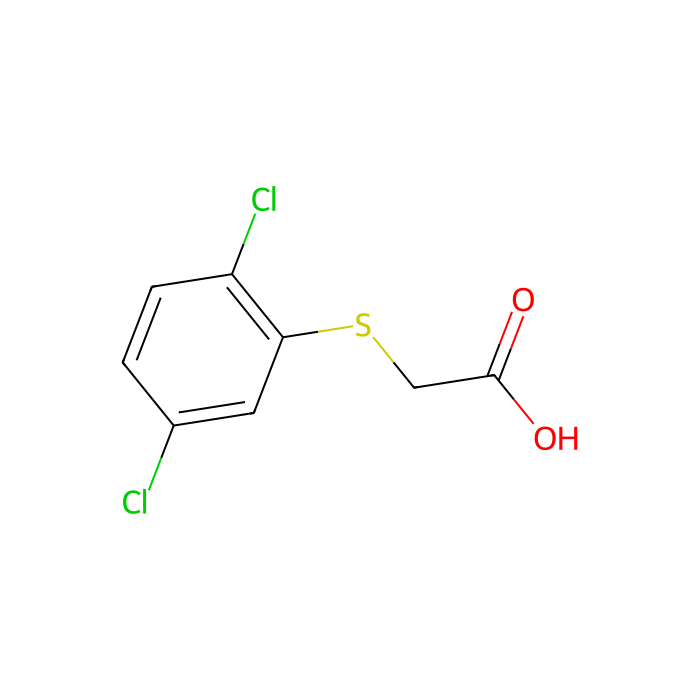
Overview: 2,5-Dichlorophenylthioglycolic acid is an aryl thioether–substituted acetic acid (a phenylthioacetic acid derivative) bearing two chloro substituents on the aromatic ring at the 2- and 5-positions.
Item-specific identifiers (from Product Data):
CAS: 6274-27-7
PubChem CID: 60049
InChIKey: 60203 (as provided)
SMILES: Not specified for this item; refer to CoA/Spec Sheet.
Literature/computed identifiers and features (for reference; not product specifications):
Typical molecular formula (literature): C8H6Cl2O2S
Structural description (2D): a benzene ring bearing chlorine substituents at positions 2 and 5; the ring is attached at position 1 to sulfur, which is linked to a methylene (–CH2–) adjacent to a carboxyl group (–CO2H).
Stereochemistry:
None (achiral as drawn); no stereogenic centers.
Notes:
The aryl–sulfur bond confers distinct reactivity (oxidation to sulfoxide/sulfone, metal-catalyzed C–S functionalization), while the carboxylic acid enables routine derivatization (esters, amides). Refer to CoA for definitive identifiers for this specific lot.
Synthetic Utility
Key functional elements and reactivity:
Carboxylic acid (–CO2H): readily transformed to acid chlorides, anhydrides, esters, amides. Enables coupling under carbodiimide/uronium chemistry, mixed-anhydride methods, or via acyl halides.
Aryl thioether (Ar–S–): tunable oxidation state (thioether → sulfoxide → sulfone), S-alkylation to sulfonium salts, and participation in Pummerer-type sequences after oxidation to sulfoxide.
Representative transformations (literature):
Amide libraries: HATU or EDC/Oxyma couplings with primary/secondary amines (DMF or DCM/DIPEA) at 0–25 °C, 1–16 h, often 70–95% yields with unhindered partners.
Esterification: Steglich (DCC/DMAP, DCM, 0–25 °C) or Fischer (ROH, catalytic TsOH, reflux) to give arylthioacetates.
Acid chloride formation: SOCl2 (3–5 equiv) or (COCl)2 (2–3 equiv) with catalytic DMF, 0–25 °C, 1–3 h; isolate in situ and couple directly.
Oxidation at sulfur: mCPBA (1.0–1.1 equiv, −20 to 0 °C) affords sulfoxide; 2.0–2.5 equiv at 0–25 °C affords sulfone. Alternative systems: Oxone or H2O2/AcOH.
Cross-coupling context: while C–S bond activation is possible under specialized conditions (e.g., Ni-catalyzed desulfurative couplings), this substrate is more commonly used as a pre-formed aryl–S motif rather than a coupling partner.
Retrosynthetic value:
Serves as an acid-bearing surrogate for installing the 2,5-dichlorophenylthioacetyl group late in a sequence, deferring introduction of the dichloroaryl sulfur moiety until diversification at the carboxyl terminus is complete.
Target Specificity
Not applicable. This product is a small-molecule chemical reagent, not a biological targeting reagent (e.g., antibody, ligand with defined biomolecular target), and no target/epitope specificity is provided in the Product Data.
We use cookies to ensure the website functions properly and, where permitted, to improve your experience. You can manage your preferences at any time in Settings. Learn more in our Cookie Policy.
Shall we send you a message when we have discounts available?
Remind me later
Thank you! Please check your email inbox to confirm.
Products are supplied to verified businesses, institutions, and qualified professionals for research and development use only. Not for use in humans, animals, diagnosis, or therapy.

 H2511066