10mM in DMSO for sensitive chromatographic and analytical workflows requiring minimal baseline interference.
🌡
Storage & shipping
Store at -80°C Ships Dry ice packs + Cold packs Check lot-specific COA for exact specifications.
📋
Quality documents
SDS, COA, datasheet, and spec sheet available for download. Lot-specific COA accessible via lot number lookup.
📚
Literature proof
Cited in 38 peer-reviewed publications across chromatography, organic synthesis, and cross-coupling reactions.
Overview
Soluble in alcohol, ether, petroleum ether, benzene and water. Low toxicity, 50% lethal dose (rat, oral) 2940mg/kg. Irritating to eyes and skin.Organic synthesis, gas chromatography to compare samples.
Specifications
Specifications & Purity
10mM in DMSO
Storage
Store at -80°C
Shipped In
Dry ice packs + Cold packs
This product requires cold chain shipping. Ground and other economy services are not available.
Determine the necessary mass, volume, or concentration for preparing a solution.
Dilution Calculator
Determine the dilution needed to prepare a stock solution.
Reconstitution Calculator
Reviews
Customer Reviews
Application Protocols
No assay-specific protocols (WB, IHC, IF, FC, etc.) are applicable to this small-molecule reagent. For synthetic uses, see Reaction Conditions and Application notes provided in Reaction & Applications and Synthetic Utility.
Biological Roles
Item-specific biological data: Not specified for this item; research use only.
General context (literature):
2,6-Dichlorophenol is not a known endogenous metabolite and has no constructive biological role in living systems. As a chlorinated phenol, it may interact nonspecifically with lipid membranes and proteins due to its hydrophobicity and acidity.
Phenols can undergo phase II metabolism (e.g., glucuronidation, sulfation) in vivo; chlorination often slows oxidative biodegradation relative to phenol.
Environmental toxicology literature highlights that certain chlorophenols exhibit aquatic toxicity and persistence; specific thresholds and regulatory classifications vary by jurisdiction and must be consulted in official databases.
This information is provided for general biochemical context. No clinical or therapeutic claims are made; this product is for research use only.
Buffer Applications
This compound is not a buffering agent and is not typically used to prepare biochemical buffers. As a weak acid (phenol), its pKa and poor aqueous solubility make it unsuitable for controlled buffering in common lab systems. For relevant usage, see Reaction & Applications and Synthetic Utility.
Green Alternatives
While 2,6-dichlorophenol is a useful building block, chlorinated phenols carry environmental concerns (persistence, aquatic toxicity). Consider greener strategies when feasible (general guidance):
Substrate/route choices:
Use less-halogenated or non-halogenated phenolic precursors when chlorine substituents are not required in the final target.
Employ catalytic C–H functionalization of phenol/anisole to install para substituents directly, avoiding pre-halogenated starting materials.
Solvent optimization around this substrate:
Replace chlorinated solvents with greener options (e.g., EtOAc, 2-MeTHF, CPME) where compatible.
For cross-coupling, aqueous micellar media (e.g., TPGS-750-M) or bio-based solvents (Cyrene, propylene carbonate) can be explored.
Comparison snapshot (general):
2,6-dichlorophenol vs phenol: The former affords para-selectivity but introduces halogenated waste; the latter is greener but leads to isomer mixtures unless directed methods are used.
Dioxane vs CPME/2-MeTHF as coupling solvents:
Dioxane: effective but with health/peroxide concerns.
CPME/2-MeTHF: bio-based options with broad utility, easier drying, and better safety profiles; may require condition re-optimization.
Waste minimization:
Capture phenolate-containing aqueous waste and treat as hazardous; avoid uncontrolled neutralization that generates heat.
Trade-offs are project-specific; assess EHS impacts alongside synthetic efficiency.
Pharmaceutical Uses
Item-specific pharmacopeial/excipient status: Not specified for this item; refer to CoA/Spec Sheet.
General notes (non-clinical, formulation/manufacturing context only):
2,6-Dichlorophenol is primarily a synthetic intermediate and is not commonly employed as a pharmaceutical excipient. In medicinal chemistry, it may be used as a building block to access para-substituted phenolic cores with defined steric profiles.
Impurity control: Chlorinated phenols may appear as process-related impurities in some syntheses and are typically tightly controlled due to safety and sensory concerns; validated analytical methods (GC, HPLC, GC–MS) are recommended for trace detection.
Handling in process development: Where used, closed handling systems and rigorous containment are advisable to mitigate operator exposure and environmental release.
No therapeutic claims are made; this product is offered strictly for research and laboratory synthesis.
Physical Properties
Item-specific specifications (grade-specific cutoffs, impurity limits, etc.): Not specified for this item; refer to CoA/Spec Sheet.
Literature/general physicochemical data for 2,6-dichlorophenol (for reference only; not product specifications):
Appearance: typically a crystalline solid (literature)
Melting point: ~68–70 °C (literature)
Boiling point: ~218–220 °C at 1 atm (literature)
Density (solid): not commonly reported; liquid density near melt is expected >1 g/mL due to Cl content (qualitative, literature trend)
pKa (phenolic OH): ~7.0–7.2 at 25 °C (literature)
LogP (octanol/water): ~3.0–3.2 (literature)
Water solubility: sparingly soluble; increased solubility in alkaline media via phenolate formation (general phenol behavior)
Solubility (organic): good in common organic solvents such as alcohols, acetone, ethyl acetate, chlorinated solvents, and aromatics (literature)
UV characteristics: phenols show π→π* absorbance near 270–280 nm; exact cutoff/ε not specified for this item.
Notes for practitioners:
The phenolic OH enables formation of sodium or potassium phenolate, markedly changing solubility and reactivity; plan workup accordingly.
Always verify exact values and acceptance criteria on the item’s CoA/specification when these parameters are critical to your method.
Quality & Grades
Item-specific grade/purity: Not specified for this item; refer to CoA/Spec Sheet.
General guidance on grades relevant to 2,6-dichlorophenol (for researchers selecting material):
Analytical/AR grade: Intended for analytical work; tighter impurity profiles. Suitable when trace impurities (e.g., other dichloro isomers or residual phenol) may interfere.
Synthetic grade: Adequate for routine transformations (O-alkylation, acylation, Pd cross-coupling) where downstream purification is planned.
HPLC grade (less common for solids): When available, implies low UV-absorbing and metal impurities; useful if the compound is used as a chromatography standard.
Stabilizers: Phenolic solids are generally offered without stabilizers; if any stabilizer is used, it should be disclosed on the CoA. This item: Not specified for this item; refer to CoA/Spec Sheet.
Best practices:
If using in metal-catalyzed cross-coupling at low catalyst loadings, consider screening lots for trace metal content and halide/isomeric purity.
Verify water content if moisture sensitivity affects your route (e.g., base-promoted O-alkylations). If Karl Fischer data are required: Not specified for this item; refer to CoA/Spec Sheet.
Reaction & Applications
As a sterically encumbered phenol bearing ortho dichloro substituents, 2,6-dichlorophenol is a versatile intermediate with notable para selectivity.
Key transformations (literature/general):
Selective para-functionalization: Electrophilic aromatic substitution (nitration, sulfonylation, Friedel–Crafts type reactions tailored to phenols) predominantly at C4 due to 2,6-blocking and OH activation.
O-derivatization: Formation of ethers (Williamson ether synthesis) and esters (acyl chlorides/anhydrides, Steglich) via the phenoxide; enables protecting-group strategies or ligand synthesis.
Cross-couplings on aryl chlorides: With optimized catalysts (Pd/XPhos, BrettPhos, SPhos systems), the 2- and 6-chloro positions can undergo Suzuki–Miyaura, Buchwald–Hartwig, or Negishi couplings at elevated temperatures.
Oxidation/reduction: Phenolic oxidation to quinone-like species is possible under strong oxidants; generally avoided unless synthetic target demands.
Directed transformations via phenolate: O-alkylation to introduce handles for further elaboration (e.g., benzyl/allyl ethers for subsequent deprotection or Claisen rearrangements).
Practical tips:
Generate the phenolate in situ with K2CO3/Cs2CO3 for mild O-alkylation; employ NaH or t-BuOK for more challenging alkyl halides (avoid elimination-prone substrates).
For Pd-catalyzed coupling on C–Cl, rigorously exclude moisture/air, use strong electron-rich ligands, and consider micro-wave heating or high-boiling solvents (120–150 °C).
Para-selectivity is a strategic advantage vs. phenol; leverage this when positional isomers are problematic.
Representative uses:
Intermediate for chlorinated phenyl ethers/esters; precursor to hindered phenolic ligands and specialty monomers; scaffold for materials and agrochemical research.
All uses are for research and laboratory synthesis only.
Reaction Conditions
General literature guidance (example conditions; optimize for your system):
Time: 6–24 h; consider microwave heating for rate enhancement.
Buchwald–Hartwig amination at aryl C–Cl:
Catalyst: Pd(OAc)2 (1–3 mol%) with BrettPhos/XPhos (3–6 mol%)
Base: NaOtBu or K3PO4
Solvent: toluene, dioxane, or DMAc; 100–130 °C
These are representative literature-style conditions meant for planning. Always run small-scale screens to identify optimal ligands, bases, and temperatures for your specific substrate set.
Safety & Handling
Item-specific hazard statements, pictograms, and GHS classes: Not specified for this item; refer to SDS.
General safety profile for chlorinated phenols (literature/general guidance; not a substitute for SDS):
Hazards: Phenols can be corrosive/irritant to skin and eyes; ingestion or significant inhalation may be harmful. Chlorinated phenols are often hazardous to the aquatic environment and may have notable odor.
PPE: Use chemical-resistant gloves (e.g., nitrile), lab coat, splash goggles. Handle solids in a fume hood to control dust and vapors, especially during heating/melting.
First aid (overview):
Skin: Remove contaminated clothing, rinse with water for ≥15 min. Seek medical attention for persistent irritation.
Eyes: Rinse cautiously with water for ≥15 min; remove contact lenses if easy. Seek medical attention.
Inhalation: Move to fresh air; monitor breathing; seek medical attention if symptoms persist.
Ingestion: Rinse mouth; do not induce vomiting; seek medical attention.
Incompatibilities: Strong oxidizers; strong bases (forms phenolates; exotherm possible); reactive metals; acid chlorides/anhydrides without control (acylation). Avoid strong heating; do not distill to dryness.
Environmental: Prevent release to the environment; collect/contain spills with inert absorbent and dispose per regulations.
Always consult the product’s SDS for authoritative hazard classification, exposure limits, and emergency measures.
Solvent Selection
This product is a solid reagent, not a solvent. The following guidance addresses suitable media for its use in synthesis and handling (literature/general):
Polarity and dissolution:
Dissolves well in moderately polar organics (EtOAc, acetone, MeOH/EtOH) and nonpolar aromatics (toluene). Sparingly soluble in water; readily soluble as phenolate in basic aqueous/MEK/EtOH mixtures.
Typical choices by transformation:
O-alkylation/O-acylation: Polar aprotic solvents (DMF, DMSO, MeCN) or acetone/MeTHF/toluene with a base (K2CO3, Cs2CO3, NaH). Alcoholic solvents for Mitsunobu alternatives may be used.
Electrophilic aromatic substitution at C4: Glacial acetic acid, dichloroethane, nitromethane, or solvent-free melt depending on electrophile; para-selectivity aided by 2,6-blocking.
Cross-coupling on aryl C–Cl: High-boiling ethers (dioxane, CPME), toluene, or DMAc/DMF with strong Pd systems.
Workup considerations:
Phenolate salts partition into aqueous phase; reprotonate before extraction if needed.
Avoid prolonged contact with strong bases in protic media to limit side reactions (e.g., hydrolysis of acyl groups after protection).
Comparison (general):
Toluene vs dioxane: Toluene favors higher-temp couplings and easy removal; dioxane offers better polarity for catalyst solubility but has peroxide/health concerns.
Storage & Reconstitution
Storage conditions (item-specific from Product Data): Store at -80 °C.
Shipping (item-specific from Product Data): Shipped on dry ice packs + cold packs.
Reconstitution/handling (general guidance for this solid reagent):
The compound is typically supplied as a solid. No reconstitution is required; dissolve the desired quantity directly in a suitable anhydrous organic solvent (e.g., acetone, MeCN, EtOAc, toluene) for immediate use.
For stock solutions, prepare under dry, inert atmosphere if subsequent steps are base- or moisture-sensitive. Store aliquots in amber vials to minimize light exposure.
If forming the sodium/potassium phenolate, generate in situ immediately before use to avoid moisture uptake.
Stability notes (general):
Phenolic solids are generally stable under dry, cool, and dark conditions. Avoid prolonged exposure to heat and light.
If long-term storage deviates from the item’s recommended -80 °C, verify integrity by NMR/LC before critical use.
Thawing guidance:
Upon receipt on dry ice, allow container to equilibrate to room temperature in a desiccator before opening to prevent condensation.
For definitive stability, impurity limits, and shelf-life, consult the item’s CoA/Spec Sheet and SDS. Research use only.
Structure & Identity
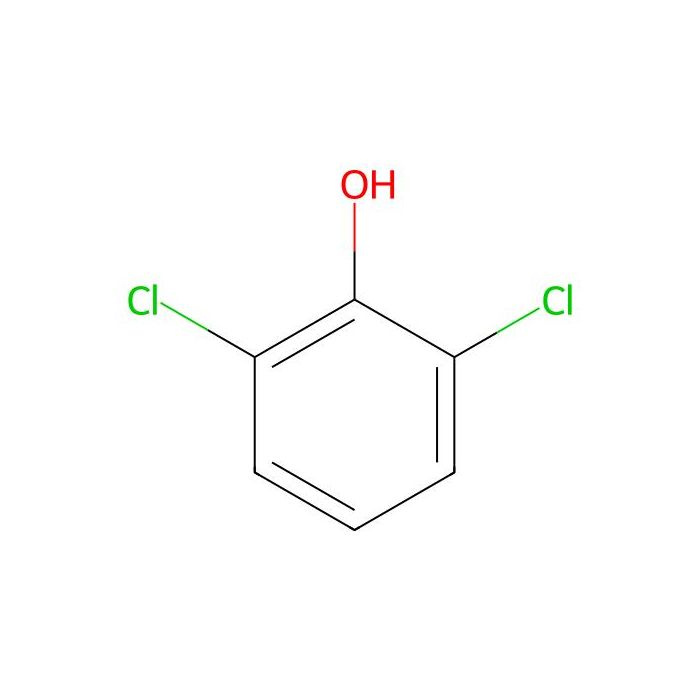
2,6-Dichlorophenol is a chlorinated phenolic building block featuring a phenyl ring bearing a hydroxyl at C1 and chloro substituents at the 2- and 6-positions, creating a sterically encumbered, para-directing phenol with blocked ortho sites.
Item-specific identifiers (from Product Data):
CAS: 87-65-0
SKU: D660567
Category: 化学和生化试剂 (research use)
Structure descriptors (literature/general):
Molecular formula: C6H4Cl2O (literature)
Molecular weight: ~163.00 g/mol (literature)
SMILES: Clc1cccc(Cl)c1O (literature)
InChIKey: Not specified for this item; refer to CoA/Spec Sheet.
Structural features (general description):
Aromatic ring with one phenolic OH and two chloro substituents in a 1,2,6-arrangement (OH at C1; Cl at C2 and C6).
The two ortho chlorides increase steric hindrance around the phenolic OH and block further ortho electrophilic substitution; the OH remains a strong para director to C4.
Functional groups: phenol (acidic OH), aryl chlorides (relatively inert toward SNAr without strong activation, but competent in Pd-catalyzed cross-coupling under appropriate conditions).
No stereocenters; planar aromatic core predominates.
Synthetic Utility
Key functional elements and reactivity (literature/general):
Phenolic OH (acidic, nucleophilic upon deprotonation):
O-alkylation (Williamson), O-acylation (acid chlorides/anhydrides, Steglich) to give ethers/esters.
Protection as benzyl/allyl/TBS ethers to enable subsequent C–C bond-forming steps.
Aryl C–Cl bonds (at 2,6):
Engage in Pd-catalyzed couplings (Suzuki, Buchwald–Hartwig, Kumada, Negishi) with appropriate ligand/catalyst systems and elevated temperatures.
Aromatic substitution patterning:
OH directs electrophiles para; ortho sites are sterically blocked by Cl. This yields high para selectivity without regioisomeric mixtures common with phenol.
Retrosynthetic value:
Serves as a para-selective phenolic synthon. For targets requiring a para-substituted phenol with ortho deactivation/steric hindrance, 2,6-dichlorophenol reduces protecting-group and regiocontrol challenges.
Analytical and purification considerations:
The phenol/phenolate equilibrium affects TLC/R_f; acidify samples for consistent chromatography.
Chlorinated aromatics often show strong signals in GC–MS (m/z patterns due to 35Cl/37Cl); useful for reaction monitoring.
Use cases:
Precursor to hindered phenolic ethers (ligands, materials), para-functionalized building blocks, and advanced intermediates for agrochemical/materials research.
Target Specificity
Not applicable. This product is a small-molecule reagent, not a biological targeting agent (e.g., antibody, ligand with defined biomolecular target). No antigen/epitope, clone, isotype, or species-reactivity information applies.
We use cookies to ensure the website functions properly and, where permitted, to improve your experience. You can manage your preferences at any time in Settings. Learn more in our Cookie Policy.
Shall we send you a message when we have discounts available?
Remind me later
Thank you! Please check your email inbox to confirm.
Products are supplied to verified businesses, institutions, and qualified professionals for research and development use only. Not for use in humans, animals, diagnosis, or therapy.