Determine the necessary mass, volume, or concentration for preparing a solution.
Dilution Calculator
Determine the dilution needed to prepare a stock solution.
Reconstitution Calculator
Reviews
Customer Reviews
Application Protocols
No item-specific validated biological or analytical application protocols are provided for SKU D972256.
General laboratory usage notes (chemistry focus):
Handling: Use as received or convert to an acid salt for weighing and storage convenience. If converting to free base, dry thoroughly (e.g., over K2CO3) before moisture-sensitive reactions.
Purity check: Verify identity by 1H/13C NMR and HRMS; for mixtures of diastereomers (possible at C-2 and C-6), characterize by chiral/ACHIRAL HPLC if stereochemistry is relevant.
Typical scales: Amenable to mg to multi-gram scales. On scale-up, control exotherms during acylation/alkylation.
Workup/purification: Favor salt formation and recrystallization to minimize silica exposure and amine tailing. If chromatography is needed, add 0.1–1% Et3N to mobile phase to suppress streaking.
For reaction-specific protocols (e.g., reductive amination, Buchwald–Hartwig coupling), see the Reaction Conditions tab and adapt to your substrate set. Always consult primary literature and conduct small-scale pilots.
Biological Roles
Applicability note: 2,6-Dimethylazepane is a synthetic small molecule amine used in chemical research. No item-specific biological role is provided.
General context (biochemistry/literature):
Structural motif: Saturated cyclic amines (e.g., azepane, piperidine) are prevalent as cationic, basic centers in bioactive molecules, influencing solubility, pKa, and target binding through hydrogen bonding and ionic interactions when protonated.
Physicochemical effects of 2,6-substitution: Alpha-alkylation near nitrogen increases steric hindrance, potentially reducing metabolic N-dealkylation and altering basicity/lipophilicity relative to unsubstituted azepane. Such modifications are commonly explored to tune ADME properties in research compounds.
Protonation state: At physiological pH, secondary aliphatic amines are largely protonated (depending on pKaH, often ~10–11), impacting membrane permeation and transporter interactions in biochemical assays.
No specific biological targets, pathways, or roles are assigned to this catalog item. Any biological testing should be designed and interpreted within controlled research settings. For all experiments, handle solely as a research chemical; do not infer clinical or diagnostic utility.
Buffer Applications
Not typically applicable. 2,6-Dimethylazepane is not used as a defined buffering agent in analytical biochemistry or cell culture.
General note (for completeness):
While secondary amines can accept protons, this compound lacks a well-established buffering range, formulation recipes, or compatibility profiles expected of standard buffers (e.g., phosphate, HEPES, TRIS). If a cationic additive is required in an assay, use established buffer systems and, if relevant, form a defined salt of the amine and evaluate experimentally.
Green Alternatives
While 2,6-dimethylazepane itself is the targeted reagent/building block, greener choices can be made around its use—primarily solvent and reagent selection, workup, and purification. Below are general considerations and comparisons relevant to typical transformations with secondary amines.
Greener solvent swaps (literature guidance):
Replace DCM/chloroform with:
Ethyl acetate or dimethyl carbonate for acylations/extractions (lower toxicity, better environmental profile).
2-MeTHF or cyclopentyl methyl ether (CPME) instead of THF/MTBE for improved safety (reduced peroxide formation risk vs. ethers varies) and biorenewable sourcing (2-MeTHF).
Use alcohol solvents (EtOH, iPrOH) for reductive aminations with hydrogenation catalysts, leveraging benign hydrogen as the reductant.
Reagent choices:
Prefer EDCI or DMC-based carbamoylation over phosgene derivatives for carbamate formation.
Use catalytic hydrogenation in EtOH/iPrOH over cyanoborohydride when feasible to avoid cyanide waste.
Process and workup:
Favor salt formation/crystallization for isolation to avoid extensive silica chromatography. Employ aqueous bicarbonate/benign brines for phase splits.
Simple comparison (general):
DCM vs EtOAc: EtOAc offers reduced toxicity and favorable EHS profile; may require longer reaction times or higher equivalents for some acylations.
THF vs 2-MeTHF: 2-MeTHF provides higher boiling point, better water immiscibility, and biorenewable sourcing; may alter reaction kinetics/solubility.
Note: Specific EHS metrics (e.g., PMI, LCA) depend on the exact route; perform solvent/reagent screening early with your target transformation involving 2,6-dimethylazepane.
Pharmaceutical Uses
No item-specific pharmacopeial status or excipient role is provided for SKU D972256.
General research/manufacturing context (non-clinical):
Intermediate/building block: Cyclic secondary amines such as 2,6-dimethylazepane are frequently used to construct drug-like molecules, serving as the amine component in amide/carbamate/urea formation, reductive amination, and Buchwald–Hartwig coupling to aryl electrophiles.
Salt screening: The free base can be converted to pharmaceutically relevant salts (e.g., HCl, fumarate, besylate) during pre-formulation studies to optimize solubility and solid-state properties—strictly within research and development settings.
Impurity standards/process aids: In process development, structurally related amines may be used as reagents or impurity markers; however, such uses are application-specific and not defined here.
No medical or therapeutic claims are made or implied. For any use in regulated environments, confirm quality attributes (identity, assay, residual solvents, water, metals, and polymorph for salts) from the CoA and adhere to internal specifications.
Physical Properties
Provided item-specific specifications:
Appearance: Not specified for this item; refer to CoA/Spec Sheet.
Molecular formula: Not specified for this item; refer to CoA/Spec Sheet.
Molecular weight: Not specified for this item; refer to CoA/Spec Sheet.
General/literature expectations for the class (secondary aliphatic cyclic amines; 2,6-dialkylazepanes):
Phase at ambient conditions: Typically low-viscosity liquids or low-melting solids; hygroscopicity is usually low-to-moderate.
Basicity: Secondary aliphatic amines show conjugate acid pKa (pKaH) typically ~10–11. Substitution at the alpha positions can modestly modulate basicity; expect similar magnitude (literature guidance).
Solubility: Miscible with many organic solvents (alcohols, ethers, chlorinated solvents, hydrocarbons to varying degrees). Water solubility is often moderate to high for small secondary amines and increases on protonation (as the ammonium salt).
Volatility: Small-ring secondary amines can be moderately volatile with amine-like odor. Exact boiling point and vapor pressure for this specific compound are not provided here.
Density, refractive index, logP, UV cutoff: Not specified for this item; consult CoA/SDS or measure under your lab conditions.
Practical notes (general):
Protonation to the hydrochloride (or other mineral acid salt) enhances aqueous solubility and simplifies handling/measurement when volatility/odor is a concern.
Free base may show amine “ghost peaks” in LC-UV; derivatization or salt formation may improve chromatographic behavior. Always confirm properties for this exact SKU via CoA.
Quality & Grades
Item-specific quality information:
Grade/Purity: Not specified for this item; refer to CoA/Spec Sheet.
Stabilizers/inhibitors: Not specified for this item; refer to CoA/Spec Sheet.
Guidance on interpreting grades for this compound class (general):
Research grade vs. high-purity: For use as a building block or ligand precursor, low levels of water, residual amines, and low UV-absorbing impurities may be desirable. If performing sensitive catalysis (e.g., cross-couplings) or quantitative kinetic studies, request/verify high assay purity and low metal content on the CoA.
Acid salt forms: Secondary amines are sometimes supplied as HCl or other mineral acid salts to improve handling and assay. If your application requires the free base, confirm the form and convert via basification (and verify purity by titration or NMR).
UV suitability: If using in HPLC method development as an additive/analyte, low baseline drift grades (HPLC grade) can help; however, such a designation is not specified here.
Residual solvent and water: Karl Fischer water and residual solvent profiles can affect downstream transformations (e.g., acylation, isocyanate reactions). Values are item-specific and should be taken from the CoA.
Recommendation: For critical applications, request recent CoA, including assay, residual solvents, water, and any stabilizer/additive. Validate identity (1H/13C NMR, HRMS) due to possible diastereomeric mixtures in 2,6-disubstituted azepanes.
Reaction & Applications
This compound is a sterically biased cyclic secondary amine useful as a nucleophile/base and as a building block for nitrogen-containing scaffolds. Below are representative applications (general literature guidance), expandable to this specific substrate.
N-Acylation to amides/carbamates/ureas:
Form amides via acid chlorides/anhydrides or coupling reagents (e.g., EDCI, HATU) to install azepanyl amide motifs. For carbamates, react with chloroformates; for ureas, with isocyanates or CDI-mediated coupling.
Practical tips: Pre-cool to moderate exotherm; maintain anhydrous conditions. For selectivity in the presence of competing nucleophiles, use DCM or THF with tertiary amine base (DIPEA). Monitor by TLC/LCMS.
Reductive amination (using this as the amine partner):
Condense with aldehydes/ketones (often catalyzed by AcOH or Ti/iPrOH) followed by reduction with NaBH3CN, NaBH(OAc)3, or catalytic hydrogenation (Pd/C, H2). The 2,6-dimethyl substitution can improve chemoselectivity by reducing over-alkylation.
N-Alkylation (SN2/Mitsunobu variants):
Alkyl halides/mesylates under basic conditions (K2CO3/DMF) give tertiary amines; consider using iodide salts or phase-transfer catalysis to enhance rates.
Cross-coupling as amine nucleophile:
Buchwald–Hartwig amination with aryl halides/triflates using Pd catalysts (e.g., Pd2(dba)3/XPhos or BrettPhos) to install 2,6-dimethylazepanyl groups on aromatics. Elevated temperatures (80–110 °C) and hindered ligands favor coupling of secondary amines.
Salt formation and resolution:
Formation of crystalline acid salts (e.g., HCl, p-TsOH) may aid purification and provide handle for diastereomeric resolution if chiral auxiliaries/acids are used.
Oxidation/derivatization:
N-oxide formation (mCPBA) or N-Boc protection (Boc2O, DMAP) as temporary protection to control reactivity and improve chromatographic behavior.
Reaction Conditions
The following are general literature-style conditions for typical reactions of secondary aliphatic amines; optimize for 2,6-dimethylazepane experimentally.
Amide formation (acid chloride route):
Solvent: DCM or THF, 0–25 °C.
Base: 2–3 equiv Et3N or DIPEA; slow addition of acyl chloride at 0–5 °C to control exotherm. Reaction times 0.5–4 h. Workup by aqueous bicarbonate, then brine; purify by salt formation/crystallization when possible.
Base: NaOtBu (2.0 equiv) or Cs2CO3 (2.0–3.0 equiv).
Solvent: Toluene or dioxane; 80–110 °C; 6–16 h. Inert atmosphere and dry glassware essential. Use excess amine (1.5–2.0 equiv) to drive conversion and suppress diarylation.
Sulfonamide formation:
Reagents: R–SO2Cl (1.05–1.2 equiv), base (2.0–3.0 equiv Et3N), 0 °C to rt, DCM; 1–3 h. Control HCl evolution.
Yields vary with substrates; monitor by TLC/LC–MS. These conditions are general guidance and should be adapted to the specific electrophile and the steric environment imparted by the 2,6-dimethyl substitution.
Safety & Handling
Item-specific safety data (from Product Data):
GHS Classification: Not specified for this item; refer to SDS.
Signal Word: Not specified for this item; refer to SDS.
H-Statements / Pictograms: Not specified for this item; refer to SDS.
General safety guidance for small aliphatic secondary amines (literature/industry practice):
Likely hazards: Flammable liquid/combustible vapors (varies by boiling range), skin/eye irritation, respiratory irritation; can be harmful if swallowed or inhaled. Amines may cause sensitization in susceptible individuals.
PPE: Chemical-resistant gloves (e.g., nitrile), lab coat, splash goggles; use in a functioning fume hood to control vapors and odor. Avoid skin contact.
Storage incompatibilities: Strong oxidizers, acid chlorides/anhydrides, isocyanates, epoxides (uncontrolled exothermic reactions possible). Avoid contact with strong inorganic acids unless deliberate salt formation is intended.
Reactivity cautions: Amines can react with CO2 in air to form carbamates over time; keep containers tightly closed. They can undergo nitrosation with nitrosating agents to form N-nitrosamines—avoid nitrite contamination under acidic conditions.
First aid (overview; defer to SDS): Move to fresh air if inhaled; flush skin/eyes with water for 15 minutes; remove contaminated clothing; seek medical attention if symptoms persist. If swallowed, rinse mouth; do not induce vomiting; seek medical attention.
Fire safety: Use alcohol-resistant foam, dry chemical, or CO2. Cool containers with water spray. Vapors may be irritating—firefighters should wear SCBA.
Always consult the product-specific SDS for authoritative hazard classification and response measures for SKU D972256.
Solvent Selection
Applicability note: 2,6-Dimethylazepane is a reagent/building block rather than a chromatography solvent. Solvent selection considerations below refer to dissolving and reacting this amine in synthesis/processing.
General solubility/miscibility (literature expectations):
Good solubility in polar aprotic solvents (DMF, DMSO, MeCN), ethers (THF, MTBE), alcohols (MeOH, EtOH), and chlorinated solvents (DCM, CHCl3). Hydrocarbon solubility is moderate; improves upon heating or in presence of co-solvents. Its ammonium salts are highly water-soluble.
Choosing solvents by task:
N-acylation/urea/carbamate formation: Use dry DCM, THF, or EtOAc with base/activator (e.g., DIPEA, DMAP) or coupling reagents (e.g., EDC/HOBt alternatives). Control exotherm upon addition.
Reductive amination (using this as the amine partner): Alcohol solvents (MeOH, iPrOH) or MeCN under hydrogenation (Pd/C) or with hydride reductants (NaBH3CN/AcOH or BH3·THF).
SN2 N-alkylation: Polar aprotics (DMF, DMSO, MeCN) to enhance nucleophilicity; consider phase-transfer if using aqueous base.
Salt formation/crystallization: IPA/Et2O or IPA/MTBE are common solvent pairs to crystallize amine salts (e.g., HCl, HBr, p-TsOH).
Comparison (general):
DCM vs. EtOAc: DCM offers higher solubility and fast workups; EtOAc is a greener alternative with slightly lower solubility for lipophilic salts.
THF vs. 2-MeTHF: 2-MeTHF provides greener profile and improved phase separation; both dissolve secondary amines well.
Storage & Reconstitution
Item-specific storage/shipping:
Storage Conditions: Room temperature (from Product Data).
Shipped In: Not specified for this item; refer to CoA/Spec Sheet.
General guidance for secondary aliphatic amines:
Container: Store in a tightly sealed, chemically resistant bottle (amber recommended) to minimize light exposure and vapor loss. If long-term storage is anticipated, consider inert headspace (N2/Ar) to limit CO2 uptake and oxidation.
Environment: Cool, dry place away from oxidizers and acids. Avoid prolonged exposure to air to minimize odor and potential carbamate formation from atmospheric CO2.
Stability: Secondary amines are generally stable at ambient temperature. If sensitive transformations are planned, confirm assay and water content before use (Karl Fischer or NMR integration).
Reconstitution: Not applicable; supplied as a neat liquid/solid (appearance not specified). To prepare acid salts (e.g., HCl), dissolve the amine in anhydrous ether or IPA and bubble dry HCl gas or add standardized HCl in dioxane/IPA to precipitate the salt; filter and dry under vacuum. Verify stoichiometry by acid-base titration or NMR.
Always refer to the product’s CoA and SDS for authoritative instructions regarding storage, stability, and handling for SKU D972256. For research use only (as noted in Product Data).
Structure & Identity
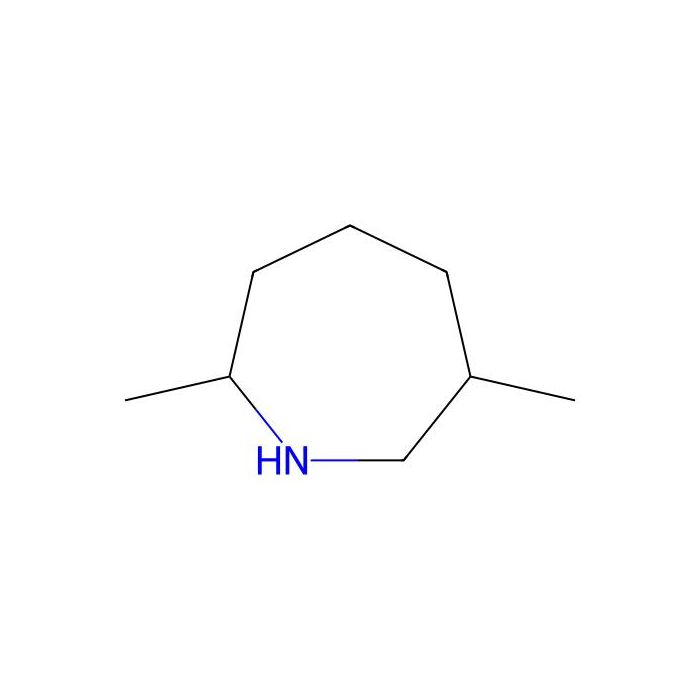
Brief overview: 2,6-Dimethylazepane is a saturated seven-membered cyclic secondary amine bearing methyl substituents at the two carbons alpha to nitrogen (positions 2 and 6). This substitution pattern creates two stereogenic centers; unless otherwise specified, commercial material is typically a racemic mixture of diastereomers/enantiomers.
Item-specific identifiers (from Product Data):
CAS: 1314920-15-4
InChIKey: 381906 (note: this appears truncated relative to the standard 27-character InChIKey; verify against CoA/Spec Sheet)
Storage: Room temperature
Molecular formula: Not specified for this item; refer to CoA/Spec Sheet.
Molecular weight: Not specified for this item; refer to CoA/Spec Sheet.
SMILES: Not specified for this item; refer to CoA/Spec Sheet.
Structural features (general/literature description):
Core ring system: Azepane (a saturated 7-membered ring containing one secondary amine, –NH–).
Substitution: Methyl groups at C-2 and C-6 (both alpha to N), increasing steric hindrance near nitrogen and reducing ring conformational flexibility relative to azepane.
Functional groups: One basic secondary amine (nucleophilic, readily protonated), two alkyl substituents.
Stereochemistry: The 2- and 6-positions are stereogenic; typical material may be a mixture unless enantioenriched/diastereodefined grades are specified (not specified for this item). 2D depiction would show a seven-membered ring with N in the ring, Me substituents on both alpha carbons adjacent to N.
Notes:
Any exact identifiers (formula, MW, SMILES) not listed above should be confirmed from the item’s CoA/Spec Sheet for this specific SKU (D972256).
Synthetic Utility
Reactivity profile (general):
Nucleophilicity/basicity: As a secondary aliphatic amine, 2,6-dimethylazepane is a strong nucleophile and base, capable of engaging electrophiles (acyl, sulfonyl, carbonyl iminium, alkyl) efficiently. The 2,6-dimethyl groups add steric control near nitrogen, which can improve mono-alkylation selectivity and modulate coupling rates.
Representative transformations:
Amide/carbamate/urea formation using acyl chlorides/anhydrides, CDI, or chloroformates; sulfonamide formation with sulfonyl chlorides (often in DCM/Et3N or DIPEA).
Reductive amination onto aldehydes/ketones (NaBH3CN, NaBH(OAc)3, BH3·THF, or H2/Pd) to form tertiary amines carrying the dimethylazepanyl moiety.
Buchwald–Hartwig amination with aryl bromides/chlorides/triflates using Pd catalysts and bulky phosphine ligands (BrettPhos, XPhos) to forge C–N bonds under basic conditions (NaOtBu, Cs2CO3).
N-Protection strategies: Boc (Boc2O, DMAP/Et3N), Cbz (Cbz–Cl, NaHCO3), or Fmoc (Fmoc–Cl) to control reactivity during multistep synthesis; deprotection under standard conditions (TFA for Boc, hydrogenolysis for Cbz, piperidine for Fmoc—note self-amine usage may complicate Fmoc protocols).
Quaternization with alkyl halides to generate ammonium salts for phase-transfer or materials applications.
Strategic value:
The azepane ring increases 3D character and can modulate physicochemical properties relative to piperidine/pyrrolidine analogs. 2,6-Disubstitution can reduce metabolic soft spots (e.g., oxidative dealkylation) and limit conformational freedom—useful in SAR exploration.
Purification notes:
Convert to crystalline acid salts (HCl, HBr, p-TsOH) to remove neutral/acidic impurities; liberate free base with aqueous base/extraction. Monitor for diastereomeric mixtures at C-2 and C-6 by NMR/LC.
Target Specificity
Not applicable. This product is a small-molecule amine, not a biological macromolecule (e.g., antibody, enzyme, ligand with defined biomolecular target) and has no item-specific target profile provided.
No antigen/epitope, clone, isotype, or species reactivity information is relevant to this item.
For biochemical assays where this amine is used as a reagent or building block, any “specificity” pertains to the chosen chemical transformation rather than a biological target.
We use cookies to ensure the website functions properly and, where permitted, to improve your experience. You can manage your preferences at any time in Settings. Learn more in our Cookie Policy.
Shall we send you a message when we have discounts available?
Remind me later
Thank you! Please check your email inbox to confirm.
Products are supplied to verified businesses, institutions, and qualified professionals for research and development use only. Not for use in humans, animals, diagnosis, or therapy.