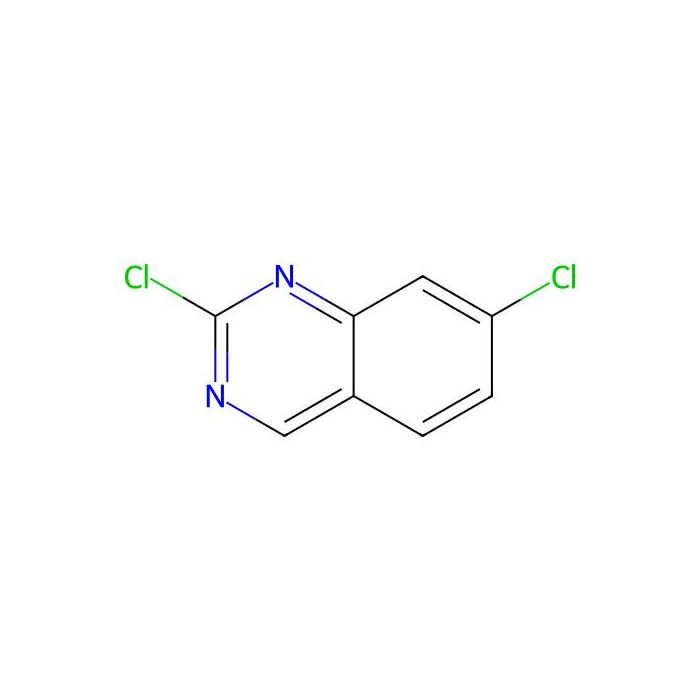
This compound belongs to the class of organic compounds known as quinazolines. These are compounds containing a quinazoline moiety, which is made up of two fused six-member aromatic rings, a benzene ring and a pyrimidine ring.
External Descriptors
Not available
1. Djoumbou Feunang Y, Eisner R, Knox C, Chepelev L, Hastings J, Owen G, Fahy E, Steinbeck C, Subramanian S, Bolton E, Greiner R, and Wishart DS. ClassyFire: Automated Chemical Classification With A Comprehensive, Computable Taxonomy. Journal of Cheminformatics, 2016, 8:61.
Determine the necessary mass, volume, or concentration for preparing a solution.
Dilution Calculator
Determine the dilution needed to prepare a stock solution.
Reconstitution Calculator
Reviews
Customer Reviews
Application Protocols
No application protocols are specified for this item. As a synthetic intermediate, typical procedures align with the Reaction Conditions tab (e.g., SNAr, Buchwald–Hartwig, and Suzuki couplings). For lab implementation:
Prepare dry glassware and maintain inert atmosphere when using moisture/air-sensitive catalysts and bases.
Use anhydrous solvents and verify substrate solubility before scale-up.
Monitor reactions by TLC and LC–MS; collect spectra (1H/13C NMR, HRMS) for identity confirmation.
Refer to peer-reviewed literature for substrate-specific optimization.
Biological Roles
Item-specific biological roles: None specified for this item; this product is intended for research use only.
General context (literature; not a claim for this specific compound’s biological activity):
Quinazoline is a privileged heteroaromatic scaffold found across natural products and synthetic probe molecules. Substituted quinazolines are frequently investigated as ligands for kinases and other nucleotide-binding proteins due to diazine ring interactions.
2,7-Dichloroquinazoline itself is best viewed as a synthetic intermediate: the chloro groups serve as handles to introduce heteroaryl, amino, or alkoxy substituents that modulate physicochemical properties and potential biointeraction in downstream compounds.
Metabolic considerations for quinazoline derivatives typically involve oxidative metabolism (N-oxidation, ring hydroxylation) and dehalogenation after biotransformation, but such behavior is highly substituent dependent and not established for this specific dichloro substrate.
Summary: use primarily as a platform for library synthesis and mechanism exploration in chemical biology, not as a biological reagent per se.
Buffer Applications
This compound is a neutral heteroaromatic building block and is not used as a buffer component. It lacks acid/base pairs with pKa values appropriate for maintaining physiological pH, and it has poor water solubility. For aqueous work, focus instead on the Solvent Selection and Reaction & Applications sections for guidance on stock solutions and synthetic conditions.
Green Alternatives
Greener process considerations focus on solvent and catalyst selection; the substrate is a fixed heteroaryl chloride.
Opportunities (literature guidance):
Replace dipolar aprotics (DMF/DMAc/NMP) with greener media when feasible.
Use ligand-enabled couplings that run in bio-derived or low-toxicity solvents.
Consider base and workup choices that minimize inorganic waste.
Illustrative comparison (general; not item-specific specs):
SNAr and amination
Conventional: DMF or DMSO, K2CO3/Cs2CO3, 80–120 °C.
Greener: MeCN or 2-MeTHF with phase-transfer catalysis or stronger nucleophiles; or water/EtOH with micellar surfactants (e.g., TPGS-750-M) if solubility allows.
Buchwald–Hartwig coupling
Conventional: toluene or dioxane, Pd2(dba)3/XPhos, NaOtBu.
Greener: 2-MeTHF or CPME; use BrettPhos/XPhos precatalysts at low Pd loadings (≤0.5 mol%); bases like K3PO4 in water-containing systems.
Suzuki–Miyaura coupling
Conventional: dioxane/H2O, Pd(PPh3)4, K2CO3.
Greener: EtOH/H2O or propylene carbonate/H2O with Pd/C or modern NHC catalysts; replace dioxane with 2-MeTHF or Me-THF.
Trade-offs:
Greener solvents may reduce substrate solubility and slow rates; temperature/ligand optimization can recover performance.
Workup is often simpler with greener solvents, reducing energy for solvent removal.
Pharmaceutical Uses
Item-specific pharmacopeial status/excipient role: Not specified for this item; refer to CoA/Spec Sheet.
General context (non-clinical; for process chemistry):
2,7-Dichloroquinazoline is used as a synthetic intermediate to access diversified quinazoline cores in medicinal chemistry programs. The dihalo pattern enables sequential, site-selective installation of amines, alkoxides, or aryl groups, facilitating structure–activity relationship (SAR) studies.
In a GMP setting, control of residual palladium (for coupling routes), residual solvents, and genotoxic impurities from halide handling is critical. Appropriate purification (crystallization, recrystallization, carbon treatment) and metal scavenging may be required.
No therapeutic claims are made; this material is offered strictly for research and development use. Any use in drug substance manufacturing requires appropriate qualification and regulatory oversight.
Physical Properties
Item-specific specifications:
Appearance: Not specified for this item; refer to CoA/Spec Sheet.
Grade/Purity: Not specified for this item; refer to CoA/Spec Sheet.
Storage and shipping (from Product Data):
Store at 2–8 °C, argon charged.
Shipped on wet ice.
Literature/general reference values (not item-specific; typical for 2,7-dichloroquinazoline and related quinazoline chlorides):
Physical state: crystalline solid (literature).
Solubility: low in water; soluble in polar aprotic organic solvents (DMSO, DMF, DMAc, NMP) and moderately in chlorinated/aromatic solvents (CH2Cl2, chloroform, toluene) (literature).
LogP: expected moderate aromatic heteroaromatic; specific value not established here (literature expectation).
pKa: quinazoline ring is weakly basic at ring nitrogens; conjugate acid pKa typically <2 for diazines; neutral in typical organic media (literature trends).
Melting/boiling points, density, refractive index, UV cutoff: Not specified for this item; refer to CoA/Spec Sheet.
Notes for handling as a solid (general):
Finely crystalline, can be weighed under ambient lab conditions but best handled quickly under inert atmosphere to limit adventitious moisture exposure during long operations.
Quality & Grades
Item-specific grade/purity:
Not specified for this item; refer to CoA/Spec Sheet.
General notes on grades (context for heteroaromatic building blocks):
Research grade: suitable for most synthetic applications; trace impurities may include halide salts, residual solvents, or regioisomeric chlorides.
High-purity or ≥98% organic synthesis grade: preferred for catalyst-sensitive couplings (e.g., Pd-catalyzed aminations) to minimize side reactions and catalyst poisoning.
HPLC grade does not apply to solids but “LC/MS qualified” materials indicate control of non-volatile residues and UV-absorbing impurities.
Stabilizers and additives:
None specified for this item. For moisture/air-sensitive heteroaryl chlorides, inert gas backfill (argon) is often used, as provided in the storage guidance.
Quality control considerations (general best practice):
Verify identity by 1H/13C NMR and HRMS; aryl chlorides show characteristic downfield aromatic signals and exact mass for C8H4Cl2N2.
Assess purity by HPLC/UPLC at multiple wavelengths (e.g., 220–300 nm) due to strong UV absorption of quinazoline cores.
Water content, halide content, and residual solvent: Not specified for this item; refer to CoA/Spec Sheet.
Reaction & Applications
Research Use Note: For research use only.
Typical applications for 2,7-dichloroquinazoline (literature; expanders beyond catalog text):
Divergent functionalization via SNAr: the 2-chloro substituent on the diazine ring is strongly activated by adjacent nitrogens, enabling substitution by amines, alkoxides, thiolates, and N-nucleophiles under relatively mild conditions. The 7-chloro (benzenoid) position is less activated and may require stronger conditions or catalytic assistance.
Pd-catalyzed cross-couplings: both chloro positions can participate in Suzuki–Miyaura, Buchwald–Hartwig, and Stille couplings given appropriate catalysts/ligands. Site-selectivity often favors C2 first (more activated) in SNAr, while cross-coupling selectivity depends on ligand and conditions.
Scaffold assembly: useful intermediate for quinazoline libraries, agrochemical leads, materials dyes, and heteroaromatic SAR exploration. The dihalide enables sequential, orthogonal diversification.
Directed metalation strategies: after initial substitution, ring metalation adjacent to nitrogen can allow further elaboration, though chloro substituents may affect regioselectivity and stability.
Practical tips (literature):
For selective C2 substitution, use polar aprotic solvent and moderate base (K2CO3/Cs2CO3) at 60–100 °C; then address C7 using stronger conditions or Pd catalysis.
Employ dry, oxygen-free conditions to protect catalysts and minimize hydrolysis of aryl chlorides.
Monitor by LC–MS/UPLC; quinazoline cores have strong UV absorbance around 260–320 nm aiding detection.
Reaction Conditions
General literature guidance (indicative, not item-specific specifications; optimize per substrate/nucleophile):
Temperature: 60–100 °C (microwave 100–140 °C can shorten times).
Time: 2–16 h. Typical isolated yields: moderate to high when targeting C2.
SNAr at C7
More forcing conditions: stronger nucleophiles (alkoxides/thiolates), higher temperature (100–140 °C), or catalytic activation.
Buchwald–Hartwig amination (for C7 or C2 if desired)
Catalyst: Pd2(dba)3 (1–2 mol%) or Pd(OAc)2 (2–5 mol%) with bulky biaryl phosphines (BrettPhos/XPhos/RuPhos, 2–6 mol%).
Base: NaOtBu or K3PO4 (2–3 equiv).
Solvent: toluene, 1,4-dioxane, or 2-MeTHF. 90–120 °C, 4–18 h.
Suzuki–Miyaura coupling (at aryl–Cl position)
Catalyst: Pd(PPh3)4 (2–5 mol%) or Pd-PEPPSI/IPr-type NHCs (0.5–2 mol%).
Base: K3PO4, Cs2CO3, or K2CO3 (2–3 equiv).
Solvent: dioxane/H2O, THF/H2O, or MeCN/H2O. 70–100 °C, 4–16 h.
Workup/purification
Quench with water/brine, extract with EtOAc or MTBE; remove polar aprotics by co-evaporation with toluene/MeOH.
Purify by flash chromatography; strong UV absorption assists monitoring.
Always confirm conditions on small scale and consult primary literature for specific couplings on quinazoline chlorides.
Safety & Handling
Item-specific hazard information:
GHS classification, signal word, pictograms, H-statements: Not specified for this item; refer to the SDS.
Known/storage guidance from Product Data:
Store at 2–8 °C under argon; shipped on wet ice to limit degradation and moisture exposure.
General safety considerations for halogenated heteroaromatics (literature guidance; not a substitute for SDS):
Likely irritant to skin/eyes/respiratory tract; avoid inhalation of dust and contact with skin/eyes.
PPE: lab coat, safety glasses or chemical splash goggles, and appropriate chemically resistant gloves (e.g., nitrile). Handle in a fume hood.
Incompatibilities: strong nucleophiles/bases may react via SNAr; avoid prolonged contact with strong oxidizers. Store away from moisture and acids that may promote hydrolysis.
Thermal stability: aromatic chlorides are generally stable; avoid overheating with strong bases to prevent decomposition.
First aid (general): after skin contact, wash with soap and water; after eye contact, rinse cautiously for several minutes; if inhaled, move to fresh air; if ingested, rinse mouth. Seek medical attention as required. Follow SDS.
Spill response: avoid dust formation, collect mechanically, and dispose per local regulations.
Always consult the product’s SDS for authoritative, item-specific hazard and response instructions.
Solvent Selection
Applicability: as a neutral heteroaromatic solid, solvent choice matters primarily for reaction media and stock solutions.
Miscibility/solubility profile: insoluble to sparingly soluble in water; soluble in DMSO, DMF, DMAc, NMP; moderate solubility in CH2Cl2, chloroform, THF, toluene; limited in hexanes.
Dielectric constant preferences: reactions often perform well in medium-to-high dielectric solvents (DMF, DMSO, NMP) for SNAr; for Pd-catalyzed couplings, toluene, dioxane, or CPME with a base/water co-solvent are common.
When to choose what (examples):
SNAr amination/alkoxylation: DMSO, DMF, or NMP with an amine/alkoxide and inorganic base (K2CO3, Cs2CO3).
Buchwald–Hartwig amination: toluene, dioxane, or tAmylOH/toluene mixtures with strong base (NaOtBu), carefully dried.
Suzuki cross-coupling: 1,4-dioxane/H2O, THF/H2O, or MeCN/H2O with K3PO4 or Cs2CO3.
Stock solutions: DMSO at 10–100 mM; for less polar solvents, gentle warming or sonication aids dissolution.
Small comparison (literature):
DMF/DMSO: excellent solubilization and SNAr rates; less green, challenging removal.
MeCN/2-MeTHF/CPME: greener, easier workup; may need higher temperature/ligand tuning for reactivity.
Chlorinated solvents: good solubility; consider environmental and safety profiles.
Storage & Reconstitution
Item-specific storage (from Product Data):
Store at 2–8 °C, argon charged.
Shipped on wet ice.
General handling guidance (literature; not item-specific specifications):
Keep container tightly closed under inert gas. Protect from moisture and prolonged light exposure.
For short-term use, allow vial to equilibrate to room temperature under argon before opening to minimize condensation.
Solid stability: heteroaryl chlorides are typically stable when dry and protected from moisture; minimize repeated exposure to ambient air.
Solution preparation (general best practice):
Prepare stock solutions in anhydrous DMSO, DMF, or MeCN (e.g., 10–100 mM) under inert atmosphere.
Filter if necessary through PTFE (0.2 µm). Aliquot to avoid repeated freeze–thaw.
Suggested storage of solutions (general): –20 °C to –30 °C under inert gas in amber vials. Actual solution stability is substrate- and solvent-dependent; verify by HPLC before use.
Disposal: Follow institutional and local regulations for halogenated organic waste.
For definitive shelf-life, retest intervals, and solution stability: Not specified for this item; refer to CoA/Spec Sheet.
Structure & Identity
Brief overview: 2,7-Dichloroquinazoline is a dihalogenated diazine-fused benzannulated heteroaromatic scaffold used as an electrophilic building block for SNAr and Pd-catalyzed couplings.
Item-specific identifiers (from Product Data)
Product name: 2,7-Dichloroquinazoline
CAS: 67092-19-7
CID: 12413929
InChIKey: 39928 (as provided; full standardized InChIKey not specified)
SMILES: Not specified for this item; refer to CoA/Spec Sheet.
Literature/computed identity (general reference; not item-specific specs)
Molecular formula (literature): C8H4Cl2N2
Molecular weight (literature): ~199.03 g/mol
Core scaffold: Quinazoline (benzopyrimidine; a benzene ring fused to a 1,3-diazine).
Substitution pattern: Chlorine atoms at the 2-position (on the diazine ring adjacent to ring N) and the 7-position (on the fused benzene ring).
Functional groups/features: Two ring nitrogens (pyrimidine-like N1 and N3), two aryl chlorides enabling nucleophilic aromatic substitution and cross-coupling.
2D structural description (verbal)
A bicyclic planar aromatic system: a six-membered benzene fused to a six-membered diazine. Chlorine at the C2 position of the quinazoline ring (activated for SNAr by adjacent ring nitrogens), and a second chlorine on the benzene portion at C7.
Synthetic Utility
Key reactive elements (literature):
Aryl chloride at C2 (activated) and C7 (less activated) provide two orthogonal leaving groups.
Ring nitrogens (quinazoline core) influence electronics, facilitating SNAr and directing metalation in some contexts.
Common transformations:
SNAr amination/alkoxylation/thiolation at C2 under mild to moderate conditions; C7 substitution may require stronger base, higher temperature, or catalytic activation.
Pd-catalyzed couplings: Suzuki (C–C), Buchwald–Hartwig (C–N), Stille/Negishi (C–C) at one or both chloro sites with ligand tuning for aryl chloride activation.
Stepwise diversification: install a key substituent at C2 via SNAr, then use cross-coupling at C7 to append aryl/heteroaryl groups, enabling rapid library generation.
N-oxide formation (mCPBA) as a temporary activation tactic for further functionalization of the quinazoline nucleus, followed by reduction.
Retrosynthetic value:
2,7-Dichloro pattern serves as a convergent branch-point; nucleophile choice and catalyst/ligand selection govern regioselectivity, allowing programmed synthesis of 2,7-disubstituted quinazolines.
Practical notes:
Dry, oxygen-free setups improve reproducibility.
For challenging C–Cl activation at C7, employ highly active ligands (BrettPhos, RuPhos, SPhos) and bases (NaOtBu, K3PO4) tailored to the nucleophile.
Target Specificity
Not applicable. This product is a small-molecule building block and not a biomolecule or affinity reagent. No antigen/epitope, species reactivity, clone, or isotype data are relevant.
Frequently Asked Questions
What is the purity of this product?
This product is supplied at ≥95% purity (chemical assay). Lot-specific values are stated on the Certificate of Analysis.
How should this product be stored?
Store at 2–8 °C under argon. It is supplied under an argon blanket; reseal under inert gas after each use.
How is this product shipped?
This product ships chilled on wet ice. Unpack on arrival and transfer it to the storage condition stated above.
What are the CAS number, molecular formula and molecular weight?
The CAS Number is 67092-19-7, the molecular formula is C8H4Cl2N2, and the molecular weight is 199.03 g/mol. InChIKey CBPZMPNJBUJQQY-UHFFFAOYSA-N.
What documentation is provided?
Available product documentation, including Certificates of Analysis (COA), Safety Data Sheets (SDS), and specification sheets, is shown in the product document area. Document availability and access follow the current site policy.
We use cookies to ensure the website functions properly and, where permitted, to improve your experience. You can manage your preferences at any time in Settings. Learn more in our Cookie Policy.
Shall we send you a message when we have discounts available?
Remind me later
Thank you! Please check your email inbox to confirm.
Products are supplied to verified businesses, institutions, and qualified professionals for research and development use only. Not for use in humans, animals, diagnosis, or therapy.