Determine the necessary mass, volume, or concentration for preparing a solution.
Taxonomy Tree
| Kingdom | Organic compounds |
|---|---|
| Superclass | Organic 1,3-dipolar compounds |
| Class | Allyl-type 1,3-dipolar organic compounds |
| Subclass | Organic nitro compounds |
| Intermediate Tree Nodes | C-nitro compounds |
| Direct Parent | Nitroaromatic compounds |
| Alternative Parents | Methylpyridines Aminopyridines and derivatives Imidolactams Heteroaromatic compounds Propargyl-type 1,3-dipolar organic compounds Organic oxoazanium compounds Azacyclic compounds Primary amines Organopnictogen compounds Organic zwitterions Organic oxides Hydrocarbon derivatives |
| Molecular Framework | Aromatic heteromonocyclic compounds |
| Substituents | Nitroaromatic compound - Aminopyridine - Methylpyridine - Pyridine - Imidolactam - Heteroaromatic compound - Organic oxoazanium - Propargyl-type 1,3-dipolar organic compound - Azacycle - Organoheterocyclic compound - Amine - Hydrocarbon derivative - Organic oxide - Organic zwitterion - Organopnictogen compound - Primary amine - Organonitrogen compound - Organic oxygen compound - Organic nitrogen compound - Aromatic heteromonocyclic compound |
| Description | This compound belongs to the class of organic compounds known as nitroaromatic compounds. These are c-nitro compounds where the nitro group is C-substituted with an aromatic group. |
| External Descriptors | Not available |
Find and download the COA for your product by matching the lot number on the packaging.
| Lot Number | Certificate Type | Date | Item |
|---|---|---|---|
| Certificate of Analysis | Jan 16, 2024 | A151663 | |
| Certificate of Analysis | Dec 14, 2023 | A151663 | |
| Certificate of Analysis | May 31, 2023 | A151663 | |
| Certificate of Analysis | May 25, 2023 | A151663 |
| Boil Point | 261 °C |
|---|---|
| Melt Point | 255°C(lit.) |
| Molecular Weight | 153.14 |
| XLogP3 | 0.700 |
| Hydrogen Bond Donor Count | 1 |
| Hydrogen Bond Acceptor Count | 4 |
| Rotatable Bond Count | 0 |
| Exact Mass | 153.054 Da |
| Monoisotopic Mass | 153.054 Da |
| Topological Polar Surface Area | 84.700 Ų |
| Heavy Atom Count | 11 |
| Formal Charge | 0 |
| Complexity | 156.000 |
| Isotope Atom Count | 0 |
| Defined Atom Stereocenter Count | 0 |
| Undefined Atom Stereocenter Count | 0 |
| Defined Bond Stereocenter Count | 0 |
| Undefined Bond Stereocenter Count | 0 |
| The total count of all stereochemical bonds | 0 |
| Covalently-Bonded Unit Count | 1 |
H302:Harmful if swallowed
H315:Causes skin irritation
H318:Causes serious eye damage
H319:Causes serious eye irritation
H335:May cause respiratory irritation
P261:Avoid breathing dust/fume/gas/mist/vapors/spray.
P264:Wash hands [and …] thoroughly after handling.
P270:Do not eat, drink or smoke when using this product.
P271:Use only outdoors or in a well-ventilated area.
P280:Wear protective gloves/protective clothing/eye protection/face protection.
P321:Specific treatment (see ... on this label).
P330:Rinse mouth.
P302+P352:IF ON SKIN: wash with plenty of water.
P304+P340:IF INHALED: Remove person to fresh air and keep comfortable for breathing.
P305+P351+P338:IF IN EYES: Rinse cautiously with water for several minutes. Remove contact lenses if present and easy to do - continue rinsing.
P362+P364:Take off contaminated clothing and wash it before reuse.
P405:Store locked up.
P403+P233:Store in a well-ventilated place. Keep container tightly closed.
P501:Dispose of contents/container to an approved waste disposal plant.
P264+P265:Wash hands [and …] thoroughly after handling. Do not touch eyes.
P301+P317:IF SWALLOWED: Get medical help.
P305+P354+P338:IF IN EYES: Immediately rinse with water for several minutes. Remove contact lenses if present and easy to do. Continue rinsing.
P317:Get emergency medical help.
P337+P317:If eye irritation persists: Get medical help.
P332+P317:If skin irritation occurs: Get medical help.
P319:Get medical help if you feel unwell.
No validated bioassay or antibody protocols apply to this small-molecule intermediate.
General lab use suggestions (non-validated):
For method-specific protocols (chromatography, crystallization, salt formation), consult internal SOPs and adapt to your instrumentation.
This compound is a synthetic heteroaromatic intermediate and does not have a known intrinsic biological role.
General context (no medical claims):
For laboratory work in biochemistry:
All uses are strictly for research and laboratory investigations. Consult your institutional biosafety protocols when moving compounds into biological assay environments.
Not typically used as a buffer component. As a basic heteroaromatic amine, it can accept protons, but it lacks the defined pKa profile, solubility, and regulatory status expected of standard buffer systems.
Practical notes for labs:
For buffer formulations, use validated systems with known buffering ranges rather than this substrate.
Greener choices pertain to the transformations performed on this substrate, as the compound itself is a solid building block (not a solvent).
Selected greener substitutions (literature guidance):
Compact comparison (general):
| Transformation | Conventional option | Greener alternative | |---|---|---| | Nitro → amine | SnCl2/HCl, Fe/HCl | H2/Pd-C in EtOH; transfer hydrogenation | | CH3 → CH2Br | NBS/AIBN in CCl4 | NBS under photoredox in MeCN/EtOAc | | CH3 → CHO/CO2H | Cr(VI) oxidants | TEMPO/NaOCl; Ru- or Mn-catalyzed aerobic | | Amide coupling | DCC/HOBt | T3P, COMU; aqueous micellar media |
General operational tips:
No excipient or pharmacopeial status is specified for this item; it is offered for research use only.
General notes (non-clinical, non-therapeutic):
This listing does not imply any suitability for human or veterinary use, nor any clinical application. For regulated manufacturing or GMP contexts, request detailed specifications and compliance documentation in advance.
Item-specific specifications: Not specified for this item; refer to CoA/Spec Sheet.
General/literature characteristics (for professional reference; not product specifications):
If precise BP/MP/density/refractive index or UV cutoff are required, please consult the CoA/Spec Sheet for this lot.
Guidance on interpreting grades (general):
Lot-specific documents: For assay, related substances, water content (KF), residual solvents, and melting behavior, consult the CoA/Spec Sheet for SKU A151663. We can provide additional testing (e.g., HPLC purity, NMR, GC-MS) on request for regulated workflows.
As a multifunctional heteroaromatic, 2-amino-3-methyl-5-nitropyridine is a versatile intermediate.
Representative application families (literature guidance):
Use cases:
Practical tips:
General literature guidance (example conditions; not product specifications):
Notes:
Item-specific GHS details: Not specified for this item; refer to SDS.
General safety considerations for aminonitropyridines (literature-based guidance; defer to SDS for authoritative data):
Always consult the product SDS for definitive hazard classifications, H/P statements, and emergency procedures.
This compound is a polar heteroaromatic solid featuring a primary amine and a nitro group.
General solvent behavior (literature expectations):
Selection tips:
Quick comparison (general):
Item-specific storage/shipping (from Product Data):
General handling:
Reconstitution and solution preparation (general guidance):
No stabilizers or special additives are specified for this item. Always consult the CoA/SDS for lot-specific recommendations and stability data.
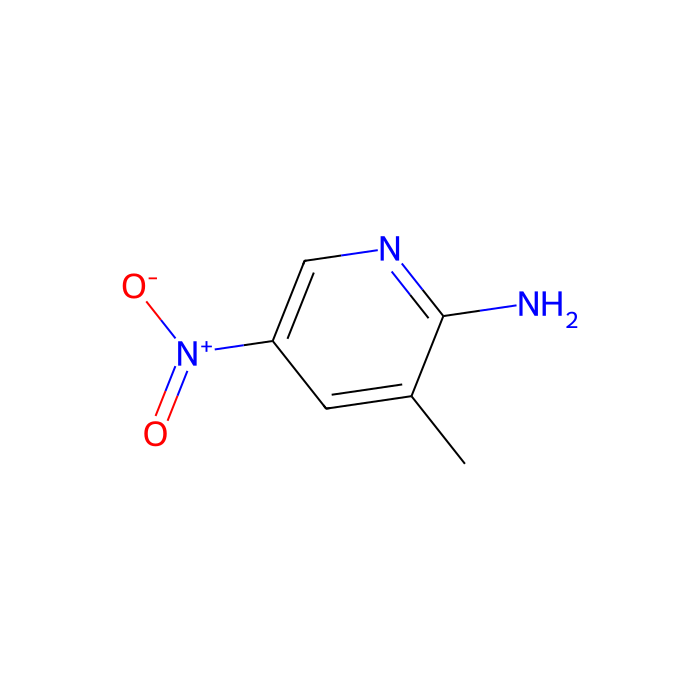
A heteroaromatic building block combining an ortho-aminopyridine, a benzylic methyl, and a nitro substituent on the pyridine ring.
Item-specific facts (from Product Data):
Literature/computed identifiers and features (for reference):
Structural description (general):
Key reactive elements and their utility (literature-based):
Retrosynthetic value:
Analytical tips:
Not applicable. This product is a small-molecule chemical building block, not a biological targeting reagent. No antigen/epitope, clone, isotype, or species reactivity is associated with this item.