This compound belongs to the class of organic compounds known as o-fluorophenols. These are fluorophenols carrying a iodine at the C2 position of the benzene ring.
External Descriptors
Not available
1. Djoumbou Feunang Y, Eisner R, Knox C, Chepelev L, Hastings J, Owen G, Fahy E, Steinbeck C, Subramanian S, Bolton E, Greiner R, and Wishart DS. ClassyFire: Automated Chemical Classification With A Comprehensive, Computable Taxonomy. Journal of Cheminformatics, 2016, 8:61.
Determine the necessary mass, volume, or concentration for preparing a solution.
Dilution Calculator
Determine the dilution needed to prepare a stock solution.
Reconstitution Calculator
Reviews
Customer Reviews
Application Protocols
Not applicable. No bioassay, IHC/IF/WB/FC, or diagnostic application protocols are defined for this small-molecule reagent in this listing. For synthetic usage, see Reaction & Applications and Reaction Conditions for representative procedures and optimization guidance.
Biological Roles
Item-specific biological roles: Not applicable; this product is supplied for research and laboratory chemical synthesis. No biological role is assigned for this catalog item.
General context (literature; not specific to this item):
Phenolic moieties are common in natural products and small-molecule ligands; the phenol group can engage in hydrogen bonding and π–π interactions in biomolecular contexts.
Halogen substitution (F, Br) modulates lipophilicity and metabolic stability in medicinal chemistry campaigns; aryl fluorides often resist oxidative metabolism, while bromides serve as synthetic handles rather than persistent features in final bioactive molecules.
The presence of both a phenol and aryl halides makes this scaffold a useful intermediate for preparing analog libraries for SAR exploration, but the compound itself is not intended for biological exposure or assays without appropriate risk assessment.
Note: No clinical, diagnostic, or therapeutic use is intended or permitted. For research use only.
Buffer Applications
This compound is not a buffering reagent and is not typically used to prepare biological buffers or pH control systems.
If handling in aqueous environments is necessary, the phenolic OH can be deprotonated by bases (e.g., carbonate) to increase apparent solubility, but this is a synthetic/workup consideration rather than a buffering application.
For preparative work, refer to Solvent Selection and Reaction & Applications for more relevant guidance.
Green Alternatives
While the molecule itself is fixed, greener choices can be made in how it is used and processed.
Replace DCM/CHCl3 with ethyl acetate or dimethyl carbonate for extractions and some acylations when feasible.
Use 2-MeTHF or CPME instead of THF/1,4-dioxane for many cross-couplings and protection steps; benefits include bio-based sourcing (2-MeTHF), higher boiling point, and easier phase separation.
Favor water/ethanol or MeCN/water mixed media for Suzuki couplings with water-tolerant catalysts.
Catalysis and conditions:
Employ ligand-optimized palladium catalysts at ppm–low mol% loadings (e.g., Buchwald-type precatalysts) to reduce precious metal waste.
Explore nickel catalysis for certain couplings (cost and sustainability advantages), recognizing different substrate scopes.
Workup/waste minimization:
pH-switch crystallizations of phenols (neutral vs phenoxide) can reduce solvent volumes vs multiple liquid–liquid extractions.
Use reusable solid-supported scavengers for palladium/ligand removal.
Comparison (general):
Traditional: DCM, dioxane, high Pd loading → effective but higher environmental impact.
Greener ethers (2-MeTHF/CPME) can form peroxides; implement peroxide testing and stabilizer management.
Aqueous systems may require base and surfactant optimization to maintain rates and selectivity.
Pharmaceutical Uses
Item-specific pharmacopeial status: Not specified for this item; refer to CoA/Spec Sheet.
General formulation/manufacturing context (not item-specific):
2-Bromo-6-fluorophenol is primarily a synthetic intermediate used in the preparation of more complex intermediates or API candidates via cross-coupling and functional group interconversions.
As a low–molecular-weight halogenated phenol, it is not typically used as an excipient. Any use in GMP manufacturing would require full qualification, impurity profiling, and residual metal/solvent controls after subsequent transformations.
Halogenated phenolic intermediates can influence downstream crystallization behavior and polymorphism of API targets; thorough control of residuals is necessary during scale-up.
No therapeutic or clinical claims are made. Research and process development use only.
Physical Properties
Item-specific specifications: Not specified for this item; refer to CoA/Spec Sheet.
General/literature expectations for halogenated phenols of this structure (provided for context only):
Appearance: typically a low-melting crystalline solid or viscous oil depending on purity and temperature (literature, varies by lot).
Molecular formula (literature): C6H4BrFO
Molecular weight (literature): ~191.00 g/mol
Acid–base: weakly acidic phenolic OH; forms phenoxide in the presence of base (literature).
Solubility (qualitative, literature): low in water; good solubility in common organic solvents (e.g., dichloromethane, ethyl acetate, THF, acetone, alcohols); can be deprotonated into aqueous base.
Volatility: generally low to moderate; expect higher boiling point than unsubstituted phenol due to halogens (literature trend).
Polarity: polarizable aromatic with one hydrogen-bond donor (OH); overall moderately polar organic compound (literature).
Stability: phenols can slowly oxidize/discolor on air/light exposure; halogen substituents increase thermal stability; avoid strong bases/acids for extended periods (literature guidance).
Note: Exact BP/MP, density, refractive index, UV cutoffs, water/peroxide/metal limits are not specified for this item; refer to CoA/Spec Sheet and SDS for definitive values.
Quality & Grades
Item-specific grade/purity: Not specified for this item; refer to CoA/Spec Sheet.
Impurity profile and stabilizers: Not specified for this item; refer to CoA/Spec Sheet. If stabilizers or inhibitors are present, they will be listed on the CoA and may affect certain reactions (e.g., coupling or lithiation).
General guidance on grades (contextual, not item-specific):
Research-grade aryl halides are typically suitable for most synthetic applications (cross-couplings, substitutions). HPLC-grade specifications (low UV background, sub-ppm metal content) are generally relevant to solvents rather than small-molecule reagents like this.
For metal-catalyzed cross-couplings, trace metal contaminants and moisture can influence catalyst performance; if your transformation is sensitive, consider purifying or recrystallizing and drying prior to use.
If a “high-purity” or “≥98%” designation appears on your lot’s CoA, that refers to assay by GC/HPLC/1H NMR. Water content and residue on ignition/ash, if reported, are lot-specific.
Suitability notes:
Aryl bromides are typically reactive in Pd-catalyzed couplings; presence of phenolic OH may necessitate base selection or temporary protection to avoid side reactions.
If trace acid is present, neutralize before strong base-sensitive steps.
Reaction & Applications
2-Bromo-6-fluorophenol is a versatile bifunctional building block offering an aryl bromide (reactive handle) and a phenolic OH (nucleophile/handle for protection) with a robust aryl fluoride retained for later-stage diversification.
Key application families (literature, general guidance):
Cross-couplings at C–Br:
Suzuki–Miyaura (to aryl/alkenyl boron partners), Sonogashira (alkynes), Heck (olefins), Negishi/Kumada (organozinc/magnesium). Phenolic OH may need protection or compatible base selection to avoid competitive O-arylation or catalyst inhibition.
Nucleophilic derivatization of the phenol:
Williamson ether synthesis (via phenoxide) to aryl alkyl ethers; Mitsunobu etherification for sensitive partners; esterifications (acyl/ sulfonyl chlorides) to modulate directing/steric effects for subsequent couplings.
The phenolic oxygen (or its protecting group) can direct ortho-lithiation of the ring under strong base/low temperature, though the presence of Br/F requires careful control to avoid halogen–lithium exchange.
Sequential chemoselective strategies:
Exploit the higher reactivity of C–Br vs C–F: first perform Pd-catalyzed coupling at bromide, leaving C–F intact. Later transformations may target the C–F via SNAr only if additional activation is introduced, or by metalation/defluorination protocols.
Intramolecular cyclizations:
After prefunctionalization (e.g., tethering through O), can enable benzofuran/benzodioxole-type ring closures under Pd/Cu catalysis.
Practical tips:
Dry, oxygen-free conditions improve Pd-catalyzed couplings. Base choice is critical with free phenols (e.g., K2CO3, Cs2CO3, or NaOtBu depending on solvent and protection state). Protect OH if side reactions are observed.
Reaction Conditions
General literature guidance for typical reactions on 2-halo phenols; adjust to your substrate and consult primary references. Values are representative, not item-specific specifications.
Reagents: Boc2O or Ac2O/pyridine; alternatively chloroformates.
Conditions: DCM or MeCN, catalytic DMAP, 0–25°C.
Ortho-metalation cautions:
Strong bases (sBuLi) at −78 to −40°C can induce halogen–lithium exchange; use directed strategies and quench with appropriate electrophiles if pursued.
Expected yields for well-optimized couplings: typically 70–95% (literature), depending on substitution and protection state.
Safety & Handling
Supplier hazard information (item-specific): Not specified for this item; refer to the SDS for authoritative classification, GHS codes, and first-aid measures.
General hazards for halogenated phenols (literature, not item-specific):
May be harmful if swallowed, inhaled, or in contact with skin; phenols can cause irritation or burns with prolonged contact.
PPE and engineering controls (good laboratory practice):
Wear lab coat, safety glasses or face shield, and chemical-resistant gloves (e.g., nitrile). Handle in a fume hood to avoid inhalation of vapors/aerosols.
Storage incompatibilities and precautions (general):
Keep container tightly closed under inert atmosphere if possible; minimize exposure to air/light to limit oxidative discoloration.
Incompatible with strong oxidizers, strong bases (which form phenoxides), and strong acids (which may promote halogen exchange or decomposition under forcing conditions).
First-aid overview (consult SDS for full instructions):
Skin/eye contact: Rinse with plenty of water for at least 15 minutes; remove contaminated clothing; seek medical attention.
Inhalation: Move to fresh air; seek medical attention if symptoms persist.
Ingestion: Rinse mouth; do not induce vomiting; seek medical attention.
Special risks: Not an ether; peroxide formation is not a concern. Phenolic compounds can be absorbed through skin—use appropriate protection. Dispose according to local regulations; halogenated organic waste stream recommended.
Solvent Selection
This compound is a moderately polar, hydrogen-bond-donating aromatic phenol with two halogens. It dissolves well in many organic solvents.
Low solubility: water (increases upon deprotonation in aqueous base).
Polarity considerations:
Phenolic OH increases polarity and H-bonding; halogens increase polarizability. Choose protic solvents (alcohols) to leverage H-bonding, or aprotic polar solvents (DMF/DMSO/MeCN) for coupling and substitution chemistries.
When to choose which:
Workup/extraction: ethyl acetate/MTBE/hexanes systems perform well; adjust pH to partition phenoxide vs neutral phenol.
Cross-couplings (on the aryl bromide): toluene, 1,4-dioxane, THF, or mixed aqueous-organic (e.g., dioxane/H2O) are common. For greener choices, see Green Alternatives.
Protection/deprotection of the phenol: DCM or MeCN for acylations/carbonylations; DMF for sulfonylations; THF or MeTHF for silylations.
Comparison snapshot (general):
DCM: fast kinetics, excellent solubility; chlorinated waste burden.
THF/2-MeTHF: good solubility, compatible with bases; watch peroxide formation in ethers (apply testing/inhibitors as needed).
MeCN: polar aprotic, good for Pd couplings with bases; lower viscosity and easy removal.
Storage & Reconstitution
Item-specific storage: Store at 2–8°C (from Product Data). Ship on wet ice.
Container and atmosphere: Keep tightly closed in an amber glass bottle to limit light exposure. If feasible, store under inert gas (N2/Ar) to minimize oxidative discoloration of phenols (general good practice).
Moisture/air sensitivity: Phenolic compounds are generally stable but may slowly oxidize or darken on exposure to air/light; minimize headspace and repeated warming/cooling cycles.
Reconstitution/handling:
Physical form for this item is not specified; refer to CoA/Spec Sheet. If provided as a solid, allow vial to equilibrate to room temperature before opening to avoid moisture condensation. If provided as a solution, verify solvent and concentration on the label.
To prepare stock solutions for synthetic work: dissolve in dry organic solvent (e.g., DCM, THF, MeCN, DMF, or DMSO) at a convenient concentration (e.g., 0.1–1.0 M) immediately before use. Filter if necessary to remove particulates.
Stability on storage: Not specified for this item; refer to CoA/Spec Sheet. As a general guideline, keep refrigerated and protected from light for long-term storage; inspect periodically for discoloration or precipitate formation.
Safety note: For research use only. Consult the SDS for detailed guidance on safe handling, spill response, and disposal.
Structure & Identity
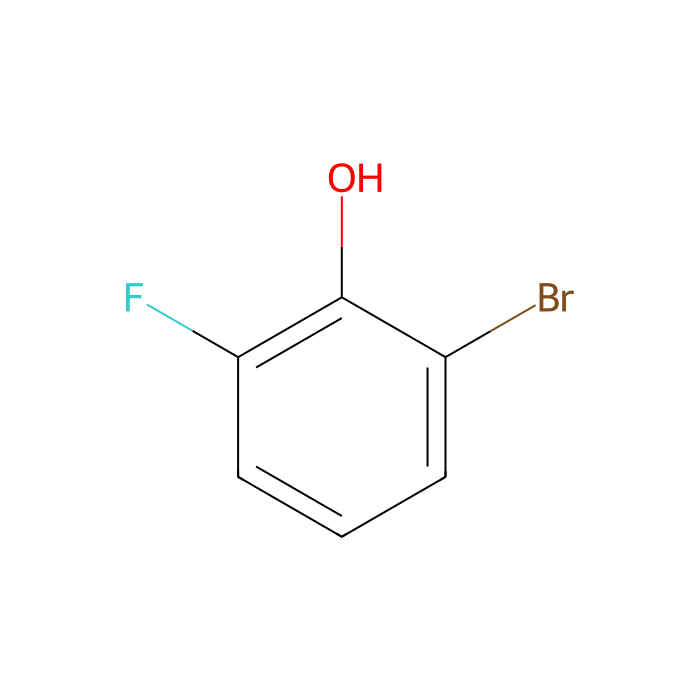
2-Bromo-6-fluorophenol is a halogenated phenolic building block featuring an ortho-bromo and an ortho-fluoro substituent flanking the phenolic OH.
Item-specific identifiers from Product Data:
SKU: B182616
CAS: 2040-89-3
InChIKey: Not specified for this item; refer to CoA/Spec Sheet.
SMILES: Not specified for this item; refer to CoA/Spec Sheet.
Literature identity (general reference values; not item-specific):
Molecular formula: C6H4BrFO (literature)
Molecular weight: ~191.00 g/mol (literature)
Typical SMILES (literature): Oc1c(F)cccc1Br
Structural features (general chemistry description):
Aromatic benzene ring bearing three functional elements: phenolic hydroxyl (–OH), bromine (–Br), and fluorine (–F).
Substitution pattern: OH at C1 (phenol), Br at C2 (ortho), F at C6 (ortho) relative to OH, giving strong ortho–ortho crowding.
No stereocenters; planar aromatic core with potential intramolecular H-bonding/steric effects due to ortho substituents.
Category path: 全部 / 可售 / 化学和生化试剂
Research use note: For research use only
Synthetic Utility
Functional handles and strategies (literature, general):
Aryl bromide (C–Br):
Highly useful in Pd/Ni-catalyzed cross-couplings (Suzuki, Sonogashira, Heck, Buchwald–Hartwig amination after amine introduction via coupling), enabling rapid diversification while retaining aryl fluoride for later stages.
Phenolic OH:
Nucleophile for ether/ester formation (Williamson, Mitsunobu, acylation/sulfonylation). Protective groups (TBDMS, MOM, benzyl, carbonate) can tune directing effects and block undesired O-arylation during metal-catalyzed C–C/C–N couplings.
Aryl fluoride (C–F):
Chemically robust; typically survives Pd-catalyzed steps. Can participate in SNAr only if additional ring activation is introduced; otherwise serves as a metabolic/stability element in medicinal scaffolds.
Retrosynthetic value:
Enables orthogonal, stepwise construction: first functionalize at C–Br (more reactive), then manipulate the phenol (deprotect/derivatize), reserving C–F for potential late-stage tactics (defluorination/metalation under strong conditions or leaving as is to modulate properties).
Select transformations:
Suzuki coupling in dioxane/H2O or 2-MeTHF with K2CO3/Cs2CO3, Pd(dppf)Cl2 or precatalyst; OH protected if necessary.
Sonogashira coupling (Pd/Cu) to install alkynes, followed by cycloisomerization to benzofurans when appropriately substituted.
Formation of aryl carbonates or sulfamates from the phenol to act as electrophiles in further cross-couplings (e.g., Ni-catalyzed C–O activation protocols).
Target Specificity
Not applicable. This product is a small-molecule chemical building block, not a biological targeting reagent (e.g., antibody, probe, or ligand with defined target selectivity) in this catalog entry. No antigen/epitope, species reactivity, clone, or isotype information applies.
We use cookies to ensure the website functions properly and, where permitted, to improve your experience. You can manage your preferences at any time in Settings. Learn more in our Cookie Policy.
Shall we send you a message when we have discounts available?
Remind me later
Thank you! Please check your email inbox to confirm.
Products are supplied to verified businesses, institutions, and qualified professionals for research and development use only. Not for use in humans, animals, diagnosis, or therapy.

 L2220122