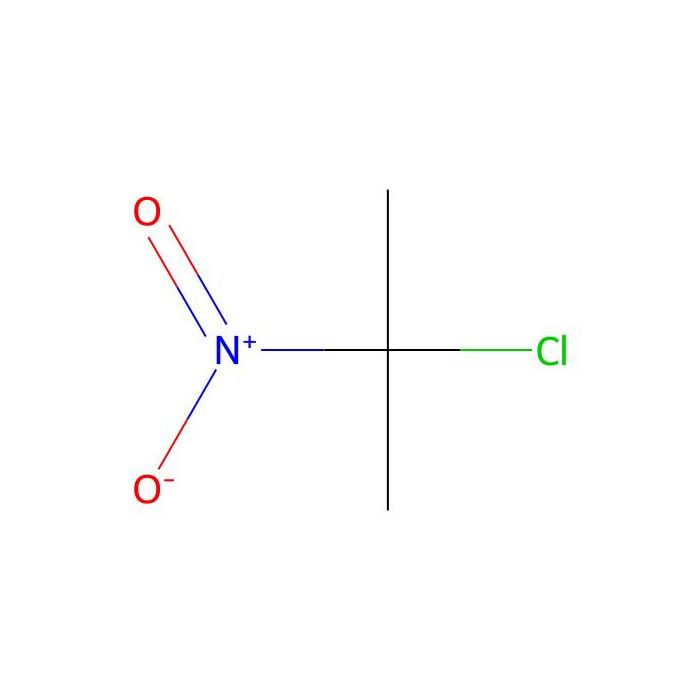
This compound belongs to the class of organic compounds known as c-nitro compounds. These are compounds having the nitro group, -NO2 (free valence on nitrogen), which is attached to carbon.
External Descriptors
Not available
1. Djoumbou Feunang Y, Eisner R, Knox C, Chepelev L, Hastings J, Owen G, Fahy E, Steinbeck C, Subramanian S, Bolton E, Greiner R, and Wishart DS. ClassyFire: Automated Chemical Classification With A Comprehensive, Computable Taxonomy. Journal of Cheminformatics, 2016, 8:61.
For SN1 substitution screening: Combine nucleophile (2.0–3.0 equiv) in dry MeCN, cool to 0–5 °C, add 2-chloro-2-nitropropane dropwise under stirring; warm to rt and monitor by TLC/GC; quench with sat. NaHCO3; extract, dry, and purify by column chromatography.
For elimination to 2-nitropropene: Stir substrate with a mild base (e.g., Et3N, pyridine) in an alcoholic solvent at rt to reflux; monitor by GC (appearance of nitroolefin); remove solvent under reduced pressure and distill or chromatograph the product.
These are general literature-style examples; optimize and validate on small scale before translation to process scale. Always consult the SDS and CoA for item-specific constraints.
Biological Roles
This product is a small synthetic organic reagent with no established biological role.
Not a metabolite: 2-Chloro-2-nitropropane is not known as a natural metabolite or biochemical intermediate.
Reactivity vs. biomolecules (general): As a tertiary alkylating agent under ionizing conditions, it could react with nucleophilic residues (thiols, amines) in proteins or small molecules; such reactivity underscores the need for careful handling and containment in biochemical labs.
Biotransformations: Aliphatic nitro compounds can undergo microbial reduction under specialized conditions; however, no specific enzymatic pathways are attributed to this exact structure in standard biochemical references.
Research context
Usage should be limited to chemical synthesis or mechanism studies in vitro. No clinical or therapeutic applications are implied or recommended. Consult institutional EHS for handling in biological facilities.
Buffer Applications
Not typically applicable. 2-Chloro-2-nitropropane is a reactive organic substrate, not a buffering agent.
It does not provide acid/base conjugate pairs suitable for buffering near physiological pH.
For work in aqueous systems, isolate manipulations to organic phases and avoid contact with common biological buffers that contain nucleophiles (e.g., Tris) which could react under ionizing conditions.
Refer instead to the Reaction & Applications and Solvent Selection sections for guidance relevant to this compound.
Green Alternatives
Context: 2-Chloro-2-nitropropane serves as a tert-alkylating electrophile and nitroolefin precursor. Greener choices focus on safer electrophiles/oxidants, reduced hazard profiles, and improved solvent selection.
Comparison options (general; literature-informed)
For tert-alkylation chemistry:
Use of tert-alcohols with catalytic Brønsted/Lewis acids in benign solvents (e.g., EtOH, 2-MeTHF) can replace tertiary chlorides, reducing halogenated waste. Tradeoff: lower reactivity/longer times; water sensitivity of catalysts.
Electrophile-free methods (photocatalytic tert-alkylation via decarboxylative radicals from tert-carboxylates) limit halogenated by-products; requires photoredox setup and careful scaling.
For access to 2-nitropropene:
Direct Henry-type condensation routes to nitroolefins (from carbonyls and nitroalkanes) or dehydration of nitroalcohols can avoid handling halo–nitro substrates. Tradeoff: additional synthetic steps.
Solvent choices:
Prefer 2-MeTHF or CPME over DCM/CHCl3 where feasible to reduce halogenated solvent use; MeCN remains effective but consider solvent recovery.
Small comparison table (qualitative)
2-Chloro-2-nitropropane: High reactivity; halogenated; potential for NOx on decomposition; waste management required.
Employ solvent recycling, minimize excess electrophile, and implement in-line quench/scrubbers for HCl/NOx when performing eliminations or solvolyses.
Pharmaceutical Uses
This reagent is not used as a pharmaceutical excipient to our knowledge and has no pharmacopeial monograph entries commonly associated with it.
Typical role: Laboratory electrophile/precursor in synthetic chemistry; not intended for formulation or clinical use.
Manufacturing considerations: If used in medicinal chemistry route scouting, ensure thorough purge studies for residual halo–nitro species and their potential nitroso/NOx-derived impurities.
Regulatory note: For any GMP-related research use, consult impurity guidelines (e.g., ICH M7 for mutagenic impurities) when handling alkylating agents, though this product is for research use only.
All usage is strictly for research and laboratory applications; no therapeutic or diagnostic claims are made.
Physical Properties
Item-specific specifications (this catalog item)
Not specified for this item; refer to CoA/Spec Sheet.
Literature/general reference values (typical; not product specifications)
Physical state: Expected to be a colorless to pale liquid at ambient conditions (tertiary halo–nitroalkanes of this size are commonly liquids).
Molecular weight: ~123.54 g/mol (from formula C3H6ClNO2, literature)
Polarity/solubility profile: Moderately polar organic due to nitro; generally miscible with common organic solvents (e.g., dichloromethane, chloroform, ether, acetone, acetonitrile) and poorly soluble in water; specific solubilities not tabulated.
Volatility: Anticipated moderate volatility; handle in a fume hood. Boiling point and density values vary by source; consult primary literature or SDS for quantitative data.
Discussion and practical notes (general)
The geminal nitro and chloro substituents elevate density and refractivity relative to saturated hydrocarbons of similar size; measured density is typically >1 g/mL for many chloro–nitroalkanes (literature trend, not a spec).
The nitro group can engage in dipole–dipole interactions; solvent selection with higher dielectric constant (e.g., acetonitrile) often accelerates ionization/substitution processes.
Avoid strong base if the goal is to preserve the substrate, as β-elimination to 2-nitropropene can occur readily under basic or strongly ionizing conditions.
Always verify numerical constants (bp, mp, density, refractive index, UV cutoff) in the CoA/SDS or primary literature prior to process design.
Quality & Grades
Item-specific grade/purity
Grade/Purity: Not specified for this item; refer to CoA/Spec Sheet.
Appearance: Not specified for this item; refer to CoA/Spec Sheet.
Guidance on grades for this reagent class (general)
Neat reagent vs. stabilized: Some electrophilic alkyl chlorides are offered with stabilizers (acid scavengers or antioxidants) to suppress decomposition or polymerization of derived alkenes. If a stabilizer is present, it will be listed explicitly in the CoA/Spec; absence of such a note typically indicates neat material.
“ACS/AR” grades: Emphasize tight control of inorganic/organic impurities; useful when trace metals or halide content impact downstream steps.
“Synthesis” or “Technical” grade: Adequate for general transformations where trace UV-absorbing species or ppb metals are not critical.
“HPLC/UV” grades (for solvents) are not applicable here; for this substrate, low UV background is less relevant than chemical purity and water content if moisture-sensitive reactions are planned.
What to check on receipt (practical)
Inspect COA for identity confirmation (matching CAS 594-71-8), assay, GC purity profile, water content, and any stabilizer or inhibitor.
Review residual solvents and specific impurity benchmarks (e.g., isobutylene/2-nitropropene, tert-butanol, chloride salts) if reported.
If using in kinetics or mechanistic studies, consider additional QC (GC/MS, 1H/13C NMR) to verify absence of elimination products.
For all unlisted specifications, use: Not specified for this item; refer to CoA/Spec Sheet.
Reaction & Applications
Overview: 2-Chloro-2-nitropropane is a compact, highly activated tert-alkyl electrophile. The geminal chloro and nitro substituents increase carbocation character under ionizing conditions, enabling efficient solvolyses and substitutions with a range of nucleophiles.
SN1 substitutions: Reaction with O-, N-, S- nucleophiles to furnish 2-nitro–tert-alkyl derivatives (e.g., tert-alkyl nitro ethers, thioethers, amines). Polar aprotic solvents (MeCN, nitromethane) often enhance rates; added salts (e.g., tetrabutylammonium) can facilitate less soluble nucleophiles.
Elimination (E1): Base or heat induces formation of 2-nitropropene via dehydrohalogenation. Choice of solvent/base controls selectivity and minimizes rearrangements.
Solvolysis: Alcoholic or aqueous media can give tert-alkoxy or tert-hydroxy nitro products; careful control limits over-elimination.
Further nitro chemistry: Resulting tertiary nitro products can undergo radical denitration, reduction to amines (with appropriate catalysts/conditions), or oxidative pathways. Note that classical Nef reactions are less straightforward for tertiary nitroalkanes and require tailored conditions.
Mechanistic/practical notes
Tertiary center disfavors concerted SN2; expect SN1/E1 manifolds. Temperature and solvent dielectric constant are primary levers.
Competing pathways: Formation of 2-nitropropene can be rapid; use lower temperatures and nucleophile excess to suppress elimination during substitution chemistry.
Moisture control: Hydrolysis and side reactions are minimized under anhydrous conditions with inert atmosphere when sensitive nucleophiles are used.
Use cases in synthesis
Installation of a tert-alkyl fragment adjacent to a nitro functionality as a masked handle for further redox or coupling steps.
Generation of nitroolefin building block (2-nitropropene) for Michael additions and subsequent transformations.
Reaction Conditions
General guidance (literature-informed; not product specifications)
SN1 substitutions
Solvent: MeCN, nitromethane, DCM, or mixed solvent systems.
Temperature: 0–25 °C to favor substitution over elimination; higher temperatures accelerate ionization but increase E1.
Additives: Phase-transfer catalysts (e.g., TBA salts) can improve rates with inorganic nucleophiles; weak acids may catalyze solvolysis with alcohols.
Workup: Quench with weak base (NaHCO3) to neutralize HCl; extract into organic; wash/dry.
Elimination to 2-nitropropene (E1)
Conditions: Mild base (e.g., pyridine, triethylamine) or heat in protic solvents; or Lewis/Brønsted acid traces can also promote ionization followed by deprotonation.
Temperature: Ambient to reflux, depending on solvent; monitor to avoid overreaction.
Reductive/derivative steps of products (context)
Nitro reductions: Catalytic hydrogenation (Pd/C) or chemoselective methods (Zn/HCl, Fe/AcOH) on derived nitro compounds; tertiary contexts may require tailored conditions.
Notes on stability and handling during reactions
Rigorous exclusion of moisture curbs hydrolysis.
Avoid strong bases (alkoxides at high temperature) unless elimination is desired.
Use inert atmosphere for sensitive nucleophiles; substrate itself is typically stable to air under storage but can emit HCl/NOx upon decomposition at high temperature.
Safety & Handling
Item-specific hazard statements and GHS
Signal word: Not specified for this item; refer to CoA/Spec Sheet and SDS.
H-statements: Not specified for this item; refer to SDS.
GHS classification/pictograms: Not specified for this item; refer to SDS.
General safety guidance for tertiary halo–nitroalkanes (literature/commonsense; defer to SDS)
Hazards: Nitroalkanes and alkyl chlorides are commonly harmful if swallowed, inhaled, or in contact with skin and may cause irritation to eyes/skin/respiratory tract. Combustible as organic liquids; some nitro compounds may present additional thermal decomposition risks.
Incompatibilities: Avoid strong bases (promote elimination), strong acids (possible decomposition to NOx under harsh conditions), reducing agents, and strong nucleophiles in storage. Keep away from heat, sparks, open flames, and hot surfaces.
PPE: Use chemical-resistant gloves (e.g., nitrile), lab coat, splash goggles. Employ fume hood for all handling and transfers to limit inhalation exposure.
First aid (overview; follow SDS):
Inhalation: Move to fresh air; seek medical attention if symptoms persist.
Skin contact: Remove contaminated clothing; wash with soap and water.
Eye contact: Rinse cautiously with water for several minutes; remove contact lenses if present and easy; continue rinsing; seek medical advice.
Ingestion: Rinse mouth; do not induce vomiting; seek medical attention.
Storage: Store tightly closed at room temperature (as provided in Product Data), in a cool, well-ventilated area, away from incompatible materials. Secondary containment recommended.
Always consult the product-specific SDS for authoritative hazard, exposure limits, and response procedures.
Solvent Selection
Applicability: This is a substrate/reagent, not a solvent. However, solvent choice strongly influences its reactivity (SN1 vs E1) and stability.
Polarity class and behavior (general)
The molecule is moderately polar (nitro group) yet hydrophobic overall; it dissolves readily in common organic solvents and poorly in water.
Polar, aprotic solvents (e.g., acetonitrile, nitromethane, sulfolane) enhance ionization and favor substitution by soft nucleophiles.
Protic solvents (alcohols) can participate as nucleophiles, leading to tert-alkyl nitro ethers; they may also promote E1 elimination depending on acidity and temperature.
Miscibility/use cases (general guidance)
For SN1-type substitutions with anionic nucleophiles: Acetonitrile, dichloromethane, or nitromethane balance solubility and control over rate.
For controlled E1 elimination to 2-nitropropene: Polar protic or mixed solvents with weak base and heat can be effective; monitor to minimize side reactions.
For low-temperature or kinetic control: Halogenated solvents (DCM, chloroform) or ethers (MTBE, TBME) may suppress overreaction.
Comparison notes (general)
Versus secondary/primary halo–nitroalkanes, tertiary substrates favor ionization; thus, higher-dielectric media have a larger effect on rate.
Water-containing media accelerate hydrolysis to tert-alcohols or other decomposition; use rigorously dry solvents for substitution chemistry.
Always match solvent to the intended pathway and consult small-scale trials to balance SN1 vs E1 outcomes.
Storage & Reconstitution
Item-specific storage
Storage Conditions: Room temperature (from Product Data). Keep container tightly closed in a dry, cool, well-ventilated place.
Shipped In: Not specified for this item; refer to CoA/Spec Sheet.
General storage guidance (for this reagent class)
Protect from moisture and strong light/heat. Store away from bases, acids, and strong nucleophiles to prevent decomposition (elimination or solvolysis).
Use amber or opaque secondary containment if long-term storage under bright light is expected.
After opening: If frequent use is anticipated, consider aliquoting under dry inert gas to minimize headspace moisture and repeated exposure.
Reconstitution
Supplied neat (typical for small organic reagents). If solidification/crystallization occurs at low temperature, gently warm to ambient and mix thoroughly before use. No special reconstitution buffer is applicable.
Stability monitoring
Periodically check by GC or 1H NMR for formation of 2-nitropropene or tert-alcohol impurities if the bottle has been open for extended periods.
For any missing item-specific details (e.g., inhibitor/stabilizer content, exact shelf life), use: Not specified for this item; refer to CoA/Spec Sheet.
Structure & Identity
Brief description: 2-Chloro-2-nitropropane is a tertiary halo–nitroalkane featuring a nitro group and a chloro substituent on the same quaternary center derived from propane.
Item-specific identifiers (from Product Data)
CAS: 594-71-8
CID (PubChem): 11673
InChIKey: 167743 (as provided)
Storage: Room temperature
Research Use: For research use only
Literature/derived structural data (for reference; not product specifications)
2D structural features: A central tertiary carbon bearing two equivalent methyl groups, one chloro substituent, and one nitro group (–NO2). No stereocenters (quaternary carbon is achiral due to two identical methyl groups). Functional groups include a nitro (strongly electron-withdrawing) and an alkyl chloride (good leaving group under SN1/SN1′-type conditions).
Structure description in words
The molecule can be viewed as a tert-alkyl electrophile: (CH3)2C(Cl)(NO2). The nitro and chloro substituents are geminal on the same tertiary carbon, creating a highly activated center prone to ionization (formation of a tert-nitrocarbocation-like intermediate) or elimination (E1) depending on conditions.
Synthetic Utility
Key functional elements
Tertiary electrophilic center: The C bearing Cl and NO2 favors ionization, enabling SN1-type substitutions to introduce tert-alkyl fragments onto soft nucleophiles (O, S, N).
Nitro handle: Provides a versatile platform for downstream transformations (reductions to amines, radical denitrations, or conversion to nitroolefins by elimination).
Access to nitroolefins: Controlled E1 gives 2-nitropropene, a valuable Michael acceptor for conjugate additions and cycloadditions; subsequent reduction or Nef-type chemistry opens routes to carbonyls or amines.
Installation of tert-alkyl nitro ethers/thioethers: Reaction with alcohols/thiols (catalyzed by acids or in polar media) yields tert-alkoxy/tert-thio nitro derivatives, which can be leveraged as protected functional motifs or radical precursors.
N-centered nucleophiles: Ammonia/amines can form tert-alkylated amines adjacent to nitro, offering entry to hindered amines after appropriate nitro manipulation.
Retrosynthetic value
Serves as a compact synthon for delivering the tert-alkyl (t-Bu-like) motif under conditions where SN2 is unfeasible.
Practical notes
Control of elimination is critical; use low temperatures, excess nucleophile, and polar aprotic solvents to bias substitution.
Monitor reactions by GC or 1H NMR (appearance of vinyl protons for 2-nitropropene) to detect E1 pathways.
Workup consideration: Neutralize/vent HCl where generated; scrubbers or base traps help manage acidic off-gas.
Target Specificity
Not applicable. This product is a small-molecule reagent and does not possess biological target specificity (no antigen/epitope, clone, isotype, or species reactivity). Refer to Reaction & Applications and Synthetic Utility for chemically relevant details.
We use cookies to ensure the website functions properly and, where permitted, to improve your experience. You can manage your preferences at any time in Settings. Learn more in our Cookie Policy.
Shall we send you a message when we have discounts available?
Remind me later
Thank you! Please check your email inbox to confirm.
Products are supplied to verified businesses, institutions, and qualified professionals for research and development use only. Not for use in humans, animals, diagnosis, or therapy.