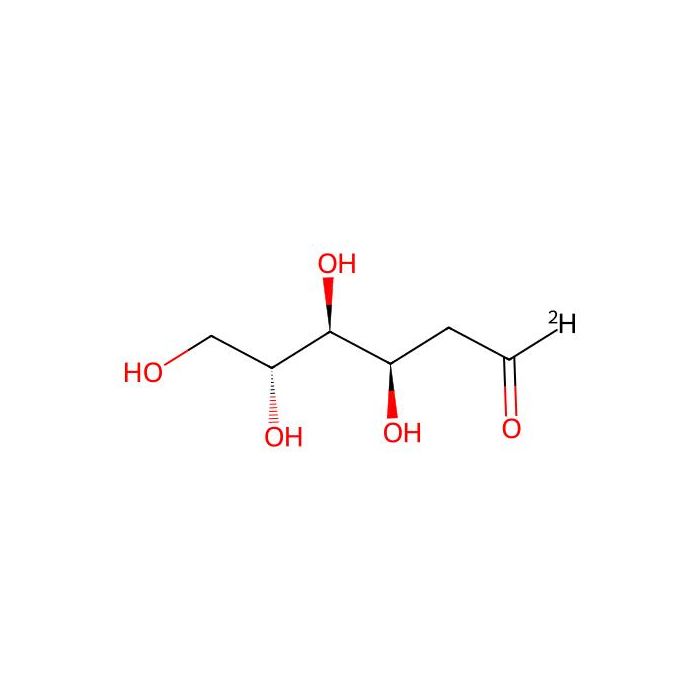
2-Deoxy-D-glucose-d is the deuterium labeled 2-Deoxy-D-glucose. 2-Deoxy-D-glucose is a glucose analog that acts as a competitive inhibitor of glucose metabolism, inhibiting glycolysis via its actions on hexokinase.
In Vitro
Stable heavy isotopes of hydrogen, carbon, and other elements have been incorporated into drug molecules, largely as tracers for quantitation during the drug development process. Deuteration has gained attention because of its potential to affect the pharmacokinetic and metabolic profiles of drugs. MCE has not independently confirmed the accuracy of these methods. They are for reference only.
Form:Solid
Specifications
Specifications & Purity
≥98%
Biochemical and Physiological Mechanisms
2-Deoxy-D-glucose-d is the deuterium labeled 2-Deoxy-D-glucose. 2-Deoxy-D-glucose is a glucose analog that acts as a competitive inhibitor of glucose metabolism, inhibiting glycolysis via its actions on hexokinase.
Storage
Store at -20°C
Shipped In
Ice chest + Ice pads
This product requires cold chain shipping. Ground and other economy services are not available.
Purity
≥98%
Names and Identifiers
SMILES
O=C([2H])C[C@@H](O)[C@H](O)[C@H](O)CO
Molecular Weight
165.16
Advanced Data
Certificates (CoA,COO,BSE/TSE and Analysis Chart)
C of A & Other Certificates(BSE/TSE, COO):
Analytical Chart:
Chemical and Physical Properties
Solubility
H2O : 250 mg/mL (1513.68 mM; Need ultrasonic)
Solution Calculators
Molarity Calculator
Determine the necessary mass, volume, or concentration for preparing a solution.
Dilution Calculator
Determine the dilution needed to prepare a stock solution.
Reconstitution Calculator
Reviews
Customer Reviews
Application Protocols
No manufacturer‑validated protocols are provided for this specific SKU. General starting points (to be optimized by the end user):
A) Preparation of sterile aqueous stock (research use only):
Bring the vial to room temperature in a desiccator to avoid condensation. Weigh the required amount quickly. Dissolve in sterile water or PBS to the desired concentration. Pass through a 0.22 µm syringe filter into sterile aliquot tubes. Store aliquots at −20 °C. Avoid multiple freeze–thaw cycles.
B) LC‑MS/MS internal standard setup (general):
Prepare calibration standards of unlabeled 2‑DG and spike a fixed concentration of 2‑deoxy‑D‑glucose‑d as internal standard. Optimize MRM transitions using deuterium‑shifted parent/product ions. Validate linearity, recovery, and matrix effects.
C) Cell uptake assay (outline):
Seed cells to desired confluence. Replace media with pre‑warmed buffer/media containing defined concentrations of 2‑deoxy‑D‑glucose‑d. Incubate for defined times (e.g., 5–60 min). Quench by rapid washing with ice‑cold buffer, extract metabolites with cold 80% MeOH/H2O, and analyze 2‑DG‑6‑P by LC‑MS, normalizing to protein/DNA.
These are generic frameworks; adapt concentrations, timings, and detection parameters to your system and the exact labeling site(s). Refer to peer‑reviewed literature and institutional SOPs.
Biological Roles
Context (literature, research use only):
Uptake and phosphorylation:
2‑Deoxy‑D‑glucose (2‑DG) is transported into cells via facilitative glucose transporters (e.g., GLUT family). Hexokinase phosphorylates it to 2‑DG‑6‑phosphate, which is poorly processed further. This leads to intracellular trapping and a readout of uptake/hexokinase activity.
Metabolic consequences:
Accumulation of 2‑DG‑6‑phosphate can inhibit glycolysis by product inhibition and perturb N‑linked glycosylation due to interference with glycan processing (literature). Effects are dose‑, time‑, and cell‑type dependent.
Isotopic labeling value (deuterium):
Deuteration provides a handle for MS‑based quantitation as internal standards and enables 2H‑NMR detection within complex biological matrices.
Kinetic isotope effects from C–D bonds can be exploited to probe enzymatic step contributions if labeling is at reactive positions; consult the CoA for labeling site(s).
Experimental applications:
Glycolytic flux analysis, glucose uptake assays, hypoxia/Warburg phenotype studies, and mapping of hexokinase activity. In vivo or ex vivo applications should be performed under appropriate approvals and dosing studies; this product is supplied for research use only.
Practical notes:
Use physiologically relevant buffers and osmolarities. For time‑course studies, pre‑equilibrate temperature and pH to avoid confounding transporter kinetics.
Combine with orthogonal tracers (e.g., 13C‑glucose in parallel cohorts) to differentiate uptake from downstream metabolism.
Buffer Applications
This compound is not itself a buffering agent. However, it is commonly dissolved in standard buffers for biochemical and cell‑based assays.
Practical guidance (general):
Compatible systems: Phosphate‑buffered saline (PBS), HEPES‑buffered saline, Krebs‑Ringer solutions, and cell culture media. Choose buffers with ionic strength and osmolarity appropriate to your model.
pH considerations: 2‑Deoxy‑D‑glucose‑d is neutral across physiological pH; typical working pH 7.2–7.6 for mammalian cells. Avoid high‑pH stock solutions (>10) that may promote degradation or isotopic exchange at labile positions.
Preparation tips:
Dissolve the weighed solid directly into sterile water or buffer; gentle warming and vortexing aid dissolution.
For sterile applications, 0.22 µm filter and aliquot. Avoid repeated freeze–thaw of aqueous stocks.
Compatibility: Generally compatible with salts, divalent cations, and common buffer additives. If chelators or amines are present and downstream derivatization is planned, confirm they do not interfere with assays.
If specialized buffering (e.g., for enzyme kinetics) is needed, choose a system that preserves enzyme activity and does not introduce UV/fluorescence background if optical readouts are used.
Green Alternatives
Perspective: This product is a stable‑isotope‑labeled metabolite, not a volatile organic solvent or hazardous reagent. “Greener” considerations relate to solvent systems, workups, and analytical methods employed with it.
Solvent and process choices (general):
Prefer water or aqueous buffers for dissolution and assays; minimize DMSO or DMF to essential levels.
For derivatization, consider greener acyl donors (e.g., isopropenyl acetate with catalytic enzymes) instead of acetic anhydride/pyridine where compatible (literature).
For chromatographic separations, use water‑rich HPLC methods (HILIC or mixed‑mode) to reduce acetonitrile consumption when possible.
Analytical “alternative” to radioisotopes:
Deuterated 2‑DG enables non‑radioactive tracing as an alternative to 14C/3H labeling. Trade‑offs include lower intrinsic sensitivity than radiodetection but improved safety and waste minimization. Coupling to MS or NMR restores sensitivity.
Waste minimization:
Prepare concentrated stocks and dilute at point‑of‑use to reduce container count.
Filter‑sterilize rather than autoclave to avoid energy‑intensive steps for heat‑labile sugars.
Comparison table (general, illustrative):
Water vs DMSO as vehicle: Water is nonflammable, benign, and biocompatible; DMSO enhances solubility but can alter membrane permeability and assay outcomes—use sparingly.
Overall, the principal green lever is selecting benign, aqueous media and non‑radioactive detection, while designing small‑scale, right‑first‑time experiments to limit resource use.
Pharmaceutical Uses
No pharmacopeial/excipient status is provided for this item. This product is supplied strictly for research use only.
General context (non‑clinical, literature):
Role in development studies: 2‑Deoxy‑D‑glucose has been explored experimentally as a tool compound to modulate glycolysis and study carbohydrate processing. Deuterated analogues are valuable as internal standards in bioanalytical method development (e.g., LC‑MS quantification of 2‑DG and its phosphates in biological matrices) during preclinical research.
Formulation research: For in vitro dosing, aqueous solutions (water for injection simulants, buffered saline) are typical. Osmolality and pH should be controlled to match test systems. For ex vivo tissue perfusion studies, use physiologically buffered solutions.
Analytical standards: Deuterated species serve as stable‑isotope internal standards for validated bioanalytical assays under regulated frameworks (e.g., internal standard normalizing extraction recovery and matrix effects). Specific labeling pattern and isotopic purity should be documented in method files.
No therapeutic claims are made. This product is not intended for human or veterinary use in medicines, diagnostics, or as a clinical excipient.
Physical Properties
Item-specific physical data for this SKU:
Appearance: Not specified for this item; refer to CoA/Spec Sheet.
Molecular weight: Not specified for this item; refer to CoA/Spec Sheet.
General/literature characteristics for 2‑deoxy‑D‑glucose (unlabeled) and deuterated analogues (for context; not product specifications):
Physical state: typically a crystalline, highly hydrophilic solid due to multiple hydroxyl groups.
Solubility: highly soluble in water; sparingly soluble in lower alcohols; essentially insoluble in nonpolar solvents (literature). Deuteration does not meaningfully change solubility behavior.
Acid–base: neutral polyol; hydroxyl pKa values typically >12 (literature) with no significant ionization in physiological pH ranges.
Optical activity: exhibits positive or negative rotation depending on anomeric ratio and solvent; specific rotation depends on conditions (literature). Deuteration can subtly shift optical rotation.
Hygroscopicity: sugars and deoxy sugars can be hygroscopic; store dry to avoid clumping and water uptake (general best practice).
Thermal behavior: may discolor/decompose on heating well above ambient; avoid prolonged exposure to elevated temperatures to preserve isotopic integrity.
Notes for experimentalists (general):
For NMR studies, dissolution in D2O is common; deuteration at specific positions can simplify spectra and enable kinetic isotope effect or tracer studies.
When preparing concentrated aqueous stocks, gentle warming (≤40 °C) and stirring aid dissolution; cool before use in biological assays.
Quality & Grades
Item-specific quality information for this SKU:
Grade/Purity: Not specified for this item; refer to CoA/Spec Sheet.
Guidance on interpreting grades for carbohydrate/isotopically labeled reagents (general):
Research grade vs. isotopic purity: For deuterated metabolites, two independent quality axes matter—chemical purity (e.g., HPLC, residual salts) and isotopic enrichment (%D at the labeled position). The CoA typically reports both. High isotopic enrichment ensures reliable tracer balances and minimal back‑exchange artifacts.
Residual moisture and volatile content: Carbohydrates can be hygroscopic; Karl Fischer water and loss on drying may be used to qualify lots. Moisture influences accurate massing for stock solution preparation.
Metals and UV background: Usually not limiting for biochemical work; if intended for catalysis or MS, low metal content and low UV background can be advantageous. If required, request a spec.
Microbial/bioburden: Not sterile unless explicitly stated. For cell‑based assays, sterile filter solutions (0.22 µm) after dissolution.
Documentation: The CoA/Spec Sheet should provide assay (%), isotopic labeling site(s), enrichment, and analytical methods (e.g., 1H/2H NMR, LC‑MS). Absent those details here, treat: Not specified for this item; refer to CoA/Spec Sheet.
Fit‑for‑purpose suggestions:
Metabolic flux analysis/NMR: prioritize high isotopic enrichment and low unlabeled contaminant.
Enzymology: ensure low inorganic impurities and accurate content by weight (correct for water where reported).
Reaction & Applications
Scope highlights (research use only):
Metabolic tracer and inhibitor studies (general):
2‑Deoxy‑D‑glucose is taken up by hexose transporters and phosphorylated by hexokinase to 2‑DG‑6‑phosphate, which accumulates because it is poorly processed by phosphoglucose isomerase (literature). Deuterium labeling enables NMR/LC‑MS tracing, kinetic isotope effect analysis, and separation from endogenous pools.
Applications include glycolytic flux probing, assessing glucose uptake, hypoxia responses, and bioenergetic profiling in cells and organisms.
Stable‑isotope methods:
2H‑NMR: position‑specific deuteration enables direct observation of uptake and metabolic fates with minimal background.
LC‑MS/MS: deuterium shifts the m/z of parent/fragment ions, providing internal standards for quantitative assays of 2‑DG and its phosphates.
Chemical derivatization and analytics:
Alditol/oxime formation for GC‑MS (after silylation) to profile sugar mixtures.
Permethylation or per‑O‑acetylation to tune chromatographic behavior.
Synthetic chemistry uses (general):
Building block for 2‑deoxy glycosides: after appropriate protection, can be converted to donors (e.g., trichloroacetimidates, thioglycosides) or acceptors for stereoselective glycosylation.
Selective protection strategies exploit differential reactivity of primary C‑6 OH vs. secondary OH groups; absence of C‑2 OH simplifies some patterns but affects neighboring group participation.
Notes:
Exact labeling site(s) affect NMR and MS method development; consult the CoA to design acquisition parameters (chemical shifts, expected m/z).
Reaction Conditions
Because this compound is primarily used in biochemistry and as a labeled standard, two condition regimes are relevant.
Solvent: sterile water or physiological buffers (PBS, HEPES). For highly concentrated stocks, DMSO or water can be used; final DMSO ≤0.5–1% in cell assays is common to maintain viability.
Concentration ranges: dictated by model and endpoint; establish dose–response curves. Prepare fresh or use frozen aliquots to maintain consistency.
Temperature/pH: 37 °C for mammalian cells; pH 7.2–7.6. Equilibrate media to 37 °C and 5% CO2 (if bicarbonate‑buffered) before dosing.
Readouts: LC‑MS/MS (MRM transitions shifted by deuterium), 2H‑NMR, enzymatic glucose uptake kits adapted with appropriate standards.
Per‑O‑acetylation: Ac2O (excess), pyridine, 0–25 °C, 1–4 h; catalytic DMAP accelerates. Work up by methanol quench and aqueous extraction (ensure minimal isotope loss at non‑exchangeable sites).
Glycosyl donor formation (trichloroacetimidate): treat per‑O‑protected hemiacetal with trichloroacetonitrile and base (e.g., DBU) in dry CH2Cl2 or MeCN at 0–25 °C.
Glycosylation: catalytic TMSOTf or BF3·OEt2 at −78 to 0 °C in dry CH2Cl2/Et2O; monitor by TLC. The lack of C‑2 neighboring participation influences α/β ratios; additives and solvent polarity tune selectivity.
Purification: silica gel chromatography with alcohol‑containing eluents (e.g., EtOAc/hexanes with 0–5% MeOH) or reversed‑phase for polar derivatives.
Always verify conditions against the specific protection pattern and the labeling site(s) to avoid H/D exchange.
Safety & Handling
Item-specific hazard information:
GHS Classification: Not specified for this item; refer to SDS.
Signal Word: Not specified for this item; refer to SDS.
H‑Statements: Not specified for this item; refer to SDS.
Pictograms: Not specified for this item; refer to SDS.
General laboratory safety guidance (non‑authoritative; defer to SDS):
Expected hazards: Polyhydroxylated carbohydrates like 2‑deoxy‑D‑glucose are generally of low acute hazard; nonetheless, avoid inhalation of dust and contact with eyes/skin. Deuteration does not introduce unique toxicity concerns at tracer levels, but handle as any fine organic solid.
PPE: lab coat, safety glasses, and appropriate gloves (e.g., nitrile). Use a dust mask or handle in a fume hood if creating aerosols/particulates.
First aid (general):
Inhalation: move to fresh air; seek medical attention if symptoms persist.
Skin: wash with soap and water; remove contaminated clothing.
Eyes: rinse cautiously with water for several minutes; remove contact lenses if present and easy to do; seek medical advice if irritation persists.
Ingestion: rinse mouth; seek medical advice as needed.
Handling/storage incompatibilities: Avoid strong oxidizers and strong dehydrating acids. Solutions may support microbial growth; prepare sterile solutions for cell work and store cold.
Environmental: A carbohydrate derivative; dispose in accordance with institutional and local regulations. Avoid uncontrolled release of solutions to drains used for live cultures.
Stability considerations: Maintain dry, cool storage; minimize repeated warming/cooling to preserve isotopic enrichment. Always consult the product SDS for definitive hazard and handling instructions.
Solvent Selection
Applicability: As a highly polar, polyhydroxylated carbohydrate analogue, 2‑deoxy‑D‑glucose‑d is primarily handled in aqueous media.
Polarity/miscibility (general/literature):
Water: highly soluble; forms clear solutions over a wide concentration range.
Alcohols (MeOH, EtOH): moderate to good solubility; warming aids dissolution.
Polar aprotic (DMSO, DMF): soluble; DMSO often used for highly concentrated stock solutions; dilute into buffer to final ≤0.5–1% DMSO for cell work.
Biochemical/cell assays: use sterile water or physiological buffers (e.g., PBS, HBSS) to target osmolarity; filter‑sterilize and use promptly or aliquot and freeze.
NMR tracer experiments: D2O is preferred to minimize 1H background; note that deuteron exchange at labile –OH positions is rapid and expected.
Organic synthesis/derivatization (protection/glycosylation): employ dry polar aprotic solvents (DMF, MeCN) or pyridine in the presence of acylation reagents; for per‑O‑acetylation, Ac2O/pyridine or Ac2O with catalytic DMAP is common (literature guidance).
Comparison notes:
Versus glucose: similar solubility behavior; slightly lower hydrogen‑bonding capacity due to the missing C‑2 OH.
Versus 2‑deoxy‑D‑ribose: higher molecular weight and different ring preference; both are strongly hydrophilic.
Always match solvent choice to downstream compatibility (enzyme tolerance, cell viability, MS ionization) and confirm with pilot tests.
Storage & Reconstitution
Item-specific instructions:
Storage Conditions: Store at −20 °C.
Shipped In: Ice chest + Ice pads.
General guidance for this compound type:
Solid storage: Keep tightly capped in the original container with desiccant. Minimize headspace humidity and avoid repeated warming/cooling cycles to maintain isotopic enrichment and prevent caking.
Light sensitivity: Not typically light‑sensitive, but store protected from direct light as best practice.
Reconstitution:
Solvent: Water, buffer (e.g., PBS), or D2O for NMR studies. For very high concentrations, DMSO or warm water can assist dissolution; dilute DMSO before biological use.
Procedure: Allow vial to equilibrate to room temperature before opening to avoid moisture condensation. Add calculated solvent volume, mix by vortexing or gentle heating (≤40 °C) until fully dissolved. Record exact weight/volume to calculate concentration; correct for water content if reported on CoA.
Working solutions: Prepare single‑use aliquots and store at −20 °C. Typical stability of aqueous carbohydrates is improved at ≤−20 °C; avoid multiple freeze–thaw cycles.
Sterility: Not supplied sterile unless stated; filter sterilize (0.22 µm) for cell culture applications.
For definitive stability/shelf‑life and any special precautions (e.g., isotopic enrichment retention), Not specified for this item; refer to CoA/Spec Sheet.
Structure & Identity
Brief overview: 2‑Deoxy‑D‑glucose‑d is a deuterium‑labeled analogue of the hexose 2‑deoxy‑D‑glucose (2‑DG). It retains the D‑gluco configuration and lacks the C‑2 hydroxyl group; one or more hydrogen atoms are replaced by deuterium for isotopic tracing.
Item-specific identifiers (this product):
CAS: 188004-07-1
Molecular formula: Not specified for this item; refer to CoA/Spec Sheet.
Molecular weight: Not specified for this item; refer to CoA/Spec Sheet.
SMILES: Not specified for this item; refer to CoA/Spec Sheet.
InChIKey: Not specified for this item; refer to CoA/Spec Sheet.
Structural features (general/literature description of 2‑DG core):
Hexose framework with five hydroxyl groups total for D‑glucose; 2‑DG specifically lacks the hydroxyl at C‑2 (i.e., –H at C‑2 in place of –OH), preserving the rest of the D‑gluco stereochemistry.
Typical depiction: open‑chain aldehydo form in equilibrium with predominant pyranose ring (six‑membered) and minor furanose (five‑membered) hemiacetal forms.
Stereocenters: four chiral centers retained relative to glucose (C‑2 becomes achiral in the open chain when deoxygenated; ring forms maintain defined stereochemistry at C‑1,3,4,5 for the D‑series). Deuterium substitution does not change configuration but introduces isotopic labeling at the designated position(s).
Isotopic label (general):
“‑d” denotes incorporation of deuterium (2H). Exact labeling site(s)/enrichment level are product‑specific and impact formula and exact mass; Not specified for this item; refer to CoA/Spec Sheet.
2D structure in words:
A D‑glucopyranose‑like ring missing the 2‑OH, bearing hydroxyls at C‑3, C‑4, and C‑6 (primary) and the anomeric hydroxyl at C‑1; one or more hydrogens replaced with deuterium.
Synthetic Utility
From a synthetic standpoint, 2‑deoxy‑D‑glucose‑d is a versatile chiral pool building block for 2‑deoxy glycoconjugates and for preparing isotopically labeled standards.
Functional group landscape:
Multiple alcohol groups (primary at C‑6, secondary at C‑3/C‑4; anomeric OH at C‑1 in hemiacetal forms) and an anomeric center amenable to activation. Absence of the C‑2 OH eliminates neighboring group participation at that position, influencing glycosylation stereoselectivity.
Typical transformations (literature):
Protective group chemistry: selective protection of C‑6 as TBDMS or trityl; acylation/benzylation of secondary OHs; acetal/benzylidene formation to control topology.
Donor/acceptor preparation: convert the anomeric OH to trichloroacetimidate, bromide, thioglycoside, or glycosyl fluoride donors; prepare acceptors by temporary anomeric protection and unveiling a free secondary OH.
Oxidation/reduction: TEMPO or Dess–Martin oxidation at C‑6 to generate uronic acids; selective reductions at tailored positions depending on protection.
Isotopic considerations:
Site‑specific deuteration is retained through many protecting‑group manipulations; avoid acidic or catalytic hydrogenolysis conditions that could promote H/D exchange at labile positions.
Applications:
Synthesis of 2‑deoxy glycosides, glycolipid mimetics, probes, and internal standards for quantitative metabolomics.
Plan protecting‑group strategies around the lack of C‑2 participation and leverage conformational bias to achieve desired α/β selectivity in glycosylations.
Target Specificity
This product is not an antibody, oligonucleotide, or targeted biological. No target specificity (e.g., antigen, epitope, clone) applies.
Functional context (general): it is a small‑molecule deuterated sugar analogue used broadly to probe glucose uptake and early glycolytic trapping, without selectivity for a particular protein target beyond transport by glucose transporters and phosphorylation by hexokinase (literature). These are cellular pathway interactions rather than a reagent “target specificity.”
Frequently Asked Questions
What is the purity of this product?
This product is supplied at ≥98% purity (chemical assay). Lot-specific values are stated on the Certificate of Analysis.
How should this product be stored?
Store at ?20 °C. Freezer storage is required to maintain the specified shelf life.
How is this product shipped?
This product ships in an insulated container with ice pads. Unpack on arrival and transfer it to the storage condition stated above.
What are the CAS number, molecular formula and molecular weight?
The CAS Number is 188004-07-1, the molecular formula is C6H11DO5, and the molecular weight is 165.16 g/mol.
What documentation is provided?
Available product documentation, including Certificates of Analysis (COA), Safety Data Sheets (SDS), and specification sheets, is shown in the product document area. Document availability and access follow the current site policy.
We use cookies to ensure the website functions properly and, where permitted, to improve your experience. You can manage your preferences at any time in Settings. Learn more in our Cookie Policy.
Shall we send you a message when we have discounts available?
Remind me later
Thank you! Please check your email inbox to confirm.
Products are supplied to verified businesses, institutions, and qualified professionals for research and development use only. Not for use in humans, animals, diagnosis, or therapy.