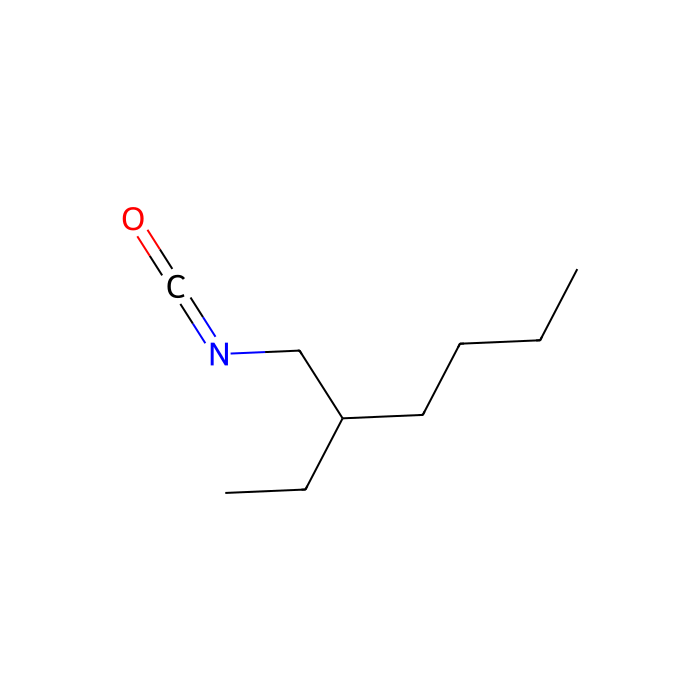
2-Ethylhexyl isocyanate - ≥98% , CAS No.20392-34-1

CAS: 20392-34-1 Cat. No.: E472325 Formula: C9H17NO Molecular Weight: 155.24 EC Number: 627-264-5
AVAILABLE TO ORDER
GRADE & PURITY ≥98%
Synonyms
2-ETHYLHEXYL ISOCYANATE|Heptane, 3-(isocyanatomethyl)-|2-Ethylhexylisocyanate|3-(ISOCYANATOMETHYL)HEPTANE
Storage
Store at 2-8°C,Argon charged
Shipped In
Wet ice
★
Size
USA
Germany (EU)*
Price
Qty
1g
E472325-1g
Made to order · 8–12 wks
$39.90
5g
E472325-5g
Made to order · 8–12 wks
$119.90
Enter a quantity for the sizes you want to add.

Specifications

Synonyms
2-ETHYLHEXYL ISOCYANATE | Heptane, 3-(isocyanatomethyl)- | 2-Ethylhexylisocyanate | 3-(ISOCYANATOMETHYL)HEPTANE
Specifications & Purity
≥98%
Storage
Store at 2-8°C,Argon charged
Shipped In
Wet ice
This product requires cold chain shipping. Ground and other economy services are not available.
Purity
≥98%
Names and Identifiers
SMILES
CCCCC(CC)CN=C=O
IUPAC Name
3-(isocyanatomethyl)heptane
InChIKey
BHDCTKUOBUNTTP-UHFFFAOYSA-N
InChI
1S/C9H17NO/c1-3-5-6-9(4-2)7-10-8-11/h9H,3-7H2,1-2H3
Isomeric SMILES
CCCCC(CC)CN=C=O
WGK Germany
3
Molecular Weight
155.24
Reaxys
1760188
Reaxys-RN_link_address
https://www.reaxys.com/reaxys/secured/hopinto.do?context=S&query=IDE.XRN=1760188&ln=

Advanced Data

Taxonomic Classification

Taxonomy Tree

KingdomOrganic compounds
SuperclassOrganic nitrogen compounds
ClassOrganonitrogen compounds
SubclassIsocyanates
Intermediate Tree Nodes Not available
Direct ParentIsocyanates
Alternative Parents Propargyl-type 1,3-dipolar organic compounds  Organic oxides  Hydrocarbon derivatives  Carbonyl compounds  
Molecular FrameworkAliphatic acyclic compounds
Substituents Isocyanate - Organic 1,3-dipolar compound - Propargyl-type 1,3-dipolar organic compound - Organic oxygen compound - Organic oxide - Hydrocarbon derivative - Organooxygen compound - Carbonyl group - Aliphatic acyclic compound
DescriptionThis compound belongs to the class of organic compounds known as isocyanates. These are organic compounds containing the isocyanic acid tautomer, HN=C=O, of cyanic acid, HOC#N or its hydrocarbyl derivatives RN=C=O.
External Descriptors Not available
3D Structure
Interactive Chemical Structure Model


Certificates (CoA,COO,BSE/TSE and Analysis Chart)
C of A & Other Certificates(BSE/TSE, COO):
Analytical Chart:

Find and download the COA for your product by matching the lot number on the packaging.

2 results found

Lot NumberCertificate TypeDateItem
E2629319E2629319Certificate of AnalysisMay 15, 2026 E472325
E2629320E2629320Certificate of AnalysisMay 15, 2026 E472325
Chemical and Physical Properties
SensitivityMoisture sensitive
Refractive Indexn20/D 1.4320 (lit.)
Flash Point158 °F
Flash Point70 °C
Boil Point190 °C (lit.)
Molecular Weight155.24
XLogP34.100
Hydrogen Bond Donor Count0
Hydrogen Bond Acceptor Count2
Rotatable Bond Count6
Exact Mass155.131 Da
Monoisotopic Mass155.131 Da
Topological Polar Surface Area29.400 Ų
Heavy Atom Count11
Formal Charge0
Complexity128.000
Isotope Atom Count0
Defined Atom Stereocenter Count0
Undefined Atom Stereocenter Count1
Defined Bond Stereocenter Count0
Undefined Bond Stereocenter Count0
The total count of all stereochemical bonds0
Covalently-Bonded Unit Count1
Safety and Hazards(GHS)
Pictogram(s)
GHS07,   GHS08
Signal
Danger
Hazard Statements

H315:Causes skin irritation

H319:Causes serious eye irritation

H334:May cause allergy or asthma symptoms or breathing difficulties if inhaled

H335:May cause respiratory irritation

H302+H312+H332:Harmful if swallowed, in contact with skin or if inhaled

Precautionary Statements

P261:Avoid breathing dust/fume/gas/mist/vapors/spray.

P264:Wash hands [and …] thoroughly after handling.

P270:Do not eat, drink or smoke when using this product.

P271:Use only outdoors or in a well-ventilated area.

P280:Wear protective gloves/protective clothing/eye protection/face protection.

P284:[In case of inadequate ventilation] Wear respiratory protection.

P321:Specific treatment (see ... on this label).

P330:Rinse mouth.

P302+P352:IF ON SKIN: wash with plenty of water.

P304+P340:IF INHALED: Remove person to fresh air and keep comfortable for breathing.

P305+P351+P338:IF IN EYES: Rinse cautiously with water for several minutes. Remove contact lenses if present and easy to do - continue rinsing.

P362+P364:Take off contaminated clothing and wash it before reuse.

P405:Store locked up.

P403+P233:Store in a well-ventilated place. Keep container tightly closed.

P501:Dispose of contents/container to an approved waste disposal plant.

P264+P265:Wash hands [and …] thoroughly after handling. Do not touch eyes.

P301+P317:IF SWALLOWED: Get medical help.

P317:Get emergency medical help.

P337+P317:If eye irritation persists: Get medical help.

P332+P317:If skin irritation occurs: Get medical help.

P319:Get medical help if you feel unwell.

P342+P316:If experiencing respiratory symptoms: Get emergence medical help immediately.

WGK Germany
3
Reaxys
1760188
Reaxys-RN_link_address
https://www.reaxys.com/reaxys/secured/hopinto.do?context=S&query=IDE.XRN=1760188&ln=
RIDADR
UN2206PSN1B6.1/PGIII
Solution Calculators
Reviews

Customer Reviews

Application Protocols

Not applicable for assay protocols (e.g., WB, IHC, IF, FC). This is a synthetic reagent. For practical laboratory use, see Reaction Conditions, Synthetic Utility, and Safety & Handling for detailed operational guidance (dry handling, inert atmosphere, solvent choice, and quenching).

Biological Roles

This product is a synthetic, non-natural small molecule with no known endogenous biological role. The following notes describe general chemical biology considerations for aliphatic isocyanates.

  • Reactivity with biomolecules (general)
    • Isocyanates are electrophiles that can react with nucleophilic residues (e.g., Lys ε‑NH2, N‑termini, occasionally Ser/Thr –OH) to form urea or carbamate linkages under anhydrous or organic-compatible conditions.
    • In aqueous buffers, rapid hydrolysis and side reactions limit utility; specialized anhydrous or biphasic conditions are typically required for bioconjugation.
  • Use in biochemistry (research context)
    • Installing hydrophobic 2‑ethylhexyl carbamate groups can modulate lipophilicity of probes or polymers for membrane interaction studies.
    • Derivatization of polyphenols or sugars (post‑drying) to adjust chromatographic properties for analytical workflows.
  • Safety note
    • Given the sensitization potential of isocyanates, direct use with proteins/cells is generally avoided; alternative chemistries (e.g., NHS esters, CDI/DSC‑based carbonates) are preferred for aqueous bioconjugation.

No medical or clinical applications are implied. For all experimental use with biomolecules, maintain anhydrous conditions and validate selectivity on small scale.

Buffer Applications

Not typically applicable. 2‑Ethylhexyl isocyanate is moisture‑sensitive and reacts with water and protic buffers, generating CO2 and urea/carbamate byproducts. It is not used to prepare or stabilize aqueous buffers. For relevant guidance, see Reaction & Applications, Synthetic Utility, and Reaction Conditions for nonaqueous transformations.

Green Alternatives

While 2‑ethylhexyl isocyanate is effective for forming carbamates/ureas, isocyanates pose sensitization hazards. Consider greener or safer strategies when feasible.

  • Alternative carbonyl sources for carbamate formation (literature)
    • Dimethyl carbonate (DMC): greener phosgene substitute; transcarbonylation of amines/alcohols under base or catalysis to form carbamates; avoids isocyanates.
    • Carbonyl diimidazole (CDI) or N,N′‑disuccinimidyl carbonate (DSC): activate alcohols or amines to access carbamates under milder, often anhydrous conditions.
    • Urea/alkyl chloroformate routes: can reduce sensitization risk relative to isocyanates, though each has its own hazards.

Comparison (general):

  • 2‑Ethylhexyl isocyanate
    • Pros: atom‑efficient; fast reactions at ambient; no leaving group waste.
    • Cons: sensitizer; moisture‑reactive; requires inert handling; potential trimerization.
  • Dimethyl carbonate
    • Pros: low toxicity profile; biodegradable; cheap; no sensitization.
    • Cons: higher temperatures/pressures or catalysts often needed; selectivity challenges.
  • CDI/DSC routes
    • Pros: controllable; compatible with many functional groups; bench‑friendly solids (CDI, DSC).
    • Cons: generate urea/succinimide byproducts; additional steps; cost.

Sustainability notes

  • Use safer solvents (2‑MeTHF, CPME, propylene carbonate) where compatible.
  • Minimize excess isocyanate; capture residuals by quenching with dilute alcohol under controlled conditions and proper ventilation.
Pharmaceutical Uses

No therapeutic or clinical claims. The compound is not an excipient. The following comments reflect general process/CMC considerations in research and development settings.

  • Potential roles (research/manufacturing context)
    • Intermediate for installing 2‑ethylhexyl carbamate/urea protecting or modulating groups on drug candidates, polymers, or excipient analogs to adjust lipophilicity and permeability in preclinical studies.
    • End‑capping isocyanate‑reactive polymers (e.g., polyols) used in device coatings or packaging R&D to impart hydrophobicity and flexibility.
  • Regulatory status
    • No pharmacopeial monograph is indicated. Any use in GMP settings would require full qualification of identity, purity, residual solvents, and isocyanate (NCO) content, plus validated handling to avoid worker exposure.
  • Formulation notes (general)
    • Not suited for aqueous formulations due to rapid hydrolysis; if carried forward as a transient intermediate, strictly control residual isocyanate by validated quench and analytical release tests (e.g., FT‑IR NCO band, derivatization assays).
  • EHS/containment
    • Isocyanate handling typically requires closed transfer, local exhaust ventilation, and exposure monitoring in manufacturing environments.
Physical Properties

Only general/literature values are provided below for context; these are not item-specific specifications. Always consult the CoA/Spec Sheet for this lot.

  • Phase/appearance (literature): typically a colorless to pale yellow liquid; pungent isocyanate odor.
  • Boiling point (literature): ~198–205 °C at 1 atm (aliphatic C8 isocyanate range).
  • Melting point (literature): typically below −50 °C (remains liquid at room temperature).
  • Density (literature): ~0.88–0.90 g/mL at 20–25 °C.
  • Refractive index n20/D (literature): ~1.440–1.445.
  • Vapor pressure (literature): low at ambient; increases with temperature (handle in fume hood).
  • Solubility (literature):
    • Miscible with many aprotic organics (e.g., toluene, hexanes, ethers, chlorinated solvents).
    • Slowly reacts with protic solvents (alcohols, water) forming carbamates/ureas and CO2.
  • LogP (literature, estimated): high (hydrophobic) due to branched C8 chain; expect poor water solubility.
  • UV cutoff (spec): Not specified for this item; refer to CoA/Spec Sheet.
  • Peroxide formation: not typical for isocyanates; principal instability is moisture reactivity and possible trimerization/polymerization under basic/acidic catalysis.
Quality & Grades
  • Grade/Purity: Not specified for this item; refer to CoA/Spec Sheet.
  • Appearance: Not specified for this item; refer to CoA/Spec Sheet.

Interpretation and guidance (general):

  • Without a stated grade, rely on the lot-specific CoA for purity, GC area %, assay method, and inhibitor/stabilizer status (if any). Isocyanates are often supplied without stabilizers but may contain trace acid/base that influences reactivity; confirm specs prior to sensitive syntheses.
  • If intended for chromatographic derivatization or materials research, review UV absorbance profile and volatile impurities on the CoA. For moisture‑sensitive reactions, confirm Karl Fischer water is low (if reported) and handle under inert gas as supplied.
  • If an HPLC or GC assay is reported on the CoA, note:
    • HPLC/GC area % indicates organic purity; residual solvents, hydrolysis products (e.g., ureas), or trimer may be listed as related substances.
    • Acid number or isocyanate (NCO) content (wt%) may be provided by some suppliers; this correlates with functionality and is a useful QA metric for isocyanates.
  • Stabilizers/inhibitors: Not specified for this item; consult CoA. In general, avoid prolonged exposure to acids/bases or heat to minimize trimerization (isocyanurate formation).
Reaction & Applications

2‑Ethylhexyl isocyanate is a monofunctional aliphatic isocyanate used to install the sterically bulky, hydrophobic 2‑ethylhexyl carbamate/urea motif.

  • Representative transformations (literature)
    • Alcohols → 2‑ethylhexyl carbamates (urethanes): base- or tin-catalyzed addition across N=C=O.
    • Primary/secondary amines → N,N′‑disubstituted ureas: typically rapid at 0–25 °C without catalyst.
    • Thiols → thiocarbamates: base-promoted addition.
    • Water → unstable carbamic acid → urea + CO2 (basis for moisture sensitivity).
  • Utility of the 2‑ethylhexyl group
    • Enhances solubility in nonpolar matrices; improves film formation and plasticization in polymers.
    • Steric bulk can attenuate hydrogen bonding and modulate thermal/mechanical properties of resulting polymers or small molecules.
  • Materials and surface chemistry
    • End‑capping isocyanate-reactive polymers or oligomers.
    • Functionalizing surfaces (–OH, –NH2 rich) to impart hydrophobic character via carbamate/urea linkages.
  • Analytical/derivatization uses
    • Formation of hydrophobic carbamate derivatives of polyols/phenols to aid extraction or GC analysis (method development dependent).
  • Practical tips
    • Strictly exclude moisture; charge glassware and headspace with argon (as provided). Add isocyanate last to pre‑dried reagents/solvents.
    • Control exotherms during additions, especially with amines and polyols. Use ice bath or metered addition.
    • Monitor by IR: strong N=C=O stretch ~2270 cm−1 disappears as reaction proceeds (literature).
Reaction Conditions

General, literature-based guidance for typical transformations with 2‑ethylhexyl isocyanate. Optimize for your substrate.

  • Alcohol → 2‑ethylhexyl carbamate (urethane)

    • Solvent: toluene, heptane, MTBE, 2‑MeTHF, or THF (anhydrous).
    • Catalyst: 0.1–1 mol% DBTDL or 5–20 mol% tertiary amine (Et3N, DBU) can accelerate; many aliphatic alcohols react thermally.
    • Temperature: 25–80 °C depending on alcohol nucleophilicity; phenols may require 60–100 °C.
    • Stoichiometry: 1.0–1.2 equiv isocyanate per –OH.
    • Time/yield: hours to overnight; good to excellent yields reported when dry and oxygen-free (literature).
  • Amine → urea

    • Solvent: DCM, toluene, THF, EtOAc (anhydrous).
    • Catalyst: typically none; add base (e.g., Et3N) if HCl salts are used to free-base the amine.
    • Temperature: 0–25 °C; control exotherm with slow addition/ice bath.
    • Stoichiometry: 1.0–1.05 equiv isocyanate per amine N–H.
    • Time/yield: minutes to a few hours; often high conversions (literature).
  • Thiol → thiocarbamate

    • Solvent: toluene or MeCN (dry).
    • Base: Et3N or DBU (0.5–1.0 equiv) to deprotonate thiol.
    • Temperature: 0–40 °C; typically rapid.
  • Monitoring and endpoints

    • IR: disappearance of NCO band (~2270 cm−1); appearance of carbamate/urea C=O (155–175 cm−1 region; note exact positions vary by structure).
    • Titration (literature): di‑n‑butylamine back‑titration for NCO content in process control.
  • Workup and purification

    • Quench unreacted NCO under cooling with dry alcohol; strip solvent under reduced pressure; purify by column or crystallization as appropriate.
Safety & Handling

Authoritative safety information resides in the SDS for this product; consult it before use. The following are general precautions for aliphatic isocyanates.

  • GHS classification, pictograms, H‑statements: Not specified for this item; refer to SDS.
  • Primary hazards (general for isocyanates)
    • Potent irritant; may cause skin and eye irritation.
    • Respiratory and skin sensitization are well-documented for isocyanates; avoid inhalation/skin contact.
    • Reacts exothermically with water, alcohols, amines; CO2 evolution can pressurize containers.
  • Engineering controls
    • Handle in a certified chemical fume hood with local exhaust.
    • Use inert gas techniques; maintain anhydrous conditions.
  • PPE
    • Chemically resistant gloves (e.g., nitrile), lab coat, safety goggles/face shield.
    • For large-scale or aerosol-generating tasks, consider respiratory protection per institutional policy.
  • Incompatibilities
    • Moisture, alcohols, amines, strong bases/acids (can catalyze trimerization/polymerization), active hydrogen compounds, and oxidizers.
  • First-aid overview (general)
    • Skin: Immediately remove contaminated clothing and wash with soap and water for ≥15 min; seek medical attention for irritation/sensitization.
    • Eyes: Rinse cautiously with water for ≥15 min; seek medical attention.
    • Inhalation: Move to fresh air; seek medical evaluation if respiratory symptoms occur.
    • Ingestion: Do not induce vomiting; rinse mouth; seek medical attention.
  • Special handling/storage notes (item-specific + general)
    • Store at 2–8 °C under argon (per Product Data). Keep container tightly closed and moisture-free.
    • Use dry syringes/needles or a glovebox; vent cautiously when opening due to possible CO2 pressure.
Solvent Selection

This compound is a reactive reagent rather than a working solvent. Solvent choice refers to media used for its reactions and handling.

  • Polarity/miscibility (literature)
    • Hydrophobic; readily soluble in nonpolar/aprotic media (hexanes, heptane, toluene, xylenes) and moderately polar aprotics (THF, CPME, MTBE, DCM).
    • Avoid protic solvents (MeOH, EtOH, water) unless intentionally forming carbamates; they consume isocyanate.
  • Common media by transformation
    • Alcohol → carbamate (urethane): toluene, heptane, MTBE, 2‑MeTHF; catalytic DBTDL or organobases as needed.
    • Amine → urea: DCM, THF, toluene; often no catalyst; sub‑ambient temp to control exotherm.
    • Thiol → thiocarbamate: toluene or MeCN with base (e.g., Et3N) to deprotonate thiol.
  • Drying/handling
    • Use anhydrous, oxygen‑free solvents. Pre‑dry with sieves; degas if moisture ingress is a concern.
  • When to choose alternatives
    • If high boiling solvent hinders workup, use MTBE or 2‑MeTHF for easier removal.
    • For bioconjugation in aqueous systems, consider carbamate formation via carbonate reagents (e.g., DSC/CDI) to avoid direct isocyanate exposure to water.
Storage & Reconstitution
  • Item-specific storage (from Product Data)

    • Store at 2–8 °C, argon charged.
    • Shipped on wet ice.
  • General handling

    • Keep tightly sealed under inert gas to exclude moisture. Use septum‑sealed bottles when possible for syringe/needle transfer. Minimize headspace and temperature cycling.
    • If crystals or solids are observed (unlikely; typically liquid), gently warm to ambient under inert gas and swirl to homogenize before use.
  • Stability considerations (general)

    • Sensitive to moisture; hydrolyzes to ureas with CO2 evolution. Avoid acids/bases that catalyze trimerization (isocyanurate formation).
    • Do not freeze aqueous mixtures; avoid contact with protic media.
  • Reconstitution

    • Not applicable—supplied neat. For solution preparation, use dry, oxygen‑free solvents (e.g., toluene, heptane, THF) and purge containers with argon/nitrogen prior to charging.
  • Container and compatibility

    • Store in compatible glass with PTFE‑lined cap. Avoid containers with reactive functional groups (e.g., unlined polyamide) that could consume isocyanate.
  • Disposal

    • Quench small residues with dry, anhydrous alcohol under cooling and ventilation to consume NCO, then dispose per institutional and regulatory guidelines. Consult SDS for detailed instructions.
Structure & Identity

Brief description: 2‑Ethylhexyl isocyanate is a branched, monofunctional aliphatic isocyanate (R–N=C=O) bearing a hydrophobic 2‑ethylhexyl group; it is a moisture‑sensitive electrophile useful for forming carbamates (urethanes) and ureas.

  • Item-specific identifiers (from Product Data)

    • SKU: E472325
    • Product Name: 2-Ethylhexyl isocyanate
    • CAS: 20392-34-1
    • InChIKey: 24749
    • Storage Conditions: Store at 2-8°C, Argon charged
    • Shipped In: Wet ice
    • Research Use: For research use only
  • Structure features (general/literature)

    • Core functional group: isocyanate (–N=C=O), linear cumulene with electrophilic carbon flanked by N and O.
    • Substituent: branched C8 alkyl (2-ethylhexyl) attached to N.
    • Ring systems: none; fully aliphatic and branched.
    • Stereochemistry: none (achiral as supplied; contains no stereocenters in the isocyanate moiety; 2‑ethylhexyl chain can be constitutionally branched without fixed chirality).
  • Molecular identifiers (literature/computed; not item-specific specifications)

    • Molecular formula (literature): C9H17NO
    • Molecular weight (literature): ~155.24 g/mol
    • SMILES: Not specified for this item; refer to CoA/Spec Sheet.
    • InChI: Not specified for this item; refer to CoA/Spec Sheet.
  • 2D structure (verbal)

    • A terminal –N=C=O unit bound to a primary methylene of a 2‑ethyl‑substituted hexyl chain: N(=C=O)–CH2–CH(CH2CH3)–(CH2)3–CH3.
Synthetic Utility

The isocyanate functionality (–N=C=O) in 2‑ethylhexyl isocyanate is a versatile handle for constructing nitrogen–carbonyl frameworks.

  • Key reactivity (literature)
    • Nucleophilic addition: ROH → carbamates; RNH2/R2NH → ureas; RSH → thiocarbamates; water → urea (undesired in most cases).
    • Selectivity: primary amines > secondary amines > alcohols > water under comparable conditions; phenols react slower than aliphatic alcohols.
    • Catalysis: organotin (DBTDL) or tertiary amines (Et3N, DBU) accelerate alcohol additions; amines usually require no catalyst.
  • Strategic uses
    • Install bulky, hydrophobic 2‑ethylhexyl carbamate as a temporary or permanent protecting/modulating group on alcohols/phenols; removal typically by strong base or hydrolysis (harsh) depending on substrate.
    • Urea formation to link two nucleophiles: 2‑ethylhexyl isocyanate + amine yields mono‑substituted urea bearing the 2‑ethylhexyl group (sterically tuned H‑bonding donor/acceptor profile).
    • Polymer chemistry: end‑capping polyols to adjust Tg, flexibility, and hydrophobicity; preparing isocyanurate networks via controlled trimerization (catalyst‑mediated) if desired.
  • Practical considerations
    • Monitor by IR (NCO ~2270 cm−1) and NMR (carbamate/urea carbonyl ~155–165 ppm in 13C, literature).
    • Avoid acidic/basic impurities that can catalyze side reactions (trimerization, biuret formation). Use inhibitors only if compatible and disclosed.
    • Workup: quench residual NCO cautiously with dry alcohol under cooling; prevent CO2 overpressure.
Target Specificity

Not applicable. This product is a small-molecule reagent, not a biological targeting agent or antibody. No antigen, epitope, clone, isotype, or species reactivity data are relevant.

Frequently Asked Questions

What is the purity of this product?
This product is supplied at ≥98% purity (chemical assay). Lot-specific values are stated on the Certificate of Analysis.

Shall we send you a message when we have discounts available?

Remind me later

Thank you! Please check your email inbox to confirm.

Oops! Notifications are disabled.