This compound belongs to the class of organic compounds known as ureas. These are compounds containing two amine groups joined by a carbonyl (C=O) functional group.
External Descriptors
Not available
1. Djoumbou Feunang Y, Eisner R, Knox C, Chepelev L, Hastings J, Owen G, Fahy E, Steinbeck C, Subramanian S, Bolton E, Greiner R, and Wishart DS. ClassyFire: Automated Chemical Classification With A Comprehensive, Computable Taxonomy. Journal of Cheminformatics, 2016, 8:61.
Determine the necessary mass, volume, or concentration for preparing a solution.
Dilution Calculator
Determine the dilution needed to prepare a stock solution.
Reconstitution Calculator
Reviews
Customer Reviews
Application Protocols
Not applicable. No vendor-tested biological assay formats (e.g., WB, IHC, IF, FC) are associated with this small-molecule reagent. For synthetic or analytical uses, follow standard organic chemistry protocols outlined under Reaction Conditions and Synthetic Utility, and adapt to your specific system.
Biological Roles
Item-specific biological data: Not specified for this item; refer to primary literature for mechanistic studies.
General/literature context:
Urea motif: The –NH–CO–NH– group is a classic peptide bond isostere with strong, directional hydrogen bonding. Ureas appear in protein–ligand recognition and as structural elements in biomimetics.
Hydroxyethyl-urea substructure: Hydroxyethyl–urea linkages are widely used as transition-state mimics for peptide-bond hydrolysis in protease-inhibitor design (literature concept). While many such molecules are elaborated and hydrophobic, the simple 2-hydroxyethylurea here is a minimal fragment embodying that functionality.
Physicochemical profile: High polarity and H-bond capacity predict high aqueous compatibility and low membrane permeability (general), making it more useful as a biochemical handle/model compound rather than a bioavailable scaffold on its own.
Use in research (non-clinical):
As a hydrogen-bond donor/acceptor probe molecule in spectroscopic or calorimetric studies of solvent effects and H-bond networks.
As a precursor for installing urea-containing side chains into peptides/peptidomimetics for binding studies.
No medical or clinical claims are made for this product. It is supplied strictly for research use only (per Product Data).
Buffer Applications
2-Hydroxyethylurea is not a conventional buffering agent and does not constitute a standard buffer system. It lacks a suitable conjugate acid/base pair in the physiological pH range and is not typically used to control pH.
Practical guidance:
If an aqueous environment is required to dissolve or react this compound, pair it with an appropriate buffer (e.g., phosphate, HEPES, MOPS) chosen for your target pH and ionic strength.
Verify compatibility of the buffer with planned transformations (e.g., avoid primary amine–containing buffers when performing acylations).
Green Alternatives
Context: 2-Hydroxyethylurea is a solid reagent/building block rather than a volatile organic solvent. Green considerations thus focus on solvent/media choices and derivatization strategies rather than replacing the compound itself.
Greener processing options (literature/general):
Reaction media:
Prefer water or bio-based alcohols (ethanol, 2-propanol) when feasible. Their low toxicity and renewability can reduce process EHS burdens.
Use high–boiling green dipolar aprotics (e.g., propylene carbonate) as alternatives to DMF/NMP when compatible with reagents.
Coupling/activation:
Replace acid chlorides with greener coupling agents (e.g., CDI for carbonate/carbamate formation) to minimize HCl generation.
Enzymatic or organocatalytic esterifications/carbamations in aqueous or mixed aqueous media can reduce solvent load and waste.
Workup/crystallization:
Employ water–ethanol anti-solvent systems to avoid chlorinated solvents; design crystallizations to maximize recovery and minimize energy input.
Illustrative comparison (general; not item-specific):
DMF vs propylene carbonate: similar polarity; propylene carbonate offers better EHS profile but may be less compatible with strong bases and at high water content.
DCM vs EtOAc/MeTHF for extractions: EtOAc/MeTHF are greener and often effective for polar organics; actual partitioning should be verified experimentally.
Pharmaceutical Uses
Item-specific pharmacopeial/excipient status: Not specified for this item; refer to regulatory sources if formulation use is contemplated.
General (non-clinical, formulation science):
2-Hydroxyethylurea is primarily a research intermediate/building block rather than a common excipient. Its urea motif can modulate hydrogen bonding and hygroscopicity in solid forms, and the alcohol handle allows further derivatization into carbamates/ethers that may serve in prodrug or materials contexts (literature/general concept).
For any use in drug product manufacturing or as an excipient, dedicated GMP-grade sourcing, full impurity profiling, and regulatory assessment would be required; this listing is for research use only (per Product Data).
Physical Properties
Item-specific specs: Not specified for this item; refer to CoA/Spec Sheet.
Literature/typical data (for reference; not item specification):
Molecular formula: C3H8N2O2 (literature)
Molecular weight: ~104.11 g/mol (literature)
Physical state/appearance: commonly isolated as a crystalline solid (literature)
Solubility: expected to be highly soluble in water and polar protic solvents (e.g., methanol, ethanol) and miscible to varying degrees with DMSO/DMF (literature/general). Quantitative solubilities are not specified for this item.
pKa: no well-defined pKa for the neutral urea; the alcohol is a very weak acid (pKa > 14, literature/general), typically remains unionized in water.
LogP: anticipated to be very low/negative due to high polarity (literature/general). Numerical value not specified for this item.
Notes:
Do not treat literature values as certificate specifications; consult the item’s CoA for release criteria.
Melting point, refractive index, density, and UV cutoff are not specified for this item; refer to CoA/Spec Sheet.
Quality & Grades
Item-specific grade/purity: Not specified for this item; refer to CoA/Spec Sheet.
Guidance on grades (general):
Research/technical grade: suitable for most synthetic and preparative workflows. May have broader impurity profile; review CoA for critical uses.
High-purity/assay-specified grade: tighter control of organic and inorganic impurities; advantageous for mechanistic studies, assay development, or when impurities interfere with downstream steps.
Stabilizers/inhibitors: none indicated for this item. If stabilizers are present in a specific lot, they will be listed on the CoA/SDS; their presence can affect reactivity in acylation/alkylation steps.
Release documentation and verification:
For each lot, consult the CoA for assay (%), residual solvents, water content (e.g., KF), and chromatographic purity if applicable. If parameters are critical (e.g., metal content for catalysis or UV background for analytical work), specify at time of order so the appropriate lot selection or testing can be arranged.
Reaction & Applications
Overview: 2-Hydroxyethylurea is a versatile bifunctional building block combining a nucleophilic/alcoholic terminus with a hydrogen-bond-rich urea motif. It serves in functional-material synthesis, heterocycle formation, and as a handle to elaborate urea-containing scaffolds.
Sulfonylation (e.g., MsCl/TsCl) to form the corresponding sulfonates for substitution or cyclization.
Carbonate/carbamate formation via reactions with chloroformates or isocyanates to furnish urethanes or mixed urea/carbamate architectures.
Mitsunobu conversion to other functional groups (e.g., halides, azides) enabling further diversification.
Urea N-chemistry:
N-acylation or N-alkylation (typically on the terminal –NH2) to tune H-bonding and lipophilicity of the scaffold.
Condensations under dehydrating conditions that can lead to cyclic urea/imidazolidinone or oxazolidinone motifs depending on activation and reaction partners (literature).
Linker chemistry and materials:
Incorporation into polymer backbones or crosslinkers where the urea enhances mechanical strength and hydrogen bonding in polyurea/polyurethane-like materials.
Model compound in H-bonding and catalysis research:
The hydroxyethyl-urea unit is used as a motif to probe hydrogen-bond networks and as a handle in organocatalyst design (literature).
Practical tips:
Moisture control: although reactions can be run in protic solvents, dehydrative couplings (e.g., to form carbonates/carbamates) benefit from anhydrous media.
Base choice: tertiary amines (DIPEA, Et3N) are often sufficient for acylations; stronger bases may deprotonate the urea NHs and alter selectivity.
Selectivity: the urea –NH2 is typically more nucleophilic than the secondary –NH–; protect if selective O-functionalization is required.
Reaction Conditions
The following are general, literature-based guidelines for common transformations of 2-hydroxyethylurea; they are not specifications for this item.
O-Sulfonylation (for leaving group installation):
Typical: MsCl or TsCl (1.1–1.5 eq), base (Et3N or DIPEA, 2–3 eq), solvent CH2Cl2, THF, or acetonitrile, 0–25 °C, 1–4 h. Monitor by TLC/HPLC. Work under anhydrous conditions to minimize side reactions at the urea nitrogens.
Carbonate/carbamate formation:
With CDI: treat alcohol with CDI (1.2–1.5 eq) in dry DMF/THF at RT, then add amine/alcohol partner; 25–50 °C, 2–16 h. CO2 evolution observed. This minimizes corrosive byproducts.
With chloroformates: 0 °C to RT, base (pyridine/Et3N), 1–3 h in DCM/THF. Control temperature to avoid N-carbamoylation scrambling.
Mitsunobu substitution (–OH to –N3, –Cl, etc.):
DEAD/DIAD (1.1–1.5 eq), PPh3 (1.1–1.5 eq), nucleophile (1.5–3 eq), solvent THF/DMF, 0–25 °C, 2–12 h. Consider greener variants (polymer-supported reagents) to simplify workup.
N-Acylation of urea –NH2:
Acyl chloride/anhydride (1.05–1.2 eq), base (Et3N), DCM or THF, 0–25 °C, 1–3 h; or EDCI/HOBt or DIC coupling in DMF for milder conditions. Selectivity for terminal –NH2 generally favored.
Cyclization to five-membered rings (literature):
Via intramolecular displacement: convert –OH to a leaving group (e.g., OMs/OTs), then treat with base (K2CO3, DBU) in polar aprotic solvent (DMF) at 50–90 °C to promote ring closure to imidazolidinone/oxazolidinone-type products depending on pathway. Optimize to avoid polymerization.
Always perform small-scale trials and analytical monitoring; adjust stoichiometry and temperature based on substrate and desired selectivity.
Safety & Handling
GHS classification and statements: Not specified for this item; refer to the SDS for authoritative hazard information.
Signal word/pictograms: Not specified for this item; refer to SDS.
General laboratory safety (good practice):
PPE: wear lab coat, safety glasses, and appropriate chemically resistant gloves (nitrile recommended). Use in a well-ventilated area or fume hood when handling powders or solutions.
Avoid dust generation and inhalation. Prevent contact with eyes and skin. Wash thoroughly after handling.
Incompatibilities (general for ureas/alcohols): strong oxidizers; strong dehydrating agents; reactive acid chlorides/anhydrides without proper temperature control. Avoid mixing with isocyanates unless intended—can form urethanes/carbamates.
Thermal behavior: urea derivatives may decompose on strong heating, releasing ammonia/CO2 or forming cyclic byproducts. Avoid overheating.
Hygroscopicity: polar urea derivatives can absorb moisture; keep container tightly closed to maintain material quality (general guidance; verify on SDS/CoA for this item).
First-aid overview (non-authoritative; defer to SDS):
Inhalation: move to fresh air; seek medical attention if symptoms persist.
Skin/eye contact: rinse with water for several minutes; remove contaminated clothing; obtain medical advice if irritation occurs.
Ingestion: rinse mouth; do not induce vomiting; seek medical attention.
Spill & disposal:
Small spills: avoid dust; collect with inert absorbent; dispose according to institutional and local regulations. Consult SDS for specific disposal guidance.
Solvent Selection
Applicability: As a polar, hydrogen-bonding solid, 2-hydroxyethylurea is typically dissolved rather than used as a solvent.
Solubility and medium choice (literature/general):
Water: usually high solubility due to multiple H-bond donors/acceptors—ideal for aqueous transformations or biochemical assays where compatible.
Polar protic solvents: methanol, ethanol, isopropanol often dissolve it well; good for recrystallization or as reaction media for esterification/acylation under mild conditions.
Polar aprotic solvents: DMSO, DMF, NMP provide excellent solvation of both urea and alcohol functions; useful for coupling, alkylation, or Mitsunobu-type transformations of the alcohol.
Less polar solvents (EtOAc, acetone): partial solubility possible; verify experimentally. Hydrocarbons/ethers: generally poor solubility.
Selection guidance:
Choose water/alcohols for green processing or when ionic reagents are involved.
Choose DMSO/DMF when activating the hydroxyl (e.g., sulfonylation, carbonate formation) or for nucleophilic substitutions on appended handles.
For crystallizations, mixed-solvent systems (e.g., EtOH/EtOAc or water/EtOH) can afford better control of supersaturation.
Comparison (general):
Water vs DMSO: water is greener and cheaper; DMSO offers broader solubility and compatibility with dehydrative coupling reagents.
Ethanol vs methanol: ethanol is less toxic; methanol may afford higher solubility at lower temperatures.
Storage & Reconstitution
Storage (per item data): Room temperature. Keep container tightly closed. Protect from excessive moisture to preserve assay/purity.
Shipped in: Normal conditions (per item data).
Reconstitution: Not applicable to solids lacking a defined buffer vehicle. For solution preparation, dissolve in a compatible solvent (e.g., water, alcohols, DMSO) at the required concentration. Filter sterilize (0.22 µm) if aseptic solutions are needed.
Stability guidance (general): Polar urea derivatives are typically stable at ambient temperature when kept dry and protected from contaminants. Avoid strong heat and dehydrating agents that could promote condensation or cyclization.
Freeze–thaw: Not relevant for the dry solid. If stored as solution, minimize freeze–thaw cycles; prepare single-use aliquots.
Note: Where specific shelf-life, water content, or impurity limits are required, consult the lot-specific CoA/Spec Sheet. This product is for research use only (per Product Data).
Structure & Identity
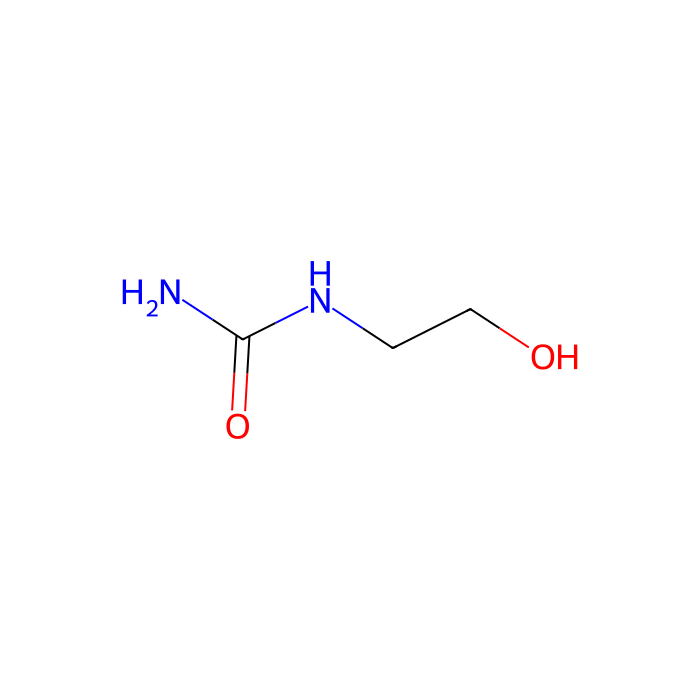
Brief description: 2-Hydroxyethylurea is a small bifunctional urea bearing a terminal primary alcohol. It combines a hydrogen-bond-rich urea motif with a 2-hydroxyethyl handle, making it a versatile polar building block.
Item-specific identifiers (from Product Data):
CAS: 2078-71-9
SKU: H136122
Storage Conditions: Room temperature (per item data)
InChIKey: Not specified for this item; refer to CoA/Spec Sheet. (Product Data shows a placeholder “47001”, which is not a full InChIKey.)
SMILES: Not specified for this item; refer to CoA/Spec Sheet.
Literature/computed identity (for reference; not item specification):
Preferred name (literature): 2-hydroxyethylurea; N-(2-hydroxyethyl)urea
Molecular formula (literature): C3H8N2O2
Molecular weight (literature): ~104.11 g/mol
Typical line notation (literature): SMILES: OCCNC(=O)N
Structural features (general):
Functional groups: primary alcohol (–CH2–CH2–OH) and urea (–NH–CO–NH2)
2D description: a carbonyl carbon flanked by two nitrogens (urea core); one nitrogen bears a 2-carbon chain terminating in an –OH; the other nitrogen is unsubstituted (–NH2). No rings; no stereocenters.
Synthetic Utility
Key functional elements and their reactivity (literature/general):
Primary alcohol (–CH2–CH2–OH): amenable to oxidation (to aldehyde/acid via two-step routes), O-alkylation, sulfonylation, carbonate formation, and etherification. Acts as an anchor for attaching spacers, labels, or polymerizable groups.
Urea (–NH–CO–NH2): provides two nitrogens with differentiated reactivity. The terminal –NH2 is typically more nucleophilic and can be selectively acylated/alkylated. The carbonyl oxygen engages strongly in H-bonding, influencing conformation and crystallinity.
Strategic transformations:
Intramolecular cyclization to five-membered heterocycles (e.g., imidazolidinone or oxazolidinone frameworks) via activation of the alcohol or carbonyl under dehydrating or carbonylation conditions (literature).
Divergent protection: temporary protection of the urea nitrogens (e.g., with Boc/CBz on the more nucleophilic N) enables selective O-chemistry, then deprotection to unveil the urea for further coupling.
Spacer installation: conversion of the alcohol to an azide or halide enables SN2 coupling to other scaffolds; subsequent Staudinger/“click” chemistry allows rapid library expansion.
Retrosynthetic value:
Serves as a linchpin to introduce the urea motif late-stage using short, robust transformations from a hydroxyethyl handle; conversely, it can be accessed from 2-aminoethanol and a carbonyl transfer reagent (e.g., urea derivatives or carbamoylating agents) in a convergent route (literature).
Target Specificity
Not applicable. This product is a small-molecule chemical reagent and does not have antigen/epitope or biological target specificity attributes. No antibody- or protein-specific information applies.
Frequently Asked Questions
What is the purity of this product?
This product is supplied at ≥98% purity (chemical assay). Lot-specific values are stated on the Certificate of Analysis.
How is this product shipped?
This product ships under standard ambient conditions. No temperature-controlled packaging is required.
What are the CAS number, molecular formula and molecular weight?
The CAS Number is 2078-71-9, the molecular formula is C3H8N2O2, and the molecular weight is 104.11 g/mol. InChIKey CLAHOZSYMRNIPY-UHFFFAOYSA-N.
What documentation is provided?
Available product documentation, including Certificates of Analysis (COA), Safety Data Sheets (SDS), and specification sheets, is shown in the product document area. Document availability and access follow the current site policy.
We use cookies to ensure the website functions properly and, where permitted, to improve your experience. You can manage your preferences at any time in Settings. Learn more in our Cookie Policy.
Shall we send you a message when we have discounts available?
Remind me later
Thank you! Please check your email inbox to confirm.
Products are supplied to verified businesses, institutions, and qualified professionals for research and development use only. Not for use in humans, animals, diagnosis, or therapy.

 E2621408