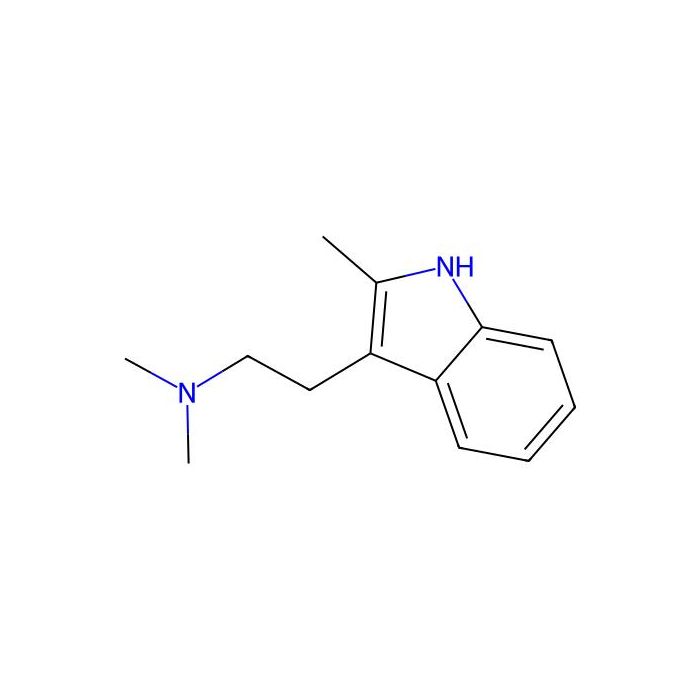
This compound belongs to the class of organic compounds known as tryptamines and derivatives. These are compounds containing the tryptamine backbone, which is structurally characterized by an indole ring substituted at the 3-position by an ethanamine.
External Descriptors
Not available
1. Djoumbou Feunang Y, Eisner R, Knox C, Chepelev L, Hastings J, Owen G, Fahy E, Steinbeck C, Subramanian S, Bolton E, Greiner R, and Wishart DS. ClassyFire: Automated Chemical Classification With A Comprehensive, Computable Taxonomy. Journal of Cheminformatics, 2016, 8:61.
Determine the necessary mass, volume, or concentration for preparing a solution.
Dilution Calculator
Determine the dilution needed to prepare a stock solution.
Reconstitution Calculator
Reviews
Customer Reviews
Application Protocols
No assay-specific, item-validated protocols are provided for this SKU.
General laboratory handling guidance (research use):
Preparing analytical standards: Accurately weigh in an amber vial; dissolve the freebase in acetonitrile or methanol to a known concentration (e.g., 1.0 mg/mL); for aqueous systems, acidify with 0.1% formic acid to ensure solubility. Store aliquots at ≤4 °C protected from light for short term; verify stability by LC–MS prior to use.
Salt conversion (example): To prepare the hydrochloride, dissolve the freebase in dry EtOAc (5–10 mL/g), cool to 0–5 °C, and add 1.0–1.1 equiv of 2 M HCl in ether dropwise with stirring. Stir 30–60 min, filter the precipitated salt, wash with cold ether, and dry under vacuum.
TLC/LC method development: Start with DCM/MeOH 9:1 + 0.5% Et3N for TLC; for LC–MS, use water/acetonitrile with 0.1% formic or formate buffer, gradient 5–95% ACN over 10–15 min.
Note: These are general research practices. Validate and adapt conditions to your laboratory’s safety policies and analytical requirements.
Biological Roles
This product is for research use only. No clinical/therapeutic claims are made.
General biochemical context (literature; not specific to this item’s lot):
Indolealkylamines constitute a broad class of compounds structurally related to endogenous metabolites like tryptamine and serotonin. The 2‑methyl‑substituted, tertiary‑amine variant here is a non-natural analogue used in structure–activity and physicochemical studies.
Typical features of indolealkylamines:
Aromatic indole system capable of π–π interactions and hydrogen bonding via the indole NH.
A basic amine side chain that is protonated near physiological pH, affecting membrane partitioning and salt formation.
Research use cases in biochemistry (non-clinical):
Probe molecules in transporter or metabolism studies in cell-free systems or microsomes (e.g., general amine N‑oxidation or dealkylation trends) without implying biological efficacy or safety.
Analytical standards to calibrate LC–MS methods targeting indolealkylamine panels in biospecimen research, where permitted by regulation.
Caveats:
Biological activity data for 2‑methyl, N,N-dimethyl analogues vary with assay and are context-dependent; any use must be evaluated under institutional approvals.
Handle as a potentially bioactive amine; implement containment to avoid accidental exposure or environmental release.
Buffer Applications
This compound is not a buffering agent and is not typically used to prepare biochemical buffers.
Practical note: As a tertiary amine, it can form salts with mineral or organic acids (e.g., HCl, fumarate), which are more water-soluble, but these are not standardized biological buffers.
If dissolution in aqueous systems is required for research assays, prepare dilute acidic media (e.g., 0.1 M acetate or phosphate buffer adjusted to pH ~5–6) to ensure protonation and solubility of the amine; confirm compatibility with your assay components.
For actual buffering applications, select established buffer systems (phosphate, HEPES, acetate, Tris) appropriate to your pH range.
Green Alternatives
While the compound itself is the target analyte/reagent, greener choices can be made around its handling and processing, notably solvent and reagent selection.
Greener solvent swaps (general guidance):
Replace dichloromethane/chloroform with ethyl acetate, 2‑MeTHF, or cyclopentyl methyl ether (CPME) for extractions and chromatography where feasible.
Prefer ethanol or isopropanol over methanol for recrystallizations/salt formations when solubility allows, to reduce toxicity.
Use water/EtOH buffered systems for LC where compatible, limiting acetonitrile consumption.
Oxidations/quaternizations:
If preparing N‑oxides, consider urea–hydrogen peroxide (UHP) or aqueous H2O2 with suitable catalysts in place of mCPBA, acknowledging selectivity tradeoffs.
Employ greener alkylating agents (e.g., dimethyl carbonate under catalysis) for quaternization instead of alkyl halides where the chemistry is compatible.
Process considerations:
Favor salt forms that crystallize from greener solvents (EtOAc/EtOH) instead of halogenated systems.
Implement solvent recovery and minimize chromatographic silica by adopting crystallization or liquid–liquid purifications.
Tradeoffs (balanced view):
2‑MeTHF/CPME offer better safety and lower VOC impact than DCM but can alter selectivity and may solubilize amines less efficiently; drying can be slower due to water retention.
Ethyl acetate is greener but may not dissolve the freebase at scale; co-solvent strategies (EtOAc/EtOH) are often effective.
Pharmaceutical Uses
No excipient or pharmacopeial role is specified for this item; it is provided strictly for research use only.
General formulation-related considerations (non-clinical, research context):
Salt selection studies: Protonated salts (e.g., hydrochloride, fumarate, maleate) may be prepared to evaluate crystallinity, hygroscopicity, and aqueous solubility of tertiary amines in pre-formulation research workflows.
Stability screening: Indole-containing amines can be susceptible to oxidative discoloration; inclusion of antioxidants (e.g., ascorbic acid) or inert-atmosphere packaging may be explored in formulation research, where permitted.
Analytical development: Establish LC–UV or LC–MS methods with appropriate ion-pairing or acidic modifiers to control peak shape for tertiary amines; determine extinction coefficients in selected solvents if quantitative UV is employed.
Important: This product is not intended for human or veterinary use, not GMP-qualified, and carries no claims of compliance with USP/EP/JP monographs.
Physical Properties
Item-specific specifications (this product):
Appearance: Not specified for this item; refer to CoA/Spec Sheet.
Grade/Purity: Not specified for this item; refer to CoA/Spec Sheet.
Molecular weight (item-specific): Not specified for this item; refer to CoA/Spec Sheet.
General/literature properties for the freebase of 2-methyl-N,N-dimethyltryptamine (for reference; not item specifications):
Physical state: typically an oil or low-melting solid depending on sample history and salt form (literature/general for dialkyltryptamines)
Acid–base: tertiary amine pKaH typically ~8–10 for dialkyltryptamines; indole NH very weakly acidic (literature, analogous compounds)
Solubility profile: freebase is sparingly soluble in water at neutral pH; freely soluble in common organic solvents (DCM, chloroform, ether, EtOAc, MeOH, EtOH, acetonitrile). Water solubility increases markedly upon conversion to mineral-acid salts (e.g., HCl) (literature/typical behavior).
Partitioning: expected lipophilicity moderate due to indole + tertiary amine (literature/analogy to related tryptamines).
Boiling/melting points, density, refractive index: Not well established publicly for this specific substitution; consult primary literature or the CoA for any measured values.
Practical notes (general):
Forming an HCl or fumarate salt provides crystalline, hygroscopically manageable solids with well-defined melting points (general practice for tertiary amines).
Freebase can exhibit glass formation or oiling-out; seeding and slow antisolvent addition help induce crystallization of salts.
Quality & Grades
Item-specific grade/purity: Not specified for this item; refer to CoA/Spec Sheet for assay, residual solvents, and impurity profile.
What to expect in a high-quality research chemical of this class (general guidance):
Identity confirmation by orthogonal methods such as 1H/13C NMR, HRMS, and, for salts, chloride or counterion assay; optional HPLC purity with UV at multiple wavelengths (e.g., 220–280 nm) given indole chromophore.
Residual solvent analysis by GC headspace; water by Karl Fischer if applicable.
Stabilizer/additives: Not specified for this item; refer to CoA/Spec Sheet.
Practical considerations for tryptamine quality (general):
Indole chromophores can show baseline drift in low-UV solvents; for chromatographic assay, choose appropriate mobile phases with buffered pH to suppress tailing of tertiary amines.
Freebase vs. salt: Freebases can show broader melting transitions and are often oils; salts (e.g., HCl, fumarate) typically offer sharper melting points and improved handling.
When to request specific grades:
For quantitative studies (e.g., analytical reference or forensic research), specify HPLC ≥98% and request full spectral package (NMR/MS/IR/elemental analysis) where needed.
For synthetic use as an intermediate, technical grade with defined assay and impurity limits may suffice.
Always defer to the item’s actual CoA for definitive specifications tied to this SKU and lot.
Reaction & Applications
Research use context: This compound is supplied for laboratory research only. It serves primarily as a specialized indolealkylamine scaffold and reference material.
Applications (general/research):
Chemical reference standard or internal standard development in analytical/forensic chemistry studies of indolealkylamines (no clinical use).
Structure–property investigations on how 2-position substitution modulates indole electronics and amine basicity.
Salt screening studies (e.g., HCl, sulfate, fumarate) to evaluate solid-state properties of tertiary amines.
Reactivity overview (synthetic context):
Tertiary amine: amenable to quaternization with alkyl halides/tosylates to give ammonium salts; oxidation to amine N‑oxides (mCPBA) or dealkylative pathways under specialized conditions.
Indole nucleus: electrophilic substitution predominantly at C‑3; presence of a 2‑methyl substituent can influence regiochemistry and sterics. Typical transformations include Vilsmeier–Haack formylation at C‑3, Mannich reactions at activated positions, and cross-coupling after prior halogenation.
Side-chain chemistry: benzylic-like activation adjacent to indole permits oxidation or acylation under controlled conditions.
Practical tips:
Exclude strong oxidants unless intentionally performing N‑oxidation or indole functionalization.
For chromatographic purification of the freebase, condition silica with 1–2% Et3N in the eluent to minimize tailing.
Convert to an acid salt for improved handling and crystallinity, then regenerate the freebase with aqueous base if needed.
All uses must remain within research and laboratory experimentation.
Reaction Conditions
General literature-guided conditions for common manipulations of tertiary indolealkylamines (not item-specific specifications):
Conditions: 20–60 °C, 2–24 h; monitor by TLC/LC–MS. Isolate ammonium salt by filtration or solvent removal followed by trituration with ether.
Amine N‑oxidation:
Reagents: mCPBA (1.1–1.5 equiv) in DCM at 0–25 °C; or H2O2/UHP with catalytic acid in MeOH/EtOH.
Workup: aqueous Na2CO3 to neutralize acids; avoid over-oxidation of indole.
Indole C‑3 formylation (Vilsmeier–Haack):
Reagents: POCl3 in DMF (formation of Vilsmeier reagent in situ).
Conditions: 0–80 °C, 1–6 h; quench into ice/water, neutralize, extract with EtOAc.
Salt formation (HCl, fumarate):
Dissolve freebase in EtOAc/ether; add ethanolic HCl or fumaric acid in EtOH; precipitate at 0–5 °C; filter and dry under vacuum.
Purification strategies:
For freebase: silica gel chromatography with 0.1–1% Et3N in eluents (e.g., DCM/MeOH 95:5 to 90:10).
For salts: recrystallization from EtOH/EtOAc or IPA/EtOAc.
Expected outcomes (typical, literature): many of these transformations proceed in moderate to high yields (60–90%) on dialkylated tryptamine analogues, contingent on substrate sensitivity and workup efficiency. Always perform small-scale trials to optimize for this specific substrate.
Safety & Handling
Authoritative safety data must be taken from the product SDS.
GHS classification, signal word, pictograms, hazard (H) statements: Not specified for this item; refer to SDS.
Likely hazards (general for tertiary amines/indolealkylamines; not product-specific):
Potential acute toxicity if swallowed, inhaled, or absorbed through skin; may cause irritation to skin, eyes, and respiratory tract.
Amines may be harmful to aquatic life; avoid release to the environment.
Recommended PPE and controls (general good laboratory practice):
Handle solids or aerosols in a certified fume hood; avoid inhalation of dust/vapors.
Avoid contact with oxidizers and strong acids/bases unless intentionally salt-forming under controlled conditions.
Incompatibilities (general):
Strong oxidizing agents (risk of exotherm/oxidation of amine/indole); potent electrophiles; acid chlorides/anhydrides without proper controls.
First-aid overview (general):
Inhalation: move to fresh air; seek medical attention if symptoms persist.
Skin/eye contact: rinse immediately with plenty of water for ≥15 minutes; remove contaminated clothing; seek medical attention if irritation persists.
Ingestion: rinse mouth; do NOT induce vomiting; seek medical advice.
Spill and disposal (general):
Absorb small spills with inert material; dispose via licensed chemical waste contractor in accordance with local regulations.
Note: The compound is for research use only; no food, drug, cosmetic, or household use.
Solvent Selection
This compound is a lipophilic tertiary amine (indolealkylamine). Solvent choice impacts handling, salt formation, and analytics.
Polarity/miscibility (general behavior):
Freebase: readily soluble in moderately polar to nonpolar organics (DCM, chloroform, ethyl acetate, toluene, THF, MeOH, EtOH, acetonitrile); sparingly soluble in water at neutral pH.
Purification of freebase: DCM/MeOH or EtOAc/hexane systems perform well; add a small amount of base (e.g., Et3N) to suppress tailing on silica.
Salt formation/crystallization: dissolve freebase in ether/EtOAc and gas with HCl or add ethanolic HCl; precipitate with anti-solvent (diethyl ether/MTBE).
NMR: CDCl3 or CD3OD are typical; for salts, DMSO‑d6 or CD3OD improve solubility.
LC analysis: acetonitrile/water with 0.1% formic acid or ammonium formate buffer to sharpen amine peaks.
Comparison snapshot (general):
DCM vs EtOAc: DCM offers higher solubility and better phase separation in extractions; EtOAc is greener and often sufficient for workups.
MeOH vs EtOH: MeOH increases solubility for salts and freebases; EtOH preferred when avoiding methanol toxicity.
Note: No item-specific solvent restrictions were provided; avoid strong oxidants regardless of solvent.
Shipped in: Not specified for this item; refer to CoA/Spec Sheet.
Appearance at receipt: Not specified for this item; refer to CoA/Spec Sheet.
General guidance for tertiary indolealkylamines (research use):
Protect from light and moisture; store in tightly closed, chemically compatible containers (amber glass recommended). If provided as a salt, keep desiccated to avoid deliquescence.
If prolonged storage is anticipated, consider 2–8 °C in the dark to minimize oxidative discoloration; allow to warm to ambient in a sealed container before opening to avoid condensation.
Reconstitution/dissolution:
For organic solutions: dissolve in acetonitrile, methanol, ethanol, DCM, or EtOAc as appropriate.
For aqueous use: dissolve in minimal alcohol, then dilute into buffered acidic aqueous media (e.g., 0.1% formic acid in water) or prepare an acid salt for direct dissolution.
Freeze–thaw: If storing solutions, aliquot to avoid repeated freeze–thaw cycles; check for precipitation upon warming and redissolve with sonication or gentle heating if compatible.
Always consult the item-specific CoA/SDS for definitive storage, stability, and handling instructions for the supplied lot.
Structure & Identity
Brief overview: 2,N,N-Trimethyltryptamine is a substituted indolealkylamine (a tryptamine) featuring an indole core bearing a 2-methyl substituent and a terminal N,N-dimethylated ethylamine side chain (tertiary amine).
Item identifiers (from Product Data)
SKU: N970584
Product name: 2,N,N-Trimethyltryptamine
CAS: 1080-95-1
Category: Life Sciences (research use only)
InChIKey (as provided): 235471 (note: this is not a standard InChIKey format; consult CoA/SDS for definitive identifier)
Structure, functional groups, and features (general/literature description)
Core scaffold: indole (fused benzene–pyrrole) ring system
Side chain: −CH2−CH2−N(CH3)2 (tertiary dimethylaminoethyl)
Ring substitution: methyl at the indole C-2 position (2-methyl)
Stereochemistry: none (achiral as the molecule lacks stereocenters)
2D description in words: a bicyclic indole with a methyl at C-2; from C-3 extends an ethyl linker terminating in a dimethyl-substituted amine; the indole nitrogen remains unsubstituted.
Calculated/compiled identifiers (literature; for reference only)
Typical molecular formula for 2-methyl-N,N-dimethyltryptamine: C13H18N2 (literature)
Typical formula weight: ~202.30 g/mol (literature)
Canonical SMILES/InChIKey: Not specified for this item; refer to CoA/Spec Sheet.
Note: Use the product’s specific CoA/SDS for definitive identifiers tied to this catalog lot.
Synthetic Utility
As a 2‑substituted indole bearing a tertiary dimethylaminoethyl side chain, 2,N,N-trimethyltryptamine is a versatile scaffold in small-molecule synthesis and SAR exploration.
Functional handles and reactivity (general):
Tertiary amine: ready for quaternization with alkylating agents to generate trialkylammonium salts; oxidation to amine N‑oxides (mCPBA, peracids), enabling subsequent rearrangements or deoxygenation sequences.
Indole core: electrophilic substitution at C‑3 remains accessible; 2‑methyl substitution modulates reactivity and can direct regioselectivity. Halogenation (NBS/NCS) enables cross-coupling (Suzuki, Buchwald–Hartwig after amination handles are introduced).
Indole N–H: possible protection (Boc, SEM) if sensitivity to acids/bases is anticipated in multistep routes.
Role in retrosynthesis/SAR:
Serves as a node to probe steric/electronic effects of C‑2 substitution on indole binding motifs and physicochemical properties (pKa, logP) without altering the side-chain basicity dramatically.
Quaternary ammonium derivatives can be used as phase-transfer catalysts or as tracers in ionic chromatography method development (research context).
Vilsmeier–Haack formylation at C‑3 (DMF/POCl3), followed by reductive amination or Wittig olefination.
Lithiation or directed metalation strategies on appropriately protected indoles for further C‑2/C‑3 diversification (consider the 2‑methyl sterics).
These are general synthetic considerations; adapt conditions to this substrate’s basic and aromatic features.
Target Specificity
Not applicable. This product is a small-molecule chemical, not an antibody, enzyme, or biological targeting reagent. No antigen/epitope, clone, isotype, or species reactivity data apply.
We use cookies to ensure the website functions properly and, where permitted, to improve your experience. You can manage your preferences at any time in Settings. Learn more in our Cookie Policy.
Shall we send you a message when we have discounts available?
Remind me later
Thank you! Please check your email inbox to confirm.
Products are supplied to verified businesses, institutions, and qualified professionals for research and development use only. Not for use in humans, animals, diagnosis, or therapy.