Determine the necessary mass, volume, or concentration for preparing a solution.
ca. 30% in Water, ca. 3.6mol/L for sensitive chromatographic and analytical workflows requiring minimal baseline interference.
Store at 2-8°C Ships Wet ice Check lot-specific COA for exact specifications.
SDS, COA, datasheet, and spec sheet available for download. Lot-specific COA accessible via lot number lookup.
Cited in 8 peer-reviewed publications across chromatography, organic synthesis, and cross-coupling reactions.
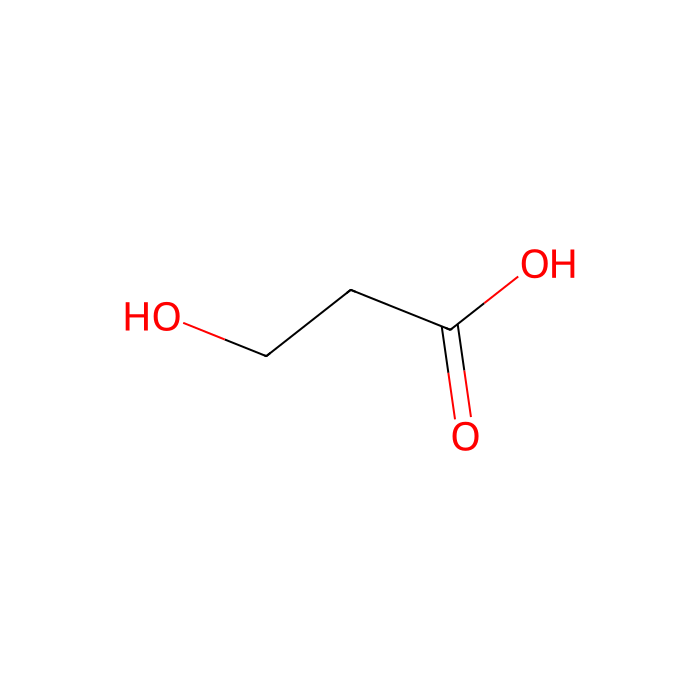
3-Hydroxypropionic acid is a three carbon non-chiral compound used as a building block to derive many important industrial chemicals. Studies indicate that 3-Hydroxypropionic acid can be synthesized from glycerol using the recombinant Escherichia coli SH254, which expresses glycerol dehydratase (DhaB) and aldehyde dehydrogenase (AldH). Structurally, the carboxyl group and the β hydroxyl group make 3-Hydroxypropionic acid very reactive. 3-Hydroxypropionic acid is a novel substrate in the production of polymers because this compound produces biodegradable polymers, which can replace existing polymers currently used in industry. Biologically, 3-Hydroxypropionic acid may be used to produce surgical biocomposite material and drug release material.
A three carbon non-chiral compound used as a building block for industrial chemicals.
| Pubchem Sid | 504754263 |
|---|---|
| Pubchem Sid Url | https://pubchem.ncbi.nlm.nih.gov/substance/504754263 |
| Canonical Smiles | C(CO)C(=O)O |
| IUPAC Name | 3-hydroxypropanoic acid |
| InChIKey | ALRHLSYJTWAHJZ-UHFFFAOYSA-N |
| INCHI | 1S/C3H6O3/c4-2-1-3(5)6/h4H,1-2H2,(H,5,6) |
| Isomeric SMILES | C(CO)C(=O)O |
| Molecular Weight | 90.08 |
| Beilstein | 3(4)689 |
| Reaxy-Rn | 773806 |
| Reaxys-RN_link_address | https://www.reaxys.com/reaxys/secured/hopinto.do?context=S&query=IDE.XRN=773806&ln= |
Comprehensive hazard, handling, storage, and regulatory compliance document.
Download SDS →Lot-specific quality data. Enter your lot number to retrieve the exact COA.
Look up COA →Full quality attributes and acceptance criteria for this grade.
View spec sheet →Taxonomy Tree
| Kingdom | Organic compounds |
|---|---|
| Superclass | Organic acids and derivatives |
| Class | Hydroxy acids and derivatives |
| Subclass | Beta hydroxy acids and derivatives |
| Intermediate Tree Nodes | Not available |
| Direct Parent | Beta hydroxy acids and derivatives |
| Alternative Parents | Monocarboxylic acids and derivatives Carboxylic acids Primary alcohols Organic oxides Hydrocarbon derivatives Carbonyl compounds |
| Molecular Framework | Aliphatic acyclic compounds |
| Substituents | Beta-hydroxy acid - Monocarboxylic acid or derivatives - Carboxylic acid - Carboxylic acid derivative - Organic oxygen compound - Organic oxide - Hydrocarbon derivative - Primary alcohol - Organooxygen compound - Carbonyl group - Alcohol - Aliphatic acyclic compound |
| Description | This compound belongs to the class of organic compounds known as beta hydroxy acids and derivatives. These are compounds containing a carboxylic acid substituted with a hydroxyl group on the C3 carbon atom. |
| External Descriptors | 3-hydroxy monocarboxylic acid - omega-hydroxy fatty acid |
Find and download the COA for your product by matching the lot number on the packaging.
| Lot Number | Certificate Type | Date | Item |
|---|---|---|---|
| Certificate of Analysis | Sep 09, 2025 | H136635 | |
| Certificate of Analysis | May 13, 2025 | H136635 | |
| Certificate of Analysis | Apr 08, 2025 | H136635 | |
| Certificate of Analysis | Mar 14, 2024 | H136635 | |
| Certificate of Analysis | Feb 11, 2022 | H136635 | |
| Certificate of Analysis | Feb 11, 2022 | H136635 | |
| Certificate of Analysis | Feb 11, 2022 | H136635 | |
| Certificate of Analysis | Feb 11, 2022 | H136635 | |
| Certificate of Analysis | Feb 11, 2022 | H136635 | |
| Certificate of Analysis | Feb 11, 2022 | H136635 | |
| Certificate of Analysis | Feb 11, 2022 | H136635 |
| Sensitivity | Heat Sensitive |
|---|---|
| Refractive Index | 1.364 |
| Flash Point(°C) | >110°C |
| Molecular Weight | 90.080 g/mol |
| XLogP3 | -1.000 |
| Hydrogen Bond Donor Count | 2 |
| Hydrogen Bond Acceptor Count | 3 |
| Rotatable Bond Count | 2 |
| Exact Mass | 90.0317 Da |
| Monoisotopic Mass | 90.0317 Da |
| Topological Polar Surface Area | 57.500 Ų |
| Heavy Atom Count | 6 |
| Formal Charge | 0 |
| Complexity | 50.000 |
| Isotope Atom Count | 0 |
| Defined Atom Stereocenter Count | 0 |
| Undefined Atom Stereocenter Count | 0 |
| Defined Bond Stereocenter Count | 0 |
| Undefined Bond Stereocenter Count | 0 |
| The total count of all stereochemical bonds | 0 |
| Covalently-Bonded Unit Count | 1 |
| 1. Zhang Lihua, Feng Song, Huang Furong, Li Bo, Li Yunqi, Sheng Hailiang, Hu Lijie, Liang Songmiao, Xie Haibo. (2023) Thiol-functionalized chitosan poly(protic ionic liquids) hydrogel selectively anchors gold nanoparticles for aqueous catalysis. CELLULOSE, 30 (6): (3837-3852). [PMID:] [10.1007/s10570-023-05126-7] |
| 2. Ziyue Zhou, Renjiang Li, Ke Li, Kai Zong, Dongshun Deng. (2022) Efficient and reversible absorption of low pressure NH3 by functional type V deep eutectic solvents based on phenol and hydroxypyridine. NEW JOURNAL OF CHEMISTRY, 46 (45): (21730-21736). [PMID:] [10.1039/D2NJ04409A] |
| 3. Haixia Wang, Xiaoyu Wang, Hao Ren, Xuejun Wang, Zhenmei Lu. (2020) 3-Hydroxypyridine Dehydrogenase HpdA Is Encoded by a Novel Four-Component Gene Cluster and Catalyzes the First Step of 3-Hydroxypyridine Catabolism in Ensifer adhaerens HP1. APPLIED AND ENVIRONMENTAL MICROBIOLOGY, 86 (19): [PMID:32709720] [10.1128/AEM.01313-20] |
| 4. Jiayi Liu, Yifeng Wei, Lianyun Lin, Lin Teng, Jinyu Yin, Qiang Lu, Jiawei Chen, Yuchun Zheng, Yaxin Li, Runyao Xu, Weixiang Zhai, Yangping Liu, Yanhong Liu, Peng Cao, Ee Lui Ang, Huimin Zhao, Zhiguang Yuchi, Yan Zhang. (2020) Two radical-dependent mechanisms for anaerobic degradation of the globally abundant organosulfur compound dihydroxypropanesulfonate. PROCEEDINGS OF THE NATIONAL ACADEMY OF SCIENCES OF THE UNITED STATES OF AMERICA, 117 (27): (15599-15608). [PMID:32571930] [10.1073/pnas.2003434117] |
| 5. Wei-Wei Liu, Jie Pan, Xiaoyuan Feng, Meng Li, Ying Xu, Fengping Wang, Ning-Yi Zhou. (2019) Evidences of aromatic degradation dominantly via the phenylacetic acid pathway in marine benthic Thermoprofundales. ENVIRONMENTAL MICROBIOLOGY, 22 (1): (329-342). [PMID:31691434] [10.1111/1462-2920.14850] |
| 6. Zhang Qiang, Gong Jin-Song, Dong Ting-Ting, Liu Ting-Ting, Li Heng, Dou Wen-Fang, Lu Zhen-Ming, Shi Jin-Song, Xu Zheng-Hong. (2017) Nitrile-hydrolyzing enzyme from Meyerozyma guilliermondii and its potential in biosynthesis of 3-hydroxypropionic acid. BIOPROCESS AND BIOSYSTEMS ENGINEERING, 40 (6): (901-910). [PMID:28285455] [10.1007/s00449-017-1754-6] |
| 7. Yifan Wei, Xiumei Zheng, Zili Huang, Chunxiao Mou, Xiaobo Xie, Yi Lv. (2025) In-Capillary Chemoselective Tagging-Facilitated Direct nESI-MS Profiling of Carboxyl- and Carbonyl-Containing Metabolites in Urine. ANALYTICAL CHEMISTRY, [PMID:41077679] [10.1021/acs.analchem.5c04351] |
| 8. Tao Huang, Chunsu Liang, Xiaomei Ling. (2025) Study on Dissociated States of Monocarboxylic Acids and Their Interactions With MCT1 by Capillary Electrophoresis With Interface-Induced Current Detector. ELECTROPHORESIS, 46 (21): (1576-1587). [PMID:41104594] [10.1002/elps.70028] |