
Determine the necessary mass, volume, or concentration for preparing a solution.
| Activity Type | Relation | Activity value | Units | Action Type | Journal | PubMed Id | doi | Assay Aladdin ID |
|---|
Product Application:
4,4'-Dihydroxybenzophenone is as a UV light stabilizer. It and its derivatives are found in cosmetics, plastics, films, adhesives and coatings, optical fiber, and printed circuit boards. It is the precursor to certain polycarbonate polymers.
Taxonomy Tree
| Kingdom | Organic compounds |
|---|---|
| Superclass | Benzenoids |
| Class | Benzene and substituted derivatives |
| Subclass | Benzophenones |
| Intermediate Tree Nodes | Not available |
| Direct Parent | Benzophenones |
| Alternative Parents | Diphenylmethanes Aryl-phenylketones Benzoyl derivatives 1-hydroxy-2-unsubstituted benzenoids Organic oxides Hydrocarbon derivatives |
| Molecular Framework | Aromatic homomonocyclic compounds |
| Substituents | Benzophenone - Aryl-phenylketone - Diphenylmethane - Aryl ketone - Benzoyl - 1-hydroxy-2-unsubstituted benzenoid - Phenol - Ketone - Organic oxygen compound - Organic oxide - Hydrocarbon derivative - Organooxygen compound - Aromatic homomonocyclic compound |
| Description | This compound belongs to the class of organic compounds known as benzophenones. These are organic compounds containing a ketone attached to two phenyl groups. |
| External Descriptors | benzophenones |
| Activity Type | Relation | Activity value | Units | Action Type | Journal | PubMed Id | doi | Assay Aladdin ID |
|---|
| Activity Type | Relation | Activity value | Units | Action Type | Journal | PubMed Id | doi | Assay Aladdin ID |
|---|
| Activity Type | Relation | Activity value | Units | Action Type | Journal | PubMed Id | doi | Assay Aladdin ID |
|---|
| Activity Type | Relation | Activity value | Units | Action Type | Journal | PubMed Id | doi | Assay Aladdin ID |
|---|
| Activity Type | Relation | Activity value | Units | Action Type | Journal | PubMed Id | doi | Assay Aladdin ID |
|---|
| Activity Type | Relation | Activity value | Units | Action Type | Journal | PubMed Id | doi | Assay Aladdin ID |
|---|
Find and download the COA for your product by matching the lot number on the packaging.
| Lot Number | Certificate Type | Date | Item |
|---|---|---|---|
 I2206755 | Certificate of Analysis | Jun 15, 2026 | D110182 |
| I2206757 | Certificate of Analysis | Jun 15, 2026 | D110182 |
| L2509300 | Certificate of Analysis | Nov 21, 2025 | D110182 |
| L2509299 | Certificate of Analysis | Nov 21, 2025 | D110182 |
| D2616059 | Certificate of Analysis | Nov 21, 2025 | D110182 |
| L2509276 | Certificate of Analysis | Nov 21, 2025 | D110182 |
| K2612014 | Certificate of Analysis | Nov 21, 2025 | D110182 |
| E2128086 | Certificate of Analysis | Mar 04, 2025 | D110182 |
| E2128088 | Certificate of Analysis | Mar 04, 2025 | D110182 |
| E2128089 | Certificate of Analysis | Mar 04, 2025 | D110182 |
| E2516568 | Certificate of Analysis | Jul 13, 2024 | D110182 |
| L2503301 | Certificate of Analysis | Jul 13, 2024 | D110182 |
| E2516571 | Certificate of Analysis | Jul 13, 2024 | D110182 |
| C2031148 | Certificate of Analysis | Jan 05, 2024 | D110182 |
| I2206600 | Certificate of Analysis | Jul 28, 2022 | D110182 |
| I2206756 | Certificate of Analysis | Jul 28, 2022 | D110182 |
| C23311553 | Certificate of Analysis | Jul 28, 2022 | D110182 |
| C23311549 | Certificate of Analysis | Jul 28, 2022 | D110182 |
| Solubility | Insoluble in water, insoluble in ether and ethanol. |
|---|---|
| Melt Point | 217-223°C |
| Molecular Weight | 214.22 |
| XLogP3 | 2.700 |
| Hydrogen Bond Donor Count | 2 |
| Hydrogen Bond Acceptor Count | 3 |
| Rotatable Bond Count | 2 |
| Exact Mass | 214.063 Da |
| Monoisotopic Mass | 214.063 Da |
| Topological Polar Surface Area | 57.500 Ų |
| Heavy Atom Count | 16 |
| Formal Charge | 0 |
| Complexity | 212.000 |
| Isotope Atom Count | 0 |
| Defined Atom Stereocenter Count | 0 |
| Undefined Atom Stereocenter Count | 0 |
| Defined Bond Stereocenter Count | 0 |
| Undefined Bond Stereocenter Count | 0 |
| The total count of all stereochemical bonds | 0 |
| Covalently-Bonded Unit Count | 1 |
H315:Causes skin irritation
H317:May cause an allergic skin reaction
H319:Causes serious eye irritation
H335:May cause respiratory irritation
P261:Avoid breathing dust/fume/gas/mist/vapors/spray.
P264:Wash hands [and …] thoroughly after handling.
P271:Use only outdoors or in a well-ventilated area.
P272:Contaminated work clothing should not be allowed out of the workplace.
P280:Wear protective gloves/protective clothing/eye protection/face protection.
P321:Specific treatment (see ... on this label).
P302+P352:IF ON SKIN: wash with plenty of water.
P304+P340:IF INHALED: Remove person to fresh air and keep comfortable for breathing.
P305+P351+P338:IF IN EYES: Rinse cautiously with water for several minutes. Remove contact lenses if present and easy to do - continue rinsing.
P333+P313:IF SKIN irritation or rash occurs: Get medical advice/attention.
P362+P364:Take off contaminated clothing and wash it before reuse.
P405:Store locked up.
P403+P233:Store in a well-ventilated place. Keep container tightly closed.
P501:Dispose of contents/container to an approved waste disposal plant.
P264+P265:Wash hands [and …] thoroughly after handling. Do not touch eyes.
P337+P317:If eye irritation persists: Get medical help.
P332+P317:If skin irritation occurs: Get medical help.
P319:Get medical help if you feel unwell.
Not applicable as standardized bioassay/diagnostic protocols. For chemical use:
No WB/IHC/IF/FC or related biological application protocols are associated with this item.
This product is a synthetic aromatic diol/ketone and is not a biological buffer, enzyme, or nutrient.
General chemistry context (literature):
Research use note: For in vitro studies only as a chemical standard or material modifier; not intended for use in living systems. No claims of biological activity or therapeutic relevance are made for this catalog item.
Practical guidance:
Not typically used as a buffering agent. 4,4′-Dihydroxybenzophenone is a neutral organic solid (phenolic diol) without a defined buffering range. For experimental work requiring dissolution in aqueous media, employ standard biological buffers (e.g., phosphate, Tris) and dissolve this compound via co-solvent addition or alkaline adjustment to form soluble phenolates, then re-acidify if precipitation is desired.
While 4,4′-dihydroxybenzophenone itself is a targeted building block/additive, process choices around it can be made greener.
Greener solvent choices (literature guidance):
Energy and workup:
Comparison snapshot (literature-based):
Tradeoffs: Greener choices may increase reaction time/temperature or alter selectivity; verify performance at small scale before process adoption.
No pharmacopeial grade or excipient designation is specified for this item.
General, non-clinical context (literature):
Manufacturing/formulation considerations:
Regulatory note: This catalog item is for research use only and is not intended for human or veterinary applications.
Item-specific specs were not provided. The following values are literature/typical for 4,4′-dihydroxybenzophenone (for reference only; not specifications for this catalog item):
Item-specific parameters such as Karl Fischer water, trace metals, UV cutoff, RI: Not specified for this item; refer to CoA/Spec Sheet.
Item-specific grade/purity: Not specified for this item; refer to CoA/Spec Sheet.
Interpreting grades (general guidance for professional users):
Stabilizers/antioxidants: Not typically required for this phenolic ketone; none are specified for this item. If stabilizers are of concern in your application (e.g., polymer additive R&D), confirm on the CoA.
Documentation best practices:
Applications focus on the phenolic and benzophenone functionalities. Examples below are literature-based general use cases for 4,4′-dihydroxybenzophenone in synthesis and materials R&D.
Polymer and materials chemistry:
Small-molecule transformations:
Photochemistry/analytics:
Practical notes:
General, literature-based conditions for common transformations of 4,4′-dihydroxybenzophenone (guidance only; optimize for your system):
O-Alkylation (bis-ether formation):
Esterification (diesters):
Carbonate formation:
Carbonyl reduction to benzhydrol:
Purification:
Product Data hazard fields (this listing):
General GHS guidance (literature, non-binding): Aromatic dihydroxybenzophenones are commonly classified as eye/skin irritants and may cause respiratory irritation as nuisance dust. Always consult the specific SDS for authoritative classification and first-aid instructions.
Handling recommendations (good laboratory practice):
First-aid overview (consult SDS):
Waste: dispose according to local regulations; segregate from oxidizers; label phenolic organic waste appropriately.
This product is a low-volatility aromatic diol/ketone solid. Solvent choice is dictated by intended operation (dissolution, reaction, crystallization, or analytical prep).
Polarity/miscibility (literature):
Typical use scenarios:
Comparison notes (literature):
Practical tips:
Storage conditions (Product Data): Room temperature. Shipped under normal conditions.
General storage guidance (solid, literature best practice):
Reconstitution/dissolution:
Stability:
Item-specific details such as shelf life, stabilizers, water/impurity limits: Not specified for this item; refer to CoA/Spec Sheet.
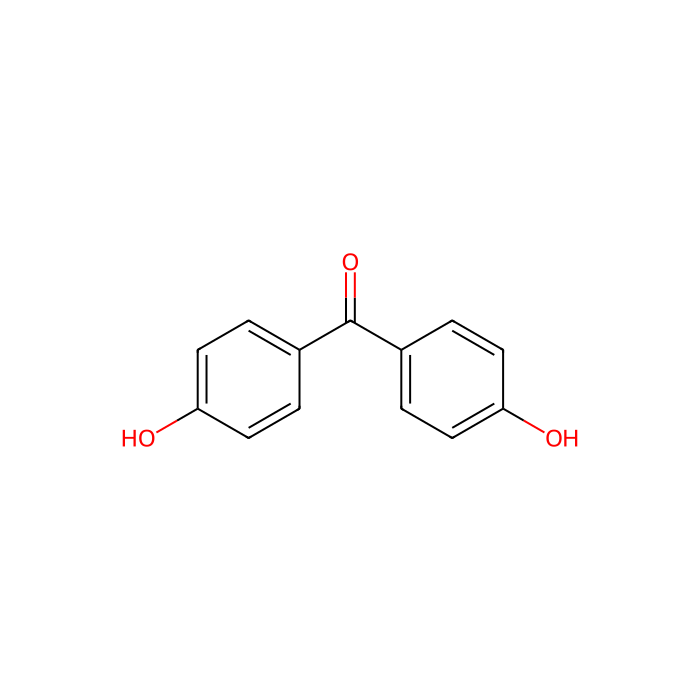
Brief description: 4,4′-Dihydroxybenzophenone is an aromatic ketone bearing two para-phenolic groups (one on each ring of the benzophenone core).
Product Data identifiers (as provided by the listing):
Literature/computed identifiers (for reference; not item-specific specs):
Structural features (general chemistry):
4,4′-Dihydroxybenzophenone combines a reactive aryl ketone with two para-phenolic OH groups, enabling orthogonal transformations.
Phenolic chemistry:
Carbonyl chemistry:
Directed metalation/cross-coupling:
Retrosynthetic value:
Practical points:
Not applicable. This product is a small-molecule chemical, not an antibody, enzyme, or affinity reagent. No target, epitope, clone, or species reactivity data apply.