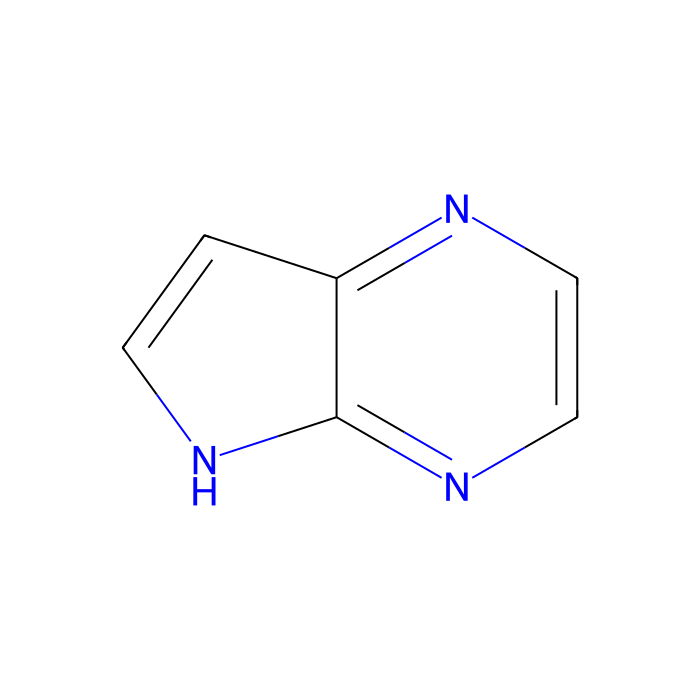
This compound belongs to the class of organic compounds known as pyrrolopyrazines. These are compounds containing a pyrrolopyrazine moiety, which consists of a pyrrole ring fused to a pyrazine. Pyrrole is 5-membered ring consisting of four carbon atoms and one nitrogen atom. Pyrazine is a 6-membered ring consisting of six carbon atoms and two nitrogen centers at ring positions 1 and 4.
External Descriptors
Not available
1. Djoumbou Feunang Y, Eisner R, Knox C, Chepelev L, Hastings J, Owen G, Fahy E, Steinbeck C, Subramanian S, Bolton E, Greiner R, and Wishart DS. ClassyFire: Automated Chemical Classification With A Comprehensive, Computable Taxonomy. Journal of Cheminformatics, 2016, 8:61.
Determine the necessary mass, volume, or concentration for preparing a solution.
Dilution Calculator
Determine the dilution needed to prepare a stock solution.
Reconstitution Calculator
Reviews
Customer Reviews
Application Protocols
No tested biological application protocols (e.g., WB, IHC, IF, FC) are provided for this item.
General laboratory usage examples (non-validated, literature-based guidance):
Stock solutions for screening: Dissolve in dry DMSO to prepare 10–100 mM stocks; filter through 0.22 µm PTFE if particulates are present. Dilute into assay buffer with vigorous mixing to mitigate precipitation. Confirm concentration by UV–Vis or quantitative NMR.
Parallel synthesis: Employ microwave-assisted cross-coupling conditions (e.g., Suzuki in 1,4-dioxane/H2O, 100–140°C, 10–30 min) on halo-derivatives to expedite library generation. Validate by LC–MS.
Note: These are generic examples intended to illustrate handling; they are not item-specific validated protocols. Always develop and validate procedures for your specific system.
Biological Roles
Item-specific biological data are not provided. The following is general biochemical/medicinal chemistry context for fused N-heteroaromatic scaffolds like pyrrolo[2,3-b]pyrazine (literature/general):
H-bonding topology: The scaffold offers one hydrogen-bond donor (pyrrolic NH) and two ring nitrogens (pyrazine) as potential H-bond acceptors/metal-coordination sites, enabling defined interaction patterns in protein binding sites.
Aromaticity and planarity: The rigid, coplanar bicyclic system favors π–π stacking and edge-to-face interactions with aromatic residues, often exploited in fragment-based lead discovery.
Protonation state: Typically neutral at physiological pH due to weakly basic/acidic nitrogens, which can promote membrane permeability in small molecules once substituted appropriately.
Metabolic considerations: N-heteroaromatics may undergo N-oxidation, aromatic hydroxylation, or conjugation after prior functionalization; such liabilities can be tuned by N-alkylation/acylation or ring substitution.
Privileged heteroarene: Related fused systems are frequently used as cores in biochemical probes and tool compounds; pyrrolo–diazine motifs can mimic purine-like electronics in nucleic acid/protein binding contexts.
Note: No clinical or therapeutic claims are made for this material. It is supplied strictly for research and laboratory use.
Buffer Applications
This product is a neutral heteroaromatic small molecule, not a buffering reagent. It is not typically used to prepare laboratory buffers or pH standards.
If the compound must be formulated into aqueous media for assays, select an appropriate external buffer system (e.g., phosphate, HEPES, or acetate) based on the assay pH, ionic strength, and compatibility with organic cosolvents.
Adjust solubility by using minimal DMSO/DMF cosolvent and serial dilution into the desired buffer while monitoring for precipitation. Specific pKa and solubility data for this item are not provided; verify experimentally.
Green Alternatives
While the compound itself is a heteroaromatic substrate (not a solvent), greener choices can be made in the transformations and purification steps that involve it.
Greener solvent and process substitutions (general literature guidance):
Comparison of common vs greener media:
THF → 2-MeTHF: Similar polarity and metalation capability; 2-MeTHF is bio-derived, has higher boiling point and lower miscibility with water, simplifying workups. Tradeoff: broader peroxide concerns still apply; ensure inhibitor monitoring.
DMF/NMP → Cyrene, propylene carbonate, or dimethyl isosorbide: Reduced reproductive toxicity vs NMP; DMF replacements can work for some couplings and SNAr; tradeoff: solubility and base compatibility can differ.
DCM → EtOAc or Me-THF: For extractions/chromatography where feasible; tradeoff: elution strength and volatility differ.
Toluene → Anisole or eco-aromatics: Similar thermal profiles with improved safety in certain jurisdictions.
Catalysis and energy:
Use Pd/Ni cross-couplings at lower loadings with modern ligands; explore micellar catalysis (TPGS-750-M) to run couplings in water or water-rich media, reducing organic solvent use.
Flow chemistry for exothermic halogenations/metalations can improve heat transfer, minimize solvent volumes, and enhance safety.
Workup/purification:
Favor crystallization/trituration over silica chromatography when possible; if chromatography is necessary, use heptane/EtOAc or greener heptane alternatives instead of hexanes/DCM.
Always validate these substitutions for your specific substrate and transformation.
Pharmaceutical Uses
Item-specific pharmacopeial/excipient status is not provided for this compound. The following context is general and does not constitute therapeutic claims:
Role in R&D: Fused N-heteroaryl scaffolds such as pyrrolo[2,3-b]pyrazine are commonly explored as cores in medicinal chemistry for SAR campaigns, kinase/inhibitor design, and fragment-based screening due to their compact, planar, and heteroatom-rich features.
Intermediate use: Substituted derivatives may serve as synthetic intermediates toward candidate molecules. When used in process development, attention should be paid to impurity fate and purge (e.g., N-oxides, halogenated byproducts).
Regulatory considerations: If material progresses toward GMP settings, tighter specifications (identity, purity, residual solvents, elemental impurities) and validated analytical methods are required. For this catalog item, grade/purity are not specified; consult CoA if intended for regulated workflows.
Formulation relevance: No excipient role is typical for this scaffold. Solubility in aqueous media is generally limited without ionizable substituents; salt formation is not applicable unless the scaffold is derivatized (e.g., N-alkylated to a cationic species).
This product is supplied strictly for research use only and is not intended for human or veterinary use.
Physical Properties
Item-specific specifications:
Appearance: Not specified for this item; refer to CoA/Spec Sheet.
Molecular Weight: Not specified for this item; refer to CoA/Spec Sheet.
Molecular Formula: Not specified for this item; refer to CoA/Spec Sheet.
Melting point (MP): Not specified for this item; refer to CoA/Spec Sheet.
Boiling point (BP): Not specified for this item; refer to CoA/Spec Sheet.
Density: Not specified for this item; refer to CoA/Spec Sheet.
Refractive index: Not specified for this item; refer to CoA/Spec Sheet.
Solubility: Not specified for this item; refer to CoA/Spec Sheet.
LogP/logD, pKa: Not specified for this item; refer to CoA/Spec Sheet.
General physicochemical considerations for pyrrolo[2,3-b]pyrazine (literature/structure-based guidance):
Aromatic, fused N-heterocycle with moderate polarity relative to carbocyclic aromatics; typically exhibits better solubility in polar aprotic organic solvents (e.g., DMSO, DMF, acetonitrile) than in alkanes.
The pyrrolic NH is weakly acidic; deprotonation requires strong base. Hydrogen bonding (donor via NH; acceptors at pyrazine nitrogens) can influence crystallinity and solvation.
UV absorption is expected in the near-UV due to the extended π-system; actual cutoffs/ε should be verified experimentally for this lot (not specified here).
Practical notes:
If performing analytical method development (HPLC/UPLC), begin with mixed aqueous–organic eluents (e.g., water–acetonitrile with 0.1% formic acid/base modifier as appropriate) and confirm retention/UV response empirically because specific logP and pKa are not provided.
Quality & Grades
Item-specific quality details:
Grade/Purity: Not specified for this item; refer to CoA/Spec Sheet.
Stabilizers/Inhibitors: Not specified for this item; refer to CoA/Spec Sheet.
How to interpret typical grades for heteroaromatic building blocks (general guidance):
Research grade: Suitable for discovery chemistry and general synthesis. Purity is commonly reported by HPLC/GC and validated by NMR; minor residual solvents or inorganic salts may be present within stated limits.
High-purity/≥98%: Preferred for medicinal chemistry SAR and analytical method development to minimize impurity carryover.
Trace metal specs: If the compound is to be used in cross-coupling or metal-catalyzed steps downstream, low residual metal content can be helpful; check CoA if relevant.
Water/peroxide/UV cutoff: Not specified for this item; always consult the CoA/SDS for these values if they are critical to your application.
Quality control best practices:
Verify identity by 1H/13C NMR and HRMS against authoritative literature spectra for pyrrolo[2,3-b]pyrazine scaffolds.
Check chromatographic purity by HPLC with at least two orthogonal detection modes (UV at multiple wavelengths; MS if available), since heteroaromatics may have coeluting isomers or trace N-oxides.
Where sensitive transformations are planned (e.g., lithiation, directed metalation), consider drying in vacuo and confirming water content by Karl Fischer (if necessary for your workflow).
Reaction & Applications
Research context: 1H-pyrrolo[2,3-b]pyrazine is a compact, electron-rich/electron-deficient fused heteroaromatic scaffold valued in discovery chemistry and heteroaryl materials.
Electrophilic substitution on the pyrrole ring: Halogenation (NBS/NCS), formylation (Vilsmeier–Haack), acylation/sulfonylation under Lewis/Brønsted acid catalysis; control of regioselectivity via directing groups.
N-functionalization: N-alkylation or N-acylation of the pyrrolic nitrogen to tune basicity, solubility, and electronics.
Cross-coupling via halo-derivatives: Convert selected C–H positions to C–X (Br/I) then employ Suzuki–Miyaura, Buchwald–Hartwig (for C–N), or Sonogashira couplings to elaborate the scaffold.
Directed metalation/ortholithiation: Use strong bases (s-BuLi, LiTMP) at low temperature in THF/toluene to achieve regioselective functionalization, typically followed by quench with electrophiles (CO2, DMF, elemental S/Se, etc.).
Oxidation to N-oxides (on the pyrazine): Transient N-oxide formation can direct Minisci-type C–H functionalization, followed by deoxygenation (literature strategy for diazine activation).
Nucleophilic aromatic substitution (SNAr): If the pyrazine ring is appropriately activated (e.g., by nitro/CF3 or halogens), anilines/alkoxides/thiolates can be installed under polar aprotic conditions.
Practical tips:
Regioselectivity is sensitive to base, temperature, and substituent pattern; employ computational or precedent-guided site-selectivity planning and confirm by 2D NMR (HMBC/NOESY).
For cross-couplings, heteroatom-rich substrates may poison catalysts; increase catalyst loading, include additives (e.g., Bu4NBr), or choose robust ligands (SPhos/XPhos).
Reaction Conditions
General conditions (literature/practice-based; verify for your substrate and substitution pattern):
Electrophilic halogenation (pyrrole ring): NBS/NCS (1.0–1.2 eq) in DMF or AcOH, 0–25°C, 1–3 h; monitor to avoid polyhalogenation. Typical isolated yields vary widely (40–85%) depending on regioselectivity.
Vilsmeier–Haack formylation: POCl3/DMF (Vilsmeier reagent) at 0–5°C addition, then 60–90°C for 2–6 h. Quench onto ice, neutralize, extract. Formylation generally proceeds at the more activated pyrrolic position.
Directed metalation: s-BuLi or LiTMP (1.1–1.5 eq) in anhydrous THF or toluene at −78 to −40°C, 0.5–2 h; trap with electrophile (CO2, DMF, I2, B(OMe)3). Strict exclusion of moisture/oxygen required. Consider using TMEDA to enhance regioselectivity.
Cross-coupling from halo-derivatives: Pd2(dba)3 (1–2 mol%) + SPhos/XPhos (2–4 mol%) in 1,4-dioxane, THF, or toluene; base K3PO4/Cs2CO3; 60–100°C, 2–16 h. For Suzuki, add boronic acid/ester (1.2–1.5 eq). For Buchwald–Hartwig, use an amine nucleophile and appropriate ligand (e.g., BrettPhos for aryl chlorides).
Minisci alkylation (via N-oxide): Oxidize to N-oxide (mCPBA, CH2Cl2, 0–25°C), then perform radical alkylation with a carboxylic acid, persulfate, and catalytic AgNO3 in water/MeCN or micellar media at 25–50°C.
Analytical/controls:
Regioisomer mixtures are common; use low-temperature NMR and 2D methods to assign substitution patterns. LC–MS with DAD helps detect N-oxides and over-alkylated byproducts.
Drying: Prior to strong base chemistry, dry the substrate in vacuo (e.g., 40–60°C) and employ freshly distilled solvents.
Safety & Handling
Safety information provided for this catalog item:
GHS Classification: Not specified for this item; refer to SDS.
Signal Word: Not specified for this item; refer to SDS.
H-Statements: Not specified for this item; refer to SDS.
Pictograms: Not specified for this item; refer to SDS.
Research Use: For research use only.
Storage: Store at 2–8°C. Shipped on wet ice.
General handling guidance for fused N-heteroaromatics (literature/practice-based):
Expected hazards: Many small N-heteroaromatics are irritants; avoid inhalation of dust/vapors, skin/eye contact. Work in a fume hood.
PPE: Safety glasses, lab coat, appropriate chemical-resistant gloves (e.g., nitrile). For weighing fine powders, consider a dust mask or handle in a ventilated balance enclosure.
Incompatibilities: Strong oxidizers, strong acids/bases (can lead to decomposition or undesirable salts/anion formation), and reactive acylation/alkylation reagents without appropriate controls.
Thermal considerations: Although specific decomposition temperature is not provided, avoid unnecessary heating; use oil bath control and monitor by TLC/LCMS.
First aid (overview; defer to SDS):
Skin/eye: Rinse with water for ≥15 min; remove contaminated clothing; seek medical attention if irritation persists.
Inhalation: Move to fresh air; seek medical attention if symptoms occur.
Ingestion: Rinse mouth; do not induce vomiting; obtain medical attention.
Waste: Collect organic residues in halogenated or non-halogenated waste streams per solvent used; follow institutional hazardous waste protocols.
Always consult the product-specific SDS for definitive hazard classification and emergency procedures.
Solvent Selection
Applicability: This section addresses dissolution and reaction media choices for a neutral fused N-heteroaromatic such as 1H-pyrrolo[2,3-b]pyrazine.
General solvent behavior (literature/practice-based):
Polarity class: Moderately polar aromatic heterocycle; typically more soluble in polar aprotic solvents than in alkanes.
Common solvents for dissolution and reactions:
Strongly polar aprotic: DMSO, DMF, NMP — good solvating power; useful for SNAr, metalation, and coupling chemistry.
Medium polarity: Acetonitrile, THF, dioxane — often suitable for catalytic cross-couplings and electrophilic functionalizations.
Aromatics: Toluene — can be used in high-temperature reactions; may reduce substrate over-solvation.
Alcohols/water: Limited intrinsic solubility is typical; solubility can be enhanced by acid/base or surfactants if needed for bioconjugation or photophysics studies.
Selection tips:
For base-mediated steps (e.g., directed ortho metalation on the pyrrolic ring), use rigorously anhydrous ethers (THF/2-MeTHF) or toluene with a cosolvent; exclude moisture/air.
For electrophilic substitution on the pyrrole portion, milder media (AcOH, CH2Cl2 with acid catalyst) may limit overreaction.
For SNAr or nucleophilic addition on the pyrazine ring (if activated/halogenated), choose high-dielectric solvents (DMSO/DMF) to stabilize anionic intermediates.
Toluene: high-temperature stability; may require heating to dissolve.
Storage & Reconstitution
Item-specific storage and logistics:
Storage Conditions: Store at 2–8°C (as provided in Product Data).
Shipped In: Wet ice.
Appearance: Not specified for this item; refer to CoA/Spec Sheet.
Stability notes (general guidance for heteroaromatic solids):
Protect from excessive heat, moisture, and prolonged light exposure. Keep container tightly closed. Allow bottle to equilibrate to room temperature before opening to minimize condensation.
If long-term storage is anticipated, consider storing under inert gas after each use, especially if repeated opening/closing is expected.
Reconstitution and working solutions (general/practice-based):
Solvents: Commonly dissolved in DMSO, DMF, acetonitrile, or THF depending on downstream use. Actual solubility for this specific item is not specified; verify experimentally.
Preparation: For stock solutions, use anhydrous solvent, record exact mass and volume, and store aliquots at 2–8°C or −20°C as appropriate to avoid freeze–thaw cycling. Monitor for precipitation or discoloration over time.
Filtration: If particulates are present, filter through a 0.22 µm PTFE syringe filter. Avoid aqueous filters if the compound is poorly water soluble.
Always consult the product’s CoA and SDS for definitive guidance on stability, storage duration, and incompatibilities specific to this lot.
Structure & Identity
A fused bicyclic N-heteroaromatic composed of a pyrrole ring condensed with a pyrazine ring (1H tautomer on the pyrrolic nitrogen).
SKU: D184472
Product Name: 1H-pyrrolo[2,3-b]pyrazine
CAS: 42430-74-0
PubChem CID: 5370803
InChIKey: 120356 (as provided; note this is not a standard-length InChIKey string)
SMILES: Not specified for this item; refer to CoA/Spec Sheet.
Molecular Formula: Not specified for this item; refer to CoA/Spec Sheet.
Molecular Weight: Not specified for this item; refer to CoA/Spec Sheet.
Structural features (general/structural description):
Fused bicyclic ring system: a five-membered pyrrole fused to a six-membered pyrazine (diazine) ring.
Heteroatom content: one pyrrolic N (proton-bearing in the 1H tautomer) and two ring nitrogens within the pyrazine ring.
Planar, aromatic π-system enabling π–π stacking and coordination to metals via ring nitrogens.
Potential tautomerism at the pyrrolic N (1H vs N-deprotonated anion under strong base). No stereocenters present.
2D description in words:
Visualize a benzene-like hexagon containing two opposite nitrogens (pyrazine) fused along one edge to a five-membered ring with an NH (pyrrole). The fusion shares two adjacent carbons, creating a rigid, coplanar, bicyclic heteroaromatic scaffold suitable for electrophilic substitution on the pyrrole portion and nucleophilic interactions at the electron-deficient pyrazine ring.
Synthetic Utility
Key functional elements enabling synthesis (general literature guidance):
Pyrrolic NH: Enables N-alkylation/acylation/sulfonylation to modulate electronics and solubility; can also act as a directing group in metalation.
Pyrazine nitrogens: Electron-withdrawing effect renders certain ring carbons more electrophilic; can engage in coordination to metals, influencing catalytic site-selectivity.
Activated C–H positions: Regioselective halogenation or lithiation enables downstream cross-couplings and carbonylation.
Named/representative transformations:
Vilsmeier–Haack formylation on the pyrrole ring to access aldehyde handles for reductive amination or Wittig/Knöevenagel chemistry.
Buchwald–Hartwig amination and Suzuki–Miyaura coupling from pre-halogenated derivatives to build aryl/heteroaryl diversity.
Minisci reactions on transient N-oxides of the diazine ring to install alkyl groups under radical conditions.
Directed ortho metalation (DoM) with LiTMP/s-BuLi at cryogenic temperatures, followed by quench with electrophiles (e.g., CO2 → carboxylates; DMF → aldehydes; B(OMe)3 → boronates).
Retrosynthetic value:
Serves as a compact, electronically tunable core from which diverse analogs can be accessed by modular C–N/C–C bond construction.
The scaffold’s dual character (electron-rich pyrrole vs electron-deficient pyrazine) permits orthogonal functionalization strategies, facilitating rapid parallel synthesis and SAR exploration.
Target Specificity
Not applicable. This product is a small-molecule heteroaromatic building block, not a biological macromolecule (e.g., antibody, enzyme, or ligand with defined biomolecular target provided in the Product Data).
No antigen/epitope, species reactivity, clone, or isotype information is relevant for this item.
For biochemical assays where this scaffold is incorporated into a probe, target specificity must be established empirically for each derivative.
Frequently Asked Questions
What is the purity of this product?
This product is supplied at ≥97% purity (chemical assay). Lot-specific values are stated on the Certificate of Analysis.
How should this product be stored?
Store at 2–8 °C. Refrigerated storage is required to maintain the specified shelf life.
How is this product shipped?
This product ships chilled on wet ice. Unpack on arrival and transfer it to the storage condition stated above.
What are the CAS number, molecular formula and molecular weight?
The CAS Number is 42430-74-0, the molecular formula is C6H5N3, and the molecular weight is 119.12 g/mol. InChIKey HFTVJMFWJUFBNO-UHFFFAOYSA-N.
What documentation is provided?
Available product documentation, including Certificates of Analysis (COA), Safety Data Sheets (SDS), and specification sheets, is shown in the product document area. Document availability and access follow the current site policy.
We use cookies to ensure the website functions properly and, where permitted, to improve your experience. You can manage your preferences at any time in Settings. Learn more in our Cookie Policy.
Shall we send you a message when we have discounts available?
Remind me later
Thank you! Please check your email inbox to confirm.
Products are supplied to verified businesses, institutions, and qualified professionals for research and development use only. Not for use in humans, animals, diagnosis, or therapy.

 E2609437