This compound belongs to the class of organic compounds known as benzoic acids. These are organic Compounds containing a benzene ring which bears at least one carboxyl group.
External Descriptors
Not available
1. Djoumbou Feunang Y, Eisner R, Knox C, Chepelev L, Hastings J, Owen G, Fahy E, Steinbeck C, Subramanian S, Bolton E, Greiner R, and Wishart DS. ClassyFire: Automated Chemical Classification With A Comprehensive, Computable Taxonomy. Journal of Cheminformatics, 2016, 8:61.
Determine the necessary mass, volume, or concentration for preparing a solution.
Dilution Calculator
Determine the dilution needed to prepare a stock solution.
Reconstitution Calculator
Reviews
Customer Reviews
Application Protocols
No assay protocols are specified for this catalog item. As a small-molecule building block, typical procedures involve standard organic synthesis operations (e.g., esterification, amidation, recrystallization). For any specific transformation, consult peer-reviewed procedures and optimize for scale, solvent, and base/acylation system.
Tested application data, recommended dilutions, or positive controls: Not applicable to this product type.
Biological Roles
This product is supplied for research use only. No medical or clinical claims are made.
General biochemical context (literature; not product-specific):
Aromatic carboxylic acids such as para-alkoxybenzoic acids can interact with proteins via hydrogen-bonding and π–π interactions; the ionization state (pKa ~4.4–4.5) governs charge at physiological pH.
The ethoxy substituent increases hydrophobic character relative to benzoic acid, potentially altering membrane association and binding in model systems versus unsubstituted benzoates.
Para-alkoxybenzoates are seen as fragments in fragrance chemistry and may serve as model ligands in studies of transporter binding or enzyme inhibition in vitro; specific biological roles for 4-ethoxybenzoic acid per se are context-dependent and not universally defined.
In supramolecular and materials biology interfaces, the carboxyl group supports self-assembly or surface anchoring on metal oxides (via carboxylate) for biosensing materials.
Note: Any in vitro biochemical or biophysical use should be supported by appropriate controls and SDS review. For organismal or cellular exposure studies, ensure compliance with institutional safety approvals and characterize purity/impurities via CoA.
Buffer Applications
4-Ethoxybenzoic acid is not a standard laboratory buffering agent. Although its pKa (~4.4–4.5, literature) lies within the acidic buffering range, specialized, well-characterized systems (acetate, citrate, phthalate) are preferred for reproducible buffering capacity and regulatory traceability.
If used exploratorily:
Effective buffering would occur roughly within pH 3.5–5.5, but solubility at low pH is modest and salt formation is needed for aqueous use.
Prepare sodium 4-ethoxybenzoate by neutralizing with NaOH; verify ionic strength and pH with a calibrated meter; assess solubility and precipitation upon pH shifts.
Recommendation: Choose established buffers for analytical or biological workflows; use this compound primarily as a synthetic building block rather than a buffer component.
Green Alternatives
While 4-ethoxybenzoic acid is a solid building block rather than a solvent, greener choices matter in its transformations.
Greener solvent swaps (literature guidance):
Prefer ethyl acetate, 2-MeTHF, CPME, or isopropanol over dichloromethane or DMF when reaction compatibility allows.
For workups, employ aqueous ethanol or EtOAc/aqueous systems to minimize chlorinated waste.
Greener coupling strategies:
Use water-tolerant carbodiimides (EDC·HCl) and catalytic N-hydroxysuccinimide or OxymaPure in MeCN/EtOAc instead of HATU/HBTU in DMF, where feasible.
Enzymatic esterifications in solvent-free or ionic-liquid media can be viable for certain 4-ethoxybenzoate esters.
Energy and waste reduction:
Employ microwave or flow conditions for rapid esterifications/amidations, reducing solvent volumes and energy consumption.
Comparison snapshot (general):
DCM vs EtOAc: EtOAc offers lower toxicity and better environmental footprint; may require temperature adjustment for solubility.
DMF/NMP vs MeCN/2-MeTHF: MeCN/2-MeTHF are typically easier to remove and have more favorable hazard profiles; assess solubility of reactants.
Thionyl chloride vs mixed anhydrides: Mixed anhydrides (pivaloyl, isobutyl chloroformate) can reduce corrosive off-gassing; balance with reagent availability and byproduct handling.
Always validate greener substitutions with small-scale trials to confirm yield, selectivity, and impurity profile.
Pharmaceutical Uses
No therapeutic claims. This product is for research use only.
General formulation/manufacturing context (literature; not product-specific):
4-Ethoxybenzoic acid can serve as an intermediate to esters and amides used in excipient development or pro-fragrance/pro-flavor systems; para-alkoxybenzoate esters are known for modulating lipophilicity and volatility.
The free acid could be examined as a counterion partner in salt selection screens for basic drug candidates, though para-alkoxybenzoates are less common than pharmacopeial acids (e.g., benzoic, salicylic, fumaric). Regulatory precedence is limited; pharmacopeial status: Not specified for this item; refer to CoA/Spec Sheet.
In materials for drug delivery research, benzoic acid derivatives are explored as hydrogen-bonding units in co-crystals or polymer functionalization.
For any application in regulated environments, source documentation (CoA, impurity profile, residual solvents, metals) and pharmacopeial compliance must be verified. None of these specifications are provided here; refer to CoA/Spec Sheet.
Physical Properties
Item-specific specifications: Not specified for this item; refer to CoA/Spec Sheet.
Literature/general data (for reference only; not product specifications):
Physical state: crystalline solid (literature)
Melting point: ~185–187 °C (literature, typical reports for p-ethoxybenzoic acid)
Boiling point: not commonly distilled; tends to decompose before boiling at atmospheric pressure (literature)
Molecular weight: ~166.17 g/mol (from formula C9H10O3)
LogP (octanol/water): estimated ~1.8–2.2 (computed/literature estimates; depends on ionization state)
Solubility (qualitative, literature):
Water: low at neutral pH; appreciably soluble as its carboxylate at basic pH
Organic: good in alcohols (MeOH, EtOH), acetone, ethyl acetate, DMSO, DMF; limited in alkanes
UV characteristics: aromatic chromophore; strong absorption in UV-B/UV-C (typical benzoate/anisole-like bands) — exact cutoffs Not specified for this item; refer to CoA/Spec Sheet.
Notes:
Ionization state strongly influences aqueous solubility; salts (e.g., Na+, K+) are water-soluble.
Hygroscopicity and water/peroxide/metal traces: Not specified for this item; refer to CoA/Spec Sheet.
Quality & Grades
Grade/Purity: Not specified for this item; refer to CoA/Spec Sheet.
Appearance: Not specified for this item; refer to CoA/Spec Sheet.
Interpretation and implications (general):
If supplied as “analytical” or “reagent” grade, typical expectations include low inorganic/organic residues suitable for routine synthesis and analytical sample preparation. HPLC/UV grades emphasize low background absorbance and particulate levels for chromatography; electronic/trace-metal grades control metal contaminants for catalysis or materials work.
Stabilizers/inhibitors: Aromatic carboxylic acids like 4-ethoxybenzoic acid generally do not require polymerization inhibitors; no stabilizer is expected unless declared. Any added stabilizer would be listed on the CoA.
Verification: For sensitive applications (e.g., pharma intermediates, materials), verify identity by orthogonal methods: melting point, 1H/13C NMR (characteristic para-disubstituted pattern), IR (broad O–H ~2500–3300 cm−1; C=O ~1685–1710 cm−1), LC/GC purity profiles, and residual solvent/moisture.
Batch-to-batch documentation: Request CoA for assay method, impurity profile, water content (KF), and residual solvents; these are Not specified for this item; refer to CoA/Spec Sheet.
Reaction & Applications
General synthetic roles (literature; not product-specific):
Carboxylic acid derivative chemistry:
Conversion to acid chlorides with SOCl2 or (COCl)2; subsequent amide/ester formation with amines/alcohols.
Direct coupling (EDC·HCl, HATU, HBTU, DIC/DMAP) to prepare amides/esters under mild conditions; para-ethoxy substituent increases ring electron density, slightly influencing acyl reactivity.
Protecting-group/functional handle on the ring:
Ethoxy as a para-directing, electron-donating group; facilitates electrophilic substitutions (e.g., nitration, sulfonylation) at the ortho positions (2/6) under controlled conditions.
Aryl–O dealkylation (BBr3, BCl3, AlCl3/thiols) to 4-hydroxybenzoic acid, enabling switch to a phenolic handle.
Cross-coupling precursors:
After halogenation (e.g., nitration→reduction→diazotization→halogenation or direct SEAr halogenation), the aryl acid can enter Pd-catalyzed couplings via its halo derivatives.
Materials and LC applications:
Para-alkoxybenzoic acids are common motifs in liquid crystal research and polymer additives; 4-ethoxybenzoate esters/amides can tune mesogenic and thermal properties.
Supramolecular/assembly chemistry:
Hydrogen-bond donor/acceptor sites (–CO2H) support co-crystal engineering; para-alkoxy group modulates packing and π–π interactions.
Practical tips:
Ensure dryness for carbodiimide couplings; add catalytic DMAP for esterification acceleration.
Control exotherms when neutralizing to precipitate the free acid from basic solutions; seed to manage particle size.
Reaction Conditions
General, literature-based guidance (not product-specific):
Esterification (Fischer):
Solvent/reagent: neat ROH or ROH with catalytic H2SO4 or p-TsOH; 60–120 °C depending on alcohol; water removal (Dean–Stark with toluene) enhances conversion.
Typical times: 2–16 h; monitor by TLC/GC/LC.
Steglich esterification:
Solvent: DCM, THF, or EtOAc; 0–25 °C; DCC (1.1–1.5 eq) and DMAP (0.05–0.2 eq).
Often complete within 2–8 h; filter dicyclohexylurea; 70–95% yields commonly reported for similar benzoic acids.
Amide coupling:
Solvent: DMF, DCM, MeCN; base: DIPEA (2–3 eq); EDC·HCl/HOBt or HATU/Oxyma; 0–25 °C to room temperature.
Time: 1–12 h; yields frequently 60–95% depending on amine nucleophilicity and sterics.
Acid chloride formation:
Reagent: SOCl2 (2–4 eq) with catalytic DMF; reflux 1–3 h in toluene/CH2Cl2 (or neat SOCl2); remove volatiles under reduced pressure; use immediately.
Ether dealkylation (to 4‑hydroxybenzoic acid):
Reagent: BBr3 (1–3 eq) in DCM, −78 to 0 °C→rt; quench carefully with MeOH/H2O; monitor to avoid overreaction.
Notes:
pH control crucial in aqueous workups: dissolve as carboxylate in base, then re-acidify (pH ~1–2) to precipitate the free acid.
Solubility management: warm polar aprotic solvents or form in situ salts for homogeneous conditions.
Safety & Handling
Item-specific hazard data (GHS, pictograms, H-statements): Not specified for this item; refer to the product SDS for authoritative information.
General laboratory guidance for aromatic carboxylic acids (literature-based, not product-specific):
Likely hazards: may cause eye/skin irritation and respiratory tract irritation as dust; avoid inhalation and contact.
PPE: safety glasses, lab coat, appropriate chemical-resistant gloves; handle solids to minimize dusting; use in a fume hood when weighing/charging.
First aid (general):
Skin/eye contact: rinse with water for several minutes; remove contaminated clothing; seek medical attention if irritation persists.
Inhalation: move to fresh air; seek medical advice if symptoms occur.
Ingestion: rinse mouth; do not induce vomiting; seek medical attention.
Incompatibilities: strong oxidizers; strong bases (forms carboxylate salts with heat evolution); strong acids may not be problematic but can enhance corrosivity; reactive acylating agents if converting to derivatives.
Thermal hazards: decomposes on strong heating; avoid dust clouds near ignition sources (general combustible dust precautions).
Environmental: avoid release to the environment; collect spills as solid waste.
Always consult the Aladdin SDS for E113366 prior to use; the SDS supersedes general guidance.
Solvent Selection
Because 4-ethoxybenzoic acid is a solid aromatic carboxylic acid, solvent selection is driven by the intended transformation or processing step.
Polarity/miscibility profile (literature):
Good solubility in moderately polar organics: ethanol, methanol, acetone, ethyl acetate, acetonitrile; high solubility in polar aprotics (DMF, DMSO, NMP), especially when warm.
Limited solubility in nonpolar solvents (hexanes, toluene at room temperature; solubility improves at reflux in toluene/xylene).
Water: low solubility at neutral pH; readily soluble as sodium/potassium carboxylates under basic conditions.
Typical choices by task:
Couplings (amide/ester via EDC/HATU/DIC): DMF, DCM, MeCN; add base (DIPEA) to modulate solubility/activation.
Fischer esterification: anhydrous MeOH or EtOH with acid catalyst (H2SO4, p-TsOH); remove water azeotropically if needed (Dean–Stark with toluene).
Salt formation/crystallizations: aqueous NaHCO3/NaOH to dissolve; re-acidify to precipitate in water/EtOAc biphasic systems.
Recrystallization: EtOH, EtOAc/hexane, or EtOH/water mixtures are often effective (optimize empirically).
Comparison notes:
For greener profiles, favor EtOAc, 2-MeTHF, isopropanol over chlorinated solvents; use water/EtOH systems for workups when feasible.
Storage & Reconstitution
Storage (item-specific): Room temperature (per Product Data). Protect from moisture and strong light; keep container tightly closed.
Shipping (item-specific): Shipped under normal conditions.
General handling and preparation (not product-specific):
Solid handling: Minimize exposure to ambient humidity to avoid caking; if high precision is needed, dry under vacuum at ambient–40 °C before weighing.
Solution preparation: Dissolve in suitable solvents (EtOH, MeOH, acetone, DMSO, DMF). For aqueous systems, dissolve as the sodium/potassium salt by adding base, then adjust pH as required.
Storage of solutions: Prepare fresh when possible. For short-term storage, keep in amber, airtight containers at 2–8 °C; avoid prolonged storage in basic aqueous media (risk of hydrolysis/oxidation). Exact solution stability: Not specified for this item; refer to CoA/Spec Sheet.
Freeze–thaw: Not typically applicable to solids; if storing solutions, avoid repeated freeze–thaw cycles.
Always consult the CoA/SDS for stability limits, impurity controls, and any item-specific reconstitution guidance.
Structure & Identity
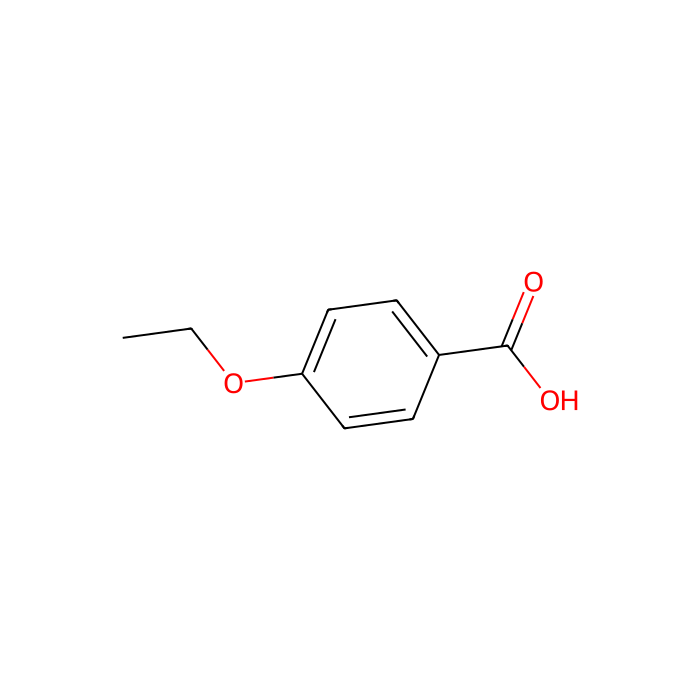
Brief overview: 4-Ethoxybenzoic acid is a para-ethoxy–substituted benzoic acid, combining an electron‑donating ethoxy group with a carboxylic acid on a benzene ring.
Product Data (item-specific):
CAS: 619-86-3
CID: 12093
InChIKey: 336243 (as provided)
Storage: Room temperature; Shipped: Normal
Literature/computed identifiers (general reference, not item-specific):
Molecular formula: C9H10O3 (literature)
Molecular weight: ~166.17 g/mol (literature)
SMILES: CCOC1=CC=C(C=C1)C(=O)O (literature)
Structural features (general description):
Aromatic ring (benzene) bearing two para-positioned substituents.
One substituent is a carboxylic acid group (–C(=O)OH), conferring Brønsted acidity and enabling acyl-derivative chemistry.
The other is an ethoxy group (–O–CH2CH3), an electron-donating, resonance/inductive substituent that modulates ring electronics (para/ortho activation) and decreases acid strength vs. benzoic acid.
2D description: a six‑membered aromatic ring with –CO2H at position 1 and –OCH2CH3 at position 4 (para); no stereocenters; planar aromatic core; one hydrogen-bond donor (acidic OH) and two acceptors (carbonyl O, ethoxy O).
Synthetic Utility
Functional group reactivity (literature; not product-specific):
Carboxylic acid handle:
Esterification (Fischer, Steglich) to access para-ethoxybenzoates; tuning alcohol R-groups adjusts solubility and volatility.
Amide formation with primary/secondary amines (EDC/HATU/DIC protocols); useful for constructing para-alkoxybenzamides common in materials and medicinal chemistry scaffolds.
Activation to acid chlorides/anhydrides for subsequent acylations; careful control avoids O→N acyl migration in complex settings.
Aryl–O functionality:
Ethoxy group directs electrophilic aromatic substitution ortho/para; with the para position occupied, ortho functionalization (2/6) is favored.
Serves as a convergent node: ring electronics set by the ethoxy group while the carboxyl can be elaborated independently, enabling late-stage diversification.
Useful precursor to mesogenic cores (e.g., biphenyl benzoates) via coupling after pre-halogenation.
Select named methods:
Steglich esterification (DCC/DMAP), Mitsunobu esterifications (for chiral alcohols), Schotten–Baumann amidation (from acyl chloride), and directed ortho-metalation on suitably protected derivatives to install further substituents.
Target Specificity
Not applicable. This product is a small organic molecule (aromatic carboxylic acid), not a biological targeting reagent (e.g., antibody, ligand with defined biomolecular target profile). No antigen/epitope/isotype information applies.
We use cookies to ensure the website functions properly and, where permitted, to improve your experience. You can manage your preferences at any time in Settings. Learn more in our Cookie Policy.
Shall we send you a message when we have discounts available?
Remind me later
Thank you! Please check your email inbox to confirm.
Products are supplied to verified businesses, institutions, and qualified professionals for research and development use only. Not for use in humans, animals, diagnosis, or therapy.

 A2211170