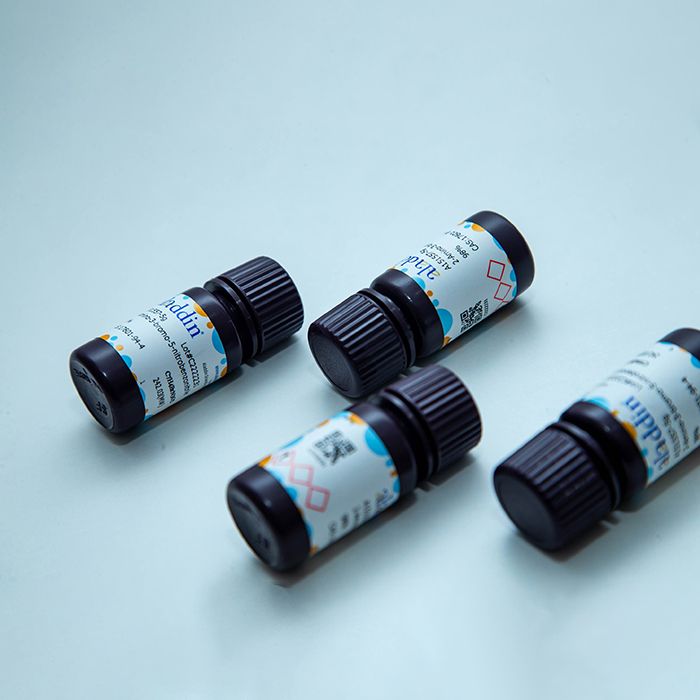
This compound belongs to the class of organic compounds known as aminopyridines and derivatives. These are organic heterocyclic compounds containing an amino group attached to a pyridine ring.
External Descriptors
Not available
1. Djoumbou Feunang Y, Eisner R, Knox C, Chepelev L, Hastings J, Owen G, Fahy E, Steinbeck C, Subramanian S, Bolton E, Greiner R, and Wishart DS. ClassyFire: Automated Chemical Classification With A Comprehensive, Computable Taxonomy. Journal of Cheminformatics, 2016, 8:61.
Determine the necessary mass, volume, or concentration for preparing a solution.
Dilution Calculator
Determine the dilution needed to prepare a stock solution.
Reconstitution Calculator
Reviews
Customer Reviews
Application Protocols
Not applicable. No validated bioassay protocols (e.g., WB, IHC, IF, FC) are associated with this small-molecule building block in the product data.
General laboratory handling
For solution preparation, weigh accurately and dissolve in an appropriate solvent (e.g., DMSO, MeOH, MeCN) to prepare stock solutions; filter if needed through 0.2 µm PTFE.
For synthetic procedures, follow the Reaction Conditions section for starting guidance and adjust per substrate and scale.
Biological Roles
Applicability: This product is intended as a research chemical building block; no biological function is claimed for the material supplied.
General context (literature)
2-Aminopyridine motifs appear in ligands, enzyme inhibitors, and coordination complexes in chemical biology. The juxtaposition of a basic ring N and a primary amine offers dual hydrogen-bonding and metal-binding capabilities.
The 4-ethoxy substituent modulates lipophilicity and electronic properties, potentially affecting membrane permeability and binding profiles in probe design.
Protonation states: At physiological pH, the pyridine N may be partially protonated (depending on pKaH), influencing target engagement and solubility; the exocyclic –NH2 acts as H-bond donor/acceptor.
Use guidance
Suitable as a fragment or intermediate for synthesizing tool compounds, affinity ligands, or chelating scaffolds for biophysical studies.
Any use in biological systems should be preceded by appropriate toxicity, solubility, and stability assessments. For research use only.
Buffer Applications
Not typically applicable. 4-Ethoxypyridin-2-amine is not a dedicated buffering reagent, and its pKa profile is not optimized for precise pH control in common laboratory buffer ranges.
Practical note
If protonation control is needed (e.g., for solubility or crystallization), simple mineral acids (HCl) or volatile acids (TFA, AcOH) can form salts with the pyridine nitrogen; however, these are not standardized buffers.
For buffering needs, choose established systems (e.g., phosphate, HEPES, acetate) appropriate to the target pH and ionic strength.
Green Alternatives
Context: The compound itself is a building block; green considerations focus on solvent/coupling choices and protection/reaction strategies.
Greener solvent swaps (general guidance)
Replace chlorinated solvents (DCM, CHCl3) with EtOAc or 2-MeTHF for acylations/extractions when feasible.
Substitute DMF/NMP with MeCN, propylene carbonate, Cyrene, or green esters (EtOAc) when reaction compatibility allows.
Use water/ethanol mixtures for salt formation/crystallization to reduce VOC footprint.
Catalysis choices
Prefer Pd-catalyzed couplings under aqueous micellar conditions (e.g., TPGS-750-M) to reduce organic solvent usage (literature).
Explore copper-catalyzed Ullmann-type N-arylations in greener solvents or under ligand-accelerated, low-loading conditions.
Energy and workup
Employ flow or microwave heating to shorten cycle times and reduce energy input.
Optimize atom economy by selecting coupling partners that minimize leaving-group waste (e.g., carbonate-based activation vs acid chloride when suitable).
Tradeoffs
Greener solvents may reduce solubility of heteroaromatic amines; co-solvents or higher temperatures may be required.
Avoid excessive protecting group manipulations; each step adds solvent and reagents—plan convergent routes to minimize steps.
Pharmaceutical Uses
Item-specific (Product Data)
Research Use Note: For research use only.
General formulation/manufacturing context (no therapeutic claims)
Heteroaromatic amines like 2-aminopyridine derivatives are commonly employed as intermediates in the synthesis of API candidates and reference standards.
Potential roles in a development setting include: route-scouting building block, impurity/degradant standard for analytical method development, or fragment for SAR elaboration.
Salt formation with pharmaceutically acceptable acids (e.g., HCl, fumaric, maleic) may be explored to adjust solubility/crystallinity during process development.
Compliance and documentation
No pharmacopeial monograph is implied for this item. Any use in GMP contexts requires full qualification of specifications, traceability, and impurity profiling per internal QA procedures.
Stability indicating methods (HPLC/UPLC with UV or MS detection) should be qualified if the material is part of regulated development work.
Physical Properties
Item-specific (Product Data)
Appearance: Not specified for this item; refer to CoA/Spec Sheet.
Grade/Purity: Not specified for this item; refer to CoA/Spec Sheet.
Literature/computed (for reference only; not item specification)
Molecular formula (from structure assignment): C7H10N2O
Molecular weight (calculated): ~138.17 g/mol
Physical state: typically a crystalline solid for analogous 2-aminopyridine derivatives.
Acid–base: expected to be amphiprotic with a pyridinic basic site (conjugate acid pKaH often ~6–7 for 2-aminopyridines, literature) and a less basic aniline-like –NH2.
Lipophilicity: ethoxy substitution increases hydrophobicity vs 2-aminopyridine; qualitative logP likely in the low-to-moderate range (literature trend for alkoxy-pyridines).
Solubility (qualitative):
Polar organics (MeOH, EtOH, DMSO, DMF): generally soluble for similar aminopyridines.
Water: limited to moderate at neutral pH; improved solubility in acidic aqueous media due to protonation of the ring N.
UV characteristics: aromatic heterocycle expected to absorb in 200–300 nm region (literature for substituted pyridines); specific UV-cutoff not determined for this item.
Notes (general)
Exact BP/MP, density, refractive index, and spectral constants are Not specified for this item; refer to CoA/Spec Sheet.
Users needing exact physical constants should consult the item’s CoA/SDS or measure under their laboratory conditions.
Quality & Grades
Item-specific (Product Data)
Grade/Purity: Not specified for this item; refer to CoA/Spec Sheet.
Stabilizers/Inhibitors: Not specified for this item; refer to CoA/Spec Sheet.
Interpreting grades (general guidance)
Research-grade heteroaromatic building blocks are typically qualified by NMR purity, LC/HPLC area %, and residual solvent/metal content appropriate to synthetic use.
HPLC grade (if applicable) indicates low UV background for chromatographic uses; AR/ACS grades target analytical consistency; “>98%” or similar denotes assay by HPLC/GC/NMR.
If a stabilizer were present (e.g., trace acid to suppress self-reaction), it would be disclosed on the CoA; absence of disclosure here means Not specified for this item; refer to CoA/Spec Sheet.
What to check on receipt (practical tips)
Review CoA for assay method, residual solvents, water (KF), and identity confirmation (1H NMR, 13C NMR, MS).
Inspect appearance versus CoA; heteroaromatic amines may darken slightly on air exposure—this does not necessarily indicate quality loss but verify purity if critical.
For sensitive reactions (e.g., metal-catalyzed couplings), consider an additional purification or base washing to remove trace acids.
Reaction & Applications
Role: Versatile heteroaromatic building block featuring a nucleophilic primary amine and a coordinating pyridine nitrogen; the 4-ethoxy group tunes electronics and solubility.
Representative transformations (general literature; expand as needed)
N-Acylation/Carbamoylation/Urea formation: Formation of amides, carbamates, and ureas using acyl chlorides, anhydrides, CDI, or isocyanates. Protecting the amine (e.g., Boc) can improve selectivity in multi-step sequences.
N-Alkylation: SN2 with alkyl halides/sulfonates under basic conditions; phase-transfer catalysis can aid less soluble systems.
Electrophilic aromatic substitution on the ring is deactivated by the ring N; however, directed metalation adjacent to substituents can be achieved with strong bases at low temperature, enabling further functionalization.
Cross-coupling after prior halogenation: Install a halide at an accessible position (e.g., 3- or 5-), then perform Suzuki, Buchwald–Hartwig (as amine coupling partner or substrate), Negishi, or Stille couplings. The pyridine N may require protection (e.g., as N-oxide) or additive control to avoid catalyst inhibition.
SNAr on activated partners: The 2-aminopyridine moiety is a competent nucleophile toward activated aryl/heteroaryl fluorides for N-arylation.
Ligand/chelation roles: The pyridinic N can coordinate to metals; temporary coordination can direct reactivity or be harnessed in complex assembly.
Practical tips
Dry conditions favor acylation/alkylation efficiency. Use bases like DIPEA/TEA/K2CO3 as appropriate.
Consider transient protection of the ring N (N-oxide formation) to alter ring electronics for regioselective substitution, followed by reduction.
Reaction Conditions
General conditions (literature guidance; verify for your system)
N-Acylation: Amine (1.0 eq), base (1.5–2.0 eq DIPEA or TEA) in DCM, THF, or EtOAc, 0–25°C, 1–4 h for acyl chlorides; monitor by TLC/LCMS. Carbamate formation via CDI in MeCN or THF at rt to 50°C.
N-Alkylation: K2CO3 or Cs2CO3 (2–3 eq) in DMF or MeCN, 20–60°C, 2–16 h with primary halides/tosylates. Avoid excess heat with sensitive electrophiles.
Reductive amination (after prior carbonyl introduction): NaBH3CN or BH3·THF in MeOH/THF, pH 5–6 (AcOH), 0–25°C.
Protection/deprotection: Boc2O (1.1–1.5 eq) with catalytic DMAP in DCM/MeCN, rt; deprotect with TFA/DCM at 0–25°C.
Cross-couplings (on pre-halogenated analogs): Pd2(dba)3/XPhos or Pd(OAc)2/SPhos (1–3 mol%), base (K3PO4, Cs2CO3), dioxane/H2O (3:1), 80–110°C, 6–16 h. Minimize catalyst inhibition by pyridine N via ligand choice or temporary N-oxide formation.
Workup/purification
Basic or acidic washes may be used to partition free base vs salt forms. Column chromatography with EtOAc/hexanes or MeOH/DCM gradients; add 0.1–1% Et3N to suppress amine tailing.
Expected performance
Typical isolated yields for amide/urea formations: 70–95% (literature, substrate-dependent). N-alkylations: 50–85% depending on electrophile and solubility.
Notes
Dry, oxygen-free conditions improve outcomes for moisture-sensitive reagents. The heteroaromatic N can bind metals; catalyst/ligand selection is important in couplings.
Safety & Handling
Item-specific (Product Data)
GHS/CLP: Not specified for this item; refer to SDS.
Signal word / H-statements / Pictograms: Not specified for this item; refer to SDS.
Storage conditions: Room temperature (as provided).
Shipping: Shipped under normal conditions (as provided).
General safety guidance (not a substitute for SDS)
Hazard overview: Aromatic amines and heteroaromatics can be irritants or sensitizers. Avoid inhalation of dust and skin/eye contact. Handle in a fume hood.
PPE: Lab coat, nitrile gloves, splash goggles; use respiratory protection if dust/aerosols may form and engineering controls are insufficient.
Incompatibilities: Strong oxidizers; strong acids/bases may cause decomposition or salt formation; acylating and alkylating agents will react with the amine. Avoid prolonged exposure to light/air if discoloration is observed.
First aid (overview):
Skin/eye contact: Rinse with water for at least 15 minutes; remove contaminated clothing; seek medical attention if irritation persists.
Inhalation: Move to fresh air; seek medical attention if symptoms occur.
Ingestion: Rinse mouth; do not induce vomiting; seek medical attention.
Spill/leak: Avoid dust; collect mechanically; absorb residues with inert material; dispose according to local regulations.
Fire: Use CO2, dry chemical, or foam. Combustion may produce NOx and CO; firefighters should wear SCBA.
Always consult the official SDS for authoritative hazard classification and response measures.
Solvent Selection
Applicability: This compound is a heteroaromatic amine/ether building block rather than a solvent. Solvent selection relates to its dissolution and reactivity in synthesis and purification.
Polarity and solubility trends (general/literature)
Polar aprotic solvents (DMSO, DMF, NMP, MeCN) typically dissolve substituted aminopyridines well and support SNAr, acylation, and coupling chemistry.
Protic solvents (MeOH, EtOH, iPrOH) often dissolve the protonated form; useful for salt formation or recrystallization.
Less polar solvents (EtOAc, toluene, MTBE) show limited solubility unless the compound is protected or derivatized; can be paired with polar co-solvents.
Selection guidance by task
N-acylation/Carbamoylation: DCM, THF, or MeCN with base (DIPEA/TEA); for greener choices, EtOAc or 2-MeTHF.
N-alkylation: DMF/MeCN; avoid water to suppress hydrolysis of alkylating agents.
Metal-catalyzed couplings on pre-halogenated analogs: dioxane, toluene, MeCN, or mixed aqueous media; ensure ligand/base compatibility.
Salt formation and purification: EtOH/IPA with HCl or other acids can generate crystalline salts to aid handling.
Small comparison (general)
DMSO/DMF: maximum solubility and rate for polar reactions; harder to remove.
MeCN/EtOAc: good balance of polarity/volatility; compatible with many bases.
2-MeTHF/CPME: greener ethers with good workup profiles; ensure stability of amine under chosen conditions.
Storage & Reconstitution
Item-specific (Product Data)
Storage conditions: Room temperature.
Shipped in: Normal conditions.
General storage guidance
Store tightly capped in a dry, well-ventilated area away from strong oxidizers and acids/bases. Protect from prolonged exposure to light and moisture to prevent discoloration or hydrolysis.
If long-term storage is anticipated, consider keeping under inert gas and in amber packaging.
Reconstitution and stock solutions
Solid handling: Allow to equilibrate to room temperature before opening to minimize moisture condensation.
Stock solutions: Prepare in dry solvents such as DMSO, DMF, MeCN, or alcohols. Typical research stocks are 10–100 mM in DMSO for screening chemistry; adjust per solubility.
Salt formation: For aqueous work, form a soluble salt (e.g., HCl salt) if needed; verify stoichiometry by titration or NMR.
Stability notes
Aminopyridines are generally stable at ambient conditions. Avoid repeated freeze–thaw of solutions; aliquot and store solutions at 2–8°C or −20°C as appropriate to solvent and use timeline.
Always refer to the product’s CoA/SDS for definitive storage and stability information.
Heteroaromatic ring: pyridine (six-membered aromatic ring containing one ring nitrogen).
Substituents: primary amine at the 2-position (adjacent to ring N); ethoxy (–O–CH2–CH3) at the 4-position (para to ring N).
Functional groups: basic ring nitrogen (pyridinic N), primary aniline-like amino group (–NH2), and an ether (alkoxy) substituent.
Tautomeric considerations: 2-aminopyridines can exhibit amino–imino tautomerism, though the amino form is typically dominant in neutral conditions.
2D description: a pyridine ring with ring N at position 1; –NH2 at C2; –O–CH2–CH3 at C4; remaining ring positions hydrogen-substituted.
Synthetic Utility
Functional handles
Primary amine (nucleophilic; amenable to acylation, sulfonylation, carbamate/urea formation, reductive amination after carbonyl introduction).
Pyridinic nitrogen (basic/ligating; can be temporarily modified as N-oxide to alter ring electronics, enabling regioselective transformations).
Ethoxy substituent (electron-donating; modulates ring electronics and can be a leaving group only after activation; also aids solubility and crystallization behavior).
Retrosynthetic value (general)
Serves as a convergent junction to build 2-aminopyridyl motifs into more complex heteroaromatic frameworks via N-arylation or amidation.
Amenable to late-stage diversification at the amine (amide/urea libraries) without perturbing the pyridine core.
Named/typical transformations
Buchwald–Hartwig coupling as nucleophile (secondary amine formation with aryl halides).
Suzuki/Negishi couplings on pre-halogenated derivatives to elaborate the heteroaryl ring.
Sandmeyer-type chemistry is less applicable directly (primary aliphatic amine), but diazotization of anilines is conceptually related; for pyridines, N-oxide strategies are preferred to guide substitution.
Protection strategies
Boc/CBz/Fmoc protection of the exocyclic amine to navigate multistep routes; N-oxide formation/reduction sequence to alter reactivity landscape.
Target Specificity
Not applicable. This product is a small-molecule chemical building block and is not an antibody, enzyme, or bioactive with defined biological target specificity in this listing.
No antigen/epitope, species reactivity, clone, or isotype information applies.
We use cookies to ensure the website functions properly and, where permitted, to improve your experience. You can manage your preferences at any time in Settings. Learn more in our Cookie Policy.
Shall we send you a message when we have discounts available?
Remind me later
Thank you! Please check your email inbox to confirm.
Products are supplied to verified businesses, institutions, and qualified professionals for research and development use only. Not for use in humans, animals, diagnosis, or therapy.