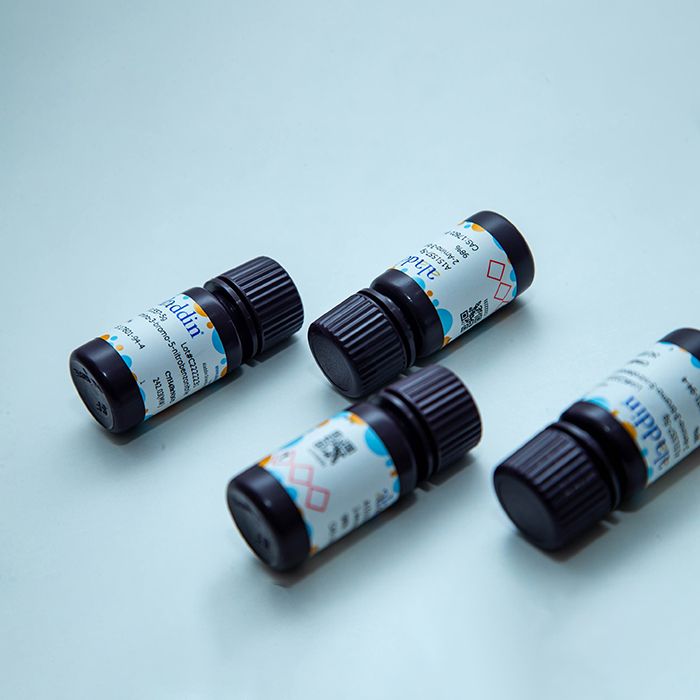
≥98% for sensitive chromatographic and analytical workflows requiring minimal baseline interference.
🌡
Storage & shipping
Desiccated,Store at -80°C Ships Dry ice packs + Cold packs Check lot-specific COA for exact specifications.
📋
Quality documents
SDS, COA, datasheet, and spec sheet available for download. Lot-specific COA accessible via lot number lookup.
📚
Literature proof
Cited in 0 peer-reviewed publications across chromatography, organic synthesis, and cross-coupling reactions.
Overview
α-Synuclein (61-75) TFA is the 61-75 fragment of α-Synuclein . α-Synuclein is an abundant neuronal protein that is highly enriched in presynaptic nerve terminals. α-Synuclein is a potential biomarker for Parkinson's disease (PD).
Appearance:Solid
In Vitro:Lewy bodies containing α-synuclein are a neuropathological hallmark of PD, and missense mutations in α-Synuclein (A30P, E46K, H50Q, G51D, A53E, A53T), as well as α-Synuclein gene duplications and triplications, appear to cause PD. Moreover, polymorphisms
Biological Activity:α-Synuclein (61-75) TFA is the 61-75 fragment of α-Synuclein . α-Synuclein is an abundant neuronal protein that is highly enriched in presynaptic nerve terminals. α-Synuclein is a potential biomarker for Parkinson's disease (PD) .
Specifications
Specifications & Purity
≥98%
Storage
Desiccated,Store at -80°C
Shipped In
Dry ice packs + Cold packs
This product requires cold chain shipping. Ground and other economy services are not available.
Purity
≥98%
Names and Identifiers
Molecular Weight
1544.58
Documentation
📋 Safety Data Sheet (SDS)
Comprehensive hazard, handling, storage, and regulatory compliance document.
Determine the necessary mass, volume, or concentration for preparing a solution.
Dilution Calculator
Determine the dilution needed to prepare a stock solution.
Reconstitution Calculator
Reviews
Customer Reviews
Application Protocols
The following are general/literature protocols commonly used with NAC-region α-synuclein peptides. They are provided as guidance and are not item-specific. Optimize for your lab’s conditions.
Stock preparation and monomerization
Allow vial to equilibrate to room temperature in a desiccator. Briefly spin down contents.
Optional: Dissolve in HFIP (1–5 mg/mL), incubate 30–60 min, aliquot to low-bind tubes, evaporate solvent under N2, then vacuum-dry ≥1 h.
Reconstitute dried film in water or buffer; alternatively dissolve in minimal DMSO, then dilute ≥50× into buffer. Pass through 0.22 µm filter or ultracentrifuge (100,000×g, 1 h) to remove seeds.
ThT aggregation assay (kinetics)
Prepare 10–100 µM peptide in 10–50 mM phosphate buffer, pH 7.4, with 10–20 µM ThT in black 96-well plates. Maintain consistent DMSO (if used) ≤1%.
Incubate at 37°C with orbital shaking (200–400 rpm) or quiescent as required. Monitor fluorescence (Ex ~440–450 nm, Em ~480–490 nm) at intervals.
Include blanks (buffer+ThT), vehicle controls, and a scrambled peptide control if available.
Liposome leakage assay
Prepare LUVs (e.g., POPC/POPG with encapsulated fluorescent dye). Mix peptide to desired lipid:peptide ratio (e.g., 50:1). Monitor dye release over time.
Note: Exact extinction coefficients, sequence, and terminal modifications for this product are not specified; refer to the CoA/Spec Sheet.
Biological Roles
General/literature context (not item-specific)
α-Synuclein is a neuronal protein involved in synaptic vesicle trafficking and membrane dynamics. Its central NAC (non-amyloid-β component) region (residues ~61–95) is hydrophobic and strongly associated with β-sheet formation and amyloid fibrillization in vitro.
The 61–75 fragment resides at the N-terminus of the NAC region and is frequently used as a minimal motif to interrogate sequence determinants of self-assembly, hydrophobic clustering, and interactions with lipid bilayers.
Peptide fragments derived from the NAC region have been shown in model systems to influence nucleation rates, fibril morphology, and cross-seeding behavior with full-length α-synuclein and related amyloidogenic proteins.
In biophysical studies, NAC-derived peptides enable high-resolution mapping of residue-level contributions to aggregation propensity via substitutions, isotopic labeling for NMR/IR, and computational validation.
Important note
This product is intended for research use only. No claims are made regarding biological activity in clinical or diagnostic settings. Exact sequence, terminal modifications, and activity for this specific item are not specified; consult the CoA/Spec Sheet for definitive details.
Buffer Applications
This product is a peptide and does not serve as a buffering agent per se. However, buffer choice critically impacts peptide solubility and aggregation behavior.
General/literature guidance
Common buffers: 10–50 mM phosphate (pH 7.0–7.4), 10–50 mM Tris (pH 7.4–8.0), HEPES (pH 7.2–7.6). Low ionic strength often reduces nonspecific aggregation during dissolution.
Additives: 100–500 mM NaCl can modulate screening of electrostatic interactions; arginine (50–200 mM) may suppress aggregation during handling (may alter kinetics).
pH considerations: Adjust pH to increase net charge (sequence dependent) for initial solubilization; return to assay pH after dilution.
Filtration/centrifugation: 0.22 µm filtration or 100,000×g ultracentrifugation is used to remove particulates/pre-aggregates prior to kinetic measurements.
Item-specific buffer specs and formulations are not provided for this product; refer to the CoA/Spec Sheet and optimize empirically for your experimental design.
Green Alternatives
Context: Peptide dissolution and pre-treatment often employ fluorinated alcohols (HFIP/TFE) or high DMSO fractions. Greener strategies can reduce hazard and waste while maintaining experimental fidelity.
Comparison (general; literature)
HFIP/TFE
Strengths: Effective at disrupting β-structures and oligomers; yields monomeric stock.
Trade-offs: High toxicity, VOC emissions, specialized waste handling.
DMSO
Strengths: Widely available, miscible with water, relatively low volatility.
Trade-offs: Can alter protein/peptide aggregation kinetics and ligand binding; keep final % minimal.
Greener options
Ethanol or isopropanol pre-wets followed by rapid evaporation; less effective than HFIP but lower hazard.
Mild alkaline aqueous (e.g., ≤0.1% NH4OH) to transiently increase net charge and solubility; ensure compatibility with downstream assays.
Aqueous buffers with arginine or low ionic strength to reduce aggregation during dissolution (may affect kinetics; validate).
Practical guidance
Start with the least hazardous approach (water/ethanol co-solvent), escalate to DMSO or HFIP/TFE only if necessary.
Use minimal volumes and remove organic solvents before kinetic measurements.
Document solvent history; aggregation outcomes are sensitive to pre-treatment.
Note: Select the approach that balances safety, environmental impact, and data quality for your specific assay.
Pharmaceutical Uses
Not applicable as a drug or excipient. This product is intended strictly for research use only.
General/literature context for peptide fragments (informational)
Peptide standards and fragments are sometimes used in pharmaceutical research labs as reference materials for method development, LC–MS calibration, or as tools to study protein–protein/peptide interactions relevant to aggregation, formulation stress testing, and mechanism-of-action investigations.
Counterion considerations: TFA can interfere with some LC–MS detection modes and bioassays; for analytical development, counterion exchange to acetate or formate may be preferred.
No pharmacopeial status, dosage forms, or clinical applications are claimed or implied for this item.
Physical Properties
Item-specific properties
Appearance: Not specified for this item; refer to CoA/Spec Sheet.
Purity/grade: Not specified for this item; refer to CoA/Spec Sheet.
Molecular weight (exact): Not specified for this item; refer to CoA/Spec Sheet.
General/literature expectations for short TFA-salt peptides (informational only)
Physical state: Typically a white to off-white, amorphous, lyophilized solid; often hygroscopic.
Solubility: Sequence-dependent. NAC-region peptides tend to be sparingly soluble in neutral aqueous buffers; initial dissolution may be aided by small volumes of DMSO, 0.1% NH4OH, or HFIP/TFE pre-treatment (literature). Final working solutions are commonly prepared in water, PBS, or biological buffers after dilution.
pI/pKa: Composite and sequence-dependent; local basicity at the N-terminus and acidic/basic side chains determines net charge versus pH (literature).
Optical activity: Peptides are typically optically active (L-amino acids), but specific rotation is sequence-dependent (literature).
Stability: TFA salts are moisture sensitive and can absorb water/CO2; prolonged exposure to light/air may promote oxidation of susceptible residues (e.g., Met) if present (sequence not specified for this item).
Note: Where exact values (MW, solubility limits, extinction coefficients) are required, consult the item’s CoA/Spec Sheet or perform an empirical solubility screen under intended assay conditions.
Quality & Grades
Item-specific quality information
Grade/purity: Not specified for this item; refer to CoA/Spec Sheet.
Guidance on peptide quality (general)
Peptide purity reporting: Typically given as HPLC area% with orthogonal confirmation by MS. Residual solvents (e.g., acetonitrile, water), residual TFA, and counterion content may be reported.
TFA salt implications: Trifluoroacetate can influence biological assays by altering ionic strength and pH, and may interact weakly with cationic sites. For sensitive applications, consider TFA removal or counterion exchange to acetate/HCl followed by desalting (literature procedures).
Identity confirmation: ESI/ MALDI mass spectrometry for monoisotopic mass, with optional amino acid analysis or sequencing for critical applications.
End-group status: Free N-terminus/C-terminus vs. acetyl/amidated termini significantly affect net charge and solubility. Not specified for this item; refer to CoA/Spec Sheet.
Aggregation state: NAC-region peptides are prone to self-assembly; pre-treatment (e.g., HFIP/TFA wash, ultracentrifugation) is often used to obtain monomeric starting material for reproducible assays (literature).
Recommendation: For quantitative work (e.g., kinetics of aggregation, binding isotherms), verify purity and counterion content from the CoA and, if necessary, perform a standardized pre-treatment and desalting workflow.
Reaction & Applications
Focus: Applications relevant to a synthetic peptide corresponding to α-synuclein residues 61–75 (NAC-region segment). No chemical synthesis reactions are implied for end-users; emphasis is on research assays.
Research application areas (literature)
Aggregation studies: The 61–75 segment lies within the NAC region implicated in amyloid formation. Short NAC-derived peptides are used to probe nucleation, β-sheet formation, and fibril polymorphism via ThT/ThS fluorescence, CD, FTIR, AFM/TEM.
Seeding assays: Peptide fragments can modulate or nucleate full-length α-synuclein aggregation, enabling mechanistic studies of cross-seeding and sequence determinants.
Membrane interaction: NAC-derived peptides are assessed for lipid binding and membrane perturbation using model vesicles (SUVs/LUVs) and dye leakage assays.
Small-molecule screening: Serve as minimal substrates for screening modulators of self-assembly or inhibitors of β-aggregation.
Practical tips (general)
Monomerization: Use HFIP/TFA wash or size-exclusion/ultracentrifugation to remove pre-formed aggregates before kinetic assays.
Concentration determination: Use dry mass with counterion correction (if known) or measure A205/A214 with appropriate extinction coefficients (sequence dependent; not specified for this item).
Controls: Include scrambled or off-target peptides to benchmark sequence specificity; include buffer/DMSO controls.
Note: Specific performance characteristics for this item are not provided; consult literature protocols and optimize for your system.
Reaction Conditions
There are no end-user chemical synthesis reactions specified for this product. For researchers studying self-assembly/aggregation of NAC-region peptides, the following literature conditions are commonly employed (informational only):
Monomer preparation: Dissolve peptide in HFIP (or TFE), incubate 30–60 min, evaporate to dryness under N2/vacuum. Alternatively, dissolve in minimal DMSO, then dilute into buffer. Final filtration (0.22 µm) or ultracentrifugation helps remove seeds.
Aggregation kinetics: 10–200 µM peptide in 10–50 mM phosphate or Tris buffer, pH 7.2–7.5, 25–37°C, with/without 100–150 mM NaCl. Agitation (orbital 200–600 rpm) or quiescent conditions used depending on study design. Monitor by ThT fluorescence (10–20 µM), CD, or TEM/AFM.
Membrane interaction assays: Incubate peptide with SUVs/LUVs (e.g., POPC/POPG mixtures) at defined lipid:peptide ratios (10:1–100:1) and assess leakage or binding by fluorescence spectroscopy or light scattering.
Inhibition screens: Pre-mix peptide with test compounds (maintain consistent DMSO ≤1–2% v/v) before initiating aggregation; include proper vehicle controls.
Important: Exact conditions depend strongly on the specific sequence, terminal modifications, and purity—all not specified for this item. Optimize empirically and document pre-treatment to ensure reproducibility.
Safety & Handling
Item-specific safety data
GHS classification, signal word, pictograms, H-statements: Not specified for this item; refer to SDS.
General laboratory guidance for peptide TFA salts (informational only; defer to SDS)
Hazards: Low volatility; dust may irritate eyes, skin, and respiratory tract. Trifluoroacetate counterions can render material moderately acidic in solution.
PPE: Lab coat, nitrile gloves, safety glasses; use a certified fume hood when weighing powders to minimize aerosol exposure.
Handling: Work quickly with minimal exposure to ambient humidity. Avoid generating dust. Use antistatic measures when handling lyophilized powders.
Incompatibilities: Strong oxidizers may degrade susceptible amino acid side chains; strong bases/acids can cause hydrolysis over time. Avoid reactive carbonyls if peptide contains nucleophilic residues (sequence not specified).
First aid overview: If inhaled—fresh air. If on skin—wash with water and soap. If in eyes—rinse cautiously with water for several minutes, remove contact lenses. If ingested—rinse mouth; seek medical attention as needed. Always consult the SDS for authoritative measures.
Waste: Dispose according to institutional and local regulations for non-hazardous organic solids or aqueous peptide waste; neutralize acidic solutions if necessary per EHS guidance.
Shipping/storage risks: Peptides can degrade with heat/moisture; this item ships on dry ice/cold packs per Product Data.
Solvent Selection
Applicability: This product is a peptide, not a bulk solvent. Solvent selection guidance here concerns dissolving and preparing peptide solutions.
General/literature guidance for α-synuclein NAC-region peptides
Polarity/solvent class: Amphiphilic/hydrophobic character; neutral aqueous buffers alone may give poor initial solubility.
Recommended dissolution sequence:
Pre-wet with minimal volume of a strong, volatile helix/aggregation disruptor (e.g., HFIP or TFE) or a small amount of DMSO; evaporate if using HFIP/TFE.
Redissolve in water or buffer (e.g., 10–20 mM Tris, PBS) with gentle sonication.
Adjust pH to enhance net charge if needed (avoid extreme pH that promotes hydrolysis).
Miscibility profile (practical):
Water/buffer: Final working medium.
DMSO: Useful co-solvent to aid initial dissolution; keep final % low to avoid assay interference.
HFIP/TFE: Effective for monomerization but require fume hood handling; remove by evaporation before aqueous dilution (literature).
When to choose alternatives: For greener practice, consider ethanol/water or brief 0.1% NH4OH to charge the peptide—sequence dependent and may not suit all assays.
Note: Exact solubility limits and compatible buffers are sequence- and assay-dependent; validate empirically under intended conditions.
General reconstitution guidance for peptide TFA salts (informational)
Before opening: Allow vial to warm to room temperature inside a desiccator to prevent condensation. Briefly centrifuge to collect material.
Solvent choice: Start with water or buffer compatible with your assay. If solubility is limited, use a minimal amount of DMSO or perform an HFIP/TFE pre-treatment, then evaporate and re-dissolve in aqueous buffer. For sequence-dependent alkaline solubilization, ≤0.1% NH4OH can help; promptly adjust to final pH after dilution.
Concentration: Determine by gravimetry or UV at 205–214 nm using sequence-specific extinction coefficients (not specified for this item; refer to CoA/Spec Sheet or calculate from sequence if available).
Aliquoting: Prepare single-use aliquots to avoid repeated freeze–thaw cycles. Store aliquots at -80°C, desiccated, protected from light.
Stability: Avoid prolonged exposure to moisture and elevated temperatures. Minimize time at room temperature. For working solutions, keep on ice and use the same day when possible; assess stability empirically.
Note: Any specific reconstitution solvent, concentration, or pH requirements unique to this lot are not specified; consult the CoA/Spec Sheet and SDS for definitive instructions.
Structure & Identity
α-Synuclein (61–75) (TFA) is a synthetic peptide fragment corresponding to residues 61–75 of human α-synuclein, supplied as the trifluoroacetate (TFA) salt.
Item-specific identifiers (from Product Data)
SKU: S658997
CAS: S658997 (catalog reference)
Molecular formula: Not specified for this item; refer to CoA/Spec Sheet.
Molecular weight: Not specified for this item; refer to CoA/Spec Sheet.
SMILES / InChI / InChIKey: Not specified for this item; refer to CoA/Spec Sheet.
Structural features (general/literature description)
Compound type: Short linear peptide (15-mer) corresponding to the N-terminal segment of the NAC (non-amyloid-β component) region of α-synuclein.
Functional groups: Multiple amide bonds (peptide backbone), side-chain functionalities typical of the constituent amino acids; C-terminus typically as carboxylate/carboxamide and N-terminus as primary amine (depending on synthesis/end-capping; not specified for this item).
Counterions: Trifluoroacetate anions associated with basic sites (typical of peptides isolated as TFA salts).
2D structure in words (general)
A linear sequence of 15 α-amino acid residues linked by trans-amide bonds, possessing rotatable φ/ψ dihedral angles; side chains project alternately along the backbone. The region is known to be relatively hydrophobic and to promote β-structure and self-assembly in vitro (literature).
Synthetic Utility
This product is a finished peptide reagent rather than a synthetic intermediate in small-molecule chemistry. As such, it is not typically used as a building block in organic synthesis.
General/literature uses in chemical biology
Minimal motif studies: Serves as a defined sequence element to dissect residue-level drivers of α-synuclein aggregation and to benchmark effects of point substitutions, D-enantiomers, or labeled residues (e.g., 15N, 13C).
Conjugation chemistry: N- or C-terminal functionalization (if termini are free; not specified for this item) can enable attachment to fluorophores, spin labels, or surfaces for biophysical assays (SPR, QCM-D, AFM tip tethering). Standard peptide coupling chemistries (NHS esters, maleimide–thiol if Cys present; sequence not specified) apply.
Material science: NAC-derived peptides can template β-sheet nanostructures for exploration of supramolecular assemblies in vitro.
Note: End-group status, presence/absence of specific reactive residues, and purity will determine compatibility with conjugation strategies. These parameters are not specified for this item; consult the CoA/Spec Sheet.
Target Specificity
Not applicable. This product is a peptide fragment, not an antibody or affinity reagent. No antigen/epitope binding specificity, species reactivity, clone, or isotype information applies.
Frequently Asked Questions
What is the purity of this product?
This product is supplied at ≥98% purity (chemical assay). Lot-specific values are stated on the Certificate of Analysis.
How should this product be stored?
Store at ?80 °C, desiccated. Keep the container tightly closed with desiccant — the material is moisture-sensitive.
How is this product shipped?
This product ships frozen with dry ice and cold packs. Unpack on arrival and transfer it to the storage condition stated above; handle dry ice with insulated gloves in a ventilated area.
What are the CAS number, molecular formula and molecular weight?
The CAS Number is S658997, the molecular formula is C62H104F3N17O25, and the molecular weight is 1544.58 g/mol.
What documentation is provided?
Available product documentation, including Certificates of Analysis (COA), Safety Data Sheets (SDS), and specification sheets, is shown in the product document area. Document availability and access follow the current site policy.
We use cookies to ensure the website functions properly and, where permitted, to improve your experience. You can manage your preferences at any time in Settings. Learn more in our Cookie Policy.
Shall we send you a message when we have discounts available?
Remind me later
Thank you! Please check your email inbox to confirm.
Products are supplied to verified businesses, institutions, and qualified professionals for research and development use only. Not for use in humans, animals, diagnosis, or therapy.