GRADE & PURITYMoligand™?Moligand™ — Aladdin's line of ligands and bioactive small molecules. Use for receptor, pathway, and binding studies needing defined small-molecule tools.10 mM in DMSO
Moligand™, 10 mM in DMSO Moligand™ for sensitive chromatographic and analytical workflows requiring minimal baseline interference.
🌡
Storage & shipping
Store at -80°C Ships Dry ice packs + Cold packs Check lot-specific COA for exact specifications.
📋
Quality documents
SDS, COA, datasheet, and spec sheet available for download. Lot-specific COA accessible via lot number lookup.
📚
Literature proof
Cited in 0 peer-reviewed publications across chromatography, organic synthesis, and cross-coupling reactions.
Overview
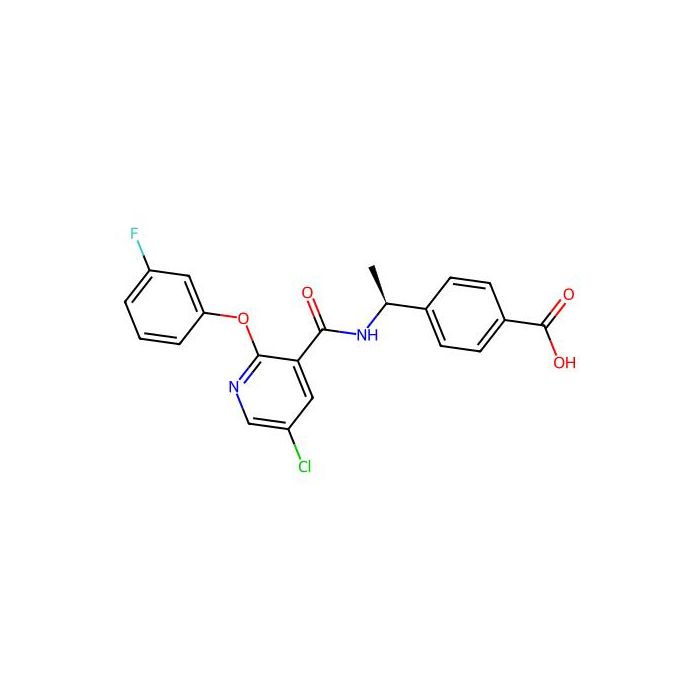
AAT-008 is a potent, selective, and orally active prostaglandin EP4 receptor antagonist with K i s of 0.97 and 6.1 nM for recombinant human EP4 and recombinant rat EP4, respectively.
Specifications
Specifications & Purity
Moligand™, 10 mM in DMSO
Storage
Store at -80°C
Shipped In
Dry ice packs + Cold packs
This product requires cold chain shipping. Ground and other economy services are not available.
Grade
Moligand™
Action Type
ANTAGONIST
Names and Identifiers
Molecular Weight
414.81
Documentation
📋 Safety Data Sheet (SDS)
Comprehensive hazard, handling, storage, and regulatory compliance document.
Determine the necessary mass, volume, or concentration for preparing a solution.
Dilution Calculator
Determine the dilution needed to prepare a stock solution.
Reconstitution Calculator
Reviews
Customer Reviews
Application Protocols
No item-specific, validated application protocols are provided for AAT-008.
General, practical protocols for small-molecule screening (not item-specific specifications):
Stock solution preparation: Weigh quickly in a low-humidity environment. Dissolve in anhydrous DMSO to 10–50 mM. Vortex and, if needed, sonicate briefly. Record exact concentration and lot.
Plate formatting: Aliquot into 96/384-well source plates (polypropylene) at 10–20 µL/well. Seal with solvent-resistant films. Store at −20 to −80°C depending on stability (this item: see Storage tab) and minimize freeze–thaw.
Assay dosing: Use calibrated liquid handlers or acoustic dispensing. Keep final DMSO ≤0.5–1% v/v unless otherwise validated. Include vehicle controls and a known positive control if available.
Stability check: After dosing, incubate assay plates as required. For longer assays, assess compound integrity by taking replicate wells for LC–MS at start/end.
Data QC: Inspect raw curves for hill-slope anomalies and maximum effect ceilings; repeat with fresh dilutions if precipitation or edge effects are suspected.
For any specialized use (e.g., biophysical binding, imaging), adapt solvent percentages, incubation times, and detection settings to your platform.
Biological Roles
Item-specific biological target(s) and mechanisms are not provided in the product data for AAT-008.
What can be stated:
Biological role/target: Not specified for this item; refer to CoA/Spec Sheet or internal project documentation.
General guidance for library ligands (not item-specific claims):
Use unbiased profiling (e.g., chemoproteomics, CETSA, transcriptomics) or targeted panels to deconvolute potential mechanisms following phenotypic hits.
Evaluate PAINS/aggregation liabilities early to avoid false positives. Apply control conditions (detergent, BSA, redox quenchers) as appropriate to your assay class.
Assess basic ADME-relevant properties experimentally if needed (stability in microsomes or plasma, permeability in PAMPA/MDCK, nonspecific binding). These are study design considerations, not product specifications.
Compliance note:
This product is for research use only. No medical, diagnostic, or therapeutic uses are claimed or implied.
Buffer Applications
While this product is a small-molecule ligand rather than a buffering agent, practical considerations arise when dosing into aqueous systems.
General, experiment-focused guidance (not item-specific specs):
Stock preparation: Dissolve in anhydrous DMSO to a convenient concentration (e.g., 10–50 mM). Confirm complete dissolution by visual inspection and, if critical, by UV/LC–MS.
Dosing into buffers: Add stock to pre-made assay buffer with vigorous mixing to avoid local supersaturation. Typical final DMSO ≤0.5–1% v/v for many biochemical/cellular assays; verify tolerance.
Precipitation control: If cloudiness forms, increase mixing time, warm gently (≤37°C if assay-permissible), or include a small amount of co-solvent/surfactant (e.g., 0.01–0.05% Tween-20) where compatible.
Common assay buffers: PBS (pH 7.2–7.6), HEPES (pH 7.0–7.5), Tris (pH 7.4–8.0). Choose based on assay needs; avoid primary amines in buffers if the readout is amine-reactive.
Adsorption minimization: Precondition plasticware with buffer containing the vehicle to reduce loss of hydrophobic compounds.
Documentation:
Record final solvent percentage, buffer composition, and any additives for reproducibility and interpretation of biological responses.
Green Alternatives
For screening compounds, the central “solvent” decision often concerns stock preparation and assay dilution. When feasible, consider greener solvent systems while maintaining data quality.
General comparison for dissolving small molecules (not item-specific specs):
DMSO (benchmark): High solvency; widely used; environmental impact moderate; potential dermal absorption risk. Typical final assay tolerance ≤0.5–1% v/v in many systems.
Ethanol or isopropanol: Greener profile than amide solvents; volatile; biological effects at ≥0.5–1% v/v may confound results.
PEG-400 or propylene glycol: Less volatile, favorable EHS profile; viscosity complicates low-volume dispensing; may affect permeability.
HP-β-cyclodextrin solutions: Enable aqueous delivery of hydrophobics; additional variables (complex stoichiometry) must be controlled; generally benign.
2-MeTHF, CPME (for synthetic workups, if applicable): Greener ethers vs. THF; not typically used for assay stock solutions.
Practical, greener tactics:
Minimize DMSO by preparing higher-concentration stocks and lower-volume additions, within solubility and stability limits.
Use microplate formats and acoustic dispensing to reduce solvent usage and waste.
Validate ethanol or PEG-400 co-solvent systems in parallel with DMSO to ensure equivalent potency/response curves.
Trade-offs:
Greener alternatives may alter permeability, target engagement, or readouts; any switch requires re-optimization and robust controls.
Pharmaceutical Uses
No pharmacopeial or excipient status is provided for this item. It is supplied strictly as a research-use-only small molecule.
Item-specific position:
Regulatory/compendial status: Not specified for this item; refer to CoA/Spec Sheet.
GMP suitability: Not intended for human or veterinary use; not manufactured under GMP for clinical administration.
If the molecule is to be evaluated in pre-formulation studies (in vitro only), establish solubility across pH 1–8, pKa, logD, and solid-state form (XRPD, DSC/TGA) to inform potential formulation strategies. These are general R&D practices and not product specifications.
Do not use in drug product manufacturing or as an excipient. For any translational work, source material that meets appropriate regulatory standards and conduct full impurity profiling.
Physical Properties
Item-specific physicochemical specifications are not provided. The following notes distinguish item data vs. general/literature guidance.
Item-specific data:
Appearance: Not specified for this item; refer to CoA/Spec Sheet.
Molecular formula: Not specified for this item; refer to CoA/Spec Sheet.
Molecular weight: Not specified for this item; refer to CoA/Spec Sheet.
Melting/boiling points, density, refractive index, UV-cutoff: Not specified for this item; refer to CoA/Spec Sheet.
General/literature guidance for small-molecule library compounds (not specifications):
Many screening compounds are solids at ambient temperature; however, oils or low-melting solids also occur. Confirm by visual inspection under inert atmosphere if the compound is hygroscopic.
Solubility strategy: Begin with anhydrous DMSO for stock solutions (e.g., 10–50 mM), then dilute into assay buffer. If precipitation occurs upon dilution, include co-solvent (0.1–1% DMSO final) or use surfactant (e.g., 0.01–0.05% Tween-20) as assay-permissible.
pKa/logP: Not provided. If required for assay design, estimate using computational tools (literature/computed) but validate experimentally (shake-flask logD7.4, potentiometric pKa).
Hygroscopicity/photolability: Unknown for this item. Protect from ambient humidity and light until verified.
Documentation reminder:
Treat any computed property as literature/computed, not as a product specification. For exact physical constants and purity-related data, consult the item’s CoA/Spec Sheet.
Quality & Grades
This item is offered as Moligand™ grade. Exact numerical specifications (e.g., purity %, residual solvents, identity confirmation methods) are not included here and should be verified on the item’s CoA/Spec Sheet.
What Moligand™ generally implies (general information, not item-specific specs):
Positioning: A research-grade small-molecule ligand suitable for screening, target validation, or chemical biology discovery workflows.
Typical QC elements for such libraries often include orthogonal identity confirmation and chromatographic purity checks; however, the specific tests applied to this item are Not specified for this item; refer to CoA/Spec Sheet.
How to interpret grade for experimental planning:
Analytical use: Prior to critical decisions (SAR, MoA), confirm identity and purity in-house (e.g., LC–MS, 1H NMR, HPLC/UPLC area%).
Assay readiness: Perform a solubility check in intended assay media and verify absence of interfering fluorescence/absorbance if optical readouts are used.
Stabilizers/impurities: Any stabilizers or counter-ions are Not specified for this item; refer to CoA/Spec Sheet. Avoid assumptions—test for peroxide or acid/base content only if mechanistically relevant to your assay.
Documentation & traceability:
Record lot number, receipt date, and storage conditions. Attach the CoA to your ELN for audit trails.
If you need a specific grade (e.g., >98% purity, salt-free, metal content), contact us prior to order; do not infer from the generic grade name.
Reaction & Applications
This product is listed in a small-molecule/compound library context (Moligand™) and is not primarily offered as a preparative reagent for stoichiometric organic synthesis.
Applicable uses (research context; no clinical claims):
Chemical biology and phenotypic screening: Prepare defined-concentration DMSO stocks, dispense to microplates (96/384/1536) using calibrated liquid handlers, and evaluate activity in biochemical or cell-based assays.
Binding/biophysical assays: Employ thermal shift (DSF), microscale thermophoresis, SPR, ITC, or NMR ligand-observed methods to probe interactions. Validate aggregation-free behavior (e.g., use 0.01–0.05% nonionic detergent if assay-permissible) and run counter-screens.
Analytical characterization: Confirm identity and purity by LC–MS and NMR on receipt to ensure data integrity for SAR or MoA studies.
Not typical/less applicable:
Named organic reactions, catalysts, or stoichiometric synthetic applications are not typically relevant for an unspecified library ligand. If you intend to use it as a building block, first acquire full structural data and evaluate reactivity/safety accordingly.
Practical handling:
Use acoustic or low-volume dispensing to minimize DMSO carryover.
Include vehicle controls matched to the highest final solvent percentage.
Monitor compound stability in assay buffer (time-course LC–MS) to distinguish true activity from degradation artifacts.
Reaction Conditions
Not applicable in the usual sense: this catalog entry is a screening ligand with undisclosed reaction functionality. No named reactions, catalysts, or preparative conditions are specified or implied.
If derivatization is later pursued (general guidance only):
Establish structural identity and functional groups from CoA/Spec Sheet.
Evaluate stability in potential reaction media (e.g., DMSO, DMF, acetonitrile, alcohols) and to pH extremes on a micro-scale before scale-up.
Use inert atmosphere and anhydrous conditions if moisture-sensitive functionalities are present. These are general laboratory best practices, not product specifications.
Safety & Handling
Safety information specific to this item is not provided in the product data. Handle as a potentially hazardous research chemical.
Item-specific safety data provided:
GHS Classification: Not specified for this item; refer to SDS.
Signal Word: Not specified for this item; refer to SDS.
Hazard (H) Statements: Not specified for this item; refer to SDS.
Pictograms: Not specified for this item; refer to SDS.
General laboratory precautions (not a substitute for the SDS):
Engineering controls: Use in a certified chemical fume hood. Avoid aerosol generation during weighing and dilution.
PPE: Lab coat, safety glasses, and appropriate chemically resistant gloves (e.g., nitrile). Consider double-gloving for DMSO handling due to enhanced dermal transport.
Avoid inhalation, ingestion, and skin/eye contact. Prevent environmental release.
Incompatibilities: Unknown for this item. As a precaution, keep away from strong oxidizers, strong acids/bases, and reactive metals. Do not heat or atomize unless safety is evaluated.
First-aid overview: In case of skin/eye contact, rinse with water for ≥15 minutes and remove contaminated clothing; seek medical attention. If inhaled, move to fresh air and seek medical attention. If ingested, rinse mouth and seek medical attention—do not induce vomiting unless directed by medical personnel.
Spill response: Contain with inert absorbent, avoid dust, collect for disposal as hazardous waste.
Always defer to the official Safety Data Sheet (SDS) for authoritative hazard classification and response procedures.
Solvent Selection
Because the exact structure is not disclosed here, select solvents using a risk-managed, tiered approach suitable for diverse small molecules.
Primary approach for stocks:
DMSO (anhydrous) as first-line solvent for concentrated stocks (e.g., 10–50 mM) due to broad solvating power and assay compatibility at low final percentages.
Secondary options if DMSO is unsuitable (general guidance):
DMF or NMP: High solvency for polar/neutral compounds; verify assay tolerance.
Ethanol or isopropanol: Useful for moderately lipophilic compounds; lower toxicity than DMF/NMP.
Aqueous buffers with co-solvent: Employ 0.1–1% DMSO or 1–5% ethanol to mitigate precipitation.
Small comparison (general, not item-specific specs):
DMSO: Pros—excellent solvency, miscible with water; Cons—skin permeation enhancer, can affect cell membranes above ~0.5–1%.
Water/buffer: Pros—biocompatible; Cons—limited solubility for many hydrophobic ligands.
Practical tips:
Filter sterilize only if the compound is filter-stable; many small molecules adsorb to nylon. Use PTFE or PVDF, and pre-rinse with solvent.
Avoid repeated freeze–thaw of stock solutions; aliquot.
Confirm solubility and absence of precipitation at the intended final assay concentration and matrix (protein binding, serum, detergents can alter apparent solubility).
Storage & Reconstitution
Item-specific storage/shipping conditions are provided below; reconstitution guidance is general and should be adapted once the structure and solubility are confirmed.
General handling and reconstitution (not specifications):
Upon receipt: Keep the container closed and cold. Allow to equilibrate to room temperature in a desiccator before opening to prevent moisture condensation.
Aliquoting: If solid, quickly subdivide into single-use aliquots in a dry box or with desiccant present. If solution, dispense into inert, low-bind vials or plate wells to minimize headspace and freeze–thaw.
Solvent for stock: Start with anhydrous DMSO to prepare a convenient stock (e.g., 10–50 mM), then store aliquots at −80°C, protected from light. Verify stability over intended storage duration by periodic LC–MS or HPLC.
Freeze–thaw: Avoid repeated cycles; use single-use aliquots. Thaw on ice or at room temperature briefly; mix thoroughly before use.
Light/moisture: Unknown sensitivity; protect from ambient light and humidity as a precaution.
Documentation:
Record preparation date, solvent, concentration, and storage location for each aliquot. Retain CoA/Spec Sheet with the lot in your ELN for traceability.
Structure & Identity
Overview of item-specific identifiers and what is (and is not) known for this catalog entry.
SKU: A1495416
Product Name: AAT-008
CAS: 847727-81-5 (item-specific)
Grade: Moligand™ (item-specific)
Category Path: 全部 / 可售 / 小分子和化合物库 (item-specific)
Research Use: For research use only (item-specific)
Item-specific identifiers (provided):
Molecular formula: Not specified for this item; refer to CoA/Spec Sheet.
Molecular weight: Not specified for this item; refer to CoA/Spec Sheet.
SMILES: Not specified for this item; refer to CoA/Spec Sheet.
InChIKey: Not specified for this item; refer to CoA/Spec Sheet.
Structural features (general statement):
The detailed 2D/3D structure, functional groups, and stereochemical configuration are not provided in the product data. For cheminformatics workflows (substructure/SMARTS queries, similarity searches, docking), please obtain the structure from the certificate of analysis (CoA) or your internal compound registration system.
Notes for data management:
If you maintain an ELN or compound registry, capture the CAS (847727-81-5) alongside the internal SKU to ensure unambiguous cross-referencing.
When structure becomes available, record: IUPAC name, canonical/isomeric SMILES, InChI/InChIKey, computed descriptors (cLogP, TPSA, HBA/HBD, rotatable bonds). These are literature/computed values and should not be treated as item specifications.
Synthetic Utility
This product is offered as a Moligand™ screening compound rather than a defined synthetic building block. Because the structure and functional groups are not disclosed here, synthetic applications cannot be described.
Applicability: Not typically used as a reagent or intermediate without full structural disclosure. If you intend to incorporate this compound into a synthetic sequence (e.g., for probe derivatization), first obtain the complete structure and assess functional group compatibility, protective group strategy, and stability.
Recommendation: Perform an initial scouting analysis (LC–MS for stability in common reaction solvents; small-scale compatibility with bases/acids and oxidants/reductants) before attempting any modification.
Conclusion: Synthetic utility is not typically applicable for this catalog entry as listed; focus on screening and analytical characterization workflows.
Target Specificity
Target, selectivity, and binding constants are not provided for AAT-008 in the product data.
Item-specific data:
Known target(s): Not specified for this item; refer to CoA/Spec Sheet or internal screening results.
Species reactivity, isotype/clone (antibody-style metadata): Not applicable to small molecules.
General guidance for determining specificity (not item-specific claims):
Profile against panels (kinases, GPCRs, ion channels, enzymes) as relevant to your biology. Use orthogonal assay formats to confirm on-target activity and rule out assay interference.
Employ counterscreens for redox cycling, fluorescence interference, and colloidal aggregation.
Quantify potency and selectivity using concentration–response curves and secondary assays.
Need help choosing the grade?
Our grade selection guide covers purity, stabilizer status, and application suitability for all variants in our catalog.
We use cookies to ensure the website functions properly and, where permitted, to improve your experience. You can manage your preferences at any time in Settings. Learn more in our Cookie Policy.
Shall we send you a message when we have discounts available?
Remind me later
Thank you! Please check your email inbox to confirm.
Products are supplied to verified businesses, institutions, and qualified professionals for research and development use only. Not for use in humans, animals, diagnosis, or therapy.