GRADE & PURITYMoligand™?Moligand™ — Aladdin's line of ligands and bioactive small molecules. Use for receptor, pathway, and binding studies needing defined small-molecule tools.≥98%(HPLC)
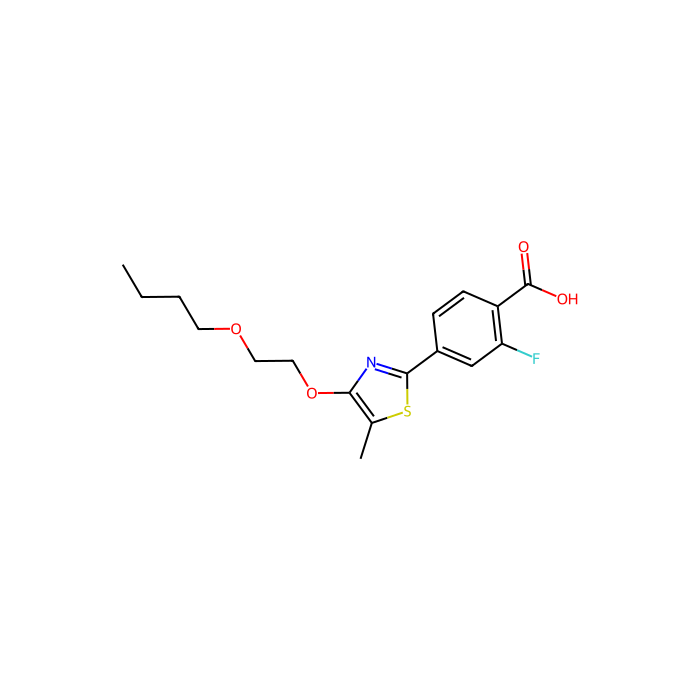
Potent RARβ2 agonist (pEC50= 8.1). Selective over RARβ1, RARαand RARγ(pEC50values are 6.4, 6.2 and 6.3 respectively). More potent and orally available than AC 55649.
This compound belongs to the class of organic compounds known as halobenzoic acids. These are benzoic acids carrying a halogen atom on the benzene ring.
External Descriptors
Not available
1. Djoumbou Feunang Y, Eisner R, Knox C, Chepelev L, Hastings J, Owen G, Fahy E, Steinbeck C, Subramanian S, Bolton E, Greiner R, and Wishart DS. ClassyFire: Automated Chemical Classification With A Comprehensive, Computable Taxonomy. Journal of Cheminformatics, 2016, 8:61.
Solvent:DMSO, Max Conc. mg/mL: 35.34, Max Conc. mM: 100; Solvent:ethanol, Max Conc. mg/mL: 35.34, Max Conc. mM: 100
Molecular Weight
353.400 g/mol
XLogP3
4.000
Hydrogen Bond Donor Count
1
Hydrogen Bond Acceptor Count
7
Rotatable Bond Count
9
Exact Mass
353.11 Da
Monoisotopic Mass
353.11 Da
Topological Polar Surface Area
96.900 Ų
Heavy Atom Count
24
Formal Charge
0
Complexity
401.000
Isotope Atom Count
0
Defined Atom Stereocenter Count
0
Undefined Atom Stereocenter Count
0
Defined Bond Stereocenter Count
0
Undefined Bond Stereocenter Count
0
The total count of all stereochemical bonds
0
Covalently-Bonded Unit Count
1
Solution Calculators
Molarity Calculator
Determine the necessary mass, volume, or concentration for preparing a solution.
Dilution Calculator
Determine the dilution needed to prepare a stock solution.
Reconstitution Calculator
Reviews
Customer Reviews
Application Protocols
Tested applications, recommended working concentrations, and procedural parameters are not provided for this item.
General guidance (non-item-specific):
Prepare a DMSO master stock (e.g., 10–50 mM), then perform a geometric dilution series to establish concentration–response curves in your assay format. Keep the final DMSO or ethanol percentage constant across wells/samples.
Include vehicle-only controls and, where available, orthogonal positive/negative controls to benchmark assay performance (Z′-factor, dynamic range).
For cell-based assays, confirm compound compatibility with serum and plasticware, and monitor precipitation after dilution.
For item-specific protocols, consult the CoA/Spec Sheet or in-house method development notes.
Biological Roles
Item-specific biological targets and modes of action are not provided in the product data. The following context is general and for research planning only.
Role of small-molecule ligands in discovery: Bioactive ligands are commonly applied to interrogate signaling pathways, transcriptional programs, and enzymatic mechanisms. They can serve as tool compounds to modulate protein function transiently and reversibly.
Pathway interrogation: In cell-based systems, ligand exposure can help map pathway dependency, feedback regulation, and crosstalk by measuring transcriptional reporters, phospho-epitopes, or phenotypic outputs.
Chemical probe considerations: Select concentrations that avoid off-target perturbation; include counter-screens and inactive analogs where possible. Validate effects using orthogonal readouts (e.g., genetic knockdown/knockout).
ADME-aware assay design: Assess compound stability in culture media, plasma protein binding (if relevant), and potential efflux by transporters in cellular models to interpret concentration–response relationships.
For this catalog item, consult the CoA/SDS or primary literature for any known protein targets, binding affinities, or selectivity if needed for your study design.
Buffer Applications
This product is a bioactive small molecule and is not a buffering agent. It has no standard use in preparing biochemical buffer systems.
Practical note:
When preparing assay buffers that will receive small-molecule stocks, ensure the buffer composition (pH, ionic strength, surfactants, protein content) maintains compound solubility upon dilution from the chosen vehicle (e.g., DMSO or ethanol). Incorporate vehicle-only controls at matching final percentages.
Green Alternatives
While the compound itself is a test article rather than a solvent or bulk reagent, greener choices can be made around its use:
Solvent selection for stocks:
Prefer ethanol or water/ethanol cosolvent systems when compatible with the assay, to reduce DMSO usage. Validate compound stability and activity in the alternative vehicle.
If DMSO is required, minimize final DMSO concentration (≤0.1–0.2% v/v where feasible) and standardize across all experimental arms.
Process considerations:
Use micro-scale working volumes in 96/384-well formats to cut solvent waste.
Employ sealed plates or low-evaporation lids to reduce volatile emissions from ethanol-containing systems.
Comparative view (general):
DMSO: high solvency, low volatility, but persistence in waste streams; often necessary for hydrophobic ligands.
PEG-400 or Captisol (sulfobutylether-β-cyclodextrin): can improve apparent solubility in in vivo formulation contexts; for in vitro use, assess assay interference.
Document solubility/stability in your selected greener vehicle to ensure data quality is maintained.
Pharmaceutical Uses
This material is supplied strictly for research use only (as stated). It is not an excipient or an approved pharmaceutical substance.
General formulation context (non-item-specific):
In preclinical research, small-molecule ligands may be formulated for in vitro or exploratory in vivo studies using standard vehicles (e.g., aqueous buffers with co-solvents, cyclodextrins, or lipid-based systems). Any such use must follow institutional approvals and is outside the scope of this catalog listing.
Regulatory note:
No pharmacopeial status, compendial monograph, or GMP suitability is provided for this item. For any regulated use, source qualified, GMP-grade materials with full regulatory documentation.
Physical Properties
Item-specific specs:
Appearance: Not specified for this item; refer to CoA/Spec Sheet.
Melting point: Not specified for this item; refer to CoA/Spec Sheet.
Boiling point: Not specified for this item; refer to CoA/Spec Sheet.
Density: Not specified for this item; refer to CoA/Spec Sheet.
Solubility: Not specified for this item; refer to CoA/Spec Sheet.
logP/logD: Not specified for this item; refer to CoA/Spec Sheet.
pKa: Not specified for this item; refer to CoA/Spec Sheet.
Refractive index/UV cutoff: Not specified for this item; refer to CoA/Spec Sheet.
General/literature guidance (not item-specific):
Bioactive screening ligands of this class are commonly supplied as crystalline solids or films and are frequently reconstituted in DMSO to generate concentrated stocks (e.g., 10–50 mM), then diluted into assay buffer or media.
Many aromatic small molecules display limited aqueous solubility; co-solvents like DMSO or ethanol, or use of solubilizing excipients (e.g., 0.1–1% w/v Pluronic F-127) are typical strategies when compatible with the assay system.
For precise physical constants required for method development (e.g., LC–MS response, extinction coefficient), consult the item’s CoA or measure experimentally under your laboratory conditions.
Quality & Grades
Grade/Purity: Moligand™ (as provided). This denotes a research-grade small-molecule ligand suitable for screening, target validation, and mechanism-of-action studies in discovery workflows.
What Moligand™ typically implies (general guidance; not item-specific):
Emphasis on identity and purity suitable for biochemical/cellular screening. Purity, residual solvent content, and analytical methods are reported on the CoA where available. Specific numeric limits for this item are Not specified for this item; refer to CoA/Spec Sheet.
Supplied to support reproducible SAR/ligandability work; often compatible with plate-based assays after DMSO reconstitution. Low water content and controlled residual solvents improve stability and assay performance.
Analytical considerations:
Confirm identity and purity by HPLC/UPLC with UV and/or MS detection per your lab’s QC procedure. Record retention time and MS response for future lot-to-lot comparisons.
If UV-based analytics are used, determine the compound’s absorbance profile experimentally to select appropriate detection wavelengths.
What is specific here:
Storage conditions for this item: Room temperature (as provided). Shipped under normal conditions (as provided). Appearance and exact purity specification: Not specified for this item; refer to CoA/Spec Sheet.
Reaction & Applications
This product is offered as a research ligand for discovery and screening. It is not primarily intended as a synthetic reagent.
Research applications (general, non-item-specific):
Chemical biology: probe-based studies in cell-based reporter assays or biochemical binding assays to explore pathway modulation. Establish concentration–response curves (e.g., serial dilutions from DMSO stocks) and include matched vehicle controls.
Target engagement: use techniques such as CETSA, DARTS, or NanoBRET target engagement assays to examine binding in cells or lysate. Optimize incubation times and temperatures empirically.
Phenotypic screening: evaluate effects in unbiased cellular assays, then deconvolute mechanism using orthogonal assays and structure–activity relationships (SAR) if analogs are available.
Not typically used for: stoichiometric or catalytic transformations in synthetic organic chemistry. For such needs, consult reagents purpose-built for chemical reactions.
Reaction Conditions
Not applicable in the conventional synthetic sense. This product is not supplied for use as a reagent in stoichiometric or catalytic organic reactions.
Stock preparation: Common practice is to dissolve bioactive ligands in anhydrous DMSO to 10–50 mM, then dilute into assay buffer or media to the desired working concentration while maintaining a consistent vehicle percentage across controls.
Incubation: Exposure times from minutes to 24–72 h are typical, determined by assay readout (enzymatic activity, reporter gene expression, phenotypic endpoints). Optimize temperature and time empirically.
Stability: Protect light- and air-sensitive compounds from prolonged exposure; use amber vials and minimize freeze–thaw.
For exact handling parameters of this item, defer to the CoA/Spec Sheet and SDS.
Safety & Handling
Hazard information (as provided for this item):
Signal word: Not specified for this item; refer to SDS.
H-statements: Not specified for this item; refer to SDS.
GHS classification/pictograms: Not specified for this item; refer to SDS.
General laboratory precautions (not item-specific; defer to SDS for authoritative guidance):
Handle in a chemical fume hood while wearing appropriate PPE: lab coat, safety glasses, and nitrile gloves. Avoid inhalation of dust/aerosols and contact with skin/eyes.
If provided as a dry solid, minimize dust generation; if dissolved in DMSO or other polar aprotic solvents, prevent skin contact as such solvents can enhance dermal absorption.
Storage incompatibilities: Keep away from strong oxidizers and strong acids/bases unless stability data indicate compatibility. Avoid prolonged exposure to light and moisture for small-molecule libraries unless otherwise specified on the label.
First aid overview: In case of contact, rinse affected area with water for at least 15 minutes; remove contaminated clothing. If inhaled, move to fresh air. Seek medical attention if symptoms persist. Spills: absorb with inert material and collect for disposal per institutional and local regulations.
Waste disposal: Treat as organic laboratory chemical waste; follow institutional procedures and local regulations.
Always consult the product’s SDS for definitive hazard classification and response measures.
Solvent Selection
Item-specific solubility is not provided. The following are general, practical strategies for reconstituting hydrophobic bioactive ligands for screening:
Primary solvent: DMSO is the most common due to broad solvating power and assay compatibility at low final percentages (often ≤0.1–0.5% v/v in wells). Ethanol (absolute) is a common alternative for certain biochemical assays.
Cosolvent systems: For limited solubility, prepare a concentrated DMSO stock and dilute into aqueous buffer containing 0.05–0.1% nonionic surfactant (e.g., Tween 20) or 0.1–1% Pluronic F-127 when compatible with the assay.
Aqueous media: Direct dissolution into water or PBS is typically poor for nonpolar ligands; pre-dissolve in DMSO or ethanol before dilution. Maintain consistent vehicle concentration across controls and treatments.
Anhydrous handling: If moisture sensitivity is suspected, use anhydrous DMSO or dry organic solvents under inert atmosphere.
Comparison (general):
DMSO: maximal solvency; potential to alter membrane permeability.
Ethanol: good solvency for many aromatics; more volatile; biological tolerance varies.
DMF/Acetonitrile: strong solvency; use cautiously in cell assays due to cytotoxicity.
Always verify solubility and stability empirically for your assay matrix.
Storage & Reconstitution
Storage conditions (as provided): Room temperature. Protect from excessive heat and direct light. Follow label instructions.
Shipping: Normal conditions (as provided).
Reconstitution: Not specified for this item; refer to CoA/Spec Sheet.
General reconstitution guidance (not item-specific):
If supplied as a solid, allow vial to equilibrate to room temperature before opening to avoid moisture condensation. Dissolve in a suitable solvent (commonly anhydrous DMSO) to prepare a concentrated stock. Filter sterilize through a 0.2 µm PTFE membrane if sterility is required and solvent-compatible.
Aliquot concentrated stocks into inert, sealed vials or plates (preferably amber) to minimize freeze–thaw; store according to your lab’s small-molecule library practices (often –20 °C for DMSO solutions unless stability data indicate room temperature is acceptable).
Inspect for precipitation or discoloration before use; discard if degradation is suspected.
Always defer to the product label and CoA/SDS for item-specific storage stability and reconstitution instructions.
Structure & Identity
Product name: AC 261066 (SKU: A288562)
CAS: 870773-76-5 (as provided)
PubChem CID: 11530459 (as provided)
InChIKey: 129502 (as provided)
Molecular formula: Not specified for this item; refer to CoA/Spec Sheet.
Molecular weight: Not specified for this item; refer to CoA/Spec Sheet.
SMILES: Not specified for this item; refer to CoA/Spec Sheet.
General notes (not item-specific):
AC 261066 is cited in the literature as a bioactive small molecule used in chemical biology screening sets. Without a provided structure for this catalog entry, specific functional groups, ring systems, and stereochemistry cannot be detailed here.
2D structural description: Not specified for this item; refer to CoA/Spec Sheet or authoritative databases for the exact connectivity and functional groups.
Identity guidance:
Always confirm identity by matching CAS, name/alias, and spectral data on the item’s CoA/SDS. When preparing analytical methods (HPLC/LC–MS), use the CoA-supplied reference retention and mass values if available.
Synthetic Utility
This catalog item is offered as a finished small-molecule ligand for screening/assay use and is not intended as a general synthetic building block.
Accordingly:
It is not commonly employed as a reagent, catalyst, or protecting-group synthon in organic synthesis.
If derivatization or conjugation is desired (e.g., to create a reporter probe), consult the structural information on the CoA/Spec Sheet to identify potential functional handles and plan appropriate chemistries. Without the item’s explicit structure, no specific transformations can be recommended here.
Target Specificity
Target, binding constants, selectivity profile, and off-target landscape: Not specified for this item; refer to CoA/Spec Sheet or primary literature if needed for study design.
Guidance (general, not item-specific):
When employing a small-molecule ligand as a probe, validate target engagement using orthogonal methods and include appropriate negative controls or inactive analogs. Consider counterscreens against closely related protein family members to assess selectivity.
Frequently Asked Questions
What is the purity of this product, and how is it determined?
This product is supplied at ≥98% purity, determined by HPLC. Lot-specific values are stated on the Certificate of Analysis.
What is Moligand??
Moligand? is one of Aladdin Scientific's premium product lines, formulated for high-purity applications across multiple workflows. Compared to standard grades in the same workflow, Moligand? products typically offer tighter specifications, more rigorous QC, and stronger lot-to-lot consistency.
How should this product be stored?
Store at room temperature.
How is this product shipped?
This product ships under standard ambient conditions. No temperature-controlled packaging is required.
What are the CAS number, molecular formula and molecular weight?
The CAS Number is 870773-76-5, the molecular formula is C17H20FNO4S, and the molecular weight is 353.41 g/mol. InChIKey HSAOETBFVAWNRP-UHFFFAOYSA-N.
What documentation is provided?
Available product documentation, including Certificates of Analysis (COA), Safety Data Sheets (SDS), and specification sheets, is shown in the product document area. Document availability and access follow the current site policy.
Need help choosing the grade?
Our grade selection guide covers purity, stabilizer status, and application suitability for all variants in our catalog.
We use cookies to ensure the website functions properly and, where permitted, to improve your experience. You can manage your preferences at any time in Settings. Learn more in our Cookie Policy.
Shall we send you a message when we have discounts available?
Remind me later
Thank you! Please check your email inbox to confirm.
Products are supplied to verified businesses, institutions, and qualified professionals for research and development use only. Not for use in humans, animals, diagnosis, or therapy.