Determine the necessary mass, volume, or concentration for preparing a solution.
Dilution Calculator
Determine the dilution needed to prepare a stock solution.
Reconstitution Calculator
Reviews
Customer Reviews
Application Protocols
Example workflows (general guidance; adapt to your method). These are not product-validated specifications.
LC–MS isotope-dilution quantitation of adenosine
Prepare a 1–10 mM stock of Adenosine-5′-13C in LC–MS-grade water. Store aliquots frozen for long-term stability; thaw immediately before use.
Spike a fixed amount into samples and calibration standards (pre-extraction if correcting recovery; post-extraction for instrument response normalization).
Chromatography: reversed-phase or HILIC with volatile buffers (e.g., ammonium formate). Monitor M+1 transition relative to the unlabeled analyte.
13C NMR/2D NMR observation of ribose C5′
Dissolve in D2O or buffered D2O; acquire 13C NMR or 1H–13C HSQC focusing on the 5′ region. Use relaxation delays appropriate for nucleosides.
Enzymatic generation of 5′-13C-AMP
Incubate adenosine-5′-13C with adenosine kinase in HEPES buffer (pH ~7.5) containing Mg2+ and ATP as phosphate donor; quench with methanol; analyze by LC–MS to confirm +1 Da AMP product.
Solid-phase precursor preparation (outline)
Protect 5′-OH (DMT), introduce 3′-phosphoramidite, or vice versa depending on strategy; verify 13C retention by HRMS.
Note: Optimize concentrations, temperatures, and times to your instruments and enzymes; consult primary literature for detailed parameters.
Biological Roles
Context for the unlabeled parent nucleoside (adenosine); the 13C label facilitates tracing without altering native biochemistry (literature/general information).
Fundamental role
Adenosine is a canonical ribonucleoside comprising adenine and ribose, a precursor to AMP/ADP/ATP and key coenzymes (e.g., NAD, FAD) via adenylate moieties. It participates in energy transfer and signaling cascades (biochemical context).
Metabolic pathways
Salvage pathway: adenosine kinase phosphorylates adenosine to AMP; nucleotidases interconvert AMP/ADP/ATP. Deamination converts adenosine to inosine; nucleosidases cleave to adenine + ribose-1-phosphate.
RNA biosynthesis: adenosine is incorporated as AMP into RNA by polymerases.
Utility of 13C labeling at 5′
The 5′-carbon resides on the ribose moiety; labeling allows selective observation of ribose metabolism, phosphorylation at 5′-OH, and incorporation into RNA backbones. 13C tracing reports on flux through salvage and anabolic pathways in cell extracts or enzyme assays.
Note: This section provides biochemical background only; this product is for research use and not intended for diagnostic or therapeutic purposes (see Research Use Note).
Buffer Applications
Not a buffering reagent. Adenosine-5′-13C does not serve as a pH buffer. For experimental use, prepare in an appropriate buffer selected for the biological or enzymatic assay (e.g., phosphate, HEPES, or Tris in the neutral range). See Solvent Selection and Reaction Conditions for practical guidance.
Green Alternatives
As a solid nucleoside reagent, the principal sustainability lever is solvent and process selection in its use rather than substitution of the molecule itself.
Greener handling and analytics (general guidance)
Prefer water or aqueous buffers for dissolution, analysis, and enzymatic steps; avoid chlorinated solvents.
In LC–MS, use volatile, low-toxicity buffers (ammonium acetate/formate) at minimal concentrations to reduce environmental impact.
For sample cleanup, consider aqueous SPE methods over large-volume organic extractions.
If organic co-solvents are required
Favor bio-derived or lower-toxicity options (e.g., ethanol) over acetonitrile or DMF where chromatographic or reaction requirements permit.
For derivatization workflows, minimize reagent excess and select less hazardous silylating/acylating agents when compatible.
Comparison snapshot (general)
Water/buffer vs. ACN/MeOH: Aqueous media reduce VOC emissions and flammability; MeOH/ACN may still be needed for LC separations—optimize gradients to limit volumes.
Enzymatic routes vs. chemical phosphorylation: Enzymatic phosphorylation of adenosine to nucleotides typically proceeds in water under mild conditions, reducing hazardous reagents compared with chemical phosphorylating agents.
Waste considerations
Collect derivatization byproducts and high-salt buffers separately; implement microscale protocols to reduce waste generation.
Pharmaceutical Uses
No medical or clinical claims are made. In a pharmaceutical R&D context, isotopically labeled adenosine can be used as a reference material or process analytical tool (general information):
Reference standard in analytical development
Isotope-dilution LC–MS quantitation of adenosine in stability studies or process samples to improve accuracy and correct for matrix effects.
Metabolic and bioprocess tracing
Tracer for in vitro metabolism studies (e.g., enzyme kinetics, pathway mapping) to characterize biotransformations without altering native chemistry.
Oligonucleotide and nucleotide manufacturing support
Building block for preparation of labeled AMP/ADP/ATP or phosphoramidites used to track incorporation and yield in process analytics.
Regulatory note: Any pharmacopeial status, compendial compliance, or suitability for GMP use is not specified for this item; consult the CoA/Spec Sheet and your quality unit before regulated use.
Physical Properties
Note: No item-specific specifications were provided. Values below are typical literature characteristics for adenosine and its 13C isotopologues; they are not certificate specifications for this SKU.
Item-specific (from Product Data)
Appearance: Not specified for this item; refer to CoA/Spec Sheet.
Molecular Weight: Not specified for this item; refer to CoA/Spec Sheet.
Literature/general properties (parent adenosine and 13C analogs)
Physical state: crystalline solid (literature for adenosine).
Melting point: typical 234–236 °C with decomposition (literature for adenosine).
UV absorbance: λmax ≈ 259 nm in water (literature; ε dependent on conditions). The 13C label does not materially affect UV.
Solubility: water-soluble; limited solubility in alcohols; essentially insoluble in nonpolar solvents (literature trends for nucleosides). 13C labeling does not meaningfully change solubility.
pKa (acid–base behavior): adenosine exhibits weakly basic purine nitrogens and neutral ribose hydroxyls; overall near-neutral in aqueous media (literature qualitative description).
LogP: very low (hydrophilic; literature qualitative).
Computed/isotope note
Exact mass shift: +1.00335 u relative to the monoisotopic parent for a single 13C incorporation (literature/computed). This aids MS separation of labeled/unlabeled species.
Always consult the product’s CoA for actual lot-specific specifications.
Quality & Grades
This is an isotopically labeled small-molecule research reagent. Specific grade and isotopic enrichment are not listed in the Product Data.
Item-specific (from Product Data)
Grade/Purity: Not specified for this item; refer to CoA/Spec Sheet.
How to interpret quality for 13C-labeled nucleosides (general guidance)
Isotopic enrichment: commonly reported as atom % 13C at the labeled position. Higher enrichment improves MS/NMR signal separation. Confirm actual enrichment on the CoA for this SKU.
Chemical purity: typically assessed by HPLC/LC–MS and 1H/13C NMR to ensure minimal unlabeled isotopologues, residual solvents, and degradation products (e.g., deaminated species or ribose cleavage products).
Residual moisture/volatiles: may affect accurate gravimetric preparation for isotope-dilution assays; check Karl Fischer or TGA data if provided on the CoA.
UV background: for HPLC/UV workflows, low-impurity levels minimize baseline artifacts; some suppliers designate "HPLC grade" to indicate low UV-absorbing impurities (general definition).
Documentation and lot traceability
Request CoA and, where applicable, isotopic analysis and impurity profiling. For quantitative MS, lot-specific correction factors may be derived from exact enrichment and purity.
Reaction & Applications
Key use-cases leverage the 13C label for tracing, quantitation, and mechanistic studies.
Internal standard for LC–MS/GC–MS (after derivatization) quantitation of adenosine in metabolomics, bioenergetics, and stability studies. The +1 Da shift minimizes isotopic overlap with the analyte’s natural isotope pattern.
NMR tracer: 13C enrichment at 5′ specifically enhances sensitivity for 13C NMR and supports 1H–13C HSQC/HMBC assignments on the ribose moiety.
Biochemical transformations (general)
Enzymatic phosphorylation: substrate for adenosine kinase to yield 5′-13C-AMP; subsequent kinase cascades afford 5′-13C-ADP/ATP for flux analysis.
Enzymatic deamination or glycosidic bond cleavage studies (adenosine deaminase, nucleosidases) can be monitored with position-specific 13C readouts.
Chemical derivatization (general)
Protection/activation of ribose hydroxyls (e.g., 5′-OH protection, phosphitylation) to access labeled phosphoramidites for oligonucleotide synthesis, preserving the 5′-13C label.
Permethylation, silylation, or acylation enable volatility for GC–MS workflows; mass shifts remain predictable.
Practical tips
Prepare calibration curves with matched matrix and identical processing to the analyte to exploit isotope-dilution accuracy.
Minimize exchange/degradation: avoid strong acids/bases and elevated temperatures that can cleave the N9–C1′ bond or deaminate the base (literature guidance).
Reaction Conditions
General, literature-based conditions commonly applied to adenosine and carried over to the 5′-13C analog. Optimize per protocol.
Enzymatic phosphorylation to AMP/ADP/ATP
Buffer: 50 mM HEPES or Tris, pH 7.4–8.0; Mg2+ 5–10 mM for kinase activity.
Substrates/cofactors: adenosine-5′-13C, ATP (for certain kinases), or polyphosphate systems; temperature 25–37 °C.
Monitoring: LC–MS with selected ion monitoring to resolve +1 Da isotopologue.
Chemical 5′-phosphorylation (example conditions from literature)
POCl3 in trimethyl phosphate at 0–5 °C to form 5′-phosphorodichloridate, followed by hydrolysis or coupling to give 5′-monophosphate; strictly anhydrous setup, inert atmosphere. Quench cautiously; neutralize to pH ~7.
Alternative: phosphoramidite route using 2-cyanoethyl N,N-diisopropylchlorophosphoramidite with 5′-OH, then oxidation (I2/H2O) to phosphate.
Protection/deprotection
5′-O-DMT installation with DMT-Cl in pyridine or CH2Cl2 with base; acidic detritylation (mild, avoid extended acid exposure).
2′,3′-acetonide formation with acetone/acid catalyst; removal under mild acid (monitor to avoid glycosidic cleavage).
Derivatization for GC–MS (where applicable)
Silylation (e.g., BSTFA) under anhydrous conditions to improve volatility; analyze promptly to limit decomposition.
Yields and times
Strongly method-dependent; consult specific procedures and scale-appropriate optimization. Reported literature yields vary widely due to protecting group strategy and substrate sensitivity.
Safety & Handling
Safety overview for lab use of a carbohydrate-like nucleoside. No item-specific GHS data were provided; defer to the product SDS for authoritative information.
Item-specific (from Product Data)
GHS Classification: Not specified for this item; refer to SDS.
Signal Word / H-Statements / Pictograms: Not specified for this item; refer to SDS.
Storage Conditions: Room temperature (as provided).
Shipped in: Normal (ambient).
General safety guidance (literature/practice)
Expected hazards: low volatility solid; dust may cause mechanical irritation to eyes/respiratory tract. Not known as acutely toxic at typical laboratory exposures (literature characterization of nucleosides).
PPE: lab coat, safety glasses, disposable nitrile gloves. Avoid creating dust; use a balance enclosure for weighing fine powders.
Handling: keep container tightly closed; avoid moisture ingress if weighing for precise mass fraction dosing (hygroscopicity can vary by form).
Incompatibilities: strong oxidizers and strong acids/bases may degrade the nucleoside (general organic compatibility guidance).
First aid (summary; refer to SDS): rinse eyes/skin with water on contact; move to fresh air if dust inhaled; if ingested, rinse mouth with water. Seek medical attention if symptoms persist.
Spills: avoid dust generation; collect with damp disposable towels or HEPA vacuum; dispose in accordance with institutional and local regulations.
Solvent Selection
Adenosine-5′-13C behaves like adenosine in solution: highly polar and hydrophilic.
Preferred solvents: water and aqueous buffers (physiological pH), D2O for NMR. It shows limited solubility in lower alcohols (MeOH, EtOH) and is poorly soluble in aprotic, nonpolar solvents (e.g., DCM, hexanes).
Dielectric environment: dissolution favored in high-dielectric, protic media; salts/buffer composition can modulate solubility.
Practical selection by application
LC–MS isotope-dilution: dissolve in LC–MS-grade water; for stabilization and chromatography, mixtures with 0.1% formic acid or ammonium formate/ammonium acetate buffers are common (adjust to instrument and method).
Enzymatic reactions: buffered aqueous systems (e.g., HEPES, Tris, or phosphate) at pH 7–8; include Mg2+ if using kinases.
NMR studies: D2O or D2O/H2O (10% D2O) for lock; phosphate-d or HEPES-d buffers as needed.
When to choose alternatives
Poor solubility in organic media suggests switching to water or water–alcohol blends; for organic-phase chemistry, use protecting groups to improve solubility, or employ co-solvents like DMF/DMSO in limited amounts (literature practice).
Storage & Reconstitution
Item-specific (from Product Data)
Storage Conditions: Room temperature.
Shipped In: Normal (ambient).
Reconstitution (general guidance)
Solvents: dissolve in water, aqueous buffer (neutral pH), or D2O for NMR. For LC–MS stocks, use LC–MS-grade water; sterile-filter (0.22 µm) if needed for biological assays.
Concentration: prepare a convenient stock (e.g., millimolar range) based on solubility and assay needs; verify clarity and absence of particulates.
Mixing: gentle vortex and brief sonication can aid dissolution; avoid strong bases/acids that promote degradation.
Storage after reconstitution (general guidance)
If aqueous solutions are prepared, aliquot to minimize freeze–thaw; store at −20 °C or −80 °C for extended periods. Protect from repeated warming to limit hydrolysis/deamination.
For short-term use (days), 2–8 °C may suffice; monitor by LC–MS or HPLC for stability if critical.
Container and handling
Use clean, low-bind polypropylene or amber glass vials. Protect from light if performing long analyses, although adenosine is not strongly photolabile.
Always consult the CoA/SDS for lot-specific stability data and follow institutional practices. The Research Use Note applies: For research use only.
Structure & Identity
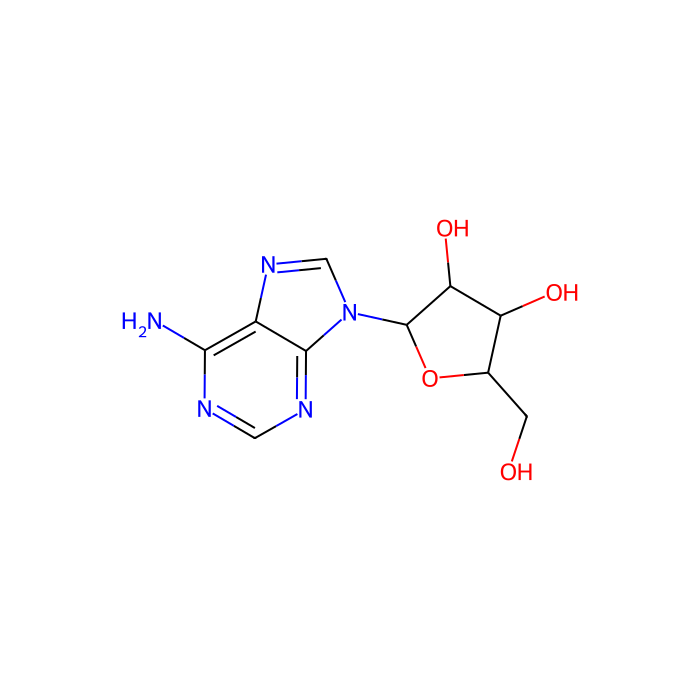
Brief: Adenosine-5′-13C is an isotopically labeled ribonucleoside in which the ribofuranose 5′-carbon is enriched with 13C, enabling tracing and quantitation in NMR and MS-based workflows.
Item-specific (from Product Data)
Product Name: Adenosine-5′-13C (SKU: A353789)
CAS: 54447-57-3
PubChem CID: 10611929
InChIKey: 259047 (as provided)
SMILES: Not specified for this item; refer to CoA/Spec Sheet.
Molecular Formula: Not specified for this item; refer to CoA/Spec Sheet.
Molecular Weight: Not specified for this item; refer to CoA/Spec Sheet.
Literature/General identity (for unlabeled parent and 13C labeling context)
Parent nucleoside (adenosine) formula: C10H13N5O4 (literature). A single 13C label at the 5′-carbon increases the exact mass by ~+1.00335 u (literature), without altering connectivity.
Core structural features: purine base adenine (1,3,5,6,7,9-hexahydro-2,6-diaminopurine framework) N9-glycosidically linked to β-D-ribofuranose. The ribose bears hydroxyls at 2′,3′,5′; the 5′ carbon (–CH2OH) is 13C-enriched.
2D description: a fused imidazole–pyrimidine (purine) ring with exocyclic –NH2 at C6, attached at N9 to the anomeric C1′ of a five-membered ribofuranose; ribose substituents: 2′-OH (down), 3′-OH (up), 5′-CH2OH (terminal), where the terminal carbon is 13C.
Stereochemistry (literature)
β-D-ribofuranose configuration (D-series; β-anomer at N9–C1′). No new stereocenters are introduced by 13C labeling.
Synthetic Utility
Adenosine-5′-13C is a versatile labeled starting material for nucleotide and oligonucleotide chemistry.
Functional groups and handles (general)
Ribose hydroxyls at 2′, 3′, 5′ enable selective protection and activation; the 5′-CH2OH carbon is 13C-enriched, allowing site-specific tracking of reactions involving the primary alcohol.
Purine ring nitrogens allow N-acylation/alkylation under controlled conditions; glycosidic linkage remains sensitive to strong acids.
Typical transformations (literature)
5′-O-phosphorylation to yield 5′-13C-AMP and higher phosphates via chemical (e.g., POCl3/trimethyl phosphate; phosphoramidite or phosphorimidazolidate routes) or enzymatic methods (adenosine kinase).
Protection strategies: 5′-O-DMT or silyl protections; 2′,3′-diacetal or silyl protections for regioselective chemistry leading to phosphoramidites for solid-phase synthesis.
Oxidation of 5′-alcohol to aldehyde/acids for conjugation chemistry while maintaining the isotopic label at the reacting carbon.
Retrosynthetic value
Using a site-specifically labeled nucleoside allows downstream labeled nucleotides/oligonucleotides with known isotopomer positions, critical for mechanistic and mass balance studies.
Practical note
Maintain neutral to mildly basic conditions to preserve the N9–C1′ bond; avoid strong mineral acids and prolonged heating (literature guidance).
Target Specificity
Not applicable. This product is a small-molecule nucleoside, not an antibody or affinity reagent. No antigen/epitope/clone specificity applies.
Frequently Asked Questions
How should this product be stored?
Store at room temperature.
How is this product shipped?
This product ships under standard ambient conditions. No temperature-controlled packaging is required.
What are the CAS number, molecular formula and molecular weight?
The CAS Number is 54447-57-3, the molecular formula is C913CH13N5O4, and the molecular weight is 268.24 g/mol. InChIKey OIRDTQYFTABQOQ-XUZOCFOZSA-N.
What documentation is provided?
Available product documentation, including Certificates of Analysis (COA), Safety Data Sheets (SDS), and specification sheets, is shown in the product document area. Document availability and access follow the current site policy.
We use cookies to ensure the website functions properly and, where permitted, to improve your experience. You can manage your preferences at any time in Settings. Learn more in our Cookie Policy.
Shall we send you a message when we have discounts available?
Remind me later
Thank you! Please check your email inbox to confirm.
Products are supplied to verified businesses, institutions, and qualified professionals for research and development use only. Not for use in humans, animals, diagnosis, or therapy.