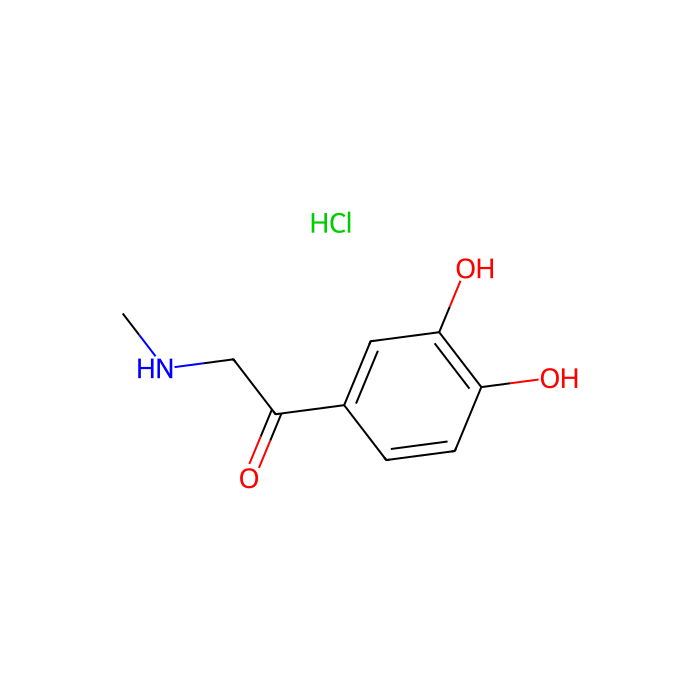
10mM in DMSO for sensitive chromatographic and analytical workflows requiring minimal baseline interference.
🌡
Storage & shipping
Store at -80°C Ships Dry ice packs + Cold packs Check lot-specific COA for exact specifications.
📋
Quality documents
SDS, COA, datasheet, and spec sheet available for download. Lot-specific COA accessible via lot number lookup.
📚
Literature proof
Cited in 0 peer-reviewed publications across chromatography, organic synthesis, and cross-coupling reactions.
Overview
Information
Adrenalone is an adrenergic agonist used as a topical vasoconstrictor and hemostatic, mainly acts on alpha-1 adrenergic receptors. In vitro
Adrenalone (12 μM) inhibits conversion of dopamine to norepinephrine by inhibiting dopamine β oxidase. The structure of Adrenalone differs from epinine only in that the former possesses a ketone group in the β position. The reduction of adrenalone (0.1 mM) by hydrated electrons in nitrogenated aqueous solutions containing either 10 or 100 mM tert-butyl alcohol results in identical transient spectra, therefore all OH radicals have been scavenged. While adrenalone behaves like a carbonyl compound during reduction, oxidation reactions are primarily governed by the catechol functional group. Adrenalone, which is a topical nasal decongestant, hemostatic, and vasoconstrictor, is a keton form of the natural substrate epinephrine. Adrenalone contains an aromatic ring that forms hydrophobic interactions with Phe72, Tyr152, and Phe317, an amine group that forms an ionic bond with Asp75, and a hydroxyl group that forms a hydrogen bond with Ala145. Adrenalone at 10 μM (100 μM) reduces substrate uptake to 99% (27%).
In vivo
Adrenalone (0.05%) administrated topically to the eyes of rabbits at 30 min intervals results in concentration of 7.75 mg/kg, 0.87 mg/kg and 2.51 mg/kg in cornea, aqueous humor and iris-ciliary body, respectively. Cell Data
We use cookies to ensure the website functions properly and, where permitted, to improve your experience. You can manage your preferences at any time in Settings. Learn more in our Cookie Policy.
Shall we send you a message when we have discounts available?
Remind me later
Thank you! Please check your email inbox to confirm.
Products are supplied to verified businesses, institutions, and qualified professionals for research and development use only. Not for use in humans, animals, diagnosis, or therapy.