
Determine the necessary mass, volume, or concentration for preparing a solution.
| Activity Type | Activity Value -log(M) | Mechanism of Action | Activity Reference | Publications (PubMed IDs) |
|---|
Moligand™, 10mM in DMSO Moligand™ for sensitive chromatographic and analytical workflows requiring minimal baseline interference.
Store at -80°C Ships Dry ice packs + Cold packs Check lot-specific COA for exact specifications.
SDS, COA, datasheet, and spec sheet available for download. Lot-specific COA accessible via lot number lookup.
Cited in 0 peer-reviewed publications across chromatography, organic synthesis, and cross-coupling reactions.
Information
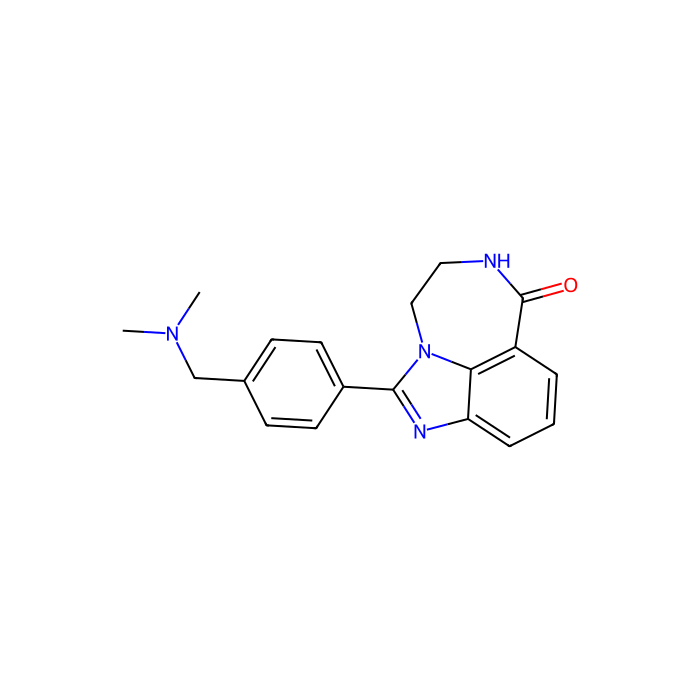
AG14361 is a potent inhibitor ofPARP1withKiof <5 nM in a cell-free assay. It is at least 1000-fold more potent than the benzamides.
In vitro
AG14361 is at least 1000-fold more potent than the benzamides. The IC50 for AG14361 is 29 nM in permeabilized SW620 cells and 14 nM in intact SW620 cells. Crystallographic analysis of AG14361 bound to the catalytic domain of chicken PARP-1 shows that the tricyclic ring system of AG14361 is located in a pocket composed of amino acid residues Trp861, His862, Gly863, Tyr896, Phe897, Ala898, Lys903, Ser904, Tyr907, and Glu988. AG14361 forms important hydrogen bonds with Ser904 and Gly863 and a water-mediated hydrogen bond with Glu988. AG14361-induced growth inhibition is not attributed to PARP-1-related effects because maximal PARP-1 inhibition is observed at much lower concentrations (≤1 μM) than the GI50. AG14361 at 0.4 μM does not affect cancer cell gene expression or growth, but it increases the antiproliferative activity of temozolomide and topotecan, and inhibits recovery from potentially lethal γ-radiation damage in LoVo cells by 73%. In addition, 0.4 μM AG14361 does not substantially alter gene expression as shown by microarray analysis. A 17-hour exposure of A549 cells to 0.4 μM AG14361 does not change the expression of the 6800 genes. Thus, although 0.4 μM AG14361 inhibits cellular PARP-1 activity by more than 85%, it essentially does not change gene expression and cell proliferation, indicating that the cellular effects of this low concentration of AG14361 are specific for PARP-1 inhibition. Higher, growth-inhibitory concentrations of AG14361 affects gene expression, but these effects are not likely to be related to PARP-1 inhibition because cell proliferation is affected equally in PARP-/- and PARP-1+/+ cells. AG14361 is rapidly absorbed into the bloodstream and distributed to the tumor and liver with lower concentrations detected in the brain. Tissue-to-plasma concentration ratio indicates that AG14361 is retained in tumor tissue over time in both xenograft models, with tumor concentrations (≥15 μM for 2 hours) in excess of that required to inhibit PARP-1 activity in vitro. AG14361 enhances temozolomide activity in all MMR-proficient cells (1.5–3.3-fold) but is more effective in MMR-deficient cells (3.7–5.2-fold potentiation), overcoming temozolomide resistance. In contrast, benzylguanine only increases the efficacy of temozolomide in MMR-proficient cells but is ineffective in MMR-deficient cells. AG14361 enhances the growth-inhibitory and cytotoxic effects of topoisomerase I poisons. AG14361 increases the persistence of camptothecin-induced DNA single-strand breaks.
In vivo
AG14361 treatment before irradiation statistically significantly increases the sensitivity to radiation therapy of mice bearing LoVo xenografts. AG14361 statistically significantly increases blood flow in xenografts and thus potentially increases drug delivery to tumor xenografts. In vivo, nontoxic doses of AG14361 increases the delay of LoVo xenograft growth induced by irinotecan, x-irradiation, or temozolomide by 2- to 3-fold. Coadministration of AG14361 with temozolomide statistically significantly increases temozolomide activity against LoVo xenografts, with the tumor growth delay being increased from 3 days to 9 days by AG14361 at 5 mg/kg and to 10 days by AG14361 at 15 mg/kg. The combination of AG14361 and temozolomide causes complete regression of SW620 xenograft tumors. PARP-1 activity, detected by pharmacodynamic assay, in SW620 xenografts is inhibited by more than 75% for at least 4 hours after intraperitoneal administration of AG14361 (10 mg/kg), consistent with the concentration of AG14361 persisting in the tumor.
Cell Data
cell lines:CD4+ T cells
Concentrations:0-20 μM
Incubation Time:5 days
Powder Purity:≥99%
| Isomeric SMILES | CN(C)CC1=CC=C(C=C1)C2=NC3=CC=CC4=C3N2CCNC4=O |
|---|---|
| Molecular Weight | 320.4 |
| Reaxy-Rn | 9283091 |
| Reaxys-RN_link_address | https://www.reaxys.com/reaxys/secured/hopinto.do?context=S&query=IDE.XRN=9283091&ln= |
Comprehensive hazard, handling, storage, and regulatory compliance document.
Download SDS →Lot-specific quality data. Enter your lot number to retrieve the exact COA.
Look up COA →Full quality attributes and acceptance criteria for this grade.
View spec sheet →| Activity Type | Activity Value -log(M) | Mechanism of Action | Activity Reference | Publications (PubMed IDs) |
|---|
| Solubility | Solubility (25°C) In vitro DMSO: 37 mg/mL warmed with 50ºC Water: bath (90.79 mM); Water: Insoluble; Ethanol: Insoluble; |
|---|
Our grade selection guide covers purity, stabilizer status, and application suitability for all variants in our catalog.
View Moligand™ grade guide →