GRADE & PURITYMoligand™?Moligand™ — Aladdin's line of ligands and bioactive small molecules. Use for receptor, pathway, and binding studies needing defined small-molecule tools.10 mM in DMSO
Moligand™, 10 mM in DMSO Moligand™ for sensitive chromatographic and analytical workflows requiring minimal baseline interference.
🌡
Storage & shipping
Store at -80°C Ships Dry ice packs + Cold packs Check lot-specific COA for exact specifications.
📋
Quality documents
SDS, COA, datasheet, and spec sheet available for download. Lot-specific COA accessible via lot number lookup.
📚
Literature proof
Cited in 1 peer-reviewed publications across chromatography, organic synthesis, and cross-coupling reactions.
Overview
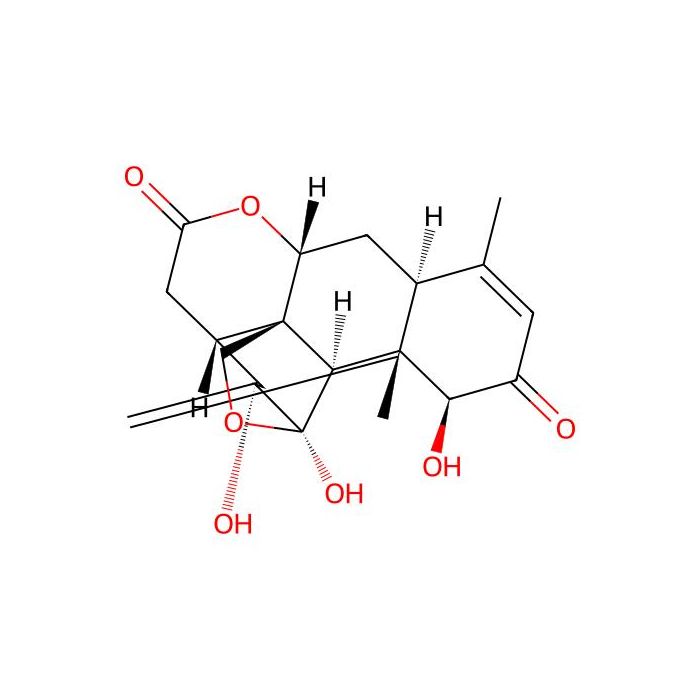
Ailanthone (Δ13-Dehydrochaparrinone) is a potent inhibitor of both full-length androgen receptor (AR) ( IC 50 =69 nM) and constitutively active truncated AR splice variants (AR 1-651 IC 50 =309 nM).
Specifications
Specifications & Purity
Moligand™, 10 mM in DMSO
Storage
Store at -80°C
Shipped In
Dry ice packs + Cold packs
This product requires cold chain shipping. Ground and other economy services are not available.
Determine the necessary mass, volume, or concentration for preparing a solution.
Dilution Calculator
Determine the dilution needed to prepare a stock solution.
Reconstitution Calculator
Reviews
Customer Reviews
Application Protocols
No tested application protocols are provided by the manufacturer for this item. The following general procedures are commonly used for small-molecule handling in research.
Preparing a DMSO stock solution:
Equilibrate vial to room temperature in a desiccator to avoid moisture condensation.
Add anhydrous DMSO to achieve a convenient concentration (e.g., 10 mM; adjust based on solubility).
Vortex and, if needed, sonicate briefly. Centrifuge to clarify and transfer supernatant to aliquot tubes.
Record exact concentration by weight-in/volume-out or by quantitative NMR/UV if applicable.
Dosing into aqueous assays:
Add DMSO stock to buffer/media under vigorous mixing to a final DMSO content typically ≤0.1–1% v/v. Include vehicle controls.
Inspect for precipitation; if observed, reduce concentration or increase cosolvent fraction within assay tolerance.
Plate handling for screening:
Aliquot stocks into low-bind plates/tubes; seal to prevent evaporation.
Avoid repeated freeze–thaw; use single-use aliquots.
Stability checks:
Conduct short-term stability assessments at room temperature and 4°C in chosen media by LC–MS.
Avoid strong base; maintain neutral pH to protect lactone/ester motifs.
These are general guidelines; optimize for your specific assay and consult the SDS and CoA for item-specific constraints.
Biological Roles
General/literature context for the quassinoid class (to which ailanthone belongs):
Origin: Quassinoids are highly oxygenated, degraded triterpenes primarily found in Simaroubaceae (e.g., Ailanthus species). They function as plant secondary metabolites.
Ecological role: Typically implicated in plant defense, contributing to deterrence of herbivores and pathogens; concentrations and profiles vary with species, tissue, and environment.
Biosynthesis: Derived from protolimonoid/triterpenoid pathways followed by oxidative skeletal rearrangements and installation of lactone/ester functionalities. Multiple oxidative tailoring steps generate the diverse oxygenation patterns and stereochemistry seen in this family.
Physicochemical/ADME-relevant traits (general): Rigid polycyclic scaffolds with multiple oxygen atoms yield moderate polarity, low aqueous solubility, and high 3D shape complexity—features valued in chemical biology libraries for target exploration.
Notes for research use:
No medical or clinical claims are made. Any observations in biological systems should be treated as preliminary and validated with orthogonal assays and appropriate controls.
Stability considerations in biological media: lactone/ester moieties may undergo hydrolysis under basic or enzymatic conditions; maintain controlled pH and minimize incubation times when stability is critical.
Manufacturer position: This product is provided for research use only (Product Data). No target, pathway, or activity annotations are specified by the manufacturer for this SKU.
Buffer Applications
Ailanthone is not a buffer reagent and is not used to set or maintain pH. Consequently, classical buffer recipes and pKa-centered buffer selection are not applicable.
Practical guidance for assay buffers (general):
If dosing ailanthone into aqueous buffers, use a pre-made DMSO (or ethanol) stock and add to the buffer with vigorous mixing to avoid local supersaturation and precipitation.
Maintain buffer pH near neutrality (e.g., phosphate-buffered saline, HEPES) to limit lactone/ester hydrolysis; avoid strong base.
Keep final organic cosolvent content low (often ≤0.1–1% v/v) to preserve biological assay integrity; include vehicle controls.
For actual buffer preparation guidance, refer to standard buffering agents (e.g., phosphate, HEPES, Tris); these are outside the scope of this product.
Green Alternatives
While the compound itself is fixed, you can improve the sustainability of handling and analytics by solvent and process selection.
Greener handling choices (general guidance):
Prefer ethanol or isopropanol over acetonitrile for preparative dissolutions when feasible (check solubility and stability).
Use water-miscible, bio-based solvents such as Cyrene or 2-methyltetrahydrofuran (2-MeTHF) for extractions/workups when compatible with polarity and stability; confirm no degradation of lactone/ester functions.
Minimize DMSO volumes while maintaining solubility in biological assays (e.g., 0.1–0.5% v/v), and consolidate plates to reduce solvent waste.
Adopt microscale assay formats and UHPLC methods to reduce solvent consumption.
Comparison (general; illustrative):
DMSO (petroleum-derived, high solvency) vs ethanol (bio-based, lower toxicity): ethanol is greener but may provide lower solubility; balance with concentration needs.
Acetonitrile (effective for LC, higher environmental burden) vs ethanol/water gradients (greener but higher backpressure and sometimes poorer peak shape): optimize columns and temperature to enable greener eluents when possible.
Operational tips:
Recycle solvents where permitted; employ solvent-saving needle wash strategies in LC autosamplers.
Use amber vials and chilled autosampler compartments to limit degradation and extend run windows, thereby avoiding repeat analyses and waste.
All recommendations are general/literature-based and should be verified for compatibility with ailanthone before adoption.
Pharmaceutical Uses
No pharmacopeial or excipient role is provided for this product. Ailanthone is supplied as a research-use-only small molecule.
Relevant non-clinical contexts (general):
Analytical reference standard: may be employed for identity/assay of botanical materials from Ailanthus species via LC–MS/UPLC, with appropriate validation.
Discovery chemistry: used as a lead-like scaffold in early-stage, non-clinical research programs to explore structure–property relationships typical of quassinoids.
Formulation for research: laboratory-scale solutions for in vitro testing are typically prepared in DMSO or ethanol and diluted into assay media; no clinical formulation claims are made.
Compliance notes:
Not intended for human or veterinary use. No GMP status is claimed in this listing. For regulated applications, source a GMP-grade reference standard with full compendial documentation.
Residual solvents, elemental impurities, and specific impurity profiles are Not specified for this item; refer to CoA/Spec Sheet if required for method validation in QC labs.
Physical Properties
Item-specific physicochemical specifications were not provided for this catalog entry. Where helpful, general/literature guidance for quassinoids like ailanthone is summarized; consult the CoA/Spec Sheet and SDS for definitive values.
Appearance: Not specified for this item; refer to CoA/Spec Sheet.
Melting point: Not specified for this item; refer to CoA/Spec Sheet. (Quassinoids are typically crystalline solids; literature values vary with source and polymorph.)
Boiling point: Not applicable (decomposes before boiling under ambient pressure; literature for quassinoids generally indicates thermal lability).
Density: Not specified for this item; refer to CoA/Spec Sheet.
LogP/logD: Not specified for this item; refer to CoA/Spec Sheet. (Quassinoids usually show moderate lipophilicity balanced by multiple oxygens.)
pKa: Not applicable/low acidity (no strong ionizable groups; any apparent acidity is due to lactone/secondary alcohols; literature reports context-dependent behavior).
Solubility (general/literature):
Water: very low aqueous solubility typical for quassinoids; practical handling usually requires organic cosolvent.
Organic solvents: soluble in DMSO and polar protic solvents (methanol, ethanol); limited to moderate solubility in acetonitrile and ethyl acetate; poor in alkanes/hexanes.
UV-Vis: Not specified for this item; refer to CoA/Spec Sheet. (Quassinoids may show UV absorbance in the 200–230 nm region due to lactone/ester chromophores; weak at longer wavelengths.)
Refractive index/optical rotation: Not specified for this item; refer to CoA/Spec Sheet.
Note: Actual values depend on source, form, and purity. Use literature data only as qualitative guidance.
Quality & Grades
Grade: Moligand™ (Product Data)
What Moligand™ typically indicates (general description):
A discovery/screening-grade small molecule intended for use in chemical biology, target identification, and high-throughput screening workflows. Emphasis is on identity and suitability for library use rather than analytical chromatography performance.
Compounds are commonly provided as neat solids or pre-formulated for storage at low temperature; purity specifications, residual solvents, water content, and stabilizers are item-dependent. For this SKU, item-specific analytical metrics are not provided here—refer to the CoA/Spec Sheet.
Implications for use:
Suitable for primary/secondary screening, phenotypic assays, and SAR exploration when used alongside appropriate controls and orthogonal analytics (HPLC/LC–MS for identity/purity verification in-house).
If ultra-low UV background or trace-metal control is required (e.g., photochemical or catalytic studies), consider additional in-lab purification or select a reagent grade that states those specifications explicitly.
What is specific to this item:
Storage at −80°C (Product Data) with shipment on dry ice + cold packs supports integrity for long-term library maintenance.
No stabilizer, salt form, counterion, or solvation state is declared here. If these details impact your workflow (e.g., dose normalization), verify on the CoA and adjust calculations accordingly.
Documentation:
For exact purity, identity confirmation (NMR/LC–MS), residual solvents, and water content: Not specified for this item; refer to CoA/Spec Sheet.
Reaction & Applications
This SKU is positioned as a Moligand™ screening compound rather than a general-purpose reagent. Its principal applications are in chemical biology and discovery workflows where the molecule is the object of study rather than a reactant.
Applications (research use):
Reference standard in natural product profiling, dereplication, and QC of Ailanthus-derived materials (e.g., LC–MS retention and MS/MS library matching).
Positive control or chemotype representative in cell-free/biochemical assay panels designed to explore quassinoid-associated pathways, with appropriate safety and ethical oversight.
Structure–activity relationship (SAR) campaigns: semi-synthetic modification at accessible positions (e.g., acylation of free hydroxyls, selective reduction of carbonyls) to tune physicochemical properties; compare bioassay readouts across analogs.
Analytical method development: evaluate extraction efficiency, recovery, and stability in various matrices; stress-testing to define handling conditions.
Practical guidance:
Maintain anhydrous, low-temperature conditions during long manipulations to minimize lactone/ester hydrolysis.
For semi-synthesis, protect acid-/base-sensitive lactone motifs; employ mild acylation (acyl chlorides/anhydrides, DMAP catalysis) or chemoselective carbonyl reductions (e.g., NaBH4/CeCl3) under carefully buffered conditions.
Verify identity/purity post-manipulation with orthogonal methods (1H/13C NMR, HRMS, HPLC/UPLC).
Note: No item-specific reactivity data or tested biological effects are provided by the manufacturer in this listing. Plan experiments accordingly and consult primary literature for quassinoid chemistry.
Reaction Conditions
This product is not offered as a reagent for routine synthetic transformations; however, if undertaking semi-synthetic derivatizations for research, the following general/literature guidance may be useful:
Solvents: dry dichloromethane, THF, or acetonitrile for acylations and carbamoylations; methanol/ethanol for solvolysis and ester interchange; DMSO employed only for stock solutions rather than reactive media due to potential side reactions.
Temperatures: 0–25°C for most acylations and protections to preserve lactone integrity; ≤0°C for highly reactive acylating agents; gentle warming (30–40°C) may be used for slow reactions if stability is verified.
Bases/catalysts: DMAP (0.05–0.2 equiv) and tertiary amines (DIPEA, pyridine) for acylations; avoid strong inorganic bases that can open lactones unless ring opening is intended.
Reductions: NaBH4 or NaBH4/CeCl3 (Luche conditions) in alcoholic solvents at 0–25°C for chemoselective carbonyl reduction; quench carefully to prevent decomposition.
Protection: Carbonate/carbamate formation using chloroformates/isocyanates under anhydrous conditions; monitor by TLC/LC–MS.
Workup: mildly acidic aqueous workups (e.g., pH 5–6) to re-close transiently opened lactones; minimize exposure to strong base.
Purification: flash chromatography on silica with cautiously buffered eluents (0.1% acetic acid) to prevent lactone hydrolysis; reverse-phase prep HPLC as needed.
Yields and times: highly substrate- and site-dependent; literature on quassinoids reports modest to good yields for mild acylations (30–80%) with reaction times from 0.5–12 h. Verify on small scale.
Safety & Handling
GHS hazard details for this product were not provided. Handle under a conservative safety paradigm appropriate for bioactive natural products. Always consult the product SDS for authoritative information.
GHS classification, H-statements, pictograms: Not specified for this item; refer to SDS.
Likely hazards (general for polyoxygenated natural products): irritation to skin/eyes; potential systemic bioactivity—avoid inhalation/ingestion and minimize dermal exposure.
PPE: lab coat, safety glasses/goggles, and appropriate chemically resistant gloves (e.g., nitrile). Use in a certified fume hood to avoid aerosol/vapor exposure during solvent handling.
Engineering controls: handle powders in a hood or ventilated enclosure; consider dust-minimizing techniques (weighing boats with anti-static measures).
Storage incompatibilities: avoid strong bases/acids that can saponify or hydrolyze lactone/ester functions; avoid strong oxidizers; protect from moisture and light to minimize hydrolysis and degradation.
Special risks: natural products may degrade via hydrolysis or oxidation; limit exposure to elevated temperature. When preparing DMSO stocks, prevent microbial contamination and repeated freeze–thaw cycles.
First aid (overview; consult SDS):
Skin/eye contact: rinse with water for ≥15 min; remove contaminated clothing; seek medical attention if irritation persists.
Inhalation: move to fresh air; seek medical attention if symptoms occur.
Ingestion: rinse mouth; do not induce vomiting; seek medical assistance.
Spill response: absorb with inert material (vermiculite), collect in compatible waste; decontaminate surfaces with alcohol, then detergent.
Waste: dispose according to local regulations for organic laboratory chemicals and bioactive substances.
Solvent Selection
Ailanthone is a polyoxygenated, moderately lipophilic natural product. Practical solvent choices are driven by assay context and required concentration.
Polarity/solvation (general/literature):
Poorly water-soluble; requires organic cosolvent for stock solutions.
Readily soluble in DMSO; typically soluble in methanol and ethanol; variable in acetonitrile and ethyl acetate; poor in nonpolar hydrocarbons.
Recommended working approach:
Prepare concentrated stocks in DMSO (e.g., 10–50 mM, solubility permitting) and dilute into aqueous media with final DMSO ≤0.1–1% v/v depending on biological/biochemical tolerance.
For non-aqueous reactions or analytics, methanol or ethanol can be used; ensure water content is controlled to limit hydrolysis.
Dielectric/miscibility context (general):
DMSO (high dielectric, fully miscible with water) offers maximal solvency; MeOH/EtOH (polar protic) support hydrogen-bonding to oxygenated sites.
ACN can be useful for LC workflows; ensure stability in chosen eluent.
Comparison (general):
DMSO vs MeOH: DMSO provides higher solubility and assay compatibility at low percentages; MeOH is more volatile and LC–MS friendly but may promote slow transesterification/hydrolysis in basic media.
EtOH vs ACN: EtOH is greener and biocompatible; ACN offers lower viscosity for UHPLC but less green.
Tip: Filter or centrifuge stock solutions to remove particulates; verify concentration by UV (if chromophore allows) or quantitative NMR.
Storage & Reconstitution
Storage conditions: Store at −80°C (Product Data). Protect from light and moisture. Use desiccation for the solid and keep solutions under inert atmosphere when feasible.
Shipping: Shipped on dry ice packs + cold packs (Product Data) to maintain low temperature throughout transit.
Stability notes (general): The quassinoid scaffold can be sensitive to hydrolysis and oxidation. Minimize exposure to ambient temperature. Plan for single-use aliquots to avoid freeze–thaw cycling.
Reconstitution and aliquoting (general guidance):
For solid material: allow the sealed container to warm to room temperature before opening to prevent moisture condensation. Immediately reseal under dry atmosphere after dispensing.
Solvent selection: prepare concentrated stocks in anhydrous DMSO; alternative solvents include methanol or ethanol if compatible with downstream use.
Typical stock concentrations (research practice): 10–50 mM in DMSO, solubility permitting. Verify visually and by analytical assay.
Aliquoting: dispense into amber, low-bind vials or 96-/384-well plates; purge headspace with inert gas if long-term storage is planned.
Storage of solutions: keep at −80°C for long-term; avoid frost-free freezers. For working stocks, store at −20°C and use within a few weeks, monitoring by LC–MS for degradation.
Item-specific specifications for solubility limits, exact stability, and re-test dates are Not specified for this item; refer to CoA/Spec Sheet. For research use only (Product Data).
Structure & Identity
Ailanthone is a highly oxygenated quassinoid (degraded triterpenoid) natural product classically isolated from Ailanthus species. It features a compact, polycyclic carbon framework bearing multiple oxygen functionalities (lactone/ester, hydroxyl/hemiketal, and ether linkages), characteristic of the quassinoid scaffold.
CAS: 981-15-7 (Product Data)
PubChem CID: 72965 (Product Data)
Molecular formula: Not specified for this item; refer to CoA/Spec Sheet.
Molecular weight: Not specified for this item; refer to CoA/Spec Sheet.
SMILES: Not specified for this item; refer to CoA/Spec Sheet.
InChIKey: Not specified for this item; refer to CoA/Spec Sheet.
Structural features (general/literature description):
Polycyclic, highly functionalized quassinoid core derived biosynthetically from triterpenes.
Multiple oxygenated centers (several stereogenic centers) with embedded lactone/esterrificed moieties and acetal/ether motifs.
Conformationally rigid, compact cage-like geometry with pronounced polarity anisotropy (oxygen-rich surface vs apolar backbone).
2D structure in words (general):
A fused, four-ring carbon skeleton bearing a γ-lactone side unit, with several tertiary/secondary alcohols and cyclic ethers arranged around the core; numerous stereocenters define a single, specific natural configuration. No halogens or heteroatoms other than oxygen are typical for this class.
Synthetic Utility
Ailanthone is primarily a target molecule rather than a building block; nevertheless, limited semi-synthetic transformations can be leveraged in research to probe SAR and physicochemical tuning.
Functional group landscape (general):
Lactone/ester motifs: susceptible to hydrolysis and transesterification; can be opened under basic conditions to access carboxylate derivatives (often reversible with care).
Hydroxyls/hemiketals: enable acylation (acyl chlorides/anhydrides), carbamate formation, carbonate protection, and selective oxidation to ketones.
Carbonyls (if present): chemoselective reduction (e.g., NaBH4/CeCl3) or oxime/hydrazone formation for derivatization and analytical tagging.
Typical transformations (literature/general):
Selective acylation with DMAP-catalyzed conditions to modulate lipophilicity and metabolic stability.
Formation of pro-moiety derivatives (e.g., carbonates/carbamates) to adjust solubility for in vitro evaluations.
Protection–deprotection sequences to enable further site-selective functionalization without compromising the core scaffold.
Utility in synthesis:
Benchmark for total synthesis and methodology development in complex molecule construction (stereocontrol, late-stage oxidation, and lactone installation).
Caveats:
The densely functionalized, stereochemically rich scaffold demands mild, chemoselective conditions; strong acid/base can cause degradation. Always monitor by LC–MS/NMR and perform small-scale trials prior to scale-up.
Item-specific catalytic or reactivity data are not provided in the Product Data; consult primary literature for examples tailored to quassinoids.
Target Specificity
No target, pathway, or binding specificity information is provided by the manufacturer for this SKU.
Antigen/epitope, species reactivity, clone/isotype: Not applicable; this product is a small molecule, not an antibody or protein reagent.
Research context: If used in target deconvolution studies (e.g., affinity capture, chemoproteomics), users must establish specificity empirically with appropriate controls and orthogonal validation.
All biological activity statements, if any, should be derived from users’ own data or peer-reviewed literature; none are asserted here.
We use cookies to ensure the website functions properly and, where permitted, to improve your experience. You can manage your preferences at any time in Settings. Learn more in our Cookie Policy.
Shall we send you a message when we have discounts available?
Remind me later
Thank you! Please check your email inbox to confirm.
Products are supplied to verified businesses, institutions, and qualified professionals for research and development use only. Not for use in humans, animals, diagnosis, or therapy.