
Determine the necessary mass, volume, or concentration for preparing a solution.
| Activity Type | Activity Value -log(M) | Mechanism of Action | Activity Reference | Publications (PubMed IDs) |
|---|
Information
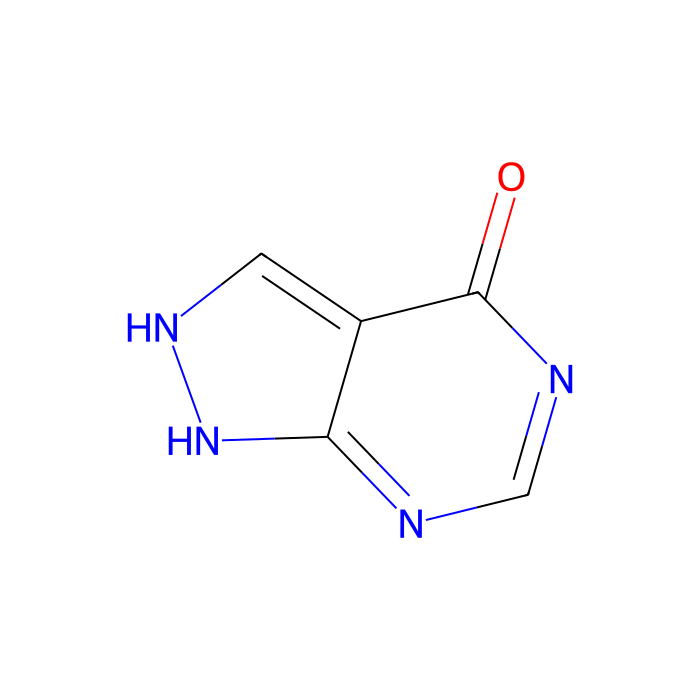
Allopurinol Allopurinol is a purine analog inhibitor of the enzyme xanthine oxidase , used to treat gout or kidney stones, and to decrease levels of uric acid.
In vitro
Allopurinol reverses the increased xanthine oxidase activity in ischemia-reperfusion injury of neonatal rat hearts. Allopurinol (10 mM) treatment suppresses xanthine oxidase activity induced by hypoxia-reoxygenation injury and the production of reactive oxygen species. Allopurinol also decreases the concentration of intracellular Ca2+ increased by enhanced xanthine oxidase activity.
In vivo
Allopurinol shows abnormal pyrimidine metabolism together with renal toxicity which could be ameliorated by uridine, indicating that Allopurinol essentially causes pyrimidine metabolism abnormality leading to renal impairment in normal mice. Allopurinol increases urinary OD excretion to an extent similar to that in normal mice administered the same dose of Allopurinol in DNFB-sensitized mice. Allopurinol promotes a clinical improvement which is accompanied by a reduction in the parasitic load in the blood, skin and lymph nodes but, even after long period of allopurinol administration alone, Leishmania may persist in dog tissues in Leishmania-infected dogs. Allopurinol prevents early alcohol-induced liver injury in rats, most likely by preventing oxidant-dependent activation of NF-kappaB. Allopurinol protects dose-dependently against acetaminophen-induced cell injury, the loss of ATP and the increase of the GSSG content in the total liver and in the mitochondrial compartment without inhibiting reactive metabolite formation in mice. Allopurinol almost completely inhibits hepatic xanthine oxidase and dehydrogenase activity, but only high doses prevents the increase of the mitochondrial GSSG content.
Cell Data
cell lines:
Concentrations:
Incubation Time:
Powder Purity:≥99%
| Activity Type | Activity Value -log(M) | Mechanism of Action | Activity Reference | Publications (PubMed IDs) |
|---|
Find and download the COA for your product by matching the lot number on the packaging.
| Lot Number | Certificate Type | Date | Item |
|---|---|---|---|
 F2425001 | Certificate of Analysis | May 13, 2026 | A409140 |
| Melt Point | 384°C |
|---|
H301:Toxic if swallowed
H317:May cause an allergic skin reaction
P261:Avoid breathing dust/fume/gas/mist/vapors/spray.
P280:Wear protective gloves/protective clothing/eye protection/face protection.
P302+P352:IF ON SKIN: wash with plenty of water.
P321:Specific treatment (see ... on this label).
P405:Store locked up.
P501:Dispose of contents/container to an approved waste disposal plant.
P264:Wash hands [and …] thoroughly after handling.
P270:Do not eat, drink or smoke when using this product.
P272:Contaminated work clothing should not be allowed out of the workplace.
P333+P313:IF SKIN irritation or rash occurs: Get medical advice/attention.
P362+P364:Take off contaminated clothing and wash it before reuse.
P330:Rinse mouth.
P301+P316:IF SWALLOWED: Get emergency medical help immediately.
Our grade selection guide covers purity, stabilizer status, and application suitability for all variants in our catalog.
View Moligand™ grade guide →