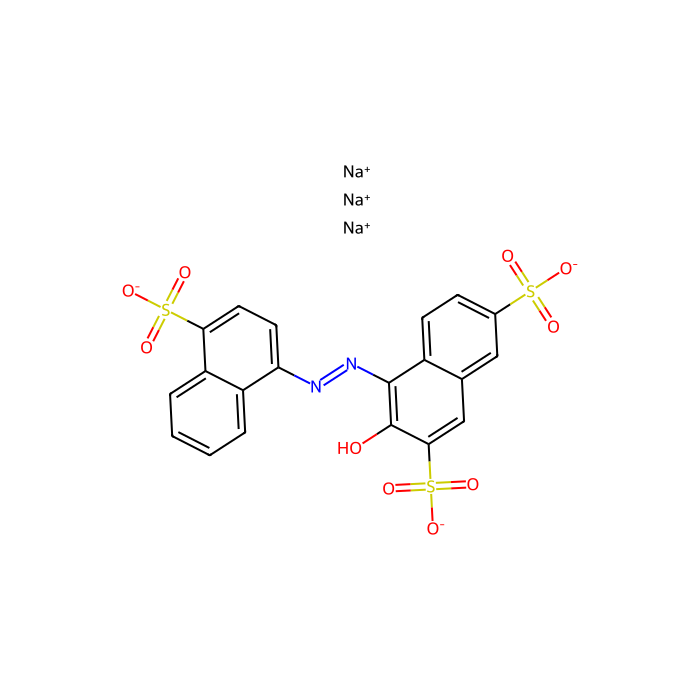
Determine the necessary mass, volume, or concentration for preparing a solution.
Taxonomy Tree
| Kingdom | Organic compounds |
|---|---|
| Superclass | Benzenoids |
| Class | Naphthalenes |
| Subclass | 1,1'-azonaphthalenes |
| Intermediate Tree Nodes | Not available |
| Direct Parent | 1,1'-azonaphthalenes |
| Alternative Parents | 2-naphthalene sulfonic acids and derivatives 2-naphthalene sulfonates 1-naphthalene sulfonic acids and derivatives 1-naphthalene sulfonates 1-sulfo,2-unsubstituted aromatic compounds Phenoxides Sulfonyls Organosulfonic acids Azo compounds Propargyl-type 1,3-dipolar organic compounds Organopnictogen compounds Organooxygen compounds Organic sodium salts Organic oxides Hydrocarbon derivatives |
| Molecular Framework | Aromatic homopolycyclic compounds |
| Substituents | 1,1'-azonaphthalene - Naphthalene sulfonate - 1-naphthalene sulfonic acid or derivatives - 2-naphthalene sulfonic acid or derivatives - Naphthalene sulfonic acid or derivatives - 1-naphthalene sulfonate - 2-naphthalene sulfonate - Arylsulfonic acid or derivatives - 1-sulfo,2-unsubstituted aromatic compound - Phenoxide - Organic sulfonic acid or derivatives - Organosulfonic acid or derivatives - Organosulfonic acid - Sulfonyl - Azo compound - Organic alkali metal salt - Organic 1,3-dipolar compound - Propargyl-type 1,3-dipolar organic compound - Hydrocarbon derivative - Organic oxide - Organopnictogen compound - Organonitrogen compound - Organic nitrogen compound - Organic oxygen compound - Organosulfur compound - Organooxygen compound - Organic sodium salt - Organic salt - Aromatic homopolycyclic compound |
| Description | This compound belongs to the class of organic compounds known as 1,1'-azonaphthalenes. These are organonitrogen aromatic compounds that contain a central azo group, where each nitrogen atom is conjugated to the 1-position of a naphthalene ring system. Naphthalene is a compound made up of two fused benzene rings. |
| External Descriptors | Not available |
Find and download the COA for your product by matching the lot number on the packaging.
| Lot Number | Certificate Type | Date | Item |
|---|---|---|---|
| Certificate of Analysis | Sep 19, 2022 | A109285 |
| Sensitivity | Light sensitive. |
|---|---|
| Melt Point | 218-220°C |
| Molecular Weight | 604.5 |
| XLogP3 | |
| Hydrogen Bond Donor Count | 1 |
| Hydrogen Bond Acceptor Count | 12 |
| Rotatable Bond Count | 2 |
| Exact Mass | 603.927 Da |
| Monoisotopic Mass | 603.927 Da |
| Topological Polar Surface Area | 242.000 Ų |
| Heavy Atom Count | 38 |
| Formal Charge | 0 |
| Complexity | 1080.000 |
| Isotope Atom Count | 0 |
| Defined Atom Stereocenter Count | 0 |
| Undefined Atom Stereocenter Count | 0 |
| Defined Bond Stereocenter Count | 0 |
| Undefined Bond Stereocenter Count | 0 |
| The total count of all stereochemical bonds | 0 |
| Covalently-Bonded Unit Count | 4 |
H315:Causes skin irritation
H319:Causes serious eye irritation
H335:May cause respiratory irritation
P261:Avoid breathing dust/fume/gas/mist/vapors/spray.
P264:Wash hands [and …] thoroughly after handling.
P271:Use only outdoors or in a well-ventilated area.
P280:Wear protective gloves/protective clothing/eye protection/face protection.
P321:Specific treatment (see ... on this label).
P302+P352:IF ON SKIN: wash with plenty of water.
P304+P340:IF INHALED: Remove person to fresh air and keep comfortable for breathing.
P305+P351+P338:IF IN EYES: Rinse cautiously with water for several minutes. Remove contact lenses if present and easy to do - continue rinsing.
P362+P364:Take off contaminated clothing and wash it before reuse.
P405:Store locked up.
P403+P233:Store in a well-ventilated place. Keep container tightly closed.
P501:Dispose of contents/container to an approved waste disposal plant.
P264+P265:Wash hands [and …] thoroughly after handling. Do not touch eyes.
P337+P317:If eye irritation persists: Get medical help.
P332+P317:If skin irritation occurs: Get medical help.
P319:Get medical help if you feel unwell.
Our grade selection guide covers purity, stabilizer status, and application suitability for all variants in our catalog.
View Analytical standard grade guide →