≥98% for sensitive chromatographic and analytical workflows requiring minimal baseline interference.
🌡
Storage & shipping
Store at -20°C Ships Ice chest + Ice pads Check lot-specific COA for exact specifications.
📋
Quality documents
SDS, COA, datasheet, and spec sheet available for download. Lot-specific COA accessible via lot number lookup.
📚
Literature proof
Cited in 0 peer-reviewed publications across chromatography, organic synthesis, and cross-coupling reactions.
Overview
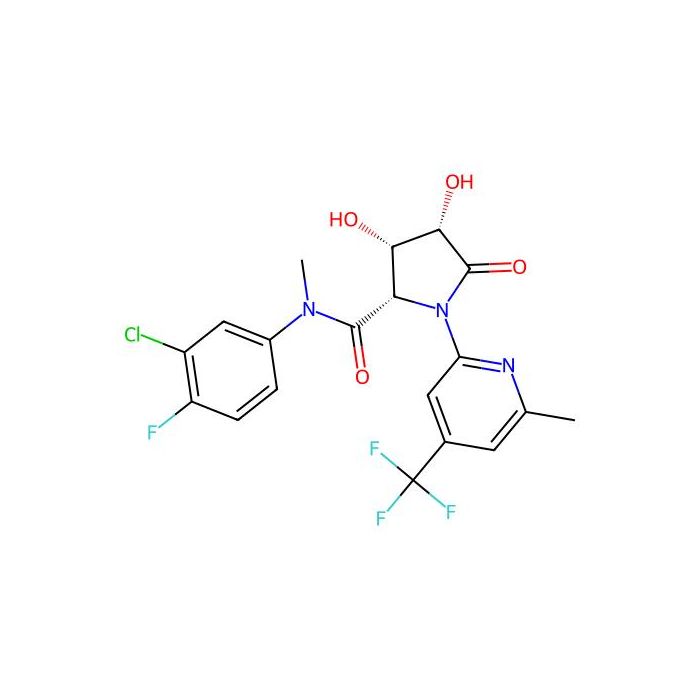
ART812 is an orally active DNA polymerase Polθ inhibitor with an IC 50 value of 7.6 nM. ART812 has an IC 50 value of 240 nM for cell based microhomology-mediated end joining (MMEJ)
In Vitro
ART812 (0-40 μM) elicits Polθ inhibitor sensitivity in MDA-MB-436 SHLD2 knockout cells. MCE has not independently confirmed the accuracy of these methods. They are for reference only.
In Vivo
ART812 (100?mg/kg; p.o. daily for 76 days) shows significant tumour inhibition in rats bearing established MDA-MB-436 BRCA1/SHLD2 defective tumours (volume 250-350?mm 3 ) . MCE has not independently confirmed the accuracy of these methods. They are for reference only.
Form:Solid
IC50& Target:Polθ 7.6 nM (IC 50 )
Specifications
Specifications & Purity
≥98%
Biochemical and Physiological Mechanisms
ART812 is an orally active DNA polymerase Polθ inhibitor with an IC 50 value of 7.6 nM. ART812 has an IC 50 value of 240 nM for cell based microhomology-mediated end joining (MMEJ).
Storage
Store at -20°C
Shipped In
Ice chest + Ice pads
This product requires cold chain shipping. Ground and other economy services are not available.
Determine the necessary mass, volume, or concentration for preparing a solution.
Dilution Calculator
Determine the dilution needed to prepare a stock solution.
Reconstitution Calculator
Reviews
Customer Reviews
Application Protocols
Item-specific (from Product Data)
No tested applications or protocols are provided for ART812 in the catalog entry.
General best practices for compound handling in screening (not item-specific)
Stock preparation: Dissolve to 10–50 mM in anhydrous DMSO. Vortex and sonicate if needed. Record exact concentration by weight-in/volume-out or by quantitative NMR/UV if appropriate.
Aliquoting: Prepare single-use aliquots (e.g., 10–50 µL) in low-bind tubes or 384-well source plates. Seal with heat seals or high-quality cap mats. Avoid repeated freeze–thaw.
Dilution: Prepare intermediate plates (e.g., 1 mM in DMSO) before final assay dilution to reduce pipetting error. Ensure final DMSO level is assay-compatible.
Controls: Include vehicle controls (DMSO only), positive/negative assay controls, and if applicable, detergent or redox controls to detect aggregation or redox cycling artifacts.
Documentation: Track lot numbers, solution prep dates, and storage conditions. Re-verify integrity by LC–MS/HPLC after prolonged storage.
Biological Roles
Applicability note
The biological function, targets, or pathways of ART812 are not provided. Without a disclosed structure or known annotation, specific biological roles cannot be assigned.
General considerations for screening compounds (not item-specific)
Many library members are exploratory chemotypes used to probe protein function, enzyme inhibition/activation, or cellular phenotypes. Any observed activity should be regarded as preliminary until orthogonal confirmation and artifact controls are completed (e.g., detergent controls for aggregator risk, redox interference tests, PAINS filters once structure is known).
If used in cells, assess permeability and cytotoxicity independently and establish a maximal non-interfering DMSO concentration (often ≤0.1–0.5% v/v in sensitive cell systems; general guidance).
Verify chemical stability in assay media (protein binding, hydrolysis, redox reactivity) to differentiate true SAR from degradation or adsorption effects.
No medical or clinical claims are made; this product is provided strictly for research use only.
Buffer Applications
Not typically applicable
ART812 is a small-molecule screening compound; it is not a buffering agent or buffer component by design.
General lab notes (not item-specific)
If formulating assay solutions, prepare compound stocks in DMSO, then dilute into pre-equilibrated assay buffer (e.g., PBS, HEPES, Tris) ensuring final DMSO is kept within assay-validated limits. Pre-warm buffers to minimize precipitation for low-solubility chemotypes.
For pH-sensitive compounds (unknown here), buffer capacity and pH should be verified around the compound’s relevant pKa values once available.
Green Alternatives
Applicability note
Without the chemical structure and intended use (solvent vs reagent vs standard), precise green-alternative recommendations specific to ART812 are not possible.
General guidance (not item-specific)
If used as a reaction substrate/standard: The greener focus should be on solvent and process choices around the compound.
Prefer bio-derived or lower-toxicity solvents where feasible: 2-MeTHF or CPME (ether class), EtOAc or IPA (medium polarity), MeTHF/EtOAc over chlorinated solvents when performance allows.
Apply solvent selection guides (CHEM21, ACS GCI) and minimize DMSO/DMF/NMP where avoidable; consider propylene carbonate or Cyrene for some polar applications.
Use water or aqueous micellar systems for robust transformations if compatible.
Energy and waste
Store at −20 °C as specified, but plan consolidated retrievals to reduce freezer door-open cycles.
Minimize assay plate dead volumes; employ acoustic dispensing to reduce DMSO waste in HTS.
Implement microscale analytical methods (UPLC vs HPLC) to reduce solvent use.
Pharmaceutical Uses
Not applicable for this catalog item
No excipient role, compendial status, or formulation guidance is provided for ART812. The compound is supplied for laboratory research use only.
General note (not item-specific)
If later repurposed for preclinical research, ensure compliance with appropriate quality frameworks (impurity profiling, solid-form selection, residual solvent analysis). Such work is beyond the scope of this product listing and requires additional qualification and documentation.
Physical Properties
Item-specific (from Product Data)
Physical state/appearance: Not specified for this item; refer to CoA/Spec Sheet.
Molecular weight: Not specified for this item; refer to CoA/Spec Sheet.
Density, melting point, boiling point, refractive index: Not specified for this item; refer to CoA/Spec Sheet.
Solubility: Not specified for this item; refer to CoA/Spec Sheet.
LogP, pKa: Not specified for this item; refer to CoA/Spec Sheet.
General/literature guidance for small-molecule screening compounds (not item-specific)
Many library compounds are supplied as solids with moderate lipophilicity (typical cLogP 1–4, literature/typical) and are readily dissolved in polar aprotic solvents such as DMSO, DMF, or acetonitrile to prepare assay stocks (e.g., 10–50 mM).
If the compound is moisture/air sensitive (unknown here), prepare solutions under dry, inert conditions and store as single-use aliquots to avoid hydrolysis or oxidation.
If solubility is uncertain, perform a small-scale solvent screen: DMSO, DMF, MeOH, ACN, then buffered aqueous with 1–5% cosolvent. Assess clarity/turbidity and stability over 24–48 h at room temperature and 4 °C.
Analytical verification of solution stability by HPLC (UV/ELSD) or LC–MS is recommended before biological screening, especially for compounds with potential hydrolytically labile motifs (esters, carbamates, lactams; general considerations).
Quality & Grades
Item-specific (from Product Data)
Grade/purity: Not specified for this item; refer to CoA/Spec Sheet.
How to interpret quality for library compounds (general guidance)
Screening library standards are commonly provided at ≥95% purity by HPLC/UPLC (UV at multiple wavelengths). Lower UV cutoff and residual solvent limits can matter for assay background; review the CoA chromatogram and solvent panel (e.g., residual MeOH/ACN/EtOAc) prior to HTS.
Identity confirmation typically includes LC–MS (correct [M+H]+ within instrument tolerance) and 1H NMR. For chiral compounds, enantiomeric purity may not be specified unless noted; verify if stereochemistry is relevant to your assay.
Stabilizers: None are listed for this item. If a stabilizer is present in a specific lot, it will be declared on the CoA and may affect UV absorbance or bioassay readouts.
Water/peroxide/metal limits, UV cutoff: Not specified for this item; refer to CoA/Spec Sheet.
Best practice: On receipt, perform incoming QC for critical programs—quick HPLC purity check, confirm exact mass, and assess solution stability in your intended solvent at working concentration.
Reaction & Applications
Item-specific (from Product Data)
Manufacturer applications: Not specified for this item; refer to CoA/Spec Sheet.
Research use note: For research use only.
General applications for library compound standards (not item-specific)
Assay development and screening: Use as a test article in biochemical or cell-based assays to probe pathways, binding interactions, or phenotypic outcomes. Maintain rigorous plate-mapping and concentration-tracking to avoid data drift.
Analytical reference: Employ as a retention-time/mass reference in LC–MS method development once identity is confirmed.
Mechanistic chemistry: If structure becomes available, evaluate functional groups for reactivity (e.g., nucleophilic substitution, cross-coupling, cycloadditions). Absent structure, do not assume reactivity; perform micro-scale test reactions with full analytical monitoring.
Practical considerations
Drying: If hygroscopic (unknown), dry under vacuum over P2O5 or molecular sieves and store at −20 °C.
Degassing: For air-sensitive motifs (e.g., boronates, sulfides; unknown here), handle under inert gas.
Plate handling: Prepare DMSO stocks (e.g., 10 mM), aliquot into low-bind tubes/plates, and minimize freeze–thaw cycles by using single-use aliquots.
Documentation: Capture batch/lot, solution prep records, and analytical verification prior to deployment in HTS/HCS.
Reaction Conditions
Item-specific (from Product Data)
No reaction conditions are specified for ART812; refer to CoA/Spec Sheet for any lot-specific notes.
General guidance for handling unknown small molecules in synthesis (not item-specific)
Solvent choice: Begin with robust solvents (DMSO, DMF, MeCN, THF, toluene, dioxane, EtOAc) selected by tentative polarity of the scaffold once known; screen with micro-reactions (0.01–0.05 mmol) and LC–MS monitoring.
Temperature: Start at ambient temperature; escalate cautiously. For thermally labile motifs (unknown), avoid >80 °C without stability data.
Catalysts/additives: If cross-coupling is intended (structure-dependent), standard Pd(0/II) systems (e.g., XPhos/Pd2(dba)3, Pd-PEPPSI) or Ni(II) for aryl halides/pseudohalides. For reductions/oxidations, select chemoselective conditions (e.g., NaBH4 vs LiAlH4; TEMPO/BAIB vs Jones) compatible with other functions.
Time/yield: Not specified for this item. Establish time-conversion profiles by HPLC and isolate on small scale before scale-up.
Atmosphere: Use inert gas (N2/Ar) when using air-sensitive catalysts or substrates; rigorously exclude water when employing moisture-sensitive reagents.
Workup: Favor buffered aqueous quench to control pH excursions; avoid strong acid/base if the compound contains labile groups (esters, acetals; unknown here).
Safety & Handling
Item-specific (from Product Data)
GHS Classification: Not specified for this item; refer to SDS.
Signal word: Not specified for this item; refer to SDS.
Hazard (H-) statements: Not specified for this item; refer to SDS.
Pictograms: Not specified for this item; refer to SDS.
Storage conditions: Store at −20 °C.
Shipped in: Ice chest + ice pads.
General laboratory precautions (not item-specific; defer to SDS/CoA)
Handle unknown screening compounds as potentially harmful. Use appropriate PPE: lab coat, safety glasses, and chemically resistant gloves (e.g., nitrile). Work in a certified fume hood to avoid inhalation or exposure.
Avoid contact with skin and eyes; do not ingest or inhale dust/vapors. Prevent environmental release; collect waste in designated organic waste streams.
First-aid overview: In case of skin/eye contact, rinse with water for ≥15 min; remove contaminated clothing. If inhaled, move to fresh air. If swallowed, rinse mouth. Seek medical attention; provide SDS to responders.
Incompatibilities: Until functional groups are known, segregate from strong oxidizers, strong acids/bases, and reactive reducing agents. Avoid prolonged exposure to moisture, light, and heat.
Special risks: Some organic solids may be combustible; minimize dust formation. If the structure includes peroxide-prone motifs (ethers/ene-ones; unknown here), store under inert gas and test periodically (general guidance only).
Always consult the product SDS for authoritative hazard, exposure limits, and spill/fire-fighting procedures.
Solvent Selection
Item-specific (from Product Data)
No solubility or solvent recommendations are provided for this item; refer to CoA/Spec Sheet.
General strategy for small-molecule screening compounds (not item-specific)
Primary stock solvent: DMSO is the de facto choice for assay stocks due to broad solvency, low volatility, and biological compatibility at ≤1% v/v in assays.
Secondary solvents: DMF, acetonitrile, methanol, ethanol can be used for method development or analytical sample prep; confirm assay compatibility.
Miscibility and polarity: Without structure, classify empirically—run a micro-solubility panel (DMSO, DMF, MeOH, ACN, IPA, EtOAc, TBME, toluene, buffers pH 2–9 with 1–5% DMSO). Note precipitation upon dilution into aqueous media.
Practical tips
Warm gently (room temp to 37 °C) and vortex/sonicate to aid dissolution; avoid heating above 40 °C unless stability is confirmed.
Filter 0.2 µm if particles persist and the compound is not adsorptive.
For LC–MS, choose solvents/additives compatible with your ionization mode (0.1% formic acid for ESI+, 5–10 mM ammonium acetate for ESI−).
Storage & Reconstitution
Item-specific (from Product Data)
Storage: Store at −20 °C.
Shipping: Ice chest + ice pads (cold chain).
Appearance: Not specified for this item; refer to CoA/Spec Sheet.
General handling and reconstitution guidance (not item-specific)
Upon receipt: Verify package integrity and maintain the cold chain. Allow the sealed container to equilibrate to room temperature before opening to prevent moisture condensation.
Solid materials: If supplied as a solid, briefly dry under vacuum (ambient temperature) if permitted by CoA, then prepare concentrated stocks in anhydrous DMSO (typical 10–50 mM). Filter if particulates persist and adsorption is minimal.
Solutions: If supplied pre-dissolved, confirm concentration by label/CoA. Store solutions as single-use aliquots at −20 °C; avoid frost-free freezers that cycle above −20 °C.
Freeze–thaw: Minimize cycles. Thaw on ice or at room temperature; do not heat above ambient unless stability has been demonstrated. Discard aliquots showing precipitation, discoloration, or degraded HPLC profiles.
Light/moisture: In absence of data, protect from light and moisture. Consider inert headspace (N2/Ar) for partially filled vials.
Stability/shelf life: Not specified for this item; refer to CoA/Spec Sheet.
Research use only: Not for human or veterinary use.
Structure & Identity
Item-specific (from Product Data)
Product name/code: ART812 (SKU: A648656)
CAS: 2607138-82-7
Category: Small molecules and compound libraries (小分子和化合物库)
Molecular formula: Not specified for this item; refer to CoA/Spec Sheet.
Molecular weight: Not specified for this item; refer to CoA/Spec Sheet.
SMILES: Not specified for this item; refer to CoA/Spec Sheet.
InChIKey: Not specified for this item; refer to CoA/Spec Sheet.
Appearance: Not specified for this item; refer to CoA/Spec Sheet.
General notes (chemistry context)
Identity confirmation for screening compounds typically relies on ≥95% purity, LC–MS single-peak profile, and 1H NMR consistency. Absent explicit structure, confirm via the CoA prior to use.
2D structural description: Not available in the Product Data. Once the structure is provided, describe the core scaffold (ring systems, heteroatoms), functional handles (e.g., halides, amines), and any stereocenters (R/S, E/Z).
Synthetic Utility
Applicability note
The structure and functional groups of ART812 are not disclosed in the Product Data; therefore, specific synthetic disconnections or named-reaction applicability cannot be detailed.
General strategies once structural information is available (not item-specific)
Functional group leverage: Identify handles such as aryl halides (for cross-coupling), nitriles/amides (for homologation or reductions), heteroaryl nitrogens (for SNAr), or boronates (for diversification).
Scaffold diversification: Plan parallel synthesis or late-stage functionalization to explore SAR if ART812 serves as a hit. Techniques may include C–H activation (literature), Minisci alkylation of heteroarenes, or photoredox-mediated substitutions.
Protecting-group policy: Favor minimal protection; choose robust, orthogonal groups if necessary (Boc, Cbz, SEM) guided by the most sensitive motif in the scaffold.
Purification/characterization: Develop orthogonal methods (flash/Prep-LC, recrystallization) and a consistent analytical package (1H/13C NMR, HRMS, HPLC, water content by KF). Establish reference standards for polymorphs/solvates if relevant.
Retrosynthetic planning: Seek convergent routes that enable rapid analogue generation with reliable scale-up to multi-gram quantities for follow-up studies.
Target Specificity
Not applicable for this item
No biological target, epitope, or specificity information is provided for ART812. It is not an antibody or biologic; therefore, antigen/clone/isotype details do not apply.
Any target engagement data would be assay- and program-specific and are not part of this catalog entry.
We use cookies to ensure the website functions properly and, where permitted, to improve your experience. You can manage your preferences at any time in Settings. Learn more in our Cookie Policy.
Shall we send you a message when we have discounts available?
Remind me later
Thank you! Please check your email inbox to confirm.
Products are supplied to verified businesses, institutions, and qualified professionals for research and development use only. Not for use in humans, animals, diagnosis, or therapy.