≥98% for sensitive chromatographic and analytical workflows requiring minimal baseline interference.
🌡
Storage & shipping
Protected from light,Store at -20°C,Desiccated Ships Ice chest + Ice pads Check lot-specific COA for exact specifications.
📋
Quality documents
SDS, COA, datasheet, and spec sheet available for download. Lot-specific COA accessible via lot number lookup.
📚
Literature proof
Cited in 0 peer-reviewed publications across chromatography, organic synthesis, and cross-coupling reactions.
Overview
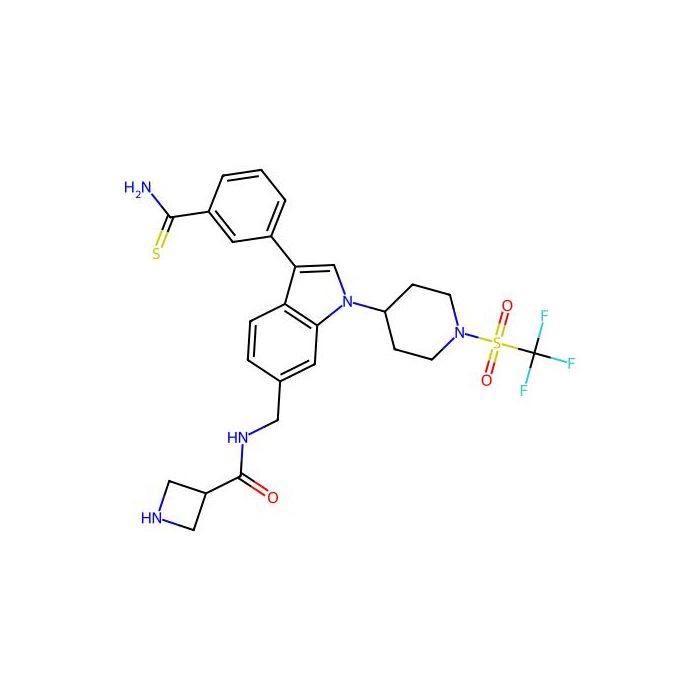
AS-85 is a potent ASH1L histone methyltransferase inhibitor ( IC 50 =0.6 µM) with anti-leukemic activity. AS-85 strongly binds to the ASH1L SET domain, with the K d value of 0.78 µM.
In Vitro
AS-85 inhibits the growth of leukemia cells (MV4;11, MOLM13, and KOPN8) harboring different MLL1 translocations, with GI 50 values ranging from 5 µM to 25 µM, and demonstrates no effect in K562 leukemia cells without MLL1 translocations. MCE has not independently confirmed the accuracy of these methods. They are for reference only.
Form:Solid
Specifications
Specifications & Purity
≥98%
Biochemical and Physiological Mechanisms
AS-85 is a potent ASH1L histone methyltransferase inhibitor ( IC 50 =0.6 µM) with anti-leukemic activity. AS-85 strongly binds to the ASH1L SET domain, with the K d value of 0.78u2009µM.
Storage
Protected from light,Store at -20°C,Desiccated
Shipped In
Ice chest + Ice pads
This product requires cold chain shipping. Ground and other economy services are not available.
Action Type
INHIBITOR
Purity
≥98%
Names and Identifiers
Molecular Weight
579.66
Documentation
📋 Safety Data Sheet (SDS)
Comprehensive hazard, handling, storage, and regulatory compliance document.
Determine the necessary mass, volume, or concentration for preparing a solution.
Dilution Calculator
Determine the dilution needed to prepare a stock solution.
Reconstitution Calculator
Reviews
Customer Reviews
Application Protocols
No tested or validated application protocols are provided for this item in the Product Data. The supplier does not claim suitability for specific assays or techniques for AS-85. Refer to your lab’s SOPs and relevant literature once the compound’s structure and properties are confirmed.
Biological Roles
Item-specific
No biological function, pathway, or mechanism information is provided for AS-85 in this listing.
General statement (not product-specific)
As a compound-library member, any biological role would be context-dependent and determined empirically in specific assays. Until structure and prior art are disclosed, no assumptions should be made regarding targets, potency, selectivity, or ADME properties.
If you plan biochemical/cellular work, confirm identity/purity, establish DMSO stock stability, and perform basic interference checks (e.g., absorbance/fluorescence overlap, redox activity) to avoid assay artifacts.
Buffer Applications
This product is a discrete small molecule rather than a buffering agent. No buffering system or pKa information is provided for AS-85.
General practice (not product-specific):
When dosing small molecules into buffers, verify compatibility with the buffer components (e.g., phosphate, HEPES, Tris) and maintain final DMSO or cosolvent at assay-acceptable levels (commonly ≤0.1–1% v/v).
Pre-screen for precipitation across the working pH range and ionic strength; filter stocks with 0.2 µm PTFE if compatible to remove particulates prior to sensitive assays.
Green Alternatives
Context
AS-85 is a small-molecule library entry, not a bulk solvent or reagent with obvious greener substitutes at the product level.
General greener practices for dissolution/processing (not product-specific)
Prefer lower-toxicity, bio-based, or benign solvents for handling when feasible, subject to solubility and stability constraints.
| Use case | Conventional choice | Greener alternative | Trade-offs |
|---|---|---|---|
| Stock solution | DMSO | Cyrene, GVL | Solubility breadth may be narrower; viscosity higher. |
| Crystallization/washing | Acetone/ACN | Ethyl acetate, IPA | Polarity range changes; drying rates differ. |
| Work-up/extraction | DCM/CHCl3 | EtOAc, 2-MeTHF | Partitioning may change; peroxide checks for ethers required. |
Implement solvent minimization (micro-scale stocks), closed-amber vials to reduce waste from photodegradation, and cold-chain consolidation to reduce shipment impact.
Pharmaceutical Uses
Regulatory/usage status
For research use only. Not for human or veterinary use.
No pharmacopeial status, excipient role, or formulation use is specified for this item.
General note (not product-specific)
If AS-85 is investigated as a development candidate or analytical standard, ensure appropriate GMP/GLP sourcing and documentation. This catalog entry does not provide such qualifications; request CoA and any available impurity/stability data if you require extended quality documentation.
Physical Properties
Item-specific (from Product Data)
Appearance: Not specified for this item; refer to CoA/Spec Sheet.
Melting point: Not specified for this item; refer to CoA/Spec Sheet.
Boiling point: Not specified for this item; refer to CoA/Spec Sheet.
Density: Not specified for this item; refer to CoA/Spec Sheet.
Solubility: Not specified for this item; refer to CoA/Spec Sheet.
LogP/pKa/refractive index: Not specified for this item; refer to CoA/Spec Sheet.
General guidance (literature/practice; not product-specific)
For unknown small molecules in screening libraries, initial solubility scouting is typically performed in DMSO (up to 10–100 mM stocks), followed by dilution into assay media with attention to final DMSO ≤0.1–1% v/v depending on biological system.
If aqueous solubility is needed, a tiered approach is commonly used: DMSO → DMSO:water cosolvent → buffered saline with surfactant (e.g., 0.01–0.05% Tween 80) → pH adjustment within stability limits. Always verify compound stability versus hydrolysis/oxidation.
Hygroscopic or light-sensitive solids may show apparent solubility variations upon moisture uptake or photodegradation; handle under desiccation and subdued light as specified under Storage & Reconstitution.
Quality & Grades
Item-specific (from Product Data)
Grade/purity: Not specified for this item; refer to CoA/Spec Sheet.
How to interpret quality for compound-library materials (general guidance)
Compound library entries are commonly supplied with HPLC/UPLC purity (area %) and identity confirmation (NMR, HRMS/LC–MS). If a numeric purity is required (e.g., ≥95% HPLC), request the current CoA.
Residual solvents, water content (e.g., KF), and counter-ions/salts can affect assay performance and mass balance. These are item-specific and should be verified on the CoA.
If a stabilizer or salt form is used, it will be listed on the CoA/Spec Sheet; absent such a note here, no stabilizer is claimed. Do not assume metal or peroxide specifications—these are not provided for this item.
Reaction & Applications
Item-specific
Manufacturer applications: Not specified for this item.
Scope note
Without a disclosed structure or functional groups, specific synthetic or reaction applications cannot be assigned to AS-85. If your intended use involves chemical transformation, please obtain the structural information (SMILES/InChI) and CoA to evaluate reactivity, compatibility, and hazards.
General research applications for library compounds (not product-specific)
Early-stage screening: Chemical biology assays, phenotypic screens, and target-based HTS as a test article or reference comparator.
SAR exploration: If analog series exist for AS-85, use parallel assays to map activity cliffs and stability windows.
Control materials: Can serve as a procedural positive/negative control in non-biomedical method validation, provided identity/purity are verified.
Reaction Conditions
Specific reaction conditions for AS-85 are not available because the structure and reactive functional groups are not disclosed in this listing.
General advice (not product-specific):
Prior to any synthetic manipulation, obtain structural data and confirm purity. Conduct small-scale test reactions and monitor by LC–MS/UPLC to establish stability windows (temperature, pH, redox environment).
If the compound is light- or moisture-sensitive (storage indicates light protection and desiccation), favor anhydrous techniques, inert atmosphere (N2/Ar), amber glassware, and cooled reactors as needed.
Safety & Handling
Item-specific (from Product Data)
GHS classification / pictograms / signal word / H-statements: Not specified for this item; refer to SDS.
Storage: Store at −20 °C, protected from light, desiccated.
Shipping: Cold shipment (ice chest + ice pads).
General laboratory precautions (not product-specific; always defer to SDS)
PPE: Lab coat, safety glasses, and suitable chemically resistant gloves. Handle powders in a fume hood to avoid inhalation.
Light sensitivity: The product is specified to be protected from light; minimize exposure by using amber vials/foil and working under low ambient light when feasible.
Moisture sensitivity: Desiccation is recommended; keep containers tightly closed, purge headspace with inert gas if practicable.
Incompatibilities: Until structure is confirmed, avoid strong oxidizers/reductants, strong acids/bases, and reactive metals. Segregate from foodstuffs and pharmaceuticals.
First aid (overview): In case of skin or eye contact, rinse with water for at least 15 minutes; if inhaled, move to fresh air; if ingested, seek medical attention. Provide SDS to healthcare providers.
Waste: Collect as organic chemical waste; do not discharge to drains. Follow institutional and local regulations.
Solvent Selection
Item-specific
No solvent recommendations are provided for this specific item; refer to CoA/Spec Sheet.
General solvent strategy for small molecules (literature/practice; not product-specific)
Primary stock solvent: DMSO is typically first choice owing to broad solvency and assay compatibility at low final %.
Secondary options: DMF or NMP (strong polar aprotics), ethanol or isopropanol (protic), or PEG-400 for low-volatility needs. For greener choices, consider Cyrene or GVL where compatible.
Aqueous work: Use cosolvent approaches (e.g., 5–20% DMSO or ethanol), mild heating (≤40 °C), sonication, and pH adjustment within stability limits.
Avoid precipitation upon dilution by pre-warming buffers, adding stock slowly with mixing, and keeping final solvent below assay-allowed thresholds.
Ethanol: Biologically compatible at ≤0.5% v/v; lower solvency than DMSO.
PEG-400: Very low volatility; may increase viscosity and reduce pipetting accuracy at high %.
Storage & Reconstitution
Item-specific (from Product Data)
Storage: Store at −20 °C.
Handling: Protect from light; keep desiccated.
Shipping: Ice chest with ice pads (cold chain).
Reconstitution
Not specified for this item; refer to CoA/Spec Sheet.
General practice (not product-specific)
Allow the sealed container to equilibrate to room temperature before opening to prevent moisture condensation. Open under dry atmosphere if possible.
Prepare concentrated stocks in a suitable solvent (commonly anhydrous DMSO for small molecules), then aliquot into amber vials to minimize freeze–thaw and light exposure. Store aliquots at −20 °C or below, following your lab’s stability program.
Avoid repeated freeze–thaw cycles; thaw on ice or at room temperature, mix gently, and promptly return unused material to cold, dark, desiccated storage.
Record preparation date, solvent, and concentration on the vial and in your ELN; confirm stability periodically by LC–MS/HPLC.
Research use only.
Structure & Identity
Item-specific (from Product Data)
SKU: A648027
Product name: AS-85
CAS: 2323623-80-7
Category: Small molecules and compound library entry (小分子和化合物库)
Molecular formula: Not specified for this item; refer to CoA/Spec Sheet.
Molecular weight: Not specified for this item; refer to CoA/Spec Sheet.
SMILES: Not specified for this item; refer to CoA/Spec Sheet.
InChIKey: Not specified for this item; refer to CoA/Spec Sheet.
Notes on identity
The structure (functional groups, rings, stereochemistry) is not provided in the current listing. Without a structural descriptor (SMILES/InChI), substructure and feature analysis cannot be summarized here.
For unambiguous identification in databases, please use the CAS and request the CoA/Spec Sheet for the full structural definition and analytical characterization (e.g., NMR, MS, HPLC).
Synthetic Utility
Item-specific
The chemical structure and functional groups of AS-85 are not provided; therefore, specific synthetic roles (e.g., electrophile/nucleophile profiles, named-reaction participation) cannot be assigned.
General considerations (not product-specific)
If the structure becomes available, evaluate retrosynthetic disconnections, protecting-group needs, and potential liabilities (e.g., hydrolytically labile esters, oxidizable anilines, photolabile motifs) before planning transformations.
Library members can serve as analytical reference materials for method development (calibration, retention time markers) even when not used as building blocks.
Target Specificity
No target information is provided for AS-85. There are no claims about biological targets, selectivity, or species reactivity in the Product Data. For any intended use as a probe or modulator, rely on primary literature and your own assay data; no target specificity is claimed by the supplier.
We use cookies to ensure the website functions properly and, where permitted, to improve your experience. You can manage your preferences at any time in Settings. Learn more in our Cookie Policy.
Shall we send you a message when we have discounts available?
Remind me later
Thank you! Please check your email inbox to confirm.
Products are supplied to verified businesses, institutions, and qualified professionals for research and development use only. Not for use in humans, animals, diagnosis, or therapy.