
Determine the necessary mass, volume, or concentration for preparing a solution.
| Activity Type | Activity Value -log(M) | Mechanism of Action | Activity Reference | Publications (PubMed IDs) |
|---|
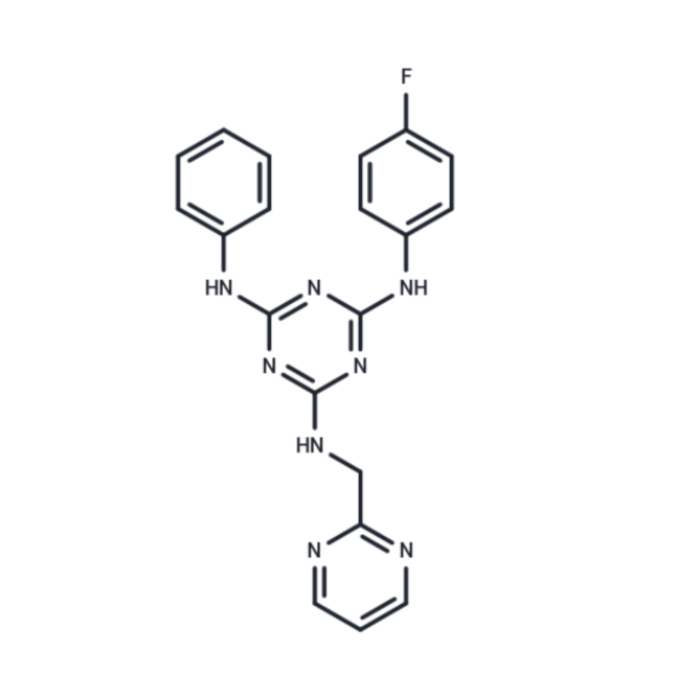
ASP2905 is a potent and selective potassium channel Kv12.2 inhibitor encoded by the Kcnh3/BEC1 gene. ASP2905 can cross the blood-brain barrier and has antipsychotic activities.
In Vivo
ASP2905 treatment inhibits hyperlocomotion induced by Phencyclidine. And significantly ameliorates Phencyclidine-induced prolongation of immobility time in mice subjected to the forced swimming test. MCE has not independently confirmed the accuracy of these methods. They are for reference only. Animal Model: Male ddY mice (aged 4-5 weeks) injected with Phencyclidine hydrochloride (PCP)Dosage: 0.01 mg/kg, 0.03 mg/kg, 0.1 mg/kg, 0.3 mg/kg Administration: Oral administration; once Result: Inhibited hyperlocomotion induced by Phencyclidine.
Form:Solid
Taxonomy Tree
| Kingdom | Organic compounds |
|---|---|
| Superclass | Benzenoids |
| Class | Benzene and substituted derivatives |
| Subclass | Aniline and substituted anilines |
| Intermediate Tree Nodes | Not available |
| Direct Parent | Aniline and substituted anilines |
| Alternative Parents | Secondary alkylarylamines N-aliphatic s-triazines Fluorobenzenes Pyrimidines and pyrimidine derivatives Aryl fluorides 1,3,5-triazines Heteroaromatic compounds Azacyclic compounds Organofluorides Hydrocarbon derivatives |
| Molecular Framework | Aromatic heteromonocyclic compounds |
| Substituents | Aniline or substituted anilines - Amino-1,3,5-triazine - Aminotriazine - Fluorobenzene - Halobenzene - Secondary aliphatic/aromatic amine - N-aliphatic s-triazine - Aryl fluoride - Aryl halide - Pyrimidine - 1,3,5-triazine - Triazine - Heteroaromatic compound - Azacycle - Secondary amine - Organoheterocyclic compound - Organonitrogen compound - Organofluoride - Organohalogen compound - Organic nitrogen compound - Hydrocarbon derivative - Amine - Aromatic heteromonocyclic compound |
| Description | This compound belongs to the class of organic compounds known as aniline and substituted anilines. These are organic compounds containing an aminobenzene moiety. |
| External Descriptors | Not available |
| Activity Type | Activity Value -log(M) | Mechanism of Action | Activity Reference | Publications (PubMed IDs) |
|---|
| Activity Type | Relation | Activity value | Units | Action Type | Journal | PubMed Id | doi | Assay Aladdin ID |
|---|
Find and download the COA for your product by matching the lot number on the packaging.
| Lot Number | Certificate Type | Date | Item |
|---|---|---|---|
 K2606262 | Certificate of Analysis | Sep 20, 2026 | A648825 |
| K2606263 | Certificate of Analysis | Sep 20, 2026 | A648825 |
| K2606264 | Certificate of Analysis | Sep 20, 2026 | A648825 |
| F2506306 | Certificate of Analysis | Nov 07, 2024 | A648825 |
| F2506307 | Certificate of Analysis | Nov 07, 2024 | A648825 |
| F2506308 | Certificate of Analysis | Nov 07, 2024 | A648825 |
| F2506309 | Certificate of Analysis | Nov 07, 2024 | A648825 |
| F2506310 | Certificate of Analysis | Nov 07, 2024 | A648825 |
| F2506311 | Certificate of Analysis | Nov 07, 2024 | A648825 |
| F2506312 | Certificate of Analysis | Nov 07, 2024 | A648825 |
| F2506313 | Certificate of Analysis | Nov 07, 2024 | A648825 |
| F2506314 | Certificate of Analysis | Nov 07, 2024 | A648825 |
| F2506315 | Certificate of Analysis | Nov 07, 2024 | A648825 |
| F2506316 | Certificate of Analysis | Nov 07, 2024 | A648825 |
| F2506317 | Certificate of Analysis | Nov 07, 2024 | A648825 |
| Solubility | DMSO : 100 mg/mL (257.47 mM; Need ultrasonic) |
|---|---|
| Molecular Weight | 388.4 |
| XLogP3 | 4.000 |
| Hydrogen Bond Donor Count | 3 |
| Hydrogen Bond Acceptor Count | 9 |
| Rotatable Bond Count | 7 |
| Exact Mass | 388.156 Da |
| Monoisotopic Mass | 388.156 Da |
| Topological Polar Surface Area | 101.000 Ų |
| Heavy Atom Count | 29 |
| Formal Charge | 0 |
| Complexity | 463.000 |
| Isotope Atom Count | 0 |
| Defined Atom Stereocenter Count | 0 |
| Undefined Atom Stereocenter Count | 0 |
| Defined Bond Stereocenter Count | 0 |
| Undefined Bond Stereocenter Count | 0 |
| The total count of all stereochemical bonds | 0 |
| Covalently-Bonded Unit Count | 1 |
Our grade selection guide covers purity, stabilizer status, and application suitability for all variants in our catalog.
View Moligand™ grade guide →