
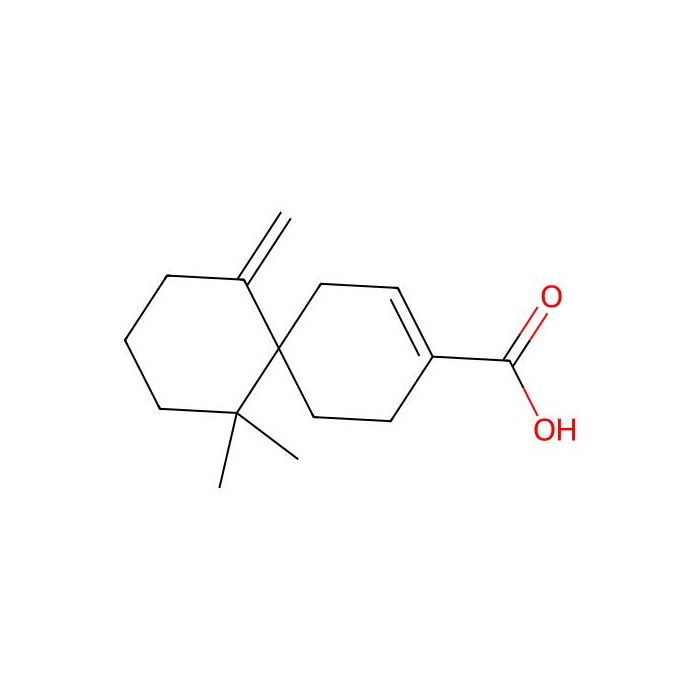
Determine the necessary mass, volume, or concentration for preparing a solution.
β-chamigrenic acid - ≥98% , CAS No.1174388-31-8
AVAILABLE TO ORDER
GRADE & PURITY ≥98%
Storage
Room temperature
Shipped In
Normal
≥98% for sensitive chromatographic and analytical workflows requiring minimal baseline interference.
Room temperature Ships Normal Check lot-specific COA for exact specifications.
SDS, COA, datasheet, and spec sheet available for download. Lot-specific COA accessible via lot number lookup.
Cited in 0 peer-reviewed publications across chromatography, organic synthesis, and cross-coupling reactions.
| Canonical Smiles | CC1(CCCC(=C)C12CCC(=CC2)C(=O)O)C |
|---|---|
| IUPAC Name | 5,5-dimethyl-1-methylidenespiro[5.5]undec-9-ene-9-carboxylic acid |
| InChIKey | TYVCBWCQQAMFRG-UHFFFAOYSA-N |
| INCHI | 1S/C15H22O2/c1-11-5-4-8-14(2,3)15(11)9-6-12(7-10-15)13(16)17/h6H,1,4-5,7-10H2,2-3H3,(H,16,17) |
| Isomeric SMILES | CC1(CCCC(=C)C12CCC(=CC2)C(=O)O)C |
| PubChem CID | 13648246 |
Comprehensive hazard, handling, storage, and regulatory compliance document.
Download SDS →Lot-specific quality data. Enter your lot number to retrieve the exact COA.
Look up COA →Full quality attributes and acceptance criteria for this grade.
View spec sheet →Taxonomy Tree
| Kingdom | Organic compounds |
|---|---|
| Superclass | Lipids and lipid-like molecules |
| Class | Prenol lipids |
| Subclass | Sesquiterpenoids |
| Intermediate Tree Nodes | Not available |
| Direct Parent | Chamigranes |
| Alternative Parents | Monocarboxylic acids and derivatives Carboxylic acids Organic oxides Hydrocarbon derivatives Carbonyl compounds |
| Molecular Framework | Aliphatic homopolycyclic compounds |
| Substituents | Chamigrane sesquiterpenoid - Monocarboxylic acid or derivatives - Carboxylic acid - Carboxylic acid derivative - Organic oxygen compound - Organic oxide - Hydrocarbon derivative - Organooxygen compound - Carbonyl group - Aliphatic homopolycyclic compound |
| Description | This compound belongs to the class of organic compounds known as chamigranes. These are sesquiterpenoids characterized by a 1,1,5,9-tetramethylspiro[5,5]undecane skeleton, formally obtained by linking the C1-C6 and C6-C11 of farnesane together. They are predominantly isolated from algae. |
| External Descriptors | Not available |