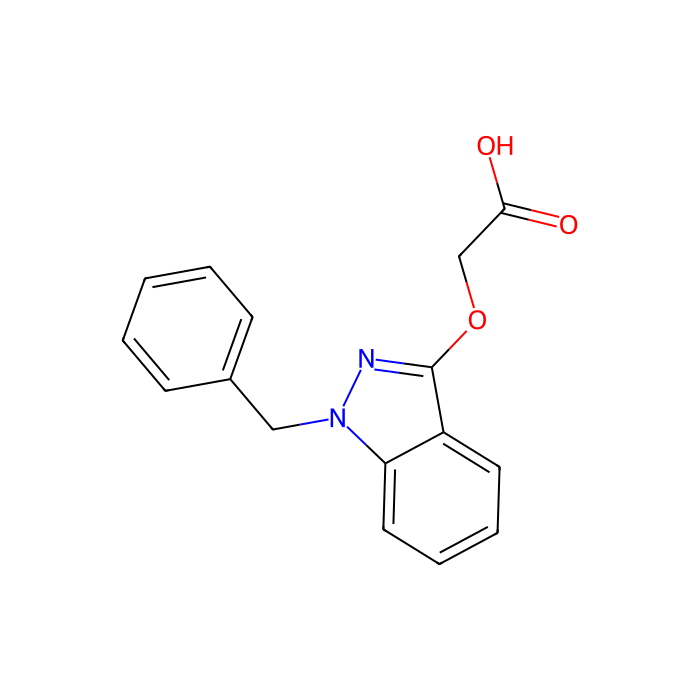
Bendazac - ≥97%(HPLC)(T) , Xanthine dehydrogenase inhibitor, CAS No.20187-55-7, Xanthine dehydrogenase inhibitor

CAS: 20187-55-7 Cat. No.: B153004 Formula: C16H14N2O3 Molecular Weight: 282.3 EC Number: 243-569-2
AVAILABLE TO ORDER
GRADE & PURITY ≥97%(HPLC)(T)
Synonyms
((1-Benzyl-1H-indazol-3-yl)oxy)essigsaeure|Zildasac|BENDAZAC [INN]|[(1-Benzyl-3-indazolyl)oxy]acetic Acid|Acetic acid, [[1-(phenylmethyl)-1H-indazol-3-yl]oxy]-|AF-1934 LYSINE|Bendazacum|Iwazac (TN)|bendazac|2-(1-benzylindazol-3-yl)oxyacetic acid;2-(1-Benzyl-1H-indazol-3-yloxy)acetic Acid|ACETIC ACID, ((1-(PHENYLMETHYL)-1H-INDAZOL-3-YL)OXY)- (2) ((1-BENZYL-1H-INDAZOL-3-YL)OXY)ACETIC ACID.|AF-1934 FREE ACID|Versus|2-(1-benzylindazol-3-yl)oxyacetic acid|Bendaline (Salt/Mix)|BENDAZAC [MART.]|1-Benzyl-3-[1-(carboxy)methoxy]indazole|Bendazac (JAN/USAN/INN)|Bendazolic acid|BENDAZAC [MI]|2-(1-Benzyl-1H-indazol-3-yloxy)acetic Acid|Bindazac; Dogalina; Zildasac; Zildazac|ACETIC ACID, 2-[[1-(PHENYLMETHYL)-1H-INDAZOL-3-YL]OXY]-|AF-983|1-Benzylindazole-3-oxyacetic acid|AF 983|BENDAZAC [JAN]|Bendazacum [INN-Latin]|[(1-Benzyl-1H-indazol-3-yl)oxy]acetic Acid|[(1-BENZYL-1H-indazol-3-yl)-oxy]acetic acid|2-[(1-benzyl-1H-indazol-3-yl)oxy]acetic acid|BENDAZAC [WHO-DD]|Bendazac lysine (Salt/Mix)|Dogalina|((1-Benzyl-1H-indazol-3-yl)oxy)acetic acid|ACETIC ACID, ((1-BENZYL-1H-INDAZOL-3-YL)OXY)-|((1-(Phenylmethyl)-1H-indazol-3-yl)oxy)acetic acid|AF 1934 (Salt/Mix)|Acetic acid, ((1-(phenylmethyl)-1H-indazol-3-yl)oxy)-|Iwazac|[[1-(Phenylmethyl)-1H-indazol-3-yl]oxy]acetic acid|Bindazac|AF 1934 [LYSINE]|AF 1934 FREE ACID|Bendazaco [INN-Spanish]|(1-BENZYL-1H-INDAZOL-3-YLOXY)-ACETICACID|Bendazac [USAN:INN:BAN:JAN]|Bendazaco
Storage
Room temperature
Shipped In
Normal
★
Size
USA
Germany (EU)*
Price
Qty
1g
B153004-1g
5 In stock
—
$29.90
5g
B153004-5g
5 In stock
—
$89.90
25g
B153004-25g
4 In stock
—

$238.90

$401.90
Save $163.00 (40.56%)
100g
B153004-100g
1 In stock
—

$844.90

$1,446.90
Save $602.00 (41.61%)
Enter a quantity for the sizes you want to add.

Specifications

Synonyms
((1-Benzyl-1H-indazol-3-yl)oxy)essigsaeure | Zildasac | BENDAZAC [INN] | [(1-Benzyl-3-indazolyl)oxy]acetic Acid | Acetic acid, [[1-(phenylmethyl)-1H-indazol-3-yl]oxy]- | AF-1934 LYSINE | Bendazacum | Iwazac (TN) | bendazac | 2-(1-benzylindazol-3-yl)oxyacetic acid;2-(1-Benzyl-1H-indazol-3-yloxy)acetic Acid | ACETIC ACID, ((1-(PHENYLMETHYL) Show more
Specifications & Purity
≥97%(HPLC)(T)
Storage
Room temperature
Shipped In
Normal
Action Type
INHIBITOR
Mechanism of action
Xanthine dehydrogenase inhibitor
Purity
≥97%(HPLC)(T)
Product Properties
ALogP
3.1
Names and Identifiers
Pubchem Sid
Pubchem Sid Url
https://pubchem.ncbi.nlm.nih.gov/substance/488179685
SMILES
C1=CC=C(C=C1)CN2C3=CC=CC=C3C(=N2)OCC(=O)O
IUPAC Name
2-(1-benzylindazol-3-yl)oxyacetic acid
InChIKey
BYFMCKSPFYVMOU-UHFFFAOYSA-N
InChI
1S/C16H14N2O3/c19-15(20)11-21-16-13-8-4-5-9-14(13)18(17-16)10-12-6-2-1-3-7-12/h1-9H,10-11H2,(H,19,20)
Isomeric SMILES
C1=CC=C(C=C1)CN2C3=CC=CC=C3C(=N2)OCC(=O)O
RTECS
AF5085000
Molecular Weight
282.3
Reaxys
893958
Reaxys-RN_link_address
https://www.reaxys.com/reaxys/secured/hopinto.do?context=S&query=IDE.XRN=893958&ln=

Advanced Data

Taxonomic Classification

Taxonomy Tree

KingdomOrganic compounds
SuperclassOrganoheterocyclic compounds
ClassBenzopyrazoles
SubclassIndazoles
Intermediate Tree Nodes Not available
Direct ParentIndazoles
Alternative Parents Alkyl aryl ethers  Benzene and substituted derivatives  Pyrazoles  Heteroaromatic compounds  Monocarboxylic acids and derivatives  Carboxylic acids  Azacyclic compounds  Organopnictogen compounds  Organonitrogen compounds  Organic oxides  Hydrocarbon derivatives  Carbonyl compounds  
Molecular FrameworkAromatic heteropolycyclic compounds
Substituents Benzopyrazole - Indazole - Alkyl aryl ether - Monocyclic benzene moiety - Benzenoid - Azole - Heteroaromatic compound - Pyrazole - Carboxylic acid derivative - Azacycle - Carboxylic acid - Ether - Monocarboxylic acid or derivatives - Organic nitrogen compound - Organonitrogen compound - Organooxygen compound - Hydrocarbon derivative - Carbonyl group - Organic oxide - Organopnictogen compound - Organic oxygen compound - Aromatic heteropolycyclic compound
DescriptionThis compound belongs to the class of organic compounds known as indazoles. These are compounds containing an indazole, which is structurally characterized by a pyrazole fused to a benzene.
External Descriptors monocarboxylic acid - indazoles
3D Structure
Interactive Chemical Structure Model


Associated Targets(Human)
F2 Tclin Thrombin (11687 Activities)
Activity TypeRelationActivity valueUnitsAction TypeJournalPubMed IddoiAssay Aladdin ID
ESR1 Tclin Estrogen receptor alpha (17718 Activities)
Activity TypeRelationActivity valueUnitsAction TypeJournalPubMed IddoiAssay Aladdin ID
PGR Tclin Progesterone receptor (8562 Activities)
Activity TypeRelationActivity valueUnitsAction TypeJournalPubMed IddoiAssay Aladdin ID
CHRM2 Tclin Muscarinic acetylcholine receptor M2 (10671 Activities)
Activity TypeRelationActivity valueUnitsAction TypeJournalPubMed IddoiAssay Aladdin ID
HTR1A Tclin Serotonin 1a (5-HT1a) receptor (14969 Activities)
Activity TypeRelationActivity valueUnitsAction TypeJournalPubMed IddoiAssay Aladdin ID
ADRA2A Tclin Alpha-2a adrenergic receptor (9450 Activities)
Activity TypeRelationActivity valueUnitsAction TypeJournalPubMed IddoiAssay Aladdin ID
AR Tclin Androgen Receptor (11781 Activities)
Activity TypeRelationActivity valueUnitsAction TypeJournalPubMed IddoiAssay Aladdin ID
CHRM1 Tclin Muscarinic acetylcholine receptor M1 (12690 Activities)
Activity TypeRelationActivity valueUnitsAction TypeJournalPubMed IddoiAssay Aladdin ID
MAOA Tclin Monoamine oxidase A (11911 Activities)
Activity TypeRelationActivity valueUnitsAction TypeJournalPubMed IddoiAssay Aladdin ID
DRD1 Tclin Dopamine D1 receptor (9720 Activities)
Activity TypeRelationActivity valueUnitsAction TypeJournalPubMed IddoiAssay Aladdin ID
ACHE Tclin Acetylcholinesterase (18204 Activities)
Activity TypeRelationActivity valueUnitsAction TypeJournalPubMed IddoiAssay Aladdin ID
PTGS1 Tclin Cyclooxygenase-1 (9233 Activities)
Activity TypeRelationActivity valueUnitsAction TypeJournalPubMed IddoiAssay Aladdin ID
SLC6A2 Tclin Norepinephrine transporter (10102 Activities)
Activity TypeRelationActivity valueUnitsAction TypeJournalPubMed IddoiAssay Aladdin ID
SLC6A4 Tclin Serotonin transporter (12625 Activities)
Activity TypeRelationActivity valueUnitsAction TypeJournalPubMed IddoiAssay Aladdin ID
ADRA1A Tclin Alpha-1a adrenergic receptor (8359 Activities)
Activity TypeRelationActivity valueUnitsAction TypeJournalPubMed IddoiAssay Aladdin ID
OPRM1 Tclin Mu opioid receptor (19785 Activities)
Activity TypeRelationActivity valueUnitsAction TypeJournalPubMed IddoiAssay Aladdin ID
DRD3 Tclin Dopamine D3 receptor (14368 Activities)
Activity TypeRelationActivity valueUnitsAction TypeJournalPubMed IddoiAssay Aladdin ID
SLC6A3 Tclin Dopamine transporter (10535 Activities)
Activity TypeRelationActivity valueUnitsAction TypeJournalPubMed IddoiAssay Aladdin ID
KCNH2 Tclin HERG (29587 Activities)
Activity TypeRelationActivity valueUnitsAction TypeJournalPubMed IddoiAssay Aladdin ID
PDE3A Tclin Phosphodiesterase 3A (3309 Activities)
Activity TypeRelationActivity valueUnitsAction TypeJournalPubMed IddoiAssay Aladdin ID
HTR2B Tclin Serotonin 2b (5-HT2b) receptor (10323 Activities)
Activity TypeRelationActivity valueUnitsAction TypeJournalPubMed IddoiAssay Aladdin ID
TBXA2R Tclin Thromboxane A2 receptor (5717 Activities)
Activity TypeRelationActivity valueUnitsAction TypeJournalPubMed IddoiAssay Aladdin ID
PDE4A Tclin Phosphodiesterase 4A (1943 Activities)
Activity TypeRelationActivity valueUnitsAction TypeJournalPubMed IddoiAssay Aladdin ID
ADORA3 Tchem Adenosine A3 receptor (15931 Activities)
Activity TypeRelationActivity valueUnitsAction TypeJournalPubMed IddoiAssay Aladdin ID
HRH3 Tclin Histamine H3 receptor (10389 Activities)
Activity TypeRelationActivity valueUnitsAction TypeJournalPubMed IddoiAssay Aladdin ID
KDR Tclin Vascular endothelial growth factor receptor 2 (20924 Activities)
Activity TypeRelationActivity valueUnitsAction TypeJournalPubMed IddoiAssay Aladdin ID
Homo sapiens (32628 Activities)
Activity TypeRelationActivity valueUnitsAction TypeJournalPubMed IddoiAssay Aladdin ID
ABCB11 Tchem Bile salt export pump (2311 Activities)
Activity TypeRelationActivity valueUnitsAction TypeJournalPubMed IddoiAssay Aladdin ID
Associated Targets(non-human)
Hdac6 Histone deacetylase 6 (222 Activities)
Activity TypeRelationActivity valueUnitsAction TypeJournalPubMed IddoiAssay Aladdin ID
Plasmodium falciparum (966862 Activities)
Activity TypeRelationActivity valueUnitsAction TypeJournalPubMed IddoiAssay Aladdin ID
Rattus norvegicus (775804 Activities)
Activity TypeRelationActivity valueUnitsAction TypeJournalPubMed IddoiAssay Aladdin ID
rep Replicase polyprotein 1ab (378 Activities)
Activity TypeRelationActivity valueUnitsAction TypeJournalPubMed IddoiAssay Aladdin ID
SARS-CoV-2 (38078 Activities)
Activity TypeRelationActivity valueUnitsAction TypeJournalPubMed IddoiAssay Aladdin ID
Mechanisms of Action
Certificates (CoA,COO,BSE/TSE and Analysis Chart)
C of A & Other Certificates(BSE/TSE, COO):
Analytical Chart:

Find and download the COA for your product by matching the lot number on the packaging.

4 results found

Lot NumberCertificate TypeDateItem
D1912069D1912069Certificate of AnalysisOct 09, 2026 B153004
E2330147E2330147Certificate of AnalysisJan 09, 2023 B153004
E2330151E2330151Certificate of AnalysisJan 09, 2023 B153004
E2330154E2330154Certificate of AnalysisJan 09, 2023 B153004
Chemical and Physical Properties
SolubilityInsoluble in water; Soluble in Acetone,Chloroform; Slightly soluble in Ethanol; Very slightly soluble in Ether
Melt Point162 °C
Molecular Weight282.29
XLogP33.100
Hydrogen Bond Donor Count1
Hydrogen Bond Acceptor Count4
Rotatable Bond Count5
Exact Mass282.1 Da
Monoisotopic Mass282.1 Da
Topological Polar Surface Area64.400 Ų
Heavy Atom Count21
Formal Charge0
Complexity357.000
Isotope Atom Count0
Defined Atom Stereocenter Count0
Undefined Atom Stereocenter Count0
Defined Bond Stereocenter Count0
Undefined Bond Stereocenter Count0
The total count of all stereochemical bonds0
Covalently-Bonded Unit Count1
Safety and Hazards(GHS)
Pictogram(s)
Signal
Warning
Hazard Statements

H302:Harmful if swallowed

Precautionary Statements

P264:Wash hands [and …] thoroughly after handling.

P270:Do not eat, drink or smoke when using this product.

P330:Rinse mouth.

P301+P312:IF SWALLOWED: call a POISON CENTER/doctor/... IF you feel unwell.

P501:Dispose of contents/container to an approved waste disposal plant.

RTECS
AF5085000
Reaxys
893958
Reaxys-RN_link_address
https://www.reaxys.com/reaxys/secured/hopinto.do?context=S&query=IDE.XRN=893958&ln=
Merck Index
1035
Solution Calculators
Reviews

Customer Reviews

Application Protocols

No tested application protocols are provided in the product data for this item. The following are general, structure-agnostic procedures to help initiate work with a small organic research compound:

  • Stock solution preparation: Dissolve in a suitable solvent (DMSO, MeOH, ACN, or ethanol) to 10–100 mM depending on solubility. Filter through 0.22 μm PTFE/nylon. Document concentration by weight and, if chromophoric, by UV-Vis using an extinction coefficient determined empirically.
  • Aliquoting: Dispense into amber microvials under inert headspace if air/light sensitivity is suspected; avoid repeated freeze–thaw by preparing single-use aliquots.
  • Analytical method setup: Develop an HPLC/UPLC method using a C18 column with water/ACN (+0.1% FA) or water/MeOH gradients; record retention time and MS data for identity tracking.
  • Stability checks: Incubate working solutions at bench, 4 °C, and 37 °C for 24–72 h; assess by LC to establish handling windows. For solid, run DSC/TGA for thermal onset and humidity cycling for hygroscopicity.
  • Bioassay dosing (research only): Keep final DMSO ≤0.5–1% v/v unless justified by controls. Validate absence of precipitation at working concentrations.

Always adapt parameters after confirming the exact structure and consulting the lot-specific CoA/SDS.

Biological Roles

No biological function or pathway information is provided for this item in the product data. As listed, the product is for research use only.

General guidance (non-clinical, non-item-specific):

  • If this compound is to be used in biochemical or cellular assays, first confirm identity and purity and establish a verified stock solution protocol (solvent, concentration, storage). Assess cytotoxicity and off-target effects empirically in your specific system before mechanistic studies.
  • For target discovery or phenotypic screens, incorporate proper negative/vehicle controls (e.g., 0.1–1% DMSO) and positive controls relevant to the pathway of interest. Pre-screen for assay interference (e.g., absorbance/fluorescence overlap, redox-reactivity) using standard panels.
  • ADME surrogates: If relevant to your research, evaluate basic in vitro properties such as kinetic solubility (pH 2/7.4), chemical stability, and microsomal stability only after structural verification. These data are context-dependent and should not be generalized from unverified literature.

Important: No medical, diagnostic, or therapeutic claims are made for this product. Any investigation of biological roles must be conducted strictly within research-use-only frameworks and with full verification of chemical identity and lot-specific purity.

Buffer Applications

This product is not supplied as a buffering agent, and item-specific acid/base properties (pKa values, ionic state) are not provided.

  • Applicability: Unless the compound is confirmed to be a weak acid/base with appropriate pKa near the intended operating pH, it is not typically used as a buffer component.
  • If formulation into aqueous media is required for research, consider standard biological buffers (e.g., phosphate, HEPES, Tris, MOPS) and use this compound only as a solute at research concentrations after establishing solubility and stability.
  • Practical tip: For aqueous work, determine pH-dependent solubility after verifying structure. Prepare stock solutions in suitable co-solvents (e.g., DMSO, ACN, or ethanol) and dilute into buffer while monitoring for precipitation. Maintain final organic co-solvent content at assay-compatible levels (often ≤0.5–1% v/v in cell-based assays).

Conclusion: Buffer applications are generally not applicable without confirmed acid/base characteristics. Refer to sections on Solvent Selection and Storage & Reconstitution for handling in solution.

Green Alternatives

Without item-specific solvent and process usage patterns, green chemistry considerations focus on general decision points:

  • Solvent choice hierarchy: Prefer water, ethanol, isopropanol, ethyl acetate, and 2-MeTHF over chlorinated and high-toxicity solvents where feasible. For nonaqueous polar media, consider Cyrene, propylene carbonate, or CPME as greener substitutes to DMF/NMP/THF when compatible.
  • Energy efficiency: If reactions with this compound require heating, assess microwave or flow chemistry to reduce energy input and reaction time once stability is confirmed.
  • Workup minimization: Replace halogenated wash solvents with greener alternatives (e.g., EtOAc or MTBE) where effective. Evaluate solid-phase workups or telescoped sequences to reduce solvent use.
  • Catalysis: Favor catalytic over stoichiometric reagents (e.g., organocatalysts, heterogeneous catalysts) once functional group tolerance is known.
  • Waste: Segregate halogenated from non-halogenated waste; implement solvent recycling for high-volume steps.

Illustrative solvent comparison (general):

  • DCM/CHCl3 (traditional) → EtOAc/MTBE or toluene/EtOAc blends (greener, lower toxicity)
  • DMF/NMP (traditional polar aprotic) → Cyrene/PC/DMSO (when compatible with reaction and workup)
  • THF (peroxide former) → 2-MeTHF/CPME (biobased options; check reactivity and water content tolerance)

Always verify that substitutions maintain yield, purity, and selectivity after you have confirmed the compound’s structure and stability profile.

Pharmaceutical Uses

No pharmacopeial grade, excipient role, or formulation details are provided in the product data for this item. This product is supplied strictly for research use only and is not intended for human or veterinary applications.

General R&D formulation guidance (non-clinical, non-item-specific):

  • If the compound will be evaluated in preclinical experiments, first confirm identity and purity. Establish a reference batch and analytical methods (HPLC/UPLC, LC-MS, NMR) for stability-indicating assays.
  • Solubilization: Determine kinetic and thermodynamic solubility in relevant media. Consider co-solvents (DMSO, PEG 400), surfactants (Tween 80, Cremophor EL), or cyclodextrin inclusion if compatible with your biological system. Validate no interference with readouts.
  • Solid-state considerations: If the compound is crystalline, screen for polymorphs or amorphous forms using PXRD/DSC. This can influence dissolution and stability in research formulations.
  • Sterility: For in vivo research work, sterile-filter final solutions through 0.22 μm membranes where feasible. Confirm absence of particulates and precipitation upon dilution.

Important: No claims are made regarding therapeutic activity, safety, efficacy, or regulatory status. Do not use for clinical diagnosis, treatment, or manufacturing of drug products.

Physical Properties

Item-specific physicochemical constants are not provided in this listing. Use the lot-specific CoA or SDS for authoritative values.

  • Appearance: Not specified for this item; refer to CoA/Spec Sheet.
  • Molecular weight: Not specified for this item; refer to CoA/Spec Sheet.
  • Molecular formula: Not specified for this item; refer to CoA/Spec Sheet.
  • Melting point: Not specified for this item; refer to CoA/Spec Sheet.
  • Boiling point: Not specified for this item; refer to CoA/Spec Sheet.
  • Density: Not specified for this item; refer to CoA/Spec Sheet.
  • Refractive index: Not applicable/unknown (typically for liquids); refer to CoA if applicable.
  • pKa(s): Not specified for this item; refer to literature after confirming structure.
  • LogP/logD: Not specified for this item; refer to literature after confirming structure.
  • Vapor pressure: Not specified for this item; refer to SDS.
  • Water solubility: Not specified for this item; refer to CoA/Spec Sheet.
  • Organic solvent solubility: Not specified for this item; preliminary solubility screening in common lab solvents (e.g., MeOH, EtOH, ACN, DMSO) is recommended.

General laboratory guidance (non-item-specific):

  • When properties are unknown, perform a micro-scale solubility screen in progressively polar solvents (hexanes → EtOAc → DCM → MeOH/EtOH → ACN → DMF/DMSO → water/buffers) at ambient temperature and at 40–50 °C with gentle agitation.
  • Record hygroscopicity or deliquescence behavior by monitoring mass change upon exposure to ambient humidity. If hygroscopic, handle in a dry box or quickly cap bottles.
  • For thermal behavior, use DSC/TGA on first receipt to determine onset of decomposition before any scale-up operations.
Quality & Grades
  • Grade/Purity: Not specified for this item; refer to CoA/Spec Sheet for assay, residual solvents, and impurity profiles.

Guidance on grades (general, for context):

  • Research grade: Suitable for exploratory lab work. Impurities and moisture limits may be broader; confirm suitability for sensitive assays.
  • Analytical/HPLC grade (if applicable): Emphasizes low UV background and particulate load for chromatographic work; UV cutoff and metal content are typically controlled. Not specified for this item; refer to CoA/Spec Sheet.
  • Pharmaceutical/USP/EP grade: Includes compendial tests and tighter impurity limits; not indicated for this item.

Quality considerations for this listing:

  • Because item-specific assay and stabilizer information are not provided, users should qualify each lot via orthogonal tests relevant to their application (e.g., HPLC purity, NMR, KF water, GC residual solvents, and, if needed, ICP-MS elemental screen). Specific limits (e.g., water ppm, peroxides, metals, UV cutoff) are Not specified for this item; refer to CoA/Spec Sheet.
  • If the compound is used as a reference standard or in structure–activity studies, secure a traceable reference (internally or from a certified provider) and document system suitability criteria (retention time, response factor, purity by area%, and peak identity by MS/NMR).
  • Stability/stabilizers: None indicated in the product data; if stability is critical, perform a short isothermal stability study at the intended storage condition before long-term use.
Reaction & Applications

Manufacturer Applications: Not specified in the product data for this item.

Given the absence of confirmed structure and reactivity profile, reaction-specific guidance must be developed after verifying the compound’s identity and functional groups. The following is general best practice for integrating an unknown or variably specified small organic compound into a synthetic workflow:

  • Identity confirmation: Acquire 1H/13C NMR, HRMS (ESI/APCI as appropriate), and FT-IR to map key functional groups (carbonyls, aromatic systems, heteroatoms). If chirality is suspected, add chiral HPLC or optical rotation.
  • Reactivity scouting: Run micro-scale tests under representative conditions (acidic/basic media, nucleophilic/electrophilic reagents, mild oxidants/reductants) to assess stability windows before scale-up.
  • Protection strategies: If protic or nucleophilic sites are present (alcohols, amines, acids), standard protecting groups (silyl ethers, carbamates, esters) can be screened; select conditions benign to potentially labile motifs (avoid strong mineral acids/bases until stability known).
  • Purification: Begin with normal-phase silica gel chromatography using a polarity gradient determined from TLC/UPLC scouting; if compound is polar/ionic, consider reverse-phase isolation.
  • Analytical controls: Establish in-process controls (IPC) based on the most sensitive orthogonal readout (e.g., LC-MS) to monitor conversions without overexposure to harsh conditions.

Note: Once the definitive structure for Bendazac is verified for your lot, re-consult literature specific to that scaffold for named transformations and compatibility.

Reaction Conditions

No reaction condition ranges specific to this item are provided. Until the compound’s structure and functional groups are verified, any reaction planning should proceed via small-scale scouting under conservative conditions.

General guidance for condition scouting (structure-agnostic):

  • Temperature: Begin at ambient temperature; escalate in 10–20 °C increments while monitoring by TLC/LC-MS. Avoid exceeding 80–100 °C until thermal stability is characterized by DSC/TGA.
  • Atmosphere: Use inert gas (N2/Ar) when moisture/oxygen sensitivity is possible or unknown.
  • Solvent: Select from the least hazardous solvent compatible with solubility and reactivity. Conduct a micro-solvent screen (e.g., EtOAc, toluene, MeCN, MeOH, DCM, 2-MeTHF, DMF/DMSO) to identify optimal media.
  • Catalysts/reagents: Start with milder reagents and catalytic loadings; evaluate compatibility stepwise (acid/base sensitivity, redox sensitivity). If cross-coupling is contemplated (post-structure verification), begin with standard Pd(0/II) systems at 0.5–2 mol%.
  • Time: Monitor closely at early time points (5–30 min) to map kinetics and degradation.
  • Workup: Favor buffered aqueous quench and liquid–liquid extraction with greener solvents where possible; confirm no decomposition during quench.

Literature benchmarks: Because the exact identity is not confirmed here, no literature yields or named-reaction parameters are quoted for this listing. Incorporate validated conditions only after establishing the compound’s definitive structure.

Safety & Handling

Authoritative safety information must be taken from the lot-specific SDS. The product data does not list GHS classification, H-statements, or pictograms for this item.

  • GHS classification: Not specified for this item; refer to SDS.
  • Signal word: Not specified for this item; refer to SDS.
  • Hazard (H) statements: Not specified for this item; refer to SDS.
  • Precautionary (P) statements: Follow general laboratory chemical hygiene and SDS guidance.

General laboratory precautions (appropriate when specific hazards are unknown):

  • PPE: Lab coat, safety glasses or splash goggles, and appropriate chemically resistant gloves (e.g., nitrile). Work in a fume hood to minimize inhalation exposure to particulates or vapors.
  • Avoid inhalation of dust/aerosols; avoid skin and eye contact. Do not ingest. Wash thoroughly after handling.
  • Incompatibilities: When structure is not verified, segregate from strong oxidizers and strong acids/bases until reactivity is known. Avoid heating above unknown decomposition temperatures.
  • First aid (overview; defer to SDS): If on skin/eyes, rinse with water for at least 15 minutes and remove contaminated clothing. If inhaled, move to fresh air; seek medical attention if symptoms persist. If ingested, rinse mouth and seek medical attention—do not induce vomiting unless directed by medical personnel.
  • Spill/accident response: Avoid dust generation. Sweep up solids or absorb solutions with inert material; place in suitable container for disposal per local regulations.
  • Waste: Dispose as organic laboratory chemical waste following institutional and local environmental regulations.
Solvent Selection

Item-specific solubility and polarity data are not provided for this listing. Select solvents empirically based on preliminary screening and your experimental constraints.

General solvent selection strategy when properties are unknown:

  • Start with a tiered solubility screen (small scale, 1–5 mg): hexanes, toluene, DCM/CHCl3, EtOAc/MTBE, acetone/MEK, MeOH/EtOH/iPrOH, ACN, DMF/DMA/DMSO, water/buffer (pH 2–10 if appropriate). Warm gently (≤50 °C) if needed.
  • If protic behavior is suspected, evaluate pH-dependent solubility: prepare buffered aqueous solutions across pH 2, 5, 7.4, 9–10. Use co-solvents (e.g., 0–50% ACN or MeOH) to aid dissolution for analytical work.
  • For moisture-sensitive reactions, use rigorously dried solvents (molecular sieves or distillation) and handle under inert atmosphere until sensitivity is ruled out.

Analytical compatibility:

  • For LC-UV: Choose low-UV solvents (water/ACN or water/MeOH); ensure compound has detectable chromophores before relying on UV.
  • For LC-MS: Favor volatile buffers (e.g., 0.1% formic acid or ammonium acetate) and MS-friendly solvents (ACN/MeOH).

Comparative notes:

  • DMSO and DMF offer broad solubilization power for stock solutions but may complicate certain reactions and biological assays; minimize final DMSO content in bioassays (often ≤0.5–1% v/v) and confirm tolerance.
  • For crystallization or polymorph work, use solvent/anti-solvent pairs identified from the solubility screen (e.g., EtOAc/hexanes, ACN/water).
Storage & Reconstitution
  • Storage conditions (product data): Room temperature.
  • Shipped in (product data): Normal.

Additional storage guidance (general, pending item-specific data):

  • Keep container tightly closed in a dry, well-ventilated place. Protect from excessive heat and direct sunlight. If the compound is light-sensitive (unknown here), prefer amber glass.
  • Moisture sensitivity: Unknown. If hygroscopicity is observed, store in a desiccator or under inert gas. Include a fresh desiccant pack after first opening.
  • Long-term stability: Not specified for this item; refer to CoA/Spec Sheet. If critical, perform a 1–3 month stability check at intended storage conditions and an accelerated condition (e.g., 40 °C/ambient RH) with LC monitoring.

Reconstitution/solution handling:

  • Solubility and preferred solvents: Not specified for this item; perform a small-scale solvent screen (DMSO, MeOH, EtOH, ACN, DMF, water/buffer if applicable).
  • Stock solutions: Prepare at a concentration appropriate for your assay (e.g., 10–100 mM), filter sterilize if needed, and aliquot to minimize freeze–thaw. For aqueous use, adjust pH only after confirming acid/base properties.
  • Freeze–thaw guidance: If solutions are frozen for convenience, avoid repeated cycles; store single-use aliquots at ≤−20 °C in compatible vials. Inspect for precipitation or degradation upon thawing.

Always defer to the lot-specific CoA and SDS for definitive storage limits, container compatibility, and stability information.

Structure & Identity

Overview: The product is listed as Bendazac (CAS 20187-55-7). Item-specific structural descriptors are not provided in this listing. Where exact identifiers are missing, consult the current Certificate of Analysis (CoA) or SDS.

  • Item name: Bendazac
  • CAS: 20187-55-7 (product data)
  • PubChem CID: 2313 (product data; verify before use if critical)
  • InChIKey: 37441 (product data; appears non-standard format; verify on CoA/SDS)
  • SMILES: Not specified for this item; refer to CoA/Spec Sheet.
  • Molecular formula: Not specified for this item; refer to CoA/Spec Sheet.
  • Molecular weight: Not specified for this item; refer to CoA/Spec Sheet.

Structural features (general guidance):

  • Functional-group and ring-system details are not provided in the product data. Without a verified structure (SMILES/InChI), stereochemistry, aromaticity, and heteroatom content cannot be authoritatively described here.
  • If you require an exact 2D/3D depiction for method development or registration dossiers, request the current structure file (SDF/MOL) from your internal database or verify using authoritative chemical registries matched to the exact CAS on the CoA.

Practical identity controls (general):

  • Recommended orthogonal checks prior to critical use: HRMS (accurate mass), 1H/13C NMR (identity/purity), and HPLC/UPLC (retention time vs. reference standard). Where UV activity is expected, record UV-Vis spectrum for fingerprinting.
  • For regulated workflows, document batch-specific identity by matching against the lot-specific CoA (appearance, purity assay, and chromatographic method where available).
Synthetic Utility

Specific functional groups and reactivity for this item cannot be detailed because structure-level information (SMILES/InChI) and functional motifs are not provided in the listing. Consequently, concrete guidance on its role as a building block, protecting-group handle, or coupling partner is not furnished here.

General strategy to assess synthetic utility after identity confirmation:

  • Functional group mapping: Use 1H/13C NMR, FT-IR, and HRMS to identify carbonyls, heteroatoms, aromatic systems, or potential leaving groups. If present, evaluate compatibility with standard transformations (e.g., amide coupling, esterification, SNAr, cross-coupling) in small-scale tests.
  • Stability profiling: Probe resistance to hydrolysis (acid/base), oxidation (air/peroxides), and reduction (borohydrides/hydrosilanes) to define process windows.
  • Derivatization: If the compound contains modifiable handles (e.g., carboxylic acid, phenol, aniline, halide), standard derivatizations can create analogs for SAR or analytical derivatization for GC/LC detectability.
  • Purification: Choose normal- or reverse-phase chromatography depending on polarity; consider salt formation or crystallization if acid/base sites are present.

Once the definitive structure for Bendazac is verified for your lot, consult primary literature and reaction databases for scaffold-specific named reactions, coupling conditions, and chemoselectivity trends.

Target Specificity

Target-binding specificity, if any, is not provided for this item. No antibody/biologic information (antigen, clone, isotype, species reactivity) is applicable, as this is listed as a small-molecule research chemical.

  • Tested biological targets: Not specified for this item; refer to your internal data or literature after confirming structure.
  • Mechanistic annotations: Not provided. Any assignment of target selectivity should be based on experimentally verified assays run with authenticated material.

Note: For screening campaigns, include orthogonal assay formats (biochemical vs. cellular) and apply counterscreens to deconvolute aggregate-based or redox-cycling artifacts. Use PAINS/REOS filters judiciously only after definitive structure confirmation.

Shall we send you a message when we have discounts available?

Remind me later

Thank you! Please check your email inbox to confirm.

Oops! Notifications are disabled.