
Determine the necessary mass, volume, or concentration for preparing a solution.
| Activity Type | Relation | Activity value | Units | Action Type | Journal | PubMed Id | doi | Assay Aladdin ID |
|---|
10% solution in Benzisothiazolinone for sensitive chromatographic and analytical workflows requiring minimal baseline interference.
Room temperature,Argon charged Ships Normal Check lot-specific COA for exact specifications.
SDS, COA, datasheet, and spec sheet available for download. Lot-specific COA accessible via lot number lookup.
Cited in 14 peer-reviewed publications across chromatography, organic synthesis, and cross-coupling reactions.
Application
BIT-10 preservative is a colorless or pale yellow transparent liquid, which is an effective bacteriostatic agent for clinical blood cell analysis, biochemical analysis and immunoassay, including various reagents, quality control products, calibration products, diluents, cleaning solutions and buffers. Because the product has a wide range of the effect of inhibiting microbial growth, excellent compatibility and stability, low toxicity and biodegradability, BIT - 10 bacteriostatic agent as a kind of ideal, can replace sodium azide (drama) inflammable, explosive, thimerosal (including organic mercury) and gentamycin (yi resistance) traditional bacteriostatic agent such as a new type of antibacterial products. The product has a wide range of inhibition of microbial growth, good compatibility and stability, low toxicity and biodegradable, so that the diagnostic reagent has a longer period of validity and bottle opening validity. During the use of the clinical test instrument in the hospital, it is easy to catch bacteria.
Advantage
BIT-10 preservative has become an ideal and effective preservative for in vitro diagnostic reagents due to its broad spectrum activity, excellent compatibility and stability, and low toxicity at the application concentration. It is compatible with all kinds of emulsifiers, surfactants and other components, and can be dissolved in any alcohol or water. Strong stability, stored at -20℃ to 40℃ for a year without change, the active ingredient can withstand the high temperature of 150℃.Therefore, it has a long-term protection function, and can protect the system from the erosion of bacteria, mold and yeast. The fungicide is one of the new generation of industrial fungicides rising in the world. In the early 1980s imperial chemical industries invested 5.5 million pounds to develop a continuous process. The study on the synthesis of this fungicide was started in 1982 in China. The original powder of BIT is a solid powder with a melting point of 156℃, a solubility of 0.14% in water at 25℃, and a solubility of 1.5% at 90℃. However, the sodium salt or potassium salt of the product is easily soluble in water. The BIT-10 of crystal albicide is compounded with potassium hydroxide solution, which makes the product more stable. And PC isothiazolinone series of antibacterial agents to form a synergisticantibacterial effect. Its features and advantages include but are not limited to:
Broad-spectrum, long-acting kill a variety of bacteria, fungi and yeast, achieve good
bacteriostatic effect
is compatible with various emulsifiers, surfactants and other components, and can
be dissolved in alcohol and water
is stable, with no change at -20°C to 40°C for one year, and the active components
are stable at 150°C
is applicable to a wide range of pH, compatible with various enzymes, and does not
inhibit the binding of antibodies
is low toxicity and does not contain heavy metals or halogen compounds
is stable to amines
contains no formaldehyde, low odor and no VOC.
BIT-10 Preservative can replace Sodium Azide (NaN3) which widely applied to in vitro diagnostic reagents. In most cases (alkaline), Sodium Azide has a good antibacterial effect, but Sodium Azide can inhibit the activities of horseradish peroxidase (HRP), superoxide dismutase and other enzymes, so Sodium Azide cannot be added to the secondary antibody containing horseradish peroxidase. At the same time, Sodium Azide has the risks of explosion, very sensitive compounds with heavy metals and the risk of toxicity, inhibit cytochrome oxidase and other enzymes, and can block the formation of oxyhemoglobin in the body, leading to death. Due to the inflammable, explosive and highly toxic nature of Sodium Azide as a dangerous chemical, its procurement, storage, use and other links of the state have special regulatory requirements, its use is increasingly limited. BND-10 Preservative can also replace Thimerosal, which was widely applied to in vitro diagnostic reagent, it for both gram positive and negative of strong antibacterial ability, as the broad-spectrum antibacterial agent, because a small amount of organic mercury in theory has the nerve toxicity, so the use of thimerosal security issues by the attention of people.
Mechanism of Action
BIT-10 Preservative is a kind of broad spectrum antibacterial agent, the sterilization mechanism of BIT is the same as the assigned or different thiazole moiety ketone compounds of receptor cell membrane and cell wall with a strong penetration, after penetrate the cell periphery with cells containing sulphur proteins, enzymes, or simple molecular interaction, make its S -N key fracture, thus and receptor form S - S keys, destroy the normal function of cells. It is obvious that the weaker S - N bond of the isothiazolinone compound is beneficial to the antibacterial activity. But bit-10 is more stable than other antimicrobial agents, especially under alkaline conditions.
MIC
BIT-10 Preservative showed excellent anti-corrosion effect, its minimum inhibition concentration (MIC) as shown in the table below when the protein content of the reagents/solution is less than 10% of the formula. The product can be used for in vitro diagnostic reagents containing organic compounds, non-ionic or aniwonic surfactants and antigenic antibodies. The above components do not affect the antibacterial effect, nor do they produce antagonistic effects on each other. Compatible with most surfactants.
Storage
Store in cool place. Keep container tightly closed in a dry and well-ventilated place.
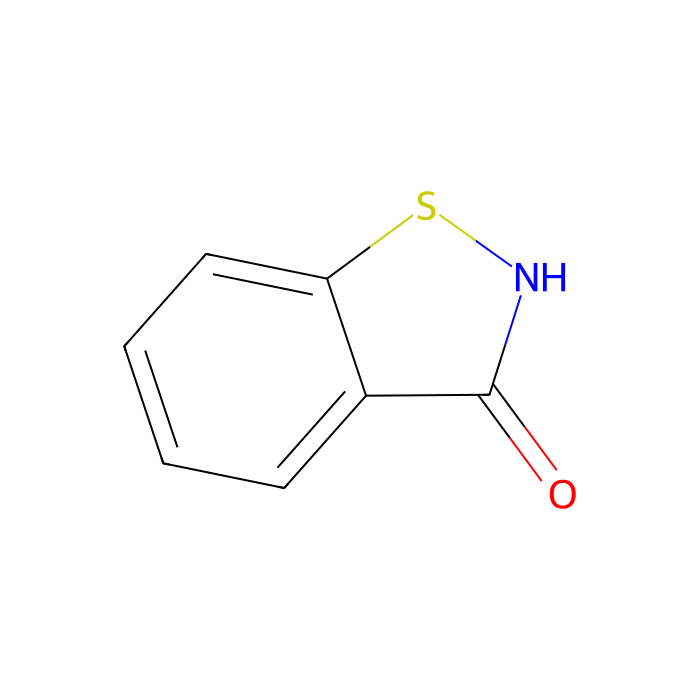
| Canonical Smiles | C1=CC=C2C(=C1)C(=O)NS2 |
|---|---|
| IUPAC Name | 1,2-benzothiazol-3-one |
| InChIKey | DMSMPAJRVJJAGA-UHFFFAOYSA-N |
| INCHI | 1S/C7H5NOS/c9-7-5-3-1-2-4-6(5)10-8-7/h1-4H,(H,8,9) |
| Isomeric SMILES | C1=CC=C2C(=C1)C(=O)NS2 |
| WGK Germany | 2 |
| RTECS | DE4620000 |
| UN Number | 3077 |
| Packing Group | III |
| Molecular Weight | 151.18 |
| Beilstein | 27(3/4)2648 |
| Reaxy-Rn | 119510 |
| Reaxys-RN_link_address | https://www.reaxys.com/reaxys/secured/hopinto.do?context=S&query=IDE.XRN=119510&ln= |
Comprehensive hazard, handling, storage, and regulatory compliance document.
Download SDS →Lot-specific quality data. Enter your lot number to retrieve the exact COA.
Look up COA →Full quality attributes and acceptance criteria for this grade.
View spec sheet →Taxonomy Tree
| Kingdom | Organic compounds |
|---|---|
| Superclass | Organoheterocyclic compounds |
| Class | Benzothiazoles |
| Subclass | Not available |
| Intermediate Tree Nodes | Not available |
| Direct Parent | Benzothiazoles |
| Alternative Parents | Benzenoids Thiazoles Heteroaromatic compounds Azacyclic compounds Organopnictogen compounds Organooxygen compounds Organonitrogen compounds Hydrocarbon derivatives |
| Molecular Framework | Aromatic heteropolycyclic compounds |
| Substituents | 1,2-benzothiazole - Benzenoid - Heteroaromatic compound - Thiazole - Azole - Azacycle - Organic nitrogen compound - Organic oxygen compound - Organopnictogen compound - Hydrocarbon derivative - Organooxygen compound - Organonitrogen compound - Aromatic heteropolycyclic compound |
| Description | This compound belongs to the class of organic compounds known as benzothiazoles. These are organic compounds containing a benzene fused to a thiazole ring (a five-membered ring with four carbon atoms, one nitrogen atom and one sulfur atom). |
| External Descriptors | organic heterobicyclic compound - organonitrogen heterocyclic compound |
| Activity Type | Relation | Activity value | Units | Action Type | Journal | PubMed Id | doi | Assay Aladdin ID |
|---|
| Activity Type | Relation | Activity value | Units | Action Type | Journal | PubMed Id | doi | Assay Aladdin ID |
|---|
| Activity Type | Relation | Activity value | Units | Action Type | Journal | PubMed Id | doi | Assay Aladdin ID |
|---|
| Activity Type | Relation | Activity value | Units | Action Type | Journal | PubMed Id | doi | Assay Aladdin ID |
|---|
| Activity Type | Relation | Activity value | Units | Action Type | Journal | PubMed Id | doi | Assay Aladdin ID |
|---|
| Activity Type | Relation | Activity value | Units | Action Type | Journal | PubMed Id | doi | Assay Aladdin ID |
|---|
| Activity Type | Relation | Activity value | Units | Action Type | Journal | PubMed Id | doi | Assay Aladdin ID |
|---|
| Activity Type | Relation | Activity value | Units | Action Type | Journal | PubMed Id | doi | Assay Aladdin ID |
|---|
| Activity Type | Relation | Activity value | Units | Action Type | Journal | PubMed Id | doi | Assay Aladdin ID |
|---|
| Activity Type | Relation | Activity value | Units | Action Type | Journal | PubMed Id | doi | Assay Aladdin ID |
|---|
| Activity Type | Relation | Activity value | Units | Action Type | Journal | PubMed Id | doi | Assay Aladdin ID |
|---|
| Activity Type | Relation | Activity value | Units | Action Type | Journal | PubMed Id | doi | Assay Aladdin ID |
|---|
| Activity Type | Relation | Activity value | Units | Action Type | Journal | PubMed Id | doi | Assay Aladdin ID |
|---|
| Activity Type | Relation | Activity value | Units | Action Type | Journal | PubMed Id | doi | Assay Aladdin ID |
|---|
| Activity Type | Relation | Activity value | Units | Action Type | Journal | PubMed Id | doi | Assay Aladdin ID |
|---|
| Activity Type | Relation | Activity value | Units | Action Type | Journal | PubMed Id | doi | Assay Aladdin ID |
|---|
| Activity Type | Relation | Activity value | Units | Action Type | Journal | PubMed Id | doi | Assay Aladdin ID |
|---|
| Activity Type | Relation | Activity value | Units | Action Type | Journal | PubMed Id | doi | Assay Aladdin ID |
|---|
| Activity Type | Relation | Activity value | Units | Action Type | Journal | PubMed Id | doi | Assay Aladdin ID |
|---|
| Activity Type | Relation | Activity value | Units | Action Type | Journal | PubMed Id | doi | Assay Aladdin ID |
|---|
| Activity Type | Relation | Activity value | Units | Action Type | Journal | PubMed Id | doi | Assay Aladdin ID |
|---|
| Activity Type | Relation | Activity value | Units | Action Type | Journal | PubMed Id | doi | Assay Aladdin ID |
|---|
| Activity Type | Relation | Activity value | Units | Action Type | Journal | PubMed Id | doi | Assay Aladdin ID |
|---|
| Activity Type | Relation | Activity value | Units | Action Type | Journal | PubMed Id | doi | Assay Aladdin ID |
|---|
| Activity Type | Relation | Activity value | Units | Action Type | Journal | PubMed Id | doi | Assay Aladdin ID |
|---|
| Activity Type | Relation | Activity value | Units | Action Type | Journal | PubMed Id | doi | Assay Aladdin ID |
|---|
| Activity Type | Relation | Activity value | Units | Action Type | Journal | PubMed Id | doi | Assay Aladdin ID |
|---|
| Activity Type | Relation | Activity value | Units | Action Type | Journal | PubMed Id | doi | Assay Aladdin ID |
|---|
| Activity Type | Relation | Activity value | Units | Action Type | Journal | PubMed Id | doi | Assay Aladdin ID |
|---|
| Activity Type | Relation | Activity value | Units | Action Type | Journal | PubMed Id | doi | Assay Aladdin ID |
|---|
| Activity Type | Relation | Activity value | Units | Action Type | Journal | PubMed Id | doi | Assay Aladdin ID |
|---|
| Activity Type | Relation | Activity value | Units | Action Type | Journal | PubMed Id | doi | Assay Aladdin ID |
|---|
| Activity Type | Relation | Activity value | Units | Action Type | Journal | PubMed Id | doi | Assay Aladdin ID |
|---|
| Activity Type | Relation | Activity value | Units | Action Type | Journal | PubMed Id | doi | Assay Aladdin ID |
|---|
| Activity Type | Relation | Activity value | Units | Action Type | Journal | PubMed Id | doi | Assay Aladdin ID |
|---|
| Activity Type | Relation | Activity value | Units | Action Type | Journal | PubMed Id | doi | Assay Aladdin ID |
|---|
| Activity Type | Relation | Activity value | Units | Action Type | Journal | PubMed Id | doi | Assay Aladdin ID |
|---|
| Activity Type | Relation | Activity value | Units | Action Type | Journal | PubMed Id | doi | Assay Aladdin ID |
|---|
| Activity Type | Relation | Activity value | Units | Action Type | Journal | PubMed Id | doi | Assay Aladdin ID |
|---|
| Activity Type | Relation | Activity value | Units | Action Type | Journal | PubMed Id | doi | Assay Aladdin ID |
|---|
| Activity Type | Relation | Activity value | Units | Action Type | Journal | PubMed Id | doi | Assay Aladdin ID |
|---|
| Activity Type | Relation | Activity value | Units | Action Type | Journal | PubMed Id | doi | Assay Aladdin ID |
|---|
| Activity Type | Relation | Activity value | Units | Action Type | Journal | PubMed Id | doi | Assay Aladdin ID |
|---|
| Activity Type | Relation | Activity value | Units | Action Type | Journal | PubMed Id | doi | Assay Aladdin ID |
|---|
| Activity Type | Relation | Activity value | Units | Action Type | Journal | PubMed Id | doi | Assay Aladdin ID |
|---|
| Activity Type | Relation | Activity value | Units | Action Type | Journal | PubMed Id | doi | Assay Aladdin ID |
|---|
| Activity Type | Relation | Activity value | Units | Action Type | Journal | PubMed Id | doi | Assay Aladdin ID |
|---|
Find and download the COA for your product by matching the lot number on the packaging.
| Lot Number | Certificate Type | Date | Item |
|---|---|---|---|
 F2204177 F2204177 | Certificate of Analysis | Mar 04, 2025 | B406425 |
| D2403060 | Certificate of Analysis | Mar 18, 2022 | B406425 |
| F2204176 | Certificate of Analysis | Mar 18, 2022 | B406425 |
| F2204178 | Certificate of Analysis | Mar 18, 2022 | B406425 |
| L2412238 | Certificate of Analysis | Mar 18, 2022 | B406425 |
| Sensitivity | air,heat sensitive |
|---|---|
| Melt Point(°C) | 154-158°C |
| Molecular Weight | 151.190 g/mol |
| XLogP3 | 1.300 |
| Hydrogen Bond Donor Count | 1 |
| Hydrogen Bond Acceptor Count | 2 |
| Rotatable Bond Count | 0 |
| Exact Mass | 151.009 Da |
| Monoisotopic Mass | 151.009 Da |
| Topological Polar Surface Area | 54.400 Ų |
| Heavy Atom Count | 10 |
| Formal Charge | 0 |
| Complexity | 160.000 |
| Isotope Atom Count | 0 |
| Defined Atom Stereocenter Count | 0 |
| Undefined Atom Stereocenter Count | 0 |
| Defined Bond Stereocenter Count | 0 |
| Undefined Bond Stereocenter Count | 0 |
| The total count of all stereochemical bonds | 0 |
| Covalently-Bonded Unit Count | 1 |
| 1. Liang Yang, Yao Wang, Yijia Liang, Haibin Deng, Jun Wang, Yuhao Dai, Fuyou Guo, Hong Zhou, Shili Li, Wei Ding. (2023) pH-responsive bentonite nanoclay carriers control the release of benzothiazolinone to restrain bacterial wilt disease. PESTICIDE BIOCHEMISTRY AND PHYSIOLOGY, [PMID:38225096] [10.1016/j.pestbp.2023.105754] |
| 2. Dazhuang Wang, Ruotong Liu, Xiaohui Liu, Guangwen Hu, Zhineng Fu, Miao Dong, Liju Liu, Xinrui Lin, Ping Zhang, Junhua Chen, Jianxin Yang, Xinghua Xue. (2023) The Synthesis and Synergistic Effect of Heterocyclic Groups Grafted on Acrylic Polymers by Ester Groups for Marine Antifouling. Coatings, 13 (9): (1643). [PMID:] [10.3390/coatings13091643] |
| 3. Chunyan Zhu, Weiqing Yu, Shuxian Zhang, Jianchao Chen, Qingyuan Liu, Qingyu Li, Shijie Wang, Minghao Hua, Xiaohang Lin, Longwei Yin, Rutao Wang. (2023) Hexaindium Heptasulfide/Nitrogen and Sulfur Co-Doped Carbon Hollow Microspindles with Ultrahigh-Rate Sodium Storage through Stable Conversion and Alloying Reactions. ADVANCED MATERIALS, 35 (16): (2211611). [PMID:36739495] [10.1002/adma.202211611] |
| 4. Gang Zhou, Ying-si Wang, Hong Peng, Su-juan Li, Ting-li Sun, Qing-shan Shi, Jordi Garcia-Ojalvo, Xiao-bao Xie. (2022) Proteomic signatures of synergistic interactions in antimicrobials. Journal of Proteomics, [PMID:36210012] [10.1016/j.jprot.2022.104743] |
| 5. Zhou Gang, Wang Ying-si, Peng Hong, Li Su-juan, Sun Ting-li, Shen Peng-fei, Xie Xiao-bao, Shi Qing-shan. (2021) Roles of ompA of Citrobacter werkmanii in bacterial growth, biocide resistance, biofilm formation and swimming motility. APPLIED MICROBIOLOGY AND BIOTECHNOLOGY, 105 (7): (2841-2854). [PMID:33763710] [10.1007/s00253-020-11057-1] |
| 6. Ying Fu, Hui Du, Zhaojun Chen, Xin Liu, Xiaodong Zhang. (2019) Preparation and performance of new antifouling resins containing BIT group. JOURNAL OF ADHESION SCIENCE AND TECHNOLOGY, [PMID:] [10.1080/01694243.2018.1509688] |
| 7. Peng Kaimei, Dai Xuexin, Mao Haili, Zou Hongtao, Yang Zaibo, Tu Weiping, Hu Jianqing. (2018) Development of direct contact-killing non-leaching antimicrobial polyurethanes through click chemistry. Journal of Coatings Technology and Research, 15 (6): (1239-1250). [PMID:] [10.1007/s11998-018-0068-1] |
| 8. Satish Gudala, Miao Dong, Xinrui Lin, Ruotong Liu, Annadurai Vinothkanna, Anubhuti Jha, Archi Sharma, Dazhuang Wang, Xinghua Liu, Jianxin Yang. (2024) 1,2,4-Triazolo-quinazolinones as Effective Antifoulants: Molecular Design, Synthesis, and Biological Evaluation. LANGMUIR, [PMID:39012063] [10.1021/acs.langmuir.4c01393] |
| 9. Xiaoxian Hao, Xin Zhang, Wenjing Wang, Wenjing Liu, Guangming Lu, Wenru Zheng, Dirong Gong, Haichao Zhao. (2024) Controlled release of 1,2-benzisothiazolin-3-one-based anion encapsulated in MgAl layered double hydroxides for antibacterial and antifouling applications. PROGRESS IN ORGANIC COATINGS, [PMID:] [10.1016/j.porgcoat.2023.108208] |
| 10. Yu Jiang, Si-Chao Liu, Li-Ping Zhang, Guo-Wei Guan, Yi-Tao Li, Shuang Ni, Run-Yuan Jiang, Su-Tao Zheng, Hao-Ran Liu, Hao-Ling Lan, Qing-Yuan Yang. (2024) Immobilization of Nickel- and Cobalt-Based Complexes in NH2-UiO-66 for Efficient CO2 Photoreduction. CHEMICAL ENGINEERING JOURNAL, [PMID:] [10.1016/j.cej.2024.153100] |
| 11. Pengfei Yu, Zhongyu Guo, Jieqiong Wang, Yuchen Guo, Tingting Wang, Lilan Zhang. (2024) Insight into the photodegradation of methylisothiazolinone and benzoisothiazolinone in aquatic environments. WATER RESEARCH, [PMID:39173356] [10.1016/j.watres.2024.122301] |
| 12. Miao Dong, Xinrui Lin, Xinyi Liu, Xiaodong Xu, Junhua Chen, Jianxin Yang. (2025) BIT-Triazine Acrylate Resins as High-Performance Sustainable Coatings for Marine Antifouling Applications. ACS Applied Polymer Materials, [PMID:] [10.1021/acsapm.5c01800] |
| 13. Peifu Sun, Xiao Zhang, Zhiren Guo, Xinyue Liu, Yuanming Lan, Dongxiang Zhang, Hansheng Li, Jinying Li, Helei Liu, Xiyan Xu. (2023) An adsorptive photo-Fenton-like removal of 1,2-benzisothiazolin-3-one by NH2-MIL-53(Fe) under simulated solar light. NEW JOURNAL OF CHEMISTRY, 47 (17): (8334-8346). [PMID:] [10.1039/D3NJ00771E] |
| 14. Zhenghui Qin, Jing Zhao, Haimang Wang, Bo Wang, Liang Zheng, Hongyu Zhang. (2022) Bioinspired Self-Adhesive Lubricating Copolymer with Bacteriostatic and Bactericidal Synergistic Effect for Marine Biofouling Prevention. ACS Applied Polymer Materials, [PMID:] [10.1021/acsapm.2c00112] |