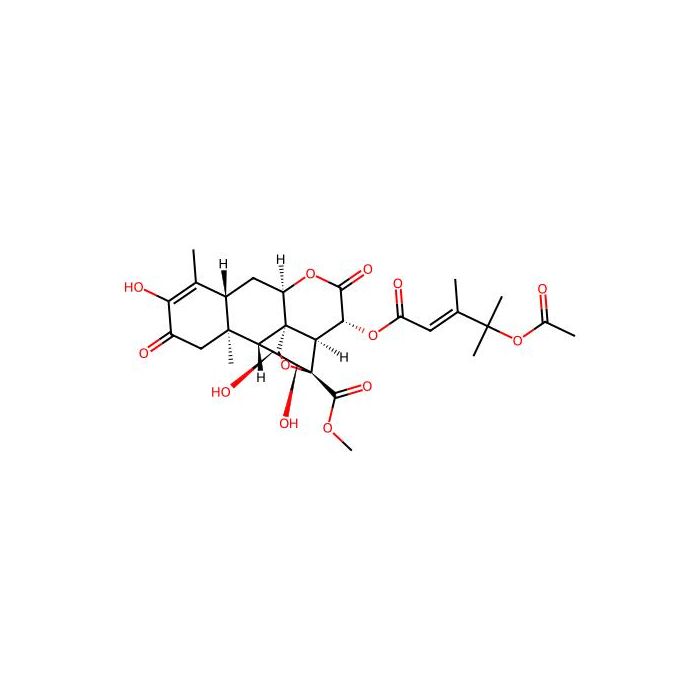
Bruceantinol, a quassinoid isolated from Brucea javanica , inhibits pepper mottle virus in pepper Bruceantinol is a STAT3 inhibitor demonstrating potent antitumor activity in in vitro and in vivo human colorectal cancer (CRC) models. Bruceantinol strongly inhibits STAT3 DNA-binding ability ( IC 50 =2.4 pM), blocks the constitutive and IL-6-induced STAT3 activation, and suppresses transcription of MCL-1 , PTTG1, survivin and c-Myc .
BRUCEANTINOL | methyl (1R,2S,3R,6R,8R,13S,14R,15R,16S,17S)-3-[(E)-4-acetyloxy-3,4-dimethylpent-2-enoyl]oxy-10,15,16-trihydroxy-9,13-dimethyl-4,11-dioxo-5,18-dioxapentacyclo[12.5.0.01,6.02,17.08,13]nonadec-9-ene-17-carboxylate | Picras-3-en-21-oic acid, 15-[[(2E)-4-(acetyloxy)-3,4-dimethyl-1-oxo-2-penten-1-yl]oxy]-13,20-epoxy-3,11,12-trihy Show more
Specifications & Purity
≥98%
Biochemical and Physiological Mechanisms
Bruceantinol, a quassinoid isolated from Brucea javanica , inhibits pepper mottle virus in pepper. Bruceantinol is a STAT3 inhibitor demonstrating potent antitumor activity in in vitro and in vivo human colorectal cancer (CRC) models. Bruceantinol st
Storage
Store at -20°C
Shipped In
Ice chest + Ice pads
This product requires cold chain shipping. Ground and other economy services are not available.
This compound belongs to the class of organic compounds known as quassinoids. These are a group of compounds chemically degraded from triterpenes. According to their basic skeleton, quassinoids are categorized into five distinct groups, C-18, C-19, C-20, C-22 and C-25 types. The C-20 quassinoids can be further classified into two types, tetracyclic and the pentacyclic. The tetracyclic variety does not have oxygenation at C-20, while the pentacyclic quassinoids possess additional oxygenation at C-20 that allows for the formation of an additional ring.
External Descriptors
Dammarenes
1. Djoumbou Feunang Y, Eisner R, Knox C, Chepelev L, Hastings J, Owen G, Fahy E, Steinbeck C, Subramanian S, Bolton E, Greiner R, and Wishart DS. ClassyFire: Automated Chemical Classification With A Comprehensive, Computable Taxonomy. Journal of Cheminformatics, 2016, 8:61.
We use cookies to ensure the website functions properly and, where permitted, to improve your experience. You can manage your preferences at any time in Settings. Learn more in our Cookie Policy.
Shall we send you a message when we have discounts available?
Remind me later
Thank you! Please check your email inbox to confirm.
Products are supplied to verified businesses, institutions, and qualified professionals for research and development use only. Not for use in humans, animals, diagnosis, or therapy.