
 C2321201
Determine the necessary mass, volume, or concentration for preparing a solution.
| Activity Type | Activity Value -log(M) | Mechanism of Action | Activity Reference | Publications (PubMed IDs) |
|---|
Moligand™, ≥98% Moligand™ for sensitive chromatographic and analytical workflows requiring minimal baseline interference.
Protected from light,Store at -20°C,Argon charged Ships Ice chest + Ice pads Check lot-specific COA for exact specifications.
SDS, COA, datasheet, and spec sheet available for download. Lot-specific COA accessible via lot number lookup.
Cited in 0 peer-reviewed publications across chromatography, organic synthesis, and cross-coupling reactions.
Comprehensive hazard, handling, storage, and regulatory compliance document.
Download SDS →Lot-specific quality data. Enter your lot number to retrieve the exact COA.
Look up COA →Full quality attributes and acceptance criteria for this grade.
View spec sheet →Taxonomy Tree
| Kingdom | Organic compounds |
|---|---|
| Superclass | Nucleosides, nucleotides, and analogues |
| Class | (3'->5')-dinucleotides and analogues |
| Subclass | (3'->5')-cyclic dinucleotides and analogues |
| Intermediate Tree Nodes | Not available |
| Direct Parent | (3'->5')-cyclic dinucleotides and analogues |
| Alternative Parents | Purine ribonucleoside 3',5'-bisphosphates Pentose phosphates Glycosylamines 6-aminopurines Monosaccharide phosphates Aminopyrimidines and derivatives Imidolactams N-substituted imidazoles Organic phosphoric acids and derivatives Tetrahydrofurans Heteroaromatic compounds Secondary alcohols Oxacyclic compounds Polyols Azacyclic compounds Hydrocarbon derivatives Primary amines Organopnictogen compounds Organic oxides |
| Molecular Framework | Aromatic heteropolycyclic compounds |
| Substituents | (3'->5')-cyclic dinucleotide or analogue - Purine ribonucleoside 3',5'-bisphosphate - Purine ribonucleoside bisphosphate - Pentose phosphate - Pentose-5-phosphate - Glycosyl compound - N-glycosyl compound - 6-aminopurine - Monosaccharide phosphate - Imidazopyrimidine - Purine - Aminopyrimidine - Monosaccharide - N-substituted imidazole - Organic phosphoric acid derivative - Imidolactam - Pyrimidine - Tetrahydrofuran - Azole - Imidazole - Heteroaromatic compound - Secondary alcohol - Organoheterocyclic compound - Oxacycle - Azacycle - Polyol - Organooxygen compound - Organonitrogen compound - Amine - Alcohol - Organic nitrogen compound - Organic oxygen compound - Hydrocarbon derivative - Organic oxide - Organopnictogen compound - Primary amine - Aromatic heteropolycyclic compound |
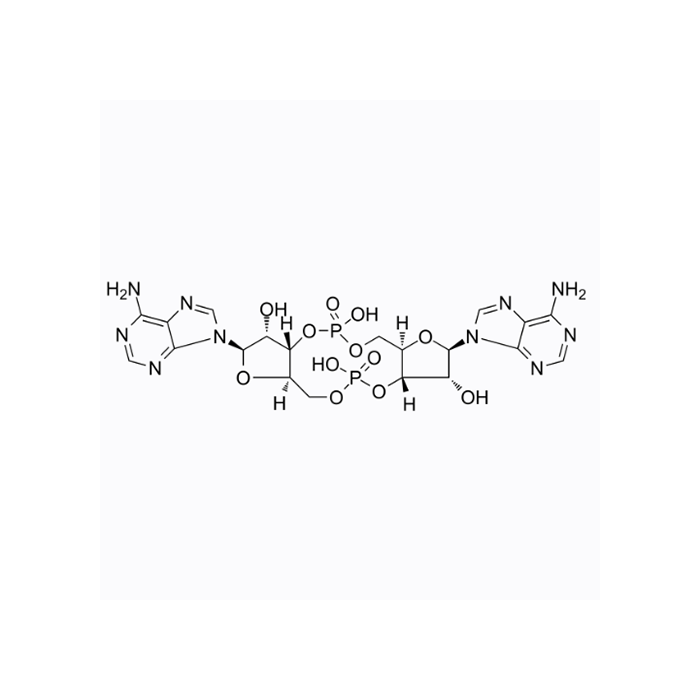
| Description | This compound belongs to the class of organic compounds known as (3'->5')-cyclic dinucleotides and analogues. These are cyclic compounds consisting of two ribose moieties connected by two 5',3'-phosphodiester bonds to form a cycle. Each ribose unit is N-linked to a nucleic base or an analogue thereof. Some natural (3'->5')-cyclic dinucleotides include c-di-AMP. Synthetic derivatives are generally more elaborated molecules in which one or the two nucleobase moieties, and/or sugar residues, and/or phosphodiester linkers have been modified. |
| External Descriptors | adenyl ribonucleotide - cyclic purine dinucleotide |
| Activity Type | Activity Value -log(M) | Mechanism of Action | Activity Reference | Publications (PubMed IDs) |
|---|
| Sensitivity | light sensitive |
|---|---|
| Molecular Weight | 658.400 g/mol |
| XLogP3 | -5.100 |
| Hydrogen Bond Donor Count | 6 |
| Hydrogen Bond Acceptor Count | 20 |
| Rotatable Bond Count | 2 |
| Exact Mass | 658.105 Da |
| Monoisotopic Mass | 658.105 Da |
| Topological Polar Surface Area | 310.000 Ų |
| Heavy Atom Count | 44 |
| Formal Charge | 0 |
| Complexity | 1080.000 |
| Isotope Atom Count | 0 |
| Defined Atom Stereocenter Count | 8 |
| Undefined Atom Stereocenter Count | 0 |
| Defined Bond Stereocenter Count | 0 |
| Undefined Bond Stereocenter Count | 0 |
| The total count of all stereochemical bonds | 0 |
| Covalently-Bonded Unit Count | 1 |
Our grade selection guide covers purity, stabilizer status, and application suitability for all variants in our catalog.
View Moligand™ grade guide →