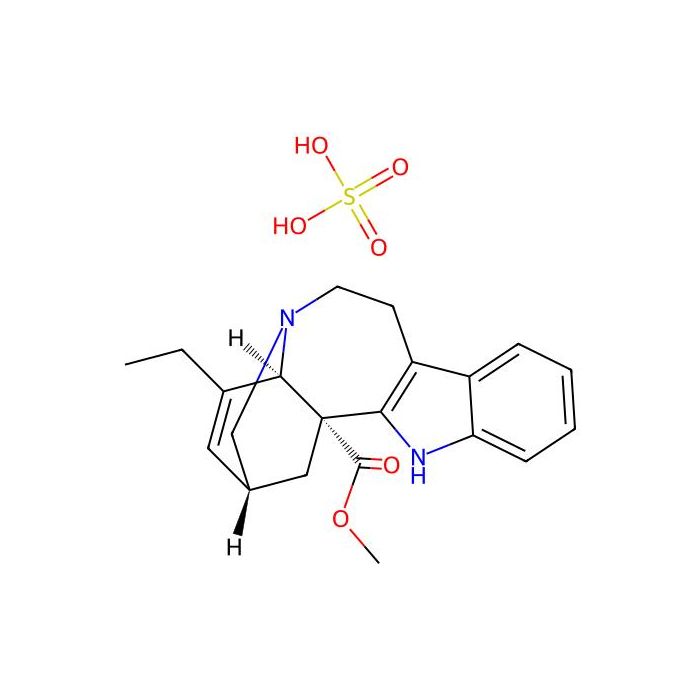
This compound belongs to the class of organic compounds known as ibogan-type alkaloids. These are indole alkaloids with a structure based on the ibogamine skeleton or a derivative thereof. Ibogamine is a pentacyclic heterocyclic compound consisting of an indole fused to an azepane-containing tricyclic moiety ring. Iboga alkaloids arise from the cyclization of a secodine-type precursor through the formation of a 16,21 bond.
External Descriptors
Not available
1. Djoumbou Feunang Y, Eisner R, Knox C, Chepelev L, Hastings J, Owen G, Fahy E, Steinbeck C, Subramanian S, Bolton E, Greiner R, and Wishart DS. ClassyFire: Automated Chemical Classification With A Comprehensive, Computable Taxonomy. Journal of Cheminformatics, 2016, 8:61.
Determine the necessary mass, volume, or concentration for preparing a solution.
Dilution Calculator
Determine the dilution needed to prepare a stock solution.
Reconstitution Calculator
Reviews
Customer Reviews
Application Protocols
No item-specific application protocols are provided for this product. General, non-validated guidance (literature-general) is below; optimize for your system.
Preparation of analytical stock solutions
Dissolve catharanthine sulfate in water, methanol, or DMSO to a convenient concentration for your method. If using LC–MS, include 0.05–0.1% formic acid or ammonium formate for improved peak shape.
Conversion to free base for organic synthesis
Dissolve the sulfate in water; basify cautiously with saturated NaHCO3 or 0.5–1 M Na2CO3 to pH ~9–10; extract with CH2Cl2 or EtOAc; dry and concentrate under reduced pressure. Use immediately or store under inert atmosphere.
Enzymatic oxidative coupling setup (conceptual)
Prepare acetate buffer (pH 5.5); add catharanthine and partner substrate (e.g., vindoline) as aqueous or co-solvent solutions; introduce peroxidase/laccase; add H2O2 slowly or oxygenate; monitor by HPLC.
These steps are provided as general research guidance only and are not validated for this specific SKU.
Biological Roles
Catharanthine is a plant-derived monoterpenoid indole alkaloid integral to the biosynthetic network of Catharanthus roseus (Madagascar periwinkle). The sulfate here refers to the protonated salt form used in laboratory settings. The notes below are literature-general and provided for biochemical context; this product is for research use only.
Biosynthetic context (literature-general)
Originates from strictosidine-derived pathways; serves as a key branch-point intermediate leading to dimeric Vinca alkaloids upon oxidative coupling with vindoline.
Intracellular trafficking and compartmentalization in plant tissues influence its accumulation and onward conversion.
Molecular features
Indole chromophore with typical UV absorbance around 280 nm facilitates detection in metabolomics workflows.
Basic tertiary amine enables protonation/transport and salt formation; pH-dependent ionization governs cellular partitioning.
Research applications
Standard for LC–MS metabolite identification/quantitation in MIA pathway studies.
Probe substrate in enzyme assays investigating oxidases/peroxidases and coupling enzymes in Vinca alkaloid biosynthesis.
ADME/toxicity: No item-specific or clinical data are provided and no medical use is implied. Handle as a laboratory chemical; any bioactivity assessments should be performed under appropriate institutional approvals.
For precise stereochemical assignment and reference spectra, consult authenticated standards and primary literature.
Buffer Applications
Catharanthine sulfate is not a buffering agent. However, as a protonated alkaloid salt it is often handled in aqueous buffers for biochemical assays or analytical workflows (literature-general guidance):
Preparation hints
Dissolve in deionized water or the target buffer (e.g., phosphate, HEPES, citrate) at the working pH. Solubility and ionization are favored at mildly acidic to neutral pH (≈5.5–7.4).
Avoid strongly basic pH, which can deprotonate the amine to the free base and reduce aqueous solubility.
Compatibility
Common inorganic buffers (PBS, phosphate) and Good’s buffers (HEPES, MOPS) are generally compatible; minimize high concentrations of multivalent metals during oxidative assays unless intended.
For LC–MS, use volatile buffers/acids (formic acid, ammonium formate/acetate) to improve signal and peak shape for basic analytes.
Filtration and storage
Filter sterilize solutions through 0.22 μm for cell-free assays. Prepare fresh or store aliquots frozen if stability has been verified for your application.
Note: No item-specific pKa/solubility or stability data are provided; establish working ranges empirically for your buffer system.
Green Alternatives
Although catharanthine sulfate is a solid alkaloid salt (not a process solvent), greener choices pertain to solvents, oxidants, and methods used with it.
Greener media and methods (literature-general)
Aqueous or water–ethanol systems for dissolution and biocatalytic/enzymatic oxidations minimize hazardous organic solvents.
Photoredox catalysis under visible light in benign solvents (MeOH, MeCN/H2O) can replace stoichiometric metal oxidants.
Replace chlorinated solvents (CH2Cl2, CHCl3) with 2-MeTHF, EtOAc, or MeCN when compatible.
Favor water/methanol/ethanol for stock solutions and analytics; avoid excessive DMSO where possible.
Trade-offs: Greener routes may alter selectivity or rate; enzyme/catalyst costs and workup differences should be evaluated for your scale.
Pharmaceutical Uses
No therapeutic or clinical uses are claimed for this product. The following notes describe non-clinical, research-oriented roles (literature-general):
Reference/analytical roles
Employed as a reference standard or process-related impurity marker in studies of Vinca alkaloid production and purification.
Used to validate analytical methods (HPLC/LC–MS) for natural product profiling and biosynthetic pathway monitoring.
Formulation research
As a sulfate salt of a basic alkaloid, it serves as a model compound for investigating salt selection, counter‑ion effects, and solid-state behavior of protonated amines in preformulation research.
Compendial status
No pharmacopeial monograph for “catharanthine sulfate” is cited here; verify any regulatory acceptance independently if needed.
Important: This product is designated For research use only and is not an API, excipient, or for diagnostic use.
Physical Properties
Item-specific specifications are not provided in the Product Data. Do not use the following as specifications; consult the CoA/SDS for authoritative values.
Appearance: Not specified for this item; refer to CoA/Spec Sheet.
Melting point: Not specified for this item; refer to CoA/Spec Sheet. (Salts of MIAs often exhibit decomposition rather than a sharp melt; literature-general.)
Boiling point: Not applicable for ionic solids; decomposition expected before boiling (literature-general).
Density: Not specified for this item; refer to CoA/Spec Sheet.
Optical rotation: Not specified for this item; refer to CoA/Spec Sheet.
Solubility (literature-general expectations)
Water: sulfate salts of tertiary amines are typically water-soluble; actual solubility depends on salt stoichiometry and hydrate state.
Alcohols: commonly soluble in methanol and ethanol.
Polar aprotic: variable in DMSO; many labs prepare concentrated DMSO stocks for in vitro work.
pKa: The conjugate acid of a tertiary amine typically has pKa ~8–10 (literature-general for MIAs); exact value for the sulfate salt form not specified for this item; refer to literature/CoA.
logP/logD: Not specified for this item; refer to CoA/Spec Sheet. Note that protonation and ion-pairing substantially reduce apparent lipophilicity compared to the free base (literature-general).
UV–Vis: Indole chromophore typically absorbs near 220–230 nm and 270–290 nm (literature-general); item-specific UV cutoff/ε not specified.
Always verify experimental parameters on the SDS/CoA before use.
Quality & Grades
Grade/Purity: Not specified for this item; refer to CoA/Spec Sheet.
Guidance for interpreting quality when available (general):
Alkaloid salts such as catharanthine sulfate are typically offered as research grade. When a purity number is provided, it usually represents HPLC area % and may exclude inorganic counter‑ion mass. If optical purity or specific rotation is critical (due to multiple stereocenters), check the CoA for chiroptical data or enantiopurity statements.
Residual solvents, water of crystallization, and precise sulfate stoichiometry can influence calculated assay. Review the assay basis on the CoA (free-base corrected vs as-is).
If a stabilizer is listed (none is provided here), understand its analytical impacts (e.g., UV baseline, mass spectral adducts).
What to request for regulated or analytical workflows:
Trace inorganic content (sulfated ash), residual solvents (ICH), and water content (KF) if your method is mass-balance sensitive.
Verified salt stoichiometry (e.g., hemisulfate vs sulfate) and hydrate state for precise molarity calculations.
Note: This catalog entry provides storage at room temperature and normal shipping, consistent with stable organic salts. For any critical application, confirm full specifications on the CoA.
Reaction & Applications
Research uses of catharanthine sulfate center on its role as a monoterpenoid indole alkaloid building block and biosynthetic intermediate.
Biosynthetic and semisynthetic transformations (literature-general)
Oxidative coupling with vindoline to form anhydrovinblastine, a key step en route to vinblastine/vincristine. Oxidants/catalysts reported include FeCl3, Cu(II) salts, peracids, vanadium catalysts, and photoredox systems. Reaction often benefits from converting the salt to the free base for organic-phase coupling.
Enzymatic/peroxidase-mediated dimerizations (e.g., horseradish peroxidase systems) in aqueous media have been explored, reflecting plant biosynthesis.
N-oxidation and subsequent rearrangements provide access to functionalized MIAs; careful control avoids indole over-oxidation.
Reference/standards
Used as an analytical standard in plant metabolomics and natural products profiling of Catharanthus roseus and related species.
Practical tips (literature-general)
If starting from the sulfate salt, basify an aqueous solution (e.g., NaHCO3/Na2CO3) and extract to obtain the free base for reactions in nonpolar media.
Maintain inert atmosphere and subdued light during oxidative coupling to minimize side reactions on the indole ring.
Monitor by TLC/HPLC with acidic modifiers to sharpen basic peaks; indole UV absorbance near 280 nm is convenient for tracking.
Note: No item-specific application testing is provided in the Product Data; tailor conditions to your substrate set and verify with small-scale trials.
Reaction Conditions
No item-specific, validated reaction conditions are provided. The following are literature-general guidelines for transformations involving catharanthine (typically as the free base) and should be optimized experimentally:
Oxidative coupling to anhydrovinblastine
Conditions: FeCl3 (1.5–3.0 eq) in CH2Cl2 or nitromethane; or Cu(OTf)2/oxidants; or photoredox catalysts (e.g., Ru(bpy)3 2+ under blue light) in MeCN/MeOH.
Temperature: 0–25 °C.
Atmosphere: inert (N2/Ar) advised to limit over-oxidation.
Notes: better in non-aqueous media with the free base; acid additives can modulate selectivity.
Enzymatic/peroxidase-mediated dimerization
Conditions: HRP or laccase with H2O2 or O2 in acetate/phosphate buffer (pH 5–6) at 20–30 °C.
Notes: provides milder, greener oxidations; enzyme concentration and H2O2 feed control selectivity.
N‑oxidation
Conditions: mCPBA or peracids in CH2Cl2 at 0–25 °C; subsequent rearrangements under Lewis/Brønsted acids.
Analytical preparation
LC–MS stocks: dissolve in water, MeOH, or DMSO; add 0.05–0.1% formic acid to improve chromatographic behavior of the basic analyte.
Caution: The sulfate salt may require basification/extraction to the free base for reactions in low-dielectric solvents. Always run small-scale trials to benchmark yield and selectivity.
Safety & Handling
Item-specific GHS classification and hazard statements are not provided in the Product Data. Treat as a laboratory chemical of unknown hazard and consult the SDS for this SKU prior to use.
GHS/CLP
Signal word, hazard classes, H/P statements, pictograms: Not specified for this item; refer to SDS.
General laboratory precautions (good practice)
PPE: lab coat, safety glasses, and appropriate chemical-resistant gloves (e.g., nitrile). Avoid inhalation of dust and contact with skin/eyes.
Engineering controls: handle powders in a fume hood or ventilated enclosure to minimize dust exposure.
Hygiene: wash hands after handling; avoid eating/drinking in work area.
Handling notes specific to indole alkaloid salts (literature-general)
Avoid strong oxidizers and strong bases that can degrade the indole core or deprotonate the salt to the free base.
Protect from prolonged exposure to strong light and elevated temperature to limit oxidative discoloration.
First aid (overview; defer to SDS)
Inhalation: move to fresh air; seek medical attention if symptoms persist.
Skin/eye contact: rinse with water for at least 15 minutes; remove contaminated clothing; seek medical advice.
Ingestion: rinse mouth; do not induce vomiting; obtain medical attention.
Spill/waste
Avoid dust generation; collect with inert absorbent; dispose according to institutional and local regulations for organic salts.
Always defer to the current SDS for authoritative safety, toxicology, and disposal guidance.
Solvent Selection
Selection principles for catharanthine sulfate (ionic, indole alkaloid salt):
Polarity/miscibility (literature-general)
Aqueous systems: sulfate salts usually dissolve readily in water; ionic strength and pH affect solubility.
Protic organics: methanol and ethanol are commonly effective, enabling LC–MS sample prep and NMR in MeOD/EtOD.
Aprotic organics: DMSO often dissolves many alkaloid salts; acetonitrile solubility can be moderate; limited in nonpolar solvents (DCM, toluene) unless converted to the free base.
Practical choices by task
Bioassays/biochemical studies: water or buffered saline at pH 5.5–7.4; avoid high pH that may free-base and precipitate.
Organic synthesis using the free base: basify an aqueous solution and extract into an organic solvent to generate the free base, then use solvents like CH2Cl2, Et2O, or 2-MeTHF.
Analytical (HPLC/LC–MS): water–acetonitrile or water–methanol with 0.05–0.1% acid (FA/TFA) to improve peak shape for basic analytes.
Small comparison (literature-general)
Water: highest ion solubility; ideal for stocks; pH control required.
Methanol/ethanol: good solubility, NMR-friendly; flammable.
Note: Verify actual solubility limits and behavior (e.g., salt stoichiometry, hydrate state) experimentally for your lot.
Storage & Reconstitution
Storage conditions (item-specific)
Storage: Room temperature (as provided in Product Data).
Shipped: Normal (as provided).
General storage guidance (good practice)
Keep container tightly closed in a dry, well-ventilated place. Minimize exposure to strong light and heat. Store segregated from strong oxidizers and strong bases.
Reconstitution and solution handling (literature-general)
Solvents: Water, methanol, ethanol, or DMSO are typical for preparing stock solutions; choose based on your downstream application (bioassay vs synthesis vs LC–MS).
pH considerations: For maximum aqueous solubility, maintain mildly acidic to neutral pH to keep the amine protonated.
Filtration: If needed, sterile-filter through a 0.22 μm membrane for biochemical assays.
Aliquoting: For multi-use solution stocks, prepare single-use aliquots to avoid repeated freeze–thaw and contamination; assess solution stability empirically.
Stability/shelf life
Not specified for this item; refer to CoA/Spec Sheet. As a general precaution for indole alkaloids, prepare solutions fresh when possible and limit prolonged exposure to air and light.
Always consult the product’s CoA and SDS for definitive storage limits and handling instructions.
Structure & Identity
Brief overview: Catharanthine sulfate is the sulfate salt of the monoterpenoid indole alkaloid catharanthine, a key intermediate in the biosynthesis of Vinca alkaloids. As a sulfate, the tertiary amine of catharanthine is protonated and paired with sulfate as counter‑ion.
Item-specific identifiers (from Product Data)
SKU: C664237
Product name: Catharanthine Sulfate
CAS: 70674-90-7
PubChem CID: 73356992
InChIKey: 362639 (as provided)
SMILES: Not specified for this item; refer to CoA/Spec Sheet.
Molecular formula: Not specified for this item; refer to CoA/Spec Sheet.
Molecular weight: Not specified for this item; refer to CoA/Spec Sheet.
Structural features (general/literature description of the free base)
Framework: monoterpenoid indole alkaloid (MIA) bearing an indole ring fused to a polycyclic aspidosperma-like scaffold.
Functional groups: tertiary amine (protonated in the sulfate salt), indole (aryl heterocycle), multiple stereocenters, and aliphatic C–N/C–C linkages typical of MIAs.
Counter‑ion: sulfate (likely as hemisulfate or sulfate; exact stoichiometry should be confirmed on the CoA/Spec Sheet).
2D structural description (general)
An indole nucleus substituted at C-3 by a bicyclic cationic framework containing a tertiary amine; in the sulfate salt, the amine is protonated and ion-paired with SO4 2−. The structure features several chiral centers that define the native catharanthine stereochemistry.
Notes: Exact stereochemistry, salt stoichiometry, and canonical line notations should be verified on the certificate of analysis for this specific lot.
Synthetic Utility
From a synthetic perspective (literature-general), catharanthine is a versatile monoterpenoid indole alkaloid nucleus; the sulfate form is a convenient, water-soluble source of the protonated amine.
Key functional elements
Indole ring: undergoes electrophilic substitution, oxidation, and cross-coupling after suitable activation/protection.
Tertiary amine: can be quaternized, oxidized (N-oxide), or leveraged in phase-transfer; protonation state governs solubility and reactivity.
Multiple stereocenters: enable diastereoselective transformations and chiral relay effects.
Typical transformations
Oxidative dimerization with vindoline to anhydrovinblastine; subsequent functional group manipulations lead to Vinca frameworks.
N-oxidation followed by Polonovski-type rearrangements to access rearranged scaffolds.
Protective strategies for the indole (e.g., N-Boc, N-alkyl) to direct site-selectivity in further modifications.
Retrosynthetic value
Serves as a chiral pool starting point to access diverse aspidosperma/iboga-type frameworks via ring-opening/closure strategies, enabling SAR exploration around the MIA core.
Practical note: For organic-phase chemistry, convert the sulfate salt to the free base prior to reactions in low-polarity solvents; conversely, retain the sulfate for aqueous-phase biotransformations.
Target Specificity
Not applicable. This product is a small-molecule alkaloid salt, not a biological affinity reagent. No antigen/epitope, species reactivity, clone, or isotype information applies.
We use cookies to ensure the website functions properly and, where permitted, to improve your experience. You can manage your preferences at any time in Settings. Learn more in our Cookie Policy.
Shall we send you a message when we have discounts available?
Remind me later
Thank you! Please check your email inbox to confirm.
Products are supplied to verified businesses, institutions, and qualified professionals for research and development use only. Not for use in humans, animals, diagnosis, or therapy.