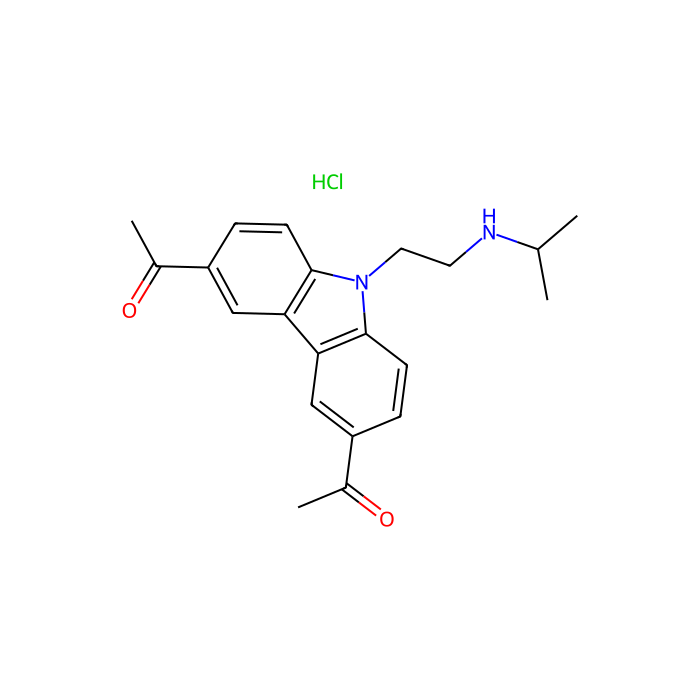
10mM in DMSO for sensitive chromatographic and analytical workflows requiring minimal baseline interference.
🌡
Storage & shipping
Store at -80°C Ships Dry ice packs + Cold packs Check lot-specific COA for exact specifications.
📋
Quality documents
SDS, COA, datasheet, and spec sheet available for download. Lot-specific COA accessible via lot number lookup.
📚
Literature proof
Cited in 0 peer-reviewed publications across chromatography, organic synthesis, and cross-coupling reactions.
Overview
Information
CBL0137 HCl CBL0137 (CBLC137, Curaxin 137) HCl activates p53 and inhibits NF-kB with EC50s of 0.37 μM and 0.47 μM in the cell-based p53 and NF-kB reporter assays, respectively. It also inhibits histone chaperone FACT (facilitates chromatin transcription In vitro
CBL0137 is a potent inducer of apoptosis in pancreatic cancer cell lines and is toxic not only for proliferating bulk tumor cells, but also for pancreatic cancer stem cells. CBL0137 and related molecules can simultaneously activate p53 and inhibit cellular stress pathways mediated by NF-κB and HSF-1. CBL0137 binds DNA but does not cause any sort of chemical modifications in DNA and therefore lacks genotoxicity. However, CBL0137 binding to DNA leads to functional inactivation of the Facilitates Chromatin Transcription (FACT) complex, a chromatin remodeling complex involved in transcription, replication, and DNA repair. In CBL0137-treated cells, FACT is lost from the nucleoplasm and trapped in chromatin, resulting in the inhibition of FACT-dependent transcription, including NF-kB-mediated transcription. Additionally, chromatin trapping of FACT leads to casein kinase 2 (CK2)-dependent phosphorylation and activation of p53.
In vivo
In mice, CBL0137 is effective against several Pancreatic ductal adenocarcinoma (PDA) models, including orthotopic gemcitabine resistant PANC-1 model and patient derived xenografts, in which CBL0137 anti-tumor effect correlated with overexpression of FACT. CBL0137 targets glioblastoma (GBM) according to its proposed mechanism of action, crosses the blood-brain barrier, and is efficacious in both TMZ-responsive and -resistant orthotopic models. The property of crossing the blood-brain barrier, especially when administered i.v, bodes well for the potential of this drug to treat CNS tumors. In orthotopic models, i.v. administration leads to greater tumor tissue accumulation than oral dosing, leading to greater bioavailability. Normal brain tissue accumulation of CBL0137 does not cause observable neurotoxicity. Cell Data
CBL0137 (CBLC137, Curaxin 137) HCl activates p53 and inhibits NF-kB with EC50s of 0.37 μM and 0.47 μM in the cell-based p53 and NF-kB reporter assays, respectively. It also inhibits histone chaperone FACT (facilitates chromatin transcription complex).
Storage
Store at -80°C
Shipped In
Dry ice packs + Cold packs
This product requires cold chain shipping. Ground and other economy services are not available.
Determine the necessary mass, volume, or concentration for preparing a solution.
Dilution Calculator
Determine the dilution needed to prepare a stock solution.
Reconstitution Calculator
Reviews
Customer Reviews
Application Protocols
Only product-data-derived application guidance may be listed here. For this SKU, no tested applications or protocols are provided.
Suggested applications: Not specified for this item; refer to CoA/Spec Sheet.
Recommended concentrations/dilutions: Not specified for this item; refer to CoA/Spec Sheet.
Positive/negative controls: Not specified for this item; refer to CoA/Spec Sheet.
General considerations (non-binding, user-validated):
Prepare DMSO stocks (e.g., 10–50 mM), dilute freshly into assay media, keep final DMSO ≤0.1–1% v/v, and protect from light.
For cell-based assays, include a vehicle control matching the highest DMSO content used.
Verify solution clarity after dilution; if precipitation occurs, adjust solvent strategy or concentration.
Please consult your lab’s SOPs and develop protocol parameters empirically; this product is provided for research use only.
Biological Roles
Context (literature, non-clinical):
CBL0137 is widely discussed in the literature as a chromatin-interacting small molecule used to interrogate genome-regulatory mechanisms. It is often categorized among “curaxins,” a class explored as DNA‑associated probes. Specific molecular targets, potencies, or phenotypic outcomes vary by study and system and are not specified in this catalog entry.
How researchers use compounds of this class (examples from literature):
As chemical tools to perturb chromatin architecture and to study transcriptional responses in cells and model systems.
To enable pathway-mapping experiments (e.g., transcriptomics/proteomics) that monitor cellular responses to chromatin stress.
In biochemical assays assessing DNA binding or nucleoprotein complex dynamics; buffer composition and ionic strength can materially affect observed behaviors.
Best practices for biological experiments:
Validate the identity and purity of the lot used (HPLC/LC–MS) prior to in-depth studies; trace impurities can confound cellular readouts.
Confirm stock solution integrity over time; perform periodic LC–MS checks for hydrolysis/oxidation products.
Include orthogonal controls (inactive analogs, vehicle controls) and concentration–response designs to distinguish on-target from off-target effects.
Important note:
For research use only. No medical, diagnostic, or therapeutic use. Institutional biosafety and chemical safety approvals should be obtained prior to in vitro or in vivo work.
Buffer Applications
CBL0137 HCl is not a buffering agent; it does not serve as a pH buffer system. However, successful use in biological assays depends on appropriate buffer selection for dissolution, stability, and biological compatibility.
Practical guidance (general):
Stock preparation: Dissolve in anhydrous DMSO to 10–50 mM. For aqueous stocks, dissolve directly in sterile water or low-ionic-strength buffer, adjusting pH slightly acidic if needed. Verify clarity and absence of particulates.
Working solutions: Dilute stocks into assay buffers such as PBS, HBSS, or culture media immediately before use. Keep final DMSO typically ≤0.1–1% v/v depending on cell/system tolerance.
pH/ionic strength: Maintain physiological pH (7.2–7.4) for live-cell assays unless specific experimental designs require variation. Elevated ionic strength can influence interactions with nucleic acids and proteins—pilot tests recommended.
Filtration: For sterile assays, filter working solutions through 0.22 µm PES or PTFE filters compatible with the solvent composition.
Light protection: Use amber tubes/plates; minimize light exposure during incubations if the compound or readout is light sensitive.
Stability checks:
Prepare fresh working solutions daily when possible. If longer use is required, store aliquots at 4 °C protected from light and assess by HPLC prior to reuse.
Note: No buffer capacity, pKa, or specific buffer recipes are provided for this item; consult CoA/Spec Sheet and perform empirical optimization.
Green Alternatives
Because CBL0137 HCl is a specific research probe rather than a commodity solvent or reagent, “green alternative” considerations primarily concern solvent choice and process minimization during handling and analysis.
Greener handling strategies (general):
Prefer water or buffered aqueous media when compatible with your assay, leveraging the salt form’s inherent aqueous solubility tendencies.
Use DMSO over DMF or NMP when a high-boiling polar aprotic solvent is required; DMSO has a more favorable environmental and safety profile.
Minimize organic solvent volumes in stock preparation and dilutions; employ high-concentration master stocks and mini-aliquots to reduce waste.
Adopt microscale analytics (UPLC, microsampling) to limit solvent consumption; utilize 96/384-well formatting for screening.
Illustrative comparison (general):
DMSO: low volatility, relatively benign EHS profile, excellent solvency for aromatic cations; challenge is persistence in wastewater—ensure proper disposal.
As a reference or tool compound, CBL0137 HCl may be formulated for preclinical research studies (e.g., solution dosing in non-clinical models). Typical approaches involve aqueous vehicles with cosolvents or acidified solutions to maintain solubility of the hydrochloride salt. No item-specific vehicle or concentration recommendations are provided here.
For in vitro studies, DMSO stock solutions are commonly diluted into culture media; compatibility with serum and protein binding should be empirically assessed.
For analytical standards, prepare gravimetrically in suitable solvents (e.g., DMSO, methanol/water) with documentation of salt content to ensure accurate molarity calculations.
Regulatory/compendial status:
No pharmacopeial monograph or excipient status is indicated for this compound in this listing.
Practical cautions:
Always base dose calculations and solution preparations on the hydrochloride salt molecular weight reported on the CoA for your lot.
Evaluate stability in the intended vehicle (e.g., short-term stability at room temperature, refrigerated stability, freeze–thaw) using stability-indicating analytical methods.
Label all solutions “For research use only.” Dispose of unused materials per institutional and local regulations.
Appearance: Not specified for this item; refer to CoA/Spec Sheet.
Molecular weight: Not specified for this item; refer to CoA/Spec Sheet.
Melting point: Not specified for this item; refer to CoA/Spec Sheet.
Boiling point: Not applicable for a salt under ambient pressure; decomposition typically precedes boiling (general note).
Density: Not specified for this item; refer to CoA/Spec Sheet.
Refractive index: Not applicable (solid) unless in solution; not specified for this item.
UV/Vis characteristics: Not specified for this item; refer to CoA/Spec Sheet.
Water content/peroxides/metals/UV cutoff: Not specified for this item; refer to CoA/Spec Sheet.
General/literature physico-chemical considerations for hydrochloride salts like CBL0137 HCl:
Solubility profile (qualitative): hydrochloride salts often display improved solubility in water and polar organic solvents (e.g., DMSO) relative to the free base. Actual solubility must be determined empirically for your lot and solvent system.
pKa/logP: Not provided here. Literature values, when available, should be used for model-based calculations; otherwise titration or potentiometric methods can be employed.
Hygroscopicity: Many amine hydrochloride salts can be mildly hygroscopic; minimize atmospheric moisture exposure during weighing and solution prep.
Practical notes:
Prepare concentrated stocks (e.g., 10–50 mM) in anhydrous DMSO for screening workflows, then dilute into aqueous assay buffers. Filter-sterilize if cell-based assays are planned.
Avoid repeated heating; if drying is required, use high vacuum at ambient temperature to limit decomposition risk.
Quality & Grades
Item-specific grade/purity: Not specified for this item; refer to CoA/Spec Sheet.
How to interpret common grades for small-molecule research compounds (general guidance):
Research grade: Suitable for discovery biology, screening, and chemical biology. Purity is often confirmed by HPLC/UPLC and NMR, with identity by MS/HRMS. Residual solvents and counter-ion content may be reported.
≥95–98% HPLC grade (if specified on CoA): Indicates chromatographic purity; does not imply trace metal, water, or UV cutoff specifications unless explicitly stated.
Salt form verification: For hydrochloride salts, counter-ion content (chloride %) and residual inorganic salts may be listed; this affects molecular weight calculations and solution molarity.
What to check on the CoA for CBL0137 HCl:
Verified salt form (HCl equivalents), assay method (e.g., HPLC area%), and identity confirmation (MS, NMR).
Residual solvent profile (GC), water content (Karl Fischer) if determined, and appearance.
Any stabilizers: Not specified for this item; refer to CoA/Spec Sheet. If none are listed, assume neat compound only.
Best practices:
Calculate working concentrations based on the salt MW stated on the CoA (not the free base).
If LC/MS quantitation is required, obtain extinction coefficients or response factors experimentally, as they are not specified for this item.
Reaction & Applications
This product is supplied as a finalized small-molecule tool compound (hydrochloride salt) and is not typically employed as a general synthetic reagent or building block.
Research applications (non-clinical, literature-based context):
Employed as a chemical probe in chemical biology and screening studies to interrogate chromatin-associated processes. Specific biological targets or potencies are intentionally not asserted here; consult primary literature and your institutional approvals before use in biological experiments.
Utilized as a reference standard in analytical method development (e.g., LC–MS quantitation in pharmacology or ADME research settings). Prepare calibration curves in the same matrix as samples to mitigate matrix effects.
Analytical and preparative considerations:
For LC–MS: Use acidic mobile phases (e.g., 0.1% formic acid) to enhance protonation and signal in positive ESI; verify retention and stability.
For NMR: DMSO‑d6 or D2O (for the HCl salt) are practical; record spectra promptly to avoid degradation.
Stability-indicating assays: Develop HPLC methods capable of resolving potential hydrolysis or oxidation products; monitor under forced-degradation stress (light, heat, pH extremes) to validate method robustness.
Not typically applicable:
Named reactions, catalysis, or coupling chemistry are not standard use-cases for this item. If derivatization is desired for probe development, consult original structural literature and perform small-scale feasibility studies.
Reaction Conditions
Not typically applicable. CBL0137 HCl is provided as a finished research probe, not as a reagent for general synthetic transformations.
Analytical/handling “conditions” (general guidance relevant to this compound class):
Stock solution preparation: 10–50 mM in anhydrous DMSO at room temperature with gentle vortexing and sonication as needed; protect from light.
Aqueous dilutions: Add DMSO stock to buffer under vigorous mixing to avoid localized precipitation; maintain final DMSO ≤1% v/v unless your system tolerates more.
LC–MS analysis: Positive ESI with acidic mobile phases (0.05–0.1% formic acid) typically enhances ionization for cationic/aromatic probes; column temperatures 30–40 °C are common. Validate a stability-indicating gradient capable of resolving degradants.
NMR: Acquire spectra promptly in DMSO‑d6 or D2O; monitor for time-dependent changes. Report concentration and temperature to aid reproducibility.
Yields, catalysts, temperatures for chemical reactions:
Not applicable to this item.
Note: If you intend to perform any chemical modification, establish reaction conditions de novo based on the confirmed scaffold from literature, as no reaction parameters are specified for this product.
Safety & Handling
Authoritative safety information must be taken from the product’s SDS.
GHS information for this specific item:
Signal word: Not specified for this item; refer to SDS.
Hazard statements (H-Statements): Not specified for this item; refer to SDS.
GHS classification: Not specified for this item; refer to SDS.
Pictograms: Not specified for this item; refer to SDS.
General laboratory precautions for small-molecule research compounds:
PPE: Use lab coat, appropriate chemical-resistant gloves (e.g., nitrile), and splash goggles. Handle powders in a fume hood to avoid inhalation of dust or aerosols.
Avoid exposure: Prevent contact with skin, eyes, and clothing. Do not ingest or inhale. Use containment when weighing to limit particulate release.
First aid (overview; consult SDS): In case of skin/eye contact, rinse with water for at least 15 minutes and seek medical attention. If inhaled, move to fresh air; if not breathing, provide artificial respiration by trained personnel. If swallowed, rinse mouth and obtain medical advice.
Incompatibilities: Strong oxidizers and strong bases/acids may be incompatible depending on functional groups present; segregate from reactive chemicals. Avoid prolonged exposure to light and heat.
Thermal/photostability: Many polycyclic/aromatic probes are light-sensitive; protect solutions from light (amber vials, foil wrap).
Waste: Collect organic solutions and contaminated disposables as hazardous chemical waste following institutional and local regulations.
Special handling tips:
Prepare single-use aliquots to avoid repeated freeze–thaw of DMSO or aqueous stocks.
Allow frozen vials to equilibrate in a desiccated environment before opening to prevent condensation and clumping.
Solvent Selection
This compound is typically handled as a solid hydrochloride salt and prepared as concentrated stock solutions.
Recommended solvent strategies (general for amine HCl salts and chromatin-binding probes):
Primary solvent: Anhydrous DMSO for high-concentration stocks (e.g., 10–50 mM). DMSO offers broad solvency and compatibility with biological assays upon dilution.
Aqueous media: Many hydrochloride salts show useful solubility in water or buffered saline. If needed, adjust pH slightly acidic (e.g., pH 5.5–6.5) to maintain the protonated form in solution; confirm compatibility with your assay.
Cosolvent approaches: For direct aqueous dissolution challenges, dissolve first in a small volume of DMSO, then dilute into aqueous buffer under vortexing to the desired final DMSO percentage (commonly 0.1–1% v/v in assays).
Volatile vehicles: For applications requiring solvent removal, use minimal DMSO and co-evaporate with acetonitrile or methanol under reduced pressure at low temperature; confirm stability.
Comparison (general):
DMSO vs DMF: DMSO is usually preferred for biotesting stocks due to lower toxicity profile and better compatibility with cells; DMF can be used for certain analytical preps but is less favored in bioassays.
Water vs PBS: Water avoids salt-specific precipitation; PBS improves physiological compatibility but may promote salt effects—test at working concentrations.
Operational tips:
Filter 0.22 µm if sterile solutions are required.
Protect solutions from light; use amber vials and minimize headspace to limit oxidation.
Storage & Reconstitution
Item-specific conditions (from Product Data):
Storage: Store at −80 °C.
Shipping: Shipped on dry ice packs + cold packs.
General best practices for this compound class:
Solid material: Keep tightly closed in the original container under dry, inert-like conditions if possible (desiccant recommended). Allow the container to warm to room temperature in a desiccator before opening to prevent condensation.
Light sensitivity: Protect from light during storage and handling (amber vials, opaque secondary containment).
Reconstitution guidance (user-validated; not a specification):
Initial dissolution: Prepare a concentrated stock in anhydrous DMSO (e.g., 10–50 mM). Vortex and, if necessary, briefly sonicate to aid dissolution. Record exact mass and final volume to ensure accurate molarity based on the hydrochloride salt molecular weight stated on your CoA.
Aliquoting: Dispense single-use aliquots (e.g., 10–50 µL) into amber microvials; flush with inert gas if available, cap tightly, and freeze at −80 °C.
Freeze–thaw: Avoid repeated cycles; thaw once, use immediately, and discard any remainder or refreeze only if stability has been verified analytically.
Aqueous working solutions: Prepare immediately before use. If short-term storage is necessary, keep at 2–8 °C protected from light and verify stability by HPLC/LC–MS.
Stability notes:
No item-specific stability data (t90, degradation pathways) are provided; verify in your system. When in doubt, err on the side of freshly prepared solutions.
Structure & Identity
Item: CBL0137 HCl (hydrochloride salt of the small-molecule probe CBL0137)
SKU: C408753
CAS: 1197397-89-9
PubChem CID: 44519123
Molecular formula: Not specified for this item; refer to CoA/Spec Sheet.
Molecular weight: Not specified for this item; refer to CoA/Spec Sheet.
SMILES: Not specified for this item; refer to CoA/Spec Sheet. (Public databases under CID 44519123 may list canonical SMILES; consult those sources if needed.)
InChIKey: Not specified for this item; refer to CoA/Spec Sheet.
Structural description (general, literature):
CBL0137 is supplied here as a hydrochloride salt; salts of this type typically enhance aqueous solubility and handling compared with the free base.
CBL0137 belongs to the “curaxin” chemical class (literature) and is designed as a DNA-interacting chromatin probe; exact ring systems/functional motifs should be verified from primary structural references (e.g., PubChem CID 44519123). No item-specific stereochemical constraints are provided in this listing.
Notes on identity control:
For definitive structural confirmation in your lab, orthogonal methods are recommended: 1H/13C NMR in DMSO‑d6 or D2O (for the HCl salt), HRMS (ESI+), and HPLC/UPLC purity profiling.
If comparing to published data, match the salt form (HCl vs free base), as NMR shifts and MS adducts differ accordingly.
Synthetic Utility
CBL0137 HCl is delivered as a defined small-molecule probe (hydrochloride salt) and is not typically used as a general-purpose synthetic intermediate.
Context (general):
Complex tool compounds such as CBL0137 are the end-products of multistep syntheses. While medicinal chemists may derivatize such scaffolds for SAR studies, that work is highly structure-specific and beyond the scope of routine laboratory synthesis workflows.
If derivatization is contemplated:
Confirm the exact structural motifs from primary literature or database records (e.g., PubChem CID 44519123). Functional group compatibility, protecting group strategies, and the feasibility of late-stage diversification depend on the precise scaffold.
Evaluate salt/base interconversions: Free-basing the HCl salt (e.g., by aqueous bicarbonate extraction) may be a prerequisite for certain transformations; characterize both forms by NMR and MS.
Plan for purification challenges: Polycyclic/aromatic cationic scaffolds may exhibit strong adsorption and tailing on silica; consider reverse-phase chromatography, ion-pairing strategies, or crystallization as alternatives.
Non-applicability:
Named reactions, catalyst systems, or general building-block roles are not typically relevant for this product as sold.
Recommendation:
For synthetic campaigns, procure or generate the free base and design bespoke routes based on the verified scaffold. This catalog item is best utilized as a research probe or analytical reference rather than a synthetic feedstock.
Target Specificity
Only product-data-derived information may be listed here. For this SKU, no target specificity details are provided.
Target/antigen: Not specified for this item; refer to CoA/Spec Sheet.
Epitope/binding site: Not specified for this item; refer to CoA/Spec Sheet.
Species reactivity/selectivity: Not specified for this item; refer to CoA/Spec Sheet.
Mechanism of action: Not specified for this item; refer to CoA/Spec Sheet.
Note: While literature may discuss putative biological targets or mechanisms for CBL0137-class compounds, such details are intentionally not asserted in this section because they are not included in the product data for this listing.
We use cookies to ensure the website functions properly and, where permitted, to improve your experience. You can manage your preferences at any time in Settings. Learn more in our Cookie Policy.
Shall we send you a message when we have discounts available?
Remind me later
Thank you! Please check your email inbox to confirm.
Products are supplied to verified businesses, institutions, and qualified professionals for research and development use only. Not for use in humans, animals, diagnosis, or therapy.