Collagen Peptide Type ⅠⅠ, CAS No.9064-67-9

CAS: 9064-67-9 Cat. No.: C1516253 Formula: C4H6N2O17R2·(C7H3N2O2R)n
AVAILABLE TO ORDER
GRADE & PURITY Protein ≥ 60.0% (dry basis), chondroitin sulfate ≥ 20.0% (dry basis)
★
Size
USA
Germany (EU)*
Price
Qty
250g
C1516253-250g
Made to order · 8–12 wks
$119.90
Enter a quantity for the sizes you want to add.
🧪
Why this grade

Protein ≥ 60.0% (dry basis), chondroitin sulfate ≥ 20.0% (dry basis) for sensitive chromatographic and analytical workflows requiring minimal baseline interference.

🌡

Storage & shipping

Room temperature,Desiccated Ships Normal Check lot-specific COA for exact specifications.

📋

Quality documents

SDS, COA, datasheet, and spec sheet available for download. Lot-specific COA accessible via lot number lookup.

📚

Literature proof

Cited in 1 peer-reviewed publications across chromatography, organic synthesis, and cross-coupling reactions.

Specifications

Product Name
Collagen Peptide Type ⅠⅠ, CAS No.9064-67-9
Specifications & Purity
Protein ≥ 60.0% (dry basis), chondroitin sulfate ≥ 20.0% (dry basis)
CAS
9064-67-9
Molecule Type
Protein
Storage and Shipping
Concentration
Protein ≥ 60.0% (dry basis), chondroitin sulfate ≥ 20.0% (dry basis)
Storage
Room temperature,Desiccated
Shipped In
Normal

Documentation

📋 Safety Data Sheet (SDS)

Comprehensive hazard, handling, storage, and regulatory compliance document.

Download SDS →

✅ Certificate of Analysis (COA)

Lot-specific quality data. Enter your lot number to retrieve the exact COA.

Look up COA →

📊 Datasheet

Quick-reference summary of product specifications and applications.

View datasheet →

🔬 Specification Sheet

Full quality attributes and acceptance criteria for this grade.

View spec sheet →

Advanced Data

Certificates(CoA,COO,BSE/TSE and Analysis Chart)
C of A & Other Certificates(BSE/TSE, COO):
Analytical Chart:

Find and download the COA for your product by matching the lot number on the packaging.

2 results found

Lot NumberCertificate TypeDateItem
F2601255Certificate of AnalysisApr 28, 2026 C1516253
F2601256Certificate of AnalysisApr 28, 2026 C1516253
Citations of This Product
Solution Calculators
Reviews

Customer Reviews

Application Protocols
  • Item-specific (Product Data)
    • No tested application protocols, recommended dilutions, or validated use-cases are provided for this item. Refer to the CoA/Spec Sheet.

Notes:

  • Because collagen peptide preparations vary by source and hydrolysis profile, end-users should pilot small-scale conditions to determine optimal concentrations, incubation times, and surfaces for their specific assay.
  • See the Reaction Conditions and Solvent Selection tabs for general literature guidance; these are not validated protocols for this specific item.
Biological Roles
  • Literature/general overview (not item-specific claims)
    • Tissue distribution: Type II collagen is the principal fibrillar collagen of hyaline cartilage and vitreous humor. It forms part of the extracellular matrix (ECM) network that imparts tensile strength and load-bearing capacity to cartilage.
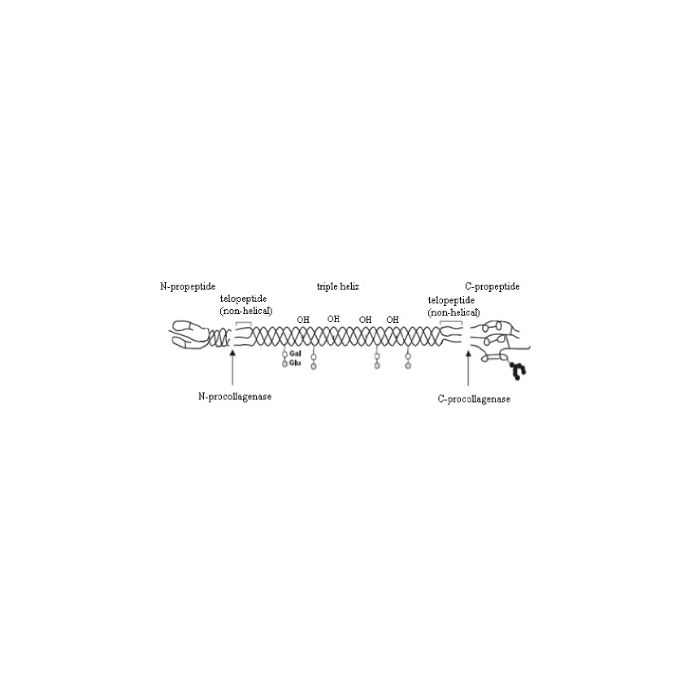
    • Molecular architecture: Composed of three α1(II) chains forming a right-handed triple helix with repeating Gly–X–Y motifs (X/Y frequently Pro and Hydroxyproline). Post-translational hydroxylation stabilizes the helix via water-bridged hydrogen bonds.
    • Interactions: Binds to collagen-binding integrins (e.g., α1β1, α2β1; cartilage-associated α10β1/α11β1) and ECM partners such as proteoglycans (aggrecan) via networked fibrils. Susceptible to cleavage by matrix metalloproteinases and collagenases.
    • Functional implications in research: Collagen-derived peptides are used as simplified surrogates to study cell–matrix adhesion, ECM remodeling, and protease specificity. Hydroxyproline content provides a proxy for collagen mass in biochemical assays.
    • Biophysical context: Fibril formation and crosslinking in native collagen affect cartilage mechanics; peptides lack supramolecular order but retain sequence cues for receptor engagement depending on length and composition.

Note: The roles above describe native Type II collagen biology. Collagen peptides in this product are heterogeneous fragments intended for research use and do not replicate the full structural properties of intact collagen fibrils.

Buffer Applications

Collagen peptides are not buffers and are not typically used to control pH. However, their preparation often involves compatible buffers.

  • Item-specific (Product Data)

    • No buffer-related specifications are provided for this item.
  • Literature/general handling guidance

    • Dissolution: Use water or physiological buffers (e.g., PBS, HEPES, Tris) at pH 6.8–7.6 for most assays. For native collagen (not hydrolysate), dilute acetic acid (0.01–0.1 M) is common.
    • Ionic strength: Moderate salt (50–150 mM NaCl) can reduce nonspecific adsorption and modulate viscosity.
    • Sterility: For cell-related applications, prepare under sterile conditions and 0.22 µm filter; avoid preservatives (e.g., azide) that are cytotoxic.

For detailed buffer recipes or pH ranges validated for this item, refer to the CoA/Spec Sheet or your application protocol.

Green Alternatives
  • Green chemistry perspective (general)

    • Solvent system: Aqueous media are inherently greener than organic solvents; most workflows with collagen peptides proceed in water or mild buffers, minimizing VOCs and flammability risks.
    • Feedstock/source: Sustainability considerations include animal-sourced vs recombinant or marine byproducts. Utilizing byproduct cartilage streams or recombinant humanized collagens can reduce environmental and ethical burdens.
  • Comparison (general; not item-specific)

    Option | Advantages | Trade-offs --- | --- | --- Aqueous buffers (PBS/HEPES) | Non-flammable, low toxicity, easy waste handling | Microbial growth risk; requires preservative/sterility for storage Dilute acetic acid (0.01–0.1 M) | Effective for dissolving native collagen | Acidic effluents; neutralization required Recombinant collagen-mimetic peptides | Animal-free, consistent quality | Higher cost; may lack full-length domain complexity Enzymatic crosslinking (e.g., transglutaminase) | Milder, fewer toxic reagents vs glutaraldehyde | Specificity constraints; requires enzyme handling

  • Process hygiene

    • Favor room-temperature operations, minimal energy input, and closed systems to limit contamination.
    • Replace aldehyde crosslinkers (e.g., glutaraldehyde) with carbodiimide or enzymatic methods when feasible to reduce hazardous waste.

Note: This item’s exact sourcing and processing are not specified; consult the CoA/Spec Sheet for provenance and processing disclosures.

Pharmaceutical Uses
  • Item-specific (Product Data)

    • No pharmacopeial status, excipient designation, or formulation guidance is specified for this item; refer to CoA/Spec Sheet.
  • Literature/general formulation context (non-clinical; for research/manufacturing development only)

    • Role as excipient/biomaterial: Collagen-derived peptides and gelatin derivatives are explored as components of film-formers, coatings, and matrix-forming agents due to filmogenic properties and compatibility with aqueous processing.
    • Compatibility: Blendable with polysaccharides (e.g., alginate, hyaluronan) or synthetic polymers (e.g., PVA, PEG) to tune mechanical properties in prototype dosage-form research (e.g., patches, fast-dissolving films).
    • Crosslinking: Carbodiimide or enzymatic crosslinking can improve moisture resistance in experimental films. Residual crosslinkers must be controlled and justified in any regulated context.
    • Analytics: Typical controls include microbial limits, bioburden/endotoxin (if parenteral-contact is envisaged), residual solvent (if applicable), ash, moisture, heavy metals, and peptide size profile.

Note: No therapeutic or clinical claims are made. This product is sold strictly for research use; suitability for pharmaceutical manufacturing requires independent qualification and compliance assessments.

Physical Properties

Type II collagen peptides are heterogeneous; fixed physicochemical constants are not defined for the mixture.

  • Item-specific (Product Data)

    • Appearance: Not specified for this item; refer to CoA/Spec Sheet.
    • Molecular Weight: Not specified for this item; refer to CoA/Spec Sheet.
  • Literature/general properties (typical; not specifications)

    • Physical form: Typically a light powder or granulate for hydrolysates; hygroscopic tendency can vary by processing.
    • Solubility: Collagen peptides are generally highly water-soluble at neutral pH; native (non-hydrolyzed) collagen is more soluble in dilute acids (e.g., ~0.1 M acetic acid). Ionic strength and pH affect solubility and viscosity.
    • pH behavior: Aqueous solutions are near neutral depending on processing; isoelectric characteristics vary with amino-acid distribution.
    • Thermal behavior: No sharp melting/boiling points (non-volatile polymeric mixture). Thermal denaturation for native collagen occurs ~35–42 C (literature); hydrolysates do not exhibit a cooperative helix–coil transition.
    • Hygroscopicity: Peptide materials can absorb moisture; desiccation improves shelf life.
    • UV/Vis: Strong peptide bond absorbance at ~190–220 nm; weak at 280 nm due to low aromatic content (literature). Quantification by ninhydrin or OPA assays is common.
    • Density, refractive index, logP, pKa: Not applicable as singular constants for mixtures; values depend on sequence distribution.

Always verify lot-specific values (peptide size distribution, nitrogen content, ash, moisture) on the CoA for experimental planning.

Quality & Grades
  • Item-specific (Product Data)

    • Grade/Purity: Not specified for this item; refer to CoA/Spec Sheet.
  • How to interpret quality for collagen peptide materials (general guidance)

    • Source and processing: Type II collagen peptides are commonly produced from cartilage (e.g., avian/bovine/marine). Key differentiators include extraction method (acid/enzymatic), hydrolysis conditions, and demineralization/defatting steps.
    • Molecular weight distribution: Reported as average MW or peptide size ranges (e.g., <3 kDa, 3–5 kDa, etc.). This impacts solubility, viscosity, and bioassay performance. Verify by GPC/SEC or MALDI as reported on the CoA.
    • Purity descriptors: Total nitrogen/protein content (Kjeldahl/Dumas), ash, moisture, and residual solvents (if used) are typical QC parameters. Endotoxin and bioburden controls may be specified for cell culture uses.
    • Identity checks: Amino-acid composition (notably glycine, proline, hydroxyproline) and FTIR (amide I/II bands) are common. Hydroxyproline content serves as a hallmark for collagen-derived peptides.
    • Functional tests: Gel strength is not typically applicable to hydrolysates (more to gelatin). For coatings, cell-adhesion assays and SDS-PAGE profiles can be informative.
    • UV transparency and fluorescence background: Relevant if peptides are used in analytical assays; low aromatic content yields low 280 nm absorbance (verify lot data).

For this specific item, consult the CoA/Spec Sheet for source, MW distribution, endotoxin, moisture/ash, and any stabilizers or additives (if present).

Reaction & Applications
  • Item-specific (Product Data)

    • Manufacturer Applications: Not specified for this item.
  • Research applications (literature/general; not item-specific claims)

    • Surface coating and adhesion studies: Collagen-derived peptides can be adsorbed onto polystyrene, glass, or metal oxides to study integrin-mediated cell adhesion and spreading. Short collagen-mimetic motifs can present binding to collagen receptors.
    • ECM model systems: Useful as components of defined matrices or hydrogels when combined with crosslinkers (e.g., EDC/NHS with carboxylate–amine coupling) or blended with other polymers (alginate, PEG) to tailor mechanics.
    • Analytical standards: Hydroxyproline-rich peptides serve as standards for amino-acid analysis and collagen quantification workflows.
    • Enzymology: Substrates for matrix metalloproteinases (MMPs) and collagenases; degradation kinetics can be profiled by LC–MS.
    • Bioconjugation and labeling: Primary amines (N-termini, Lys) and carboxylates (C-termini, Asp/Glu) permit coupling to reporters, fluorophores, or surfaces using carbodiimide, NHS ester, or click-chemistry handles after prior derivatization.
    • Materials science: Peptide incorporation into films and coatings can modulate wettability and protein adsorption; supports corrosion-protective and biointerface design studies.
  • Practical tips

    • Prepare fresh aqueous solutions; filter sterilize for cell-related assays. Maintain low microbial load; consider 0.02% sodium azide for non-cell applications (never for cell culture).
    • For conjugations, buffer at pH 6–7 (MES for EDC/NHS) or pH 7.5–8.5 (carbonate for NHS-ester/amine reactions). Control stoichiometry to mitigate over-crosslinking and loss of bioactivity.
Reaction Conditions

General laboratory conditions for common chemistries involving collagen-derived peptides (literature guidance; not item specifications):

  • Carbodiimide-mediated coupling (EDC/NHS)

    • Buffer: 50–100 mM MES or phosphate, pH 5.0–6.5 for activation; pH 7.0–7.4 for coupling.
    • Reagents: EDC (0.5–10 mM) with NHS (1–20 mM) depending on amine density and desired crosslinking.
    • Temperature/time: 20–25 C, 15 min to 2 h for activation; 0.5–4 h for coupling.
    • Notes: Minimize competing primary amines in buffer. Excess coupling can reduce bioactivity; optimize empirically.
  • NHS-ester labeling (e.g., fluorophores)

    • Buffer: 50–100 mM sodium bicarbonate/carbonate, pH 8.3–8.6.
    • Stoichiometry: 3–20 molar equivalents of dye to accessible amines.
    • Time/temp: 30–90 min at RT, protect from light.
  • Schiff base formation/reductive amination

    • Buffer: Sodium acetate or phosphate, pH 5.5–7.0; add NaBH3CN (5–50 mM) for stabilization.
    • Compatibility: Ensure absence of reactive aldehydes/ketones in excipients unless intended.
  • Enzymatic digestion (for analysis)

    • Enzymes: Trypsin, collagenase, or MMPs.
    • Conditions: Typically pH 7.4–8.0, 25–37 C, 0.5–16 h depending on enzyme and endpoint.
  • Adsorptive coating on plastics/glass

    • Solvent: Water or PBS.
    • Concentration: 10–200 µg/mL typical screening range.
    • Incubation: 1–16 h at RT or 4 C; rinse to remove unbound material.

These are representative conditions from literature. Optimize based on your assay, surface chemistry, and desired functional readouts.

Safety & Handling
  • Item-specific (Product Data)

    • GHS Classification: Not specified for this item; refer to SDS.
    • Signal Word / H-Statements / Pictograms: Not specified for this item; refer to SDS.
    • Storage Conditions: Room temperature, Desiccated, Cool. Shipped: Normal.
    • Research Use: For research use only.
  • General safety guidance (literature/general; consult SDS for authoritative instructions)

    • Expected hazards: Collagen peptides are generally considered low hazard; however, fine powders can cause mechanical irritation to eyes/respiratory tract. Proteinaceous materials may present allergenicity for sensitized individuals.
    • PPE: Use lab coat, safety glasses, and appropriate gloves. Avoid generating dust/aerosols; handle in a fume hood or biosafety cabinet if airborne exposure is possible.
    • Incompatibilities: Strong oxidizers may degrade peptide backbones; avoid elevated temperatures and high humidity that promote hydrolysis/microbial growth. Proteases or contaminated aqueous solutions can rapidly degrade peptides.
    • First aid (overview):
      • Inhalation: Move to fresh air; seek medical attention if symptoms persist.
      • Skin: Wash with soap and water; remove contaminated clothing.
      • Eyes: Rinse cautiously with water for several minutes; remove contact lenses if present and easy to do.
      • Ingestion: Rinse mouth; seek medical advice as appropriate.
    • Spill response: Avoid dust; collect mechanically or with HEPA vacuum. For solutions, absorb with inert material, then clean with detergent/water. Dispose according to institutional and local regulations.

Always defer to the product’s SDS for classification, emergency measures, and disposal instructions.

Solvent Selection
  • Item-specific (Product Data)

    • No solvent recommendations are specified for this item; refer to CoA/Spec Sheet.
  • Literature/general guidance for collagen type II peptides

    • Primary medium: Water and aqueous buffers (e.g., PBS, HEPES) are typically suitable for hydrolyzed collagen peptides; adjust pH to 6.5–7.5 for most biological assays. Native collagen (non-hydrolyzed) prefers dilute acids (e.g., 0.01–0.1 M acetic acid) for dissolution.
    • Polarity and miscibility: Highly polar, extensively hydrogen-bonding; insoluble in nonpolar organic solvents; practically insoluble in alcohols at high concentration but may disperse in aqueous alcohol mixtures.
    • Additives: Low concentrations of salts (NaCl) can modulate ionic strength and solubility. Avoid strong denaturants (6–8 M urea, guanidinium) unless intentionally used for unfolding or cleaning.
    • Filtration: Use 0.22–0.45 µm filters after dissolution to remove particulates. Warm (room temperature) gentle stirring aids dissolution; avoid foaming.
  • Comparison (general)

    • Collagen peptides vs intact collagen: Peptides dissolve readily in neutral water and are convenient for coatings and biochemical assays; intact collagen requires acidic conditions and may form gels/triple helices, better for 3D scaffolds.
    • Versus other ECM proteins (e.g., fibronectin, laminin): Collagen peptides are cost-effective and robust but may lack specific domain-mediated signaling present in full-length ECM proteins.
Storage & Reconstitution
  • Item-specific (Product Data)

    • Storage Conditions: Room temperature, Desiccated, Cool.
    • Shipped In: Normal.
  • Reconstitution

    • Item-specific instructions: Not specified for this item; refer to CoA/Spec Sheet.
  • Literature/general guidance (not specifications)

    • Reconstitution solvent: Use sterile water or compatible buffer (e.g., PBS, HEPES) at desired concentration; gentle stirring at room temperature aids dissolution. Avoid vigorous vortexing that introduces air/foam.
    • Filtration: 0.22–0.45 µm filtration recommended for clarity/sterility when compatible with intended use.
    • Working solutions: Prepare fresh. For short-term storage (days), hold at 2–8 C. For longer-term storage, aliquot and freeze at −20 C or −80 C to limit microbial growth and repeated freeze–thaw; note that freeze–thaw can cause aggregation in some peptide mixtures.
    • Microbial control: For non-cell applications, 0.02–0.05% sodium azide can be used as a preservative; do not use azide in cell culture.
    • Container: Use low-protein-binding plastics or silanized glass to reduce adsorption at low concentrations.

Always consult the product’s CoA/SDS for lot-specific stability and any stabilizers or additives.

Structure & Identity

Brief overview: Collagen Peptide Type II is a heterogeneous mixture of short peptides derived from Type II collagen (cartilage extracellular matrix). It lacks a single defined molecular structure; instead it consists of Gly–X–Y repeat–rich peptide fragments enriched in proline and hydroxyproline.

  • Item-specific (Product Data)

    • Product Name: Collagen Peptide Type ⅠⅠ (Type II)
    • SKU: C1516253
    • CAS: 9064-67-9 (mixture; collagen type II/hydrolysate)
    • Molecular Formula: Not specified for this item; refer to CoA/Spec Sheet.
    • Molecular Weight: Not specified for this item; refer to CoA/Spec Sheet.
    • InChIKey: Not specified for this item; refer to CoA/Spec Sheet.
    • SMILES: Not applicable to heterogeneous peptide mixtures; not specified for this item.
    • PubChem CID: 71571507 (collagen type II record; mixture)
  • Literature/general structural features

    • Composition: Peptides derived from the triple-helical Type II collagen (characteristic Gly–X–Y repeats where X/Y are often Pro/Hyp).
    • Functional groups: Multiple primary amines (N-termini, Lys), carboxylates (C-termini, Asp/Glu), hydroxyls (Hyp/Ser/Thr), amide backbones; occasional disulfide-poor.
    • Higher-order structure: As peptides, predominantly non-helical/random coil in solution; native triple helix pertains to intact collagen, not hydrolysates.
    • 2D description in words: Linear oligomers of amino acids containing repeating amide linkages with side-chain functionalities typical of collagen (notably proline/hydroxyproline-rich).
Synthetic Utility

While not a classical small-molecule building block, collagen peptides possess reactive functional groups enabling diverse bioconjugation and materials chemistry.

  • Functional group handle map (literature/general)

    • Primary amines: N-termini and lysine side chains enable amide formation with NHS esters, isothiocyanates (thiourea formation), or aldehydes (Schiff bases, reducible with NaBH3CN).
    • Carboxylates: C-termini and Asp/Glu side chains for carbodiimide-mediated coupling (EDC/NHS) to amines on surfaces or polymers.
    • Hydroxyls: Ser/Thr and hydroxyproline can be derivatized (e.g., succinylation, carbonate formation) under controlled conditions.
    • Thiols: Typically low due to sparse cysteine in collagen; if present, can be targeted with maleimides/iodoacetamides after reduction.
  • Synthetic contexts

    • Surface immobilization: Create peptide-functionalized substrates for biosensors and cell-adhesion assays via EDC/NHS or silane–linker strategies.
    • Polymer conjugates: Graft to PEG, polyacrylates, or polysaccharides to modulate biointerface properties and hydration.
    • Click chemistry: Introduction of azide/alkyne handles (via NHS–PEG–N3 or NHS–alkyne) allows CuAAC or SPAAC conjugations.
    • Crosslinking networks: Form hydrogels with multifunctional amines/acids; tune stiffness by crosslinker density and reaction pH.
  • Practical notes

    • Buffer choice is critical: Use non-amine buffers (MES, phosphate) for EDC/NHS; avoid Tris during NHS-ester reactions to prevent buffer quenching.
    • Characterization: Use TNBS or OPA assays for free amines, FTIR (amide I/II), and SEC for size distribution. LC–MS/MS feasible for select peptides but not whole mixtures.
Target Specificity

This section is primarily applicable to antibodies, probes, or bioactive ligands with defined targets. For Collagen Peptide Type II (a heterogeneous peptide material):

  • Item-specific (Product Data)
    • No target specificity, epitope, clone, isotype, or species-reactivity data are applicable or provided for this item.

For receptor-binding studies, consult literature on collagen–integrin interactions; however, such data are sequence- and length-dependent and are not specifications of this product.

Frequently Asked Questions

How should this product be stored?
Store in a cool place, desiccated. Keep the container tightly closed with desiccant — the material is moisture-sensitive.
How is this product shipped?
This product ships under standard ambient conditions. No temperature-controlled packaging is required.
What are the CAS number, molecular formula and molecular weight?
The CAS Number is 9064-67-9.
What documentation is provided?
Available product documentation, including Certificates of Analysis (COA), Safety Data Sheets (SDS), and specification sheets, is shown in the product document area. Document availability and access follow the current site policy.

Shall we send you a message when we have discounts available?

Remind me later

Thank you! Please check your email inbox to confirm.

Oops! Notifications are disabled.