
Determine the necessary mass, volume, or concentration for preparing a solution.
| Activity Type | Activity Value -log(M) | Mechanism of Action | Activity Reference | Publications (PubMed IDs) |
|---|
Moligand™, ≥99%(HPLC) Moligand™ for sensitive chromatographic and analytical workflows requiring minimal baseline interference.
Store at -20°C Ships Ice chest + Ice pads Check lot-specific COA for exact specifications.
SDS, COA, datasheet, and spec sheet available for download. Lot-specific COA accessible via lot number lookup.
Cited in 1 peer-reviewed publications across chromatography, organic synthesis, and cross-coupling reactions.
Product description:
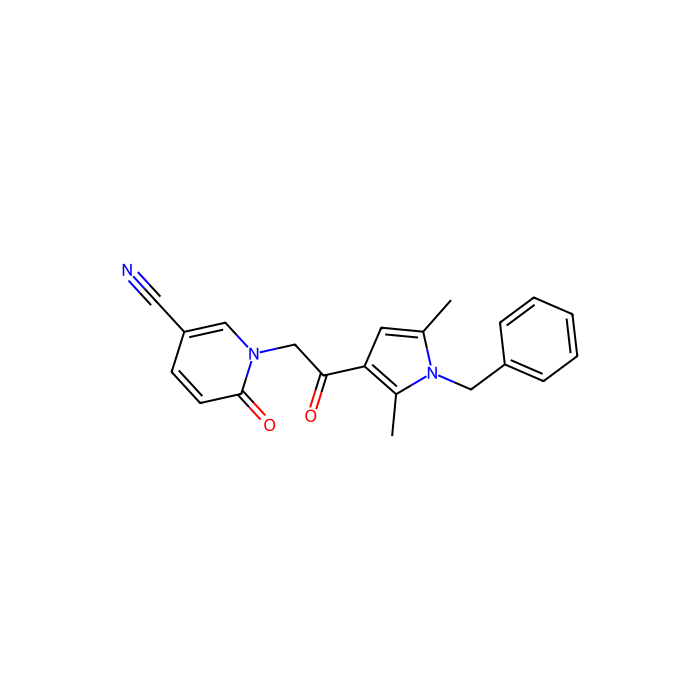
CYM-5520 has been used as a sphingosine 1-phosphate receptor 2 (S1pr2) agonist in pancreatic adenocarcinoma cell line (CFPAC-1).
Application:
CYM-5520 is a specific, noncompetitive allosteric agonist of sphingosine 1-phosphate receptor 2 (S1PR2; EC50 = 1.0 μM). The compound CYM-5520 does not show any agonsit activity towards S1PR1, S1PR3, S1PR4 or S1PR5.
CYM-5520 mediates phosphorylation of transcription factor p65. It upregulates trabecular number, thickness as well as tibial bone volume density in osteoblasts.
Comprehensive hazard, handling, storage, and regulatory compliance document.
<<<<<<< HEAD Download SDS → ======= Download SDS → >>>>>>> release248-p3Lot-specific quality data. Enter your lot number to retrieve the exact COA.
Look up COA →Full quality attributes and acceptance criteria for this grade.
View spec sheet →Taxonomy Tree
| Kingdom | Organic compounds |
|---|---|
| Superclass | Organoheterocyclic compounds |
| Class | Pyridines and derivatives |
| Subclass | 3-pyridinecarbonitriles |
| Intermediate Tree Nodes | Not available |
| Direct Parent | 3-pyridinecarbonitriles |
| Alternative Parents | Aryl alkyl ketones Pyridinones Dihydropyridines Substituted pyrroles Benzene and substituted derivatives Vinylogous amides Heteroaromatic compounds Lactams Nitriles Azacyclic compounds Organic oxides Hydrocarbon derivatives |
| Molecular Framework | Aromatic heteromonocyclic compounds |
| Substituents | 3-pyridinecarbonitrile - Aryl alkyl ketone - Aryl ketone - Dihydropyridine - Pyridinone - Monocyclic benzene moiety - Hydropyridine - Benzenoid - Substituted pyrrole - Heteroaromatic compound - Vinylogous amide - Pyrrole - Ketone - Lactam - Carbonitrile - Nitrile - Azacycle - Organic nitrogen compound - Hydrocarbon derivative - Organic oxide - Cyanide - Organonitrogen compound - Organooxygen compound - Organic oxygen compound - Aromatic heteromonocyclic compound |
| Description | This compound belongs to the class of organic compounds known as 3-pyridinecarbonitriles. These are organic compounds containing a pyridine ring substituted at the 3-position by a carbonitrile group. |
| External Descriptors | Not available |
| Activity Type | Activity Value -log(M) | Mechanism of Action | Activity Reference | Publications (PubMed IDs) |
|---|
Find and download the COA for your product by matching the lot number on the packaging.
| Lot Number | Certificate Type | Date | Item |
|---|---|---|---|
 K2219225 | Certificate of Analysis | Sep 08, 2022 | C287402 |
| K2219234 | Certificate of Analysis | Sep 08, 2022 | C287402 |
| K2219235 | Certificate of Analysis | Sep 08, 2022 | C287402 |
| K2219236 | Certificate of Analysis | Sep 08, 2022 | C287402 |
| K2219238 | Certificate of Analysis | Sep 08, 2022 | C287402 |
| Solubility | Solvent:DMSO, Max Conc. mg/mL: 34.54, Max Conc. mM: 100 |
|---|---|
| Molecular Weight | 345.400 g/mol |
| XLogP3 | 2.400 |
| Hydrogen Bond Donor Count | 0 |
| Hydrogen Bond Acceptor Count | 3 |
| Rotatable Bond Count | 5 |
| Exact Mass | 345.148 Da |
| Monoisotopic Mass | 345.148 Da |
| Topological Polar Surface Area | 66.100 Ų |
| Heavy Atom Count | 26 |
| Formal Charge | 0 |
| Complexity | 666.000 |
| Isotope Atom Count | 0 |
| Defined Atom Stereocenter Count | 0 |
| Undefined Atom Stereocenter Count | 0 |
| Defined Bond Stereocenter Count | 0 |
| Undefined Bond Stereocenter Count | 0 |
| The total count of all stereochemical bonds | 0 |
| Covalently-Bonded Unit Count | 1 |
Our grade selection guide covers purity, stabilizer status, and application suitability for all variants in our catalog.
View Moligand™ grade guide →