Determine the necessary mass, volume, or concentration for preparing a solution.
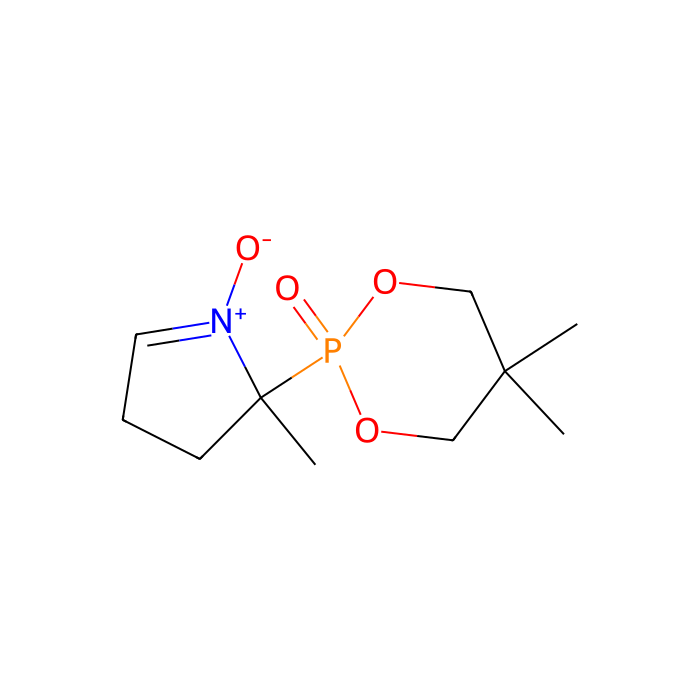
CYPMPO is a solvent used in electron spin resonance (ESR) free radical spin trapping. One advantage to using CYPMPO is that it shows preference for trapping superoxide and hydroxyl radicals. Studies indicate that ESR trapping of free radicals is very difficult on lipophilic antioxidants as a result of poor solubility and formation unstable adducts. CYPMPO is favorable because it can form stable adducts that are clearly separated and identifiable in ESR. Furthermore, CYPMPO is efficient in biological and chemical systems because of its low toxicity.
Taxonomy Tree
| Kingdom | Organic compounds |
|---|---|
| Superclass | Organic acids and derivatives |
| Class | Organic phosphonic acids and derivatives |
| Subclass | Phosphonic acid diesters |
| Intermediate Tree Nodes | Not available |
| Direct Parent | Dialkyl alkylphosphonates |
| Alternative Parents | Phosphonic acid esters Pyrrolines Nitrones Propargyl-type 1,3-dipolar organic compounds Oxacyclic compounds Azacyclic compounds Organophosphorus compounds Organooxygen compounds Organonitrogen compounds Organic salts Organic oxides Hydrocarbon derivatives Organic cations |
| Molecular Framework | Aliphatic heteromonocyclic compounds |
| Substituents | Dialkyl alkylphosphonate - Phosphonic acid ester - Pyrroline - Nitrone - Allyl-type 1,3-dipolar organic compound - Propargyl-type 1,3-dipolar organic compound - Organic 1,3-dipolar compound - Organoheterocyclic compound - Azacycle - Oxacycle - Organic nitrogen compound - Organic oxide - Organonitrogen compound - Organic salt - Organooxygen compound - Organophosphorus compound - Organic oxygen compound - Hydrocarbon derivative - Organic cation - Aliphatic heteromonocyclic compound |
| Description | This compound belongs to the class of organic compounds known as dialkyl alkylphosphonates. These are compounds containing a phosphonic acid that is diesterified with alkyl groups, and the phosphorus atom is also directly attached to an alkyl group. |
| External Descriptors | Not available |
| Solubility | Soluble in water (10mg/ml) at 25°C |
|---|---|
| Sensitivity | Moisture sensitive |
| Melt Point | 126° C |
| Molecular Weight | 247.23 |
| XLogP3 | -0.300 |
| Hydrogen Bond Donor Count | 0 |
| Hydrogen Bond Acceptor Count | 4 |
| Rotatable Bond Count | 1 |
| Exact Mass | 247.097 Da |
| Monoisotopic Mass | 247.097 Da |
| Topological Polar Surface Area | 64.300 Ų |
| Heavy Atom Count | 16 |
| Formal Charge | 0 |
| Complexity | 365.000 |
| Isotope Atom Count | 0 |
| Defined Atom Stereocenter Count | 0 |
| Undefined Atom Stereocenter Count | 1 |
| Defined Bond Stereocenter Count | 0 |
| Undefined Bond Stereocenter Count | 0 |
| The total count of all stereochemical bonds | 0 |
| Covalently-Bonded Unit Count | 1 |
H315:Causes skin irritation
H319:Causes serious eye irritation
H335:May cause respiratory irritation
P261:Avoid breathing dust/fume/gas/mist/vapors/spray.
P264:Wash hands [and …] thoroughly after handling.
P271:Use only outdoors or in a well-ventilated area.
P280:Wear protective gloves/protective clothing/eye protection/face protection.
P321:Specific treatment (see ... on this label).
P302+P352:IF ON SKIN: wash with plenty of water.
P304+P340:IF INHALED: Remove person to fresh air and keep comfortable for breathing.
P305+P351+P338:IF IN EYES: Rinse cautiously with water for several minutes. Remove contact lenses if present and easy to do - continue rinsing.
P362+P364:Take off contaminated clothing and wash it before reuse.
P405:Store locked up.
P403+P233:Store in a well-ventilated place. Keep container tightly closed.
P501:Dispose of contents/container to an approved waste disposal plant.
P264+P265:Wash hands [and …] thoroughly after handling. Do not touch eyes.
P337+P317:If eye irritation persists: Get medical help.
P332+P317:If skin irritation occurs: Get medical help.
P319:Get medical help if you feel unwell.