
Determine the necessary mass, volume, or concentration for preparing a solution.
| Activity Type | Relation | Activity value | Units | Action Type | Journal | PubMed Id | doi | Assay Aladdin ID |
|---|
Taxonomy Tree
| Kingdom | Organic compounds |
|---|---|
| Superclass | Lipids and lipid-like molecules |
| Class | Prenol lipids |
| Subclass | Quinone and hydroquinone lipids |
| Intermediate Tree Nodes | Vitamin E compounds |
| Direct Parent | Tocopherols |
| Alternative Parents | Diterpenoids 1-benzopyrans Alkyl aryl ethers 1-hydroxy-2-unsubstituted benzenoids Oxacyclic compounds Hydrocarbon derivatives |
| Molecular Framework | Aromatic heteropolycyclic compounds |
| Substituents | Tocopherol - Diterpenoid - 1-benzopyran - Benzopyran - Chromane - 1-hydroxy-2-unsubstituted benzenoid - Alkyl aryl ether - Benzenoid - Oxacycle - Organoheterocyclic compound - Ether - Organic oxygen compound - Hydrocarbon derivative - Organooxygen compound - Aromatic heteropolycyclic compound |
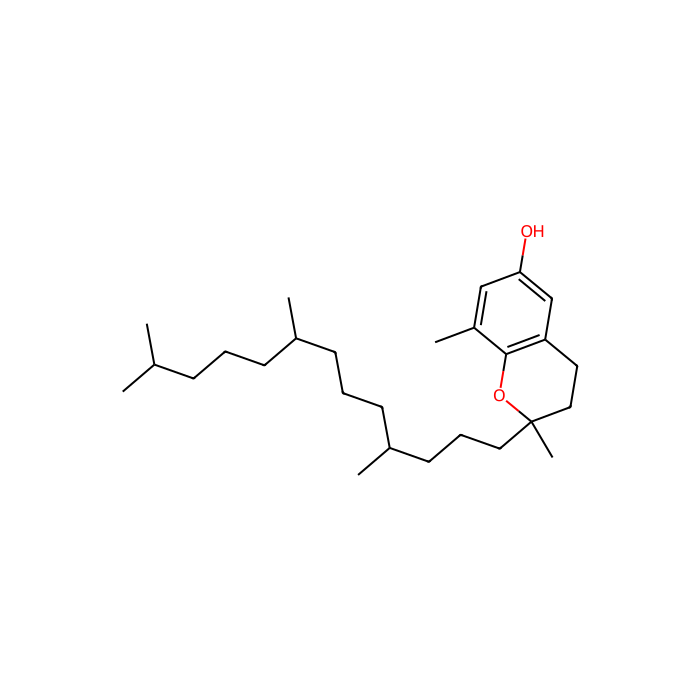
| Description | This compound belongs to the class of organic compounds known as tocopherols. These are vitamin E derivatives containing a saturated trimethyltridecyl chain attached to the carbon C6 atom of a benzopyran ring system. The differ from tocotrienols that contain an unsaturated trimethyltrideca-3,7,11-trien-1-yl chain. |
| External Descriptors | Vitamin E |
| Activity Type | Relation | Activity value | Units | Action Type | Journal | PubMed Id | doi | Assay Aladdin ID |
|---|
| Activity Type | Relation | Activity value | Units | Action Type | Journal | PubMed Id | doi | Assay Aladdin ID |
|---|
| Activity Type | Relation | Activity value | Units | Action Type | Journal | PubMed Id | doi | Assay Aladdin ID |
|---|
Find and download the COA for your product by matching the lot number on the packaging.
| Lot Number | Certificate Type | Date | Item |
|---|---|---|---|
 K2606055 | Certificate of Analysis | Nov 16, 2026 | T109349 |
| E23231155 | Certificate of Analysis | Oct 09, 2026 | T109349 |
| E2323972 | Certificate of Analysis | Oct 09, 2026 | T109349 |
| E2323976 | Certificate of Analysis | Oct 09, 2026 | T109349 |
| E2323978 | Certificate of Analysis | Oct 09, 2026 | T109349 |
| H2605021 | Certificate of Analysis | Aug 08, 2026 | T109349 |
| D2424427 | Certificate of Analysis | Jan 21, 2026 | T109349 |
| G2216632 | Certificate of Analysis | Jan 19, 2026 | T109349 |
| G2216609 | Certificate of Analysis | Jun 25, 2022 | T109349 |
| C2031139 | Certificate of Analysis | Jan 26, 2022 | T109349 |
| Molecular Weight | 402.7 |
|---|---|
| XLogP3 | 10.000 |
| Hydrogen Bond Donor Count | 1 |
| Hydrogen Bond Acceptor Count | 2 |
| Rotatable Bond Count | 12 |
| Exact Mass | 402.35 Da |
| Monoisotopic Mass | 402.35 Da |
| Topological Polar Surface Area | 29.500 Ų |
| Heavy Atom Count | 29 |
| Formal Charge | 0 |
| Complexity | 448.000 |
| Isotope Atom Count | 0 |
| Defined Atom Stereocenter Count | 3 |
| Undefined Atom Stereocenter Count | 0 |
| Defined Bond Stereocenter Count | 0 |
| Undefined Bond Stereocenter Count | 0 |
| The total count of all stereochemical bonds | 0 |
| Covalently-Bonded Unit Count | 1 |
No vendor-validated protocols are specified for this item; refer to CoA/Spec Sheet.
General research-use procedures (literature/good practice):
All procedures are for research use only.
General biochemical context (literature):
Important caveats:
Not typically applicable. δ-Tocopherol is highly hydrophobic and is not used as a buffering agent.
Practical guidance for aqueous work (general knowledge):
Positioning: δ-Tocopherol itself is a bio-based, biodegradable antioxidant and can serve as a greener alternative to synthetic phenolic antioxidants in many formulations.
Comparison (literature/general knowledge):
Application: Antioxidant for lipids and polymers
Application: Radical-scavenging in research assays
Process considerations:
Formulation context (literature/general knowledge; no therapeutic claims):
Regulatory note:
This product is provided strictly for research use only.
Item-specific physical data: Not specified for this item; refer to CoA/Spec Sheet.
Literature/typical properties for (+)-δ-tocopherol (for general reference only):
Practical notes (general knowledge):
Item-specific grade/purity: Not specified for this item; refer to CoA/Spec Sheet.
How to interpret grades for tocopherols (general guidance):
What to request/verify for critical applications:
Applied roles (literature/general knowledge):
Chemical transformations (synthetic context):
Practical tips:
General laboratory conditions for common transformations of δ-tocopherol (literature guidance; optimize per lab):
Esterification/acylation of phenolic OH:
Carbonate/urethane formation:
Oxidation to tocopheryl quinone:
Purification/handling:
Solution preparation for assays:
Item-specific hazard data: Not specified for this item; refer to CoA/Spec Sheet and SDS for authoritative safety information.
General safety profile for tocopherols (literature/general knowledge):
Handling recommendations:
First-aid overview (defer to SDS):
Fire safety:
Chemotype: Highly lipophilic phenolic antioxidant with a long isoprenoid tail.
Polarity and miscibility (general knowledge/literature):
Selection tips by application:
Comparison to alternatives:
Item-specific conditions (from Product Data):
General stability guidance for tocopherols:
Reconstitution and aliquoting (general practice):
Expiry and quality checks:
Brief overview: (+)-δ-Tocopherol is a lipophilic chromanol (tocopherol) with a long isoprenoid side chain; it is one of the natural Vitamin E homologs and a potent chain-breaking antioxidant in hydrophobic media.
Item-specific (from Product Data):
Literature identity (typical for (+)-δ-tocopherol):
2D structure description (general):
Functional group reactivity (general knowledge):
Use cases:
Retrosynthetic perspective:
Not applicable. This product is a small-molecule antioxidant, not an affinity reagent or antibody. No antigen, epitope, species reactivity, clone, or isotype information applies.