GRADE & PURITYMoligand™?Moligand™ — Aladdin's line of ligands and bioactive small molecules. Use for receptor, pathway, and binding studies needing defined small-molecule tools.≥99%
Moligand™, ≥99% Moligand™ for sensitive chromatographic and analytical workflows requiring minimal baseline interference.
🌡
Storage & shipping
Store at -20°C,Desiccated Ships Ice chest + Ice pads Check lot-specific COA for exact specifications.
📋
Quality documents
SDS, COA, datasheet, and spec sheet available for download. Lot-specific COA accessible via lot number lookup.
📚
Literature proof
Cited in 0 peer-reviewed publications across chromatography, organic synthesis, and cross-coupling reactions.
Overview
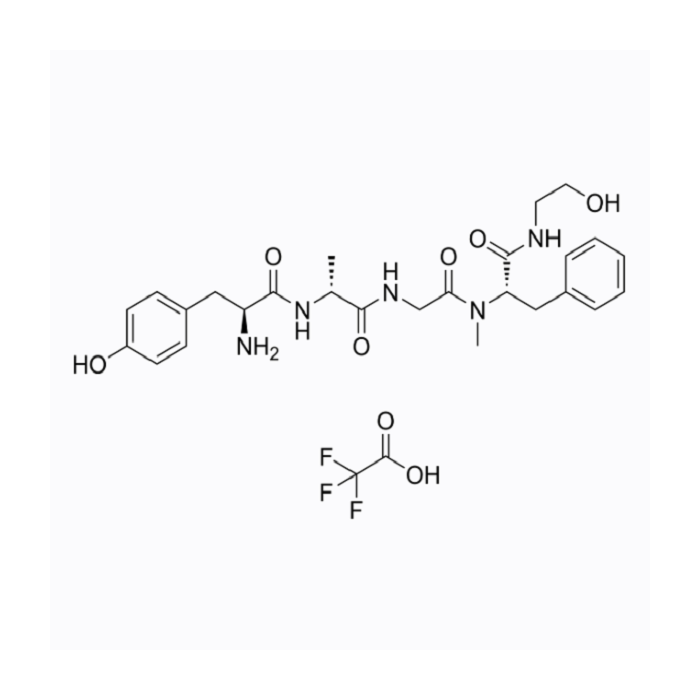
DAMGO TFA is a μ-opioid receptor ( μ-OPR ) selective agonist with a K d of 3.46 nM for native μ-OPR.
In Vitro
DAMGO (1-10 μM) TFA significantly reduces the activation of neuronal Akt and ERK1/2 by CXCL12 and inhibits CXCL12-promoted neuronal survival, but does not down-regulate CXCR4 protein expression. DAMGO (1 μM) TFA effectively inhibits the prostaglandin E 2 (PGE 2) induced increase in a tetrodotoxin-resistant voltage-gated Na + current (TTX-R I Na ), i.e. PGE 2 (1 μM) can increase the TTX-R I Na peak by 103 % compared to 24.9 % with the addition of DAMGO. MCE has not independently confirmed the accuracy of these methods. They are for reference only.
In Vivo
DAMGO (i.v., 0.5-2 mg/kg) TFA can produce significant anti-injury effects on injured paws of male Sprague-Dawley rats weighing 200-225 g in a dose-dependent manner, producing an effective and long-lasting analgesic effect. MCE has not independently confirmed the accuracy of these methods. They are for reference only.
This compound belongs to the class of organic compounds known as oligopeptides. These are organic compounds containing a sequence of between three and ten alpha-amino acids joined by peptide bonds.
External Descriptors
peptide
1. Djoumbou Feunang Y, Eisner R, Knox C, Chepelev L, Hastings J, Owen G, Fahy E, Steinbeck C, Subramanian S, Bolton E, Greiner R, and Wishart DS. ClassyFire: Automated Chemical Classification With A Comprehensive, Computable Taxonomy. Journal of Cheminformatics, 2016, 8:61.
We use cookies to ensure the website functions properly and, where permitted, to improve your experience. You can manage your preferences at any time in Settings. Learn more in our Cookie Policy.
Shall we send you a message when we have discounts available?
Remind me later
Thank you! Please check your email inbox to confirm.
Products are supplied to verified businesses, institutions, and qualified professionals for research and development use only. Not for use in humans, animals, diagnosis, or therapy.

 H2525342