
Determine the necessary mass, volume, or concentration for preparing a solution.
| Activity Type | Relation | Activity value | Units | Action Type | Journal | PubMed Id | doi | Assay Aladdin ID |
|---|
≥98% for sensitive chromatographic and analytical workflows requiring minimal baseline interference.
Store at -20°C Ships Ice chest + Ice pads Check lot-specific COA for exact specifications.
SDS, COA, datasheet, and spec sheet available for download. Lot-specific COA accessible via lot number lookup.
Cited in 63 peer-reviewed publications across chromatography, organic synthesis, and cross-coupling reactions.
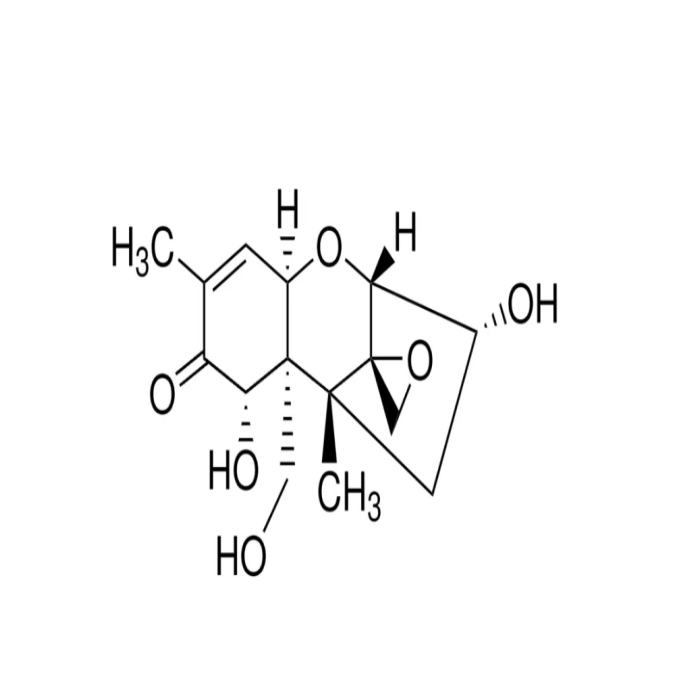
Deoxynivalenol is a mycotoxin usually produced by Fusarium species and is often detected in grains. This compound demonstrates immunosuppressive characteristics at high concentrations and immunostimulatory effects at low concentrations. Other effects of this mycotoxin include down-regulation of genes involved in protein synthesis, proliferation, ribosomal proteins, and mitochondria. Further studies show that Deoxynivalenol is an inducer of calcium release from the endoplasmic reticulum.
A Fusarium mycotoxin.The main toxic effect of Deoxynivalenol is inhibition of protein synthesis via binding to the ribosome.In agricultural R&D, it is widely used to select crops strains with increased resistance against Fusarium.
Application:
Deoxynivalenol has been used:
as a mycotoxin to induce cytotoxicity in porcine jejunal epithelial cells and study the protective effects of Saccharomyces cerevisiae on the cell viability of host cells.
to induce toxicity in nude mice to study the effect of probiotics (Lactobacillus rhamnosus GG (LGG) or Lactobacillus acidophilus (LA)) supplementation on host protection.
as a thyroid hormone receptor (TRβ) antagonist in cell-based luciferase reporter gene (CALUX) assay.
Comprehensive hazard, handling, storage, and regulatory compliance document.
Download SDS →Lot-specific quality data. Enter your lot number to retrieve the exact COA.
Look up COA →Full quality attributes and acceptance criteria for this grade.
View spec sheet →Taxonomy Tree
| Kingdom | Organic compounds |
|---|---|
| Superclass | Lipids and lipid-like molecules |
| Class | Prenol lipids |
| Subclass | Sesquiterpenoids |
| Intermediate Tree Nodes | Not available |
| Direct Parent | Trichothecenes |
| Alternative Parents | Oxepanes Cyclohexenones Oxanes Secondary alcohols Cyclic alcohols and derivatives Oxacyclic compounds Epoxides Dialkyl ethers Primary alcohols Organic oxides Hydrocarbon derivatives |
| Molecular Framework | Aliphatic heteropolycyclic compounds |
| Substituents | Trichothecene skeleton - Cyclohexenone - Oxepane - Oxane - Cyclic alcohol - Ketone - Secondary alcohol - Cyclic ketone - Dialkyl ether - Oxirane - Ether - Oxacycle - Organoheterocyclic compound - Organic oxide - Carbonyl group - Organooxygen compound - Hydrocarbon derivative - Organic oxygen compound - Primary alcohol - Alcohol - Aliphatic heteropolycyclic compound |
| Description | This compound belongs to the class of organic compounds known as trichothecenes. These are sesquiterpene mycotoxins structurally characterized by the presence of an epoxide ring and a benzopyran derivative with a variant number of hydroxyl, acetyl, or other substituents. The most important structural features causing the biological activities of trichothecenes are the 12,13-epoxy ring, the presence of hydroxyl or acetyl groups at appropriate positions on the trichothecene nucleus and the structure and position of the side-chain. |
| External Descriptors | Not available |
| Activity Type | Relation | Activity value | Units | Action Type | Journal | PubMed Id | doi | Assay Aladdin ID |
|---|
| Activity Type | Relation | Activity value | Units | Action Type | Journal | PubMed Id | doi | Assay Aladdin ID |
|---|
| Activity Type | Relation | Activity value | Units | Action Type | Journal | PubMed Id | doi | Assay Aladdin ID |
|---|
| Activity Type | Relation | Activity value | Units | Action Type | Journal | PubMed Id | doi | Assay Aladdin ID |
|---|
| Activity Type | Relation | Activity value | Units | Action Type | Journal | PubMed Id | doi | Assay Aladdin ID |
|---|
Find and download the COA for your product by matching the lot number on the packaging.
| Lot Number | Certificate Type | Date | Item |
|---|---|---|---|
 G2601113 G2601113 | Certificate of Analysis | Apr 03, 2025 | B135944 |
| H2522267 | Certificate of Analysis | Apr 03, 2025 | B135944 |
| H2522268 | Certificate of Analysis | Apr 03, 2025 | B135944 |
| H2110393 | Certificate of Analysis | Feb 07, 2025 | B135944 |
| J2421912 | Certificate of Analysis | Sep 27, 2024 | B135944 |
| J2421913 | Certificate of Analysis | Sep 27, 2024 | B135944 |
| H2110115 | Certificate of Analysis | May 12, 2023 | B135944 |
| G2408015 | Certificate of Analysis | Oct 11, 2022 | B135944 |
| K2212271 | Certificate of Analysis | Oct 11, 2022 | B135944 |
| K2212274 | Certificate of Analysis | Oct 11, 2022 | B135944 |
| Solubility | Soluble in methanol, chloroform, water (slightly), ethanol (9.8 - 10.2 mg/ml), and DMSO. |
|---|---|
| Sensitivity | Moisture sensitive |
| Molecular Weight | 296.310 g/mol |
| XLogP3 | -0.700 |
| Hydrogen Bond Donor Count | 3 |
| Hydrogen Bond Acceptor Count | 6 |
| Rotatable Bond Count | 1 |
| Exact Mass | 296.126 Da |
| Monoisotopic Mass | 296.126 Da |
| Topological Polar Surface Area | 99.500 Ų |
| Heavy Atom Count | 21 |
| Formal Charge | 0 |
| Complexity | 558.000 |
| Isotope Atom Count | 0 |
| Defined Atom Stereocenter Count | 7 |
| Undefined Atom Stereocenter Count | 0 |
| Defined Bond Stereocenter Count | 0 |
| Undefined Bond Stereocenter Count | 0 |
| The total count of all stereochemical bonds | 0 |
| Covalently-Bonded Unit Count | 1 |