60% in water for sensitive chromatographic and analytical workflows requiring minimal baseline interference.
🌡
Storage & shipping
Room temperature Ships Normal Check lot-specific COA for exact specifications.
📋
Quality documents
SDS, COA, datasheet, and spec sheet available for download. Lot-specific COA accessible via lot number lookup.
📚
Literature proof
Cited in 124 peer-reviewed publications across chromatography, organic synthesis, and cross-coupling reactions.
Overview
Application:
DADMAC is used as a cationic monomer solution for the fabrication of ion-selective polyelectrolytic anodized aluminium oxide (AAO) membranes which can be used for the development of electrical power generation systems. It may be grafted on carboxymethyl cellulose (CMC) for use as an absorbent for cationic dyes.
Tetraalkylammonium salt - Organopnictogen compound - Hydrocarbon derivative - Organic chloride salt - Organic salt - Amine - Aliphatic acyclic compound
Description
This compound belongs to the class of organic compounds known as tetraalkylammonium salts. These are organonitrogen compounds containing a quaternary ammonium substituted with four alkyl chains.
External Descriptors
Not available
1. Djoumbou Feunang Y, Eisner R, Knox C, Chepelev L, Hastings J, Owen G, Fahy E, Steinbeck C, Subramanian S, Bolton E, Greiner R, and Wishart DS. ClassyFire: Automated Chemical Classification With A Comprehensive, Computable Taxonomy. Journal of Cheminformatics, 2016, 8:61.
Determine the necessary mass, volume, or concentration for preparing a solution.
Dilution Calculator
Determine the dilution needed to prepare a stock solution.
Reconstitution Calculator
Reviews
Customer Reviews
Application Protocols
No application protocols are specified for this item in the product data. The following general, non–item-specific outlines may assist in planning polymerizations (verify and optimize for your lab):
Aqueous homopolymerization (outline, literature):
Charge deionized water (degassed) to reactor; add DADMAC to desired solids (e.g., 20–30%).
Adjust pH to 6–7; add EDTA (trace) if metal-sensitive.
Heat to 60–70 °C under N2. Initiate with APS (0.2–0.5 wt% to monomer). Maintain temperature and stir 2–6 h.
Monitor conversion (solids, residual monomer by NMR). Cool and filter. Store under inert atmosphere.
Redox-initiated polymerization (low-temperature):
Set up at 20–30 °C under N2.
Add persulfate solution and reducing agent (e.g., NaHSO3) separately, controlling addition rate and temperature.
Hold until target conversion; quench by cooling and air exclusion.
Prepare 0.1–1.0% w/v polyDADMAC solution in buffer with controlled ionic strength (e.g., 10–100 mM NaCl).
Alternate adsorption with anionic polymer (e.g., PSS), rinsing between steps; monitor via QCM-D or UV absorbance.
These outlines are provided as general literature guidance only; adapt to your specific monomer grade and reactor configuration.
Biological Roles
DADMAC is a synthetic, permanently cationic small molecule and is not an endogenous metabolite. The notes below are general/literature context for researchers and are not medical/clinical claims.
Membrane interaction: Quaternary ammonium compounds can associate with negatively charged biological membranes and macromolecules through electrostatic interactions. At sufficient concentrations, cationic species may disrupt membrane integrity; actual effects depend strongly on chain length, hydrophobicity, and formulation (monomer vs polymer).
Macromolecular complexation: DADMAC and its polymers (polyDADMAC) bind to polyanions (e.g., DNA, glycosaminoglycans, acidic proteins) via Coulombic interactions. This property underpins use in flocculation and can be explored in vitro for polyelectrolyte complex coacervation studies.
Biodegradability/toxicity considerations: The monomer is a low–molecular weight quaternary ammonium salt; ecotoxicity is typically linked to cationic surfactant-like behavior, though DADMAC lacks a hydrophobic tail. PolyDADMAC’s high molecular weight reduces bioavailability but may still interact with biopolymers in environmental matrices.
Enzymatic/transport roles: None known; DADMAC does not participate in central metabolism.
Use constraints: For research use only. Any biological testing must follow institutional biosafety and chemical hygiene guidelines. Consult the SDS for organism-specific hazard and environmental fate data before discharging solutions to aqueous systems.
Buffer Applications
DADMAC is not a buffering agent and does not constitute a conventional acid/base pair with a defined pKa range suitable for buffering. Its quaternary ammonium center is permanently charged and not titratable under normal laboratory conditions.
Practical guidance:
If formulating DADMAC solutions, select an appropriate external buffer system (e.g., acetate pH 4–5.5, phosphate pH 6–8) to control pH during polymerization, complexation, or analytical titration.
Be aware that DADMAC strongly complexes with anionic species, including some buffer counterions and polyanions. Avoid buffers containing high levels of strongly anionic polymers or surfactants that could precipitate with DADMAC.
For specific buffer recipes and pH targets in your application (e.g., copolymerization with acrylic acid salts or polyelectrolyte complexation studies), develop conditions empirically and monitor ionic strength and conductivity.
Green Alternatives
Context: DADMAC is commonly used because it is water-soluble, allowing polymerizations in aqueous media—already a greener solvent choice compared to many organic systems. Green considerations revolve around monomer selection, solvent, and initiator systems.
Solvent choice: Prefer water as the continuous phase. Water-based radical polymerizations (persulfate initiation) reduce VOCs. Redox initiation enables lower temperatures, reducing energy consumption.
Alternative cationic monomers (literature comparison):
METAC (methacryloyloxyethyltrimethylammonium chloride): Also water-soluble; acrylic platform offers different reactivity. Often lower residual diallyl-type impurities. May provide more controlled copolymerization with acrylics.
AETAC (acryloyloxyethyltrimethylammonium chloride): Similar to METAC but acrylate-based; higher propagation rate in radical polymerizations; can achieve high charge density at lower dosages.
Trade-offs (general):
DADMAC-based polymers are free of ester linkages, often improving hydrolytic stability relative to (meth)acrylate cationics (benefit in harsh water conditions).
Acrylic cationics (METAC/AETAC) can offer more predictable kinetics with acrylic comonomers and potentially lower color/odor but may have ester hydrolysis concerns at high pH/temperature.
Process-level improvements:
Employ continuous-flow or semi-batch aqueous polymerizations to improve heat management and reduce runaway risks.
Use salt-tolerant or biobased radical initiators where feasible; assess RAFT agents with lower environmental impact.
Optimize solids content to minimize post-polymerization concentration and associated energy usage.
Pharmaceutical Uses
No pharmacopeial or excipient status is specified for this item; refer to CoA/Spec Sheet and relevant pharmacopeias if a regulated use is contemplated. The following are general research-context notes (not medical or clinical claims):
Role: Quaternary ammonium monomers like DADMAC are primarily used in materials research rather than as direct pharmaceutical excipients. Their polymers (e.g., polyDADMAC) may be investigated as cationic conditioning or flocculating components in non-pharmaceutical formulations.
Formulation considerations:
Strong cationic charge leads to binding of anionic excipients (e.g., carbomers, alginates), potentially altering rheology and release properties.
High ionic strength environments can screen interactions and change viscosity/complex stability.
Residual monomer content and low–molecular weight impurities are critical quality attributes if materials contact biological systems; verify via CoA.
Regulatory/quality: For any application beyond research, confirm impurity profiles (residual allyl chloride, dimethylamine, metals, halides) and perform risk assessments on extractables/leachables from processing equipment.
Conclusion: Treat DADMAC as a research-grade chemical for polymer/materials development unless a specific pharmacopeial grade is documented for the item.
Physical Properties
Item-specific specifications (BP/MP/density/assay/UV cutoff, etc.): Not specified for this item; refer to CoA/Spec Sheet.
State/appearance: Frequently supplied as an aqueous solution (e.g., 60 wt%) in industry; neat monomer is a hygroscopic, strongly hydrophilic quaternary ammonium salt. Actual item appearance is not specified.
Solubility (literature): Fully miscible with water; soluble in lower alcohols (MeOH, EtOH); limited solubility in nonpolar solvents due to ionic character.
Acid/base: Permanently cationic (quaternary) — no meaningful pKa for the cationic center (does not deprotonate under normal conditions).
Boiling/melting (literature): Quaternary ammonium salts commonly show decomposition on heating rather than a clean boiling point; aqueous concentrates are processed below ~100 °C to avoid premature polymerization or decomposition.
Partitioning (literature): Strongly hydrophilic; expected very low logP and high water affinity.
Reactivity flags (literature): Contains two allyl double bonds susceptible to radical polymerization; may autopolymerize on overheating or in presence of radical initiators.
Practical notes:
If supplied as an aqueous solution, viscosity increases with concentration and temperature reduction; handle with appropriate dispensing tools.
Minimize exposure to high temperatures and light to reduce risk of undesired polymerization.
For authoritative numeric values relevant to this SKU (assay, water, inhibitors, density, refractive index), consult the product’s CoA/Spec Sheet.
Quality & Grades
Grade/Purity: Not specified for this item; refer to CoA/Spec Sheet.
Appearance: Not specified for this item; refer to CoA/Spec Sheet.
Interpretive guidance (general):
DADMAC is often offered in different assay levels (e.g., % active in water) with low residuals (e.g., allyl chloride, dimethylamine, salts) depending on manufacturer. For high-performance applications (e.g., precise copolymerization, charge-demand titration standards), tighter controls on residual monomers, halides, and metals are preferred.
If listed as “polymer-grade monomer,” expect control of inhibitors, peroxide content, and UV-absorbance to minimize side reactions during radical polymerization. If “analytical grade,” UV background and ionic impurities are typically constrained for titrimetric or charge-density analyses.
Stabilizers/inhibitors: Not specified for this item. Some suppliers include trace inhibitors or chelants to limit autopolymerization and metal-catalyzed side reactions; verify on CoA if present and remove as necessary (e.g., ion exchange) prior to sensitive polymerizations.
If HPLC/LC-MS use is anticipated (e.g., as a standard), confirm background absorbance, residual organic contaminants, and accurate assay by validated titration/NMR on the CoA.
Recommendation: Match the monomer grade to the polymerization method (e.g., free-radical bulk/solution, RAFT, redox) and end-use (water treatment, papermaking additives, antistatic finishes). Always rely on the item’s CoA/Spec Sheet for exact grade definitions and numeric limits.
Reaction & Applications
Manufacturer-stated applications: Not specified in the product data. The following expands on common research uses of DADMAC (literature/general knowledge):
Cationic monomer for polyelectrolytes: DADMAC undergoes free-radical polymerization to poly(diallyldimethylammonium chloride) (polyDADMAC), a water-soluble, strongly cationic polymer used in coagulation/flocculation, paper retention/drainage aids, sludge dewatering, and antistatic finishes.
Copolymerization: Readily copolymerizes with acrylamide, acrylic acid (as salts), AMPS, styrenics (in suitable polar media), and cationic methacrylates (e.g., METAC, AETAC) to tailor charge density, hydrophilicity, and rheology.
Initiation modes: Thermal initiators (ammonium/sodium persulfate) in water at 40–75 °C; redox pairs (e.g., persulfate/bisulfite, H2O2/Fe2+) for low-temperature starts; azo initiators (AIBN) in alcohols/aprotics for specialty copolymers.
Architectures: Formation of linear, branched (via multifunctional crosslinkers), and block copolymers (ATRP/RAFT) for advanced materials, membranes, and colloid stabilization.
Complexation/assembly: Strong electrostatic interaction with anionic polymers (e.g., PAA, PSS) enables layer-by-layer assembly, microcapsules, and multilayer films; forms insoluble complexes with high-charge anionic polyelectrolytes in low-salt media.
Analytical uses: Charge-demand titrations and colloid titration standards (with potassium polyvinyl sulfate or other anionics) due to defined cationic charge stoichiometry.
Practical notes:
Control ionic strength and pH (neutral to slightly acidic) to minimize side reactions and optimize polymer growth.
Metal contamination can affect radical kinetics; chelation (e.g., EDTA) is sometimes employed.
To avoid autopolymerization in storage, exclude radical initiators and sunlight; process under inert gas when preparing prepolymer solutions.
Reaction Conditions
General/literature guidance for polymerization and copolymerization of DADMAC (not item-specific):
Media: Water is the standard solvent. Water/alcohol blends (MeOH, EtOH, iPrOH) or polar aprotics (DMSO, DMF) are used for specialty copolymers.
Initiators:
Thermal aqueous: Ammonium or sodium persulfate (APS/SPS), 0.1–1 wt% relative to monomer.
Redox: Persulfate/bisulfite or H2O2/Fe2+ systems allow 20–40 °C starts and better heat control.
Azo in alcoholic/aprotic media: AIBN or VA-44/VA-50 for tailored architectures.
Temperature: Typically 40–75 °C for thermal initiation; lower for redox systems. Avoid overheating to limit side reactions.
pH/Ionic strength: Neutral to slightly acidic (pH 5–7) often used; added salts (e.g., NaCl) can tune viscosity and macroion conformation but may suppress complexation during assembly.
Solids content: Aqueous polymerizations commonly run at 10–40% solids to balance viscosity and heat removal.
Oxygen control: Degas with N2 or Ar; oxygen scavenges radicals and can retard polymerization.
Molecular weight control: Adjust initiator level, temperature, and use of chain-transfer agents (e.g., isopropanol) or RAFT agents for narrow dispersity.
Workup: Dialysis or ultrafiltration to remove salts/residual monomer for analytical applications; precipitation into acetone/IPA for isolation depending on composition.
Expected outcomes (literature): High conversions (>90%) with water-soluble homopolymers; copolymers’ reactivity ratios depend on comonomer selection (acrylamide/acrylates typically copolymerize efficiently). Always verify exact conditions empirically for your setup.
Safety & Handling
GHS classification, signal word, hazard statements, and pictograms: Not specified for this item; refer to the SDS for authoritative safety information.
General safety guidance (literature/industry practice):
Hazards: Quaternary ammonium monomers can be irritating to skin, eyes, and respiratory tract. Concentrated solutions are corrosive/irritant to mucous membranes. Avoid inhalation of aerosols/mists.
Polymerization risk: The diallyl groups can undergo free-radical polymerization. Avoid contact with peroxides, azo initiators, strong UV exposure, or elevated temperatures unless intentionally polymerizing under controlled conditions.
Incompatibilities: Strong oxidizers, strong bases at high temperature, and anionic polyelectrolytes (instant complexation/precipitation). Avoid contamination with transition-metal salts that can catalyze radical formation.
PPE: Laboratory coat, nitrile gloves, safety goggles/face shield; use in a fume hood when handling large volumes or generating aerosols.
First aid (overview):
Eye: Rinse cautiously with water for several minutes; remove contact lenses if present and easy to do; continue rinsing and seek medical attention.
Skin: Wash with soap and water; remove contaminated clothing.
Inhalation: Move to fresh air; seek medical attention if symptoms persist.
Ingestion: Rinse mouth; do not induce vomiting; obtain medical advice.
Spill response: Contain with inert absorbent, avoid discharge to drains; neutralize/complex cautiously if appropriate and dispose in accordance with regulations.
Always consult the product-specific SDS for definitive hazard classification and handling recommendations.
Solvent Selection
Applicability: DADMAC is a permanently cationic monomer with high water affinity; solvent choice centers on aqueous and polar protic media.
Polarity/miscibility (literature):
Water: Completely miscible; preferred for homopolymerization and copolymerization.
Lower alcohols (MeOH, EtOH, iPrOH): Miscible; may be used to tune viscosity/solvation or in precipitation polymerizations.
Glycols (EG, PG): Miscible; sometimes used for controlled redox initiation at lower temperatures.
Polar aprotics (DMSO, DMF): Generally miscible; useful for specialized copolymerizations or kinetics studies.
Nonpolar solvents (hexane, toluene): Poor solubility; not typically used.
Dielectric context (general): Aqueous media (ε ~80) support ionic stabilization of the DADMAC cation and counterion; alcohols (ε ~18–33) reduce ion separation and can modify polymerization rate and molecular-weight distribution.
When to choose water vs alcohol cosolvents:
Water only: Maximizes monomer activity and heat removal; ideal for high-conversion, water-soluble polymers.
Water/alcohol blends: Improve mass transfer in copolymerizations with less water-soluble comonomers; can lower viscosity and favor bead/precipitation polymer formats.
DMSO/DMF: Enable homogeneous copolymerizations with hydrophobic monomers at low levels while maintaining cationic monomer solvation.
Practical tips:
Degas aqueous media to control radical processes and oxygen inhibition.
Monitor ionic strength; added salts can influence microrheology and polymer conformation.
Match initiator solubility to solvent system (persulfates for water, AIBN for alcohols/aprotics).
Appearance: Not specified for this item; refer to CoA/Spec Sheet.
Stabilizers/inhibitors: Not specified for this item; refer to CoA/Spec Sheet.
General guidance (literature/industry practice):
Store in tightly closed, chemically compatible containers away from heat and direct sunlight to minimize risk of unintended polymerization.
Avoid contamination with radical initiators, peroxides, or transition-metal salts. If supplied as an aqueous solution, minimize headspace oxygen cycling and microbial contamination (use clean technique; consider adding biocide only if compatible with downstream use and permitted by your protocols).
Do not freeze aqueous concentrates unless validated; freeze–thaw can alter viscosity and lead to phase inhomogeneity.
If solids precipitate during cool storage (rare for typical aqueous formulations), warm gently and mix thoroughly to re-homogenize.
Reconstitution: Not applicable if supplied as a ready-to-use liquid. If received as a solid or high-viscosity concentrate, dilute with deionized water or the intended reaction medium under inert gas while stirring until fully dissolved. Always consult the item’s CoA/Spec Sheet for exact instructions pertinent to the supplied form.
For research use only.
Structure & Identity
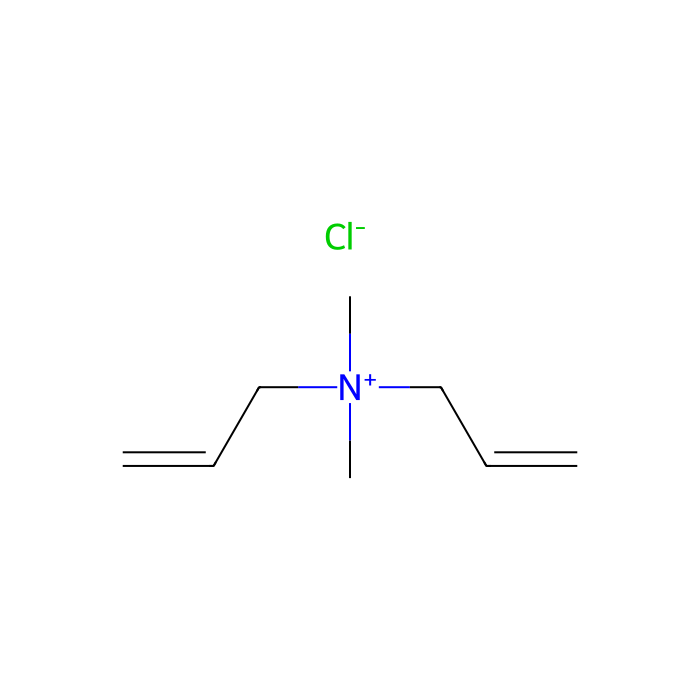
Diallyldimethylammonium chloride (DADMAC) is a quaternary ammonium salt widely used as a cationic monomer.
CAS: 7398-69-8 (product data)
PubChem CID: 33286 (product data)
Molecular formula: Not specified for this item; refer to CoA/Spec Sheet.
• Literature: C8H16N·Cl (often written as C8H16NCl)
Molecular weight: Not specified for this item; refer to CoA/Spec Sheet.
• Literature (neutral formula basis): ~161.67 g/mol
InChIKey: Not specified for this item; refer to CoA/Spec Sheet.
SMILES: Not specified for this item; refer to CoA/Spec Sheet.
• Literature example: C=CCCN+(C)CC=C.[Cl-]
Structural features (general description):
Quaternary ammonium center: Permanently cationic N with two methyl substituents and two allyl (–CH2–CH=CH2) substituents; paired with chloride as the counterion.
Functional groups: Two terminal alkenes (allyl groups) provide sites for free-radical polymerization and copolymerization; no stereogenic centers.
2D/connection description: A central N+ bearing Me– and Me– substituents; two –CH2–CH2–CH=CH2 chains (allyl) on nitrogen; the chloride anion is ion-paired. Overall molecule is amphiphilic but strongly hydrophilic due to the permanent positive charge.
Note: Identity details above marked as “literature” are general chemical information and not item-specific specifications. Always confirm exact identifiers and any stabilizers with the item’s CoA/Spec Sheet.
Synthetic Utility
DADMAC’s primary synthetic value lies in its role as a cationic, difunctional (allylic) monomer for radical polymerization and as a strong polyelectrolyte component.
Polymer formation:
Homopolymerization to polyDADMAC delivers high charge density, fully water-soluble cationic polymers used in flocculation and retention aids.
Copolymerization with acrylamide/acrylate families adjusts charge density, hydrophilicity, and mechanical properties.
Crosslinking & network formation: The allyl groups can participate in network formation when multifunctional crosslinkers (e.g., N,N′-methylenebisacrylamide) are present, enabling hydrogels and ion-exchange resins.
Advanced polymerization techniques: DADMAC is compatible (with suitable catalysts/agents) with RAFT and ATRP to craft block copolymers and controlled architectures for membranes, colloids, and layer-by-layer assemblies.
Interpolymer complexes: Strong complexation with anionic polymers enables facile assembly of multilayers, capsules, and coacervates without covalent chemistry—useful for gentle encapsulation and surface modification.
Analytical titrations: Defined cationic charge per repeat unit allows its polymers to serve as standards for colloid titrations against anionic polyelectrolytes.
Note: DADMAC is not commonly used as a small-molecule building block in stepwise organic synthesis; its strengths are in radical polymerization and electrostatic assembly.
Target Specificity
Not applicable. This product is a small-molecule monomer, not a biological affinity reagent or antibody. No antigen/epitope, clone, isotype, or species reactivity applies.
Frequently Asked Questions
How should this product be stored?
Store at room temperature.
How is this product shipped?
This product ships under standard ambient conditions. No temperature-controlled packaging is required.
What are the CAS number, molecular formula and molecular weight?
The CAS Number is 7398-69-8, the molecular formula is C8H16ClN, and the molecular weight is 161.67 g/mol. InChIKey GQOKIYDTHHZSCJ-UHFFFAOYSA-M.
What documentation is provided?
Available product documentation, including Certificates of Analysis (COA), Safety Data Sheets (SDS), and specification sheets, is shown in the product document area. Document availability and access follow the current site policy.
We use cookies to ensure the website functions properly and, where permitted, to improve your experience. You can manage your preferences at any time in Settings. Learn more in our Cookie Policy.
Shall we send you a message when we have discounts available?
Remind me later
Thank you! Please check your email inbox to confirm.
Products are supplied to verified businesses, institutions, and qualified professionals for research and development use only. Not for use in humans, animals, diagnosis, or therapy.

 A2305396