This compound belongs to the class of organic compounds known as fatty acid esters. These are carboxylic ester derivatives of a fatty acid.
External Descriptors
Not available
1. Djoumbou Feunang Y, Eisner R, Knox C, Chepelev L, Hastings J, Owen G, Fahy E, Steinbeck C, Subramanian S, Bolton E, Greiner R, and Wishart DS. ClassyFire: Automated Chemical Classification With A Comprehensive, Computable Taxonomy. Journal of Cheminformatics, 2016, 8:61.
Determine the necessary mass, volume, or concentration for preparing a solution.
Dilution Calculator
Determine the dilution needed to prepare a stock solution.
Reconstitution Calculator
Reviews
Customer Reviews
Application Protocols
No tested bioassay or immunoassay protocols are provided for this small-molecule reagent.
Practical chemistry protocols instead (literature; not item-specific)
Representative CuAAC: Dissolve Diethyl 2-Propynylmalonate and an organic azide (1.0 equiv each) in t-BuOH/H2O (1:1), add CuSO4·5H2O (2 mol%) and sodium ascorbate (10 mol%), stir at rt until TLC indicates completion, then extract with EtOAc and purify by silica gel chromatography.
Representative enolate alkylation: Suspend NaH (60% in oil, 1.2 equiv) in dry THF at 0 °C under N2, add the malonate dropwise, stir 15–30 min, then add an alkyl bromide (1.1 equiv). Warm to rt and monitor by TLC/GC. Quench with MeOH then water; extract and purify.
These are generic references; optimize stoichiometry, temperature, and time for your substrate and scale.
Biological Roles
This product is supplied strictly for research use. No biomedical or clinical claims are made.
General context (literature; not item-specific)
Dialkyl malonates are synthetic intermediates without inherent biological roles; they can be transformed into carboxylic acids, ketones, and heterocycles used in chemical biology probes.
The terminal alkyne is a bioorthogonal handle utilized in CuAAC “click” chemistry to append tags (e.g., fluorophores, biotin) to a malonate-derived scaffold for assay development or materials conjugation.
Hydrolysis/decarboxylation of malonates can provide propargylated acids or alcohols that, after further elaboration, serve as linkers or spacers in bioconjugation.
Biocompatibility notes
Copper-catalyzed click reactions often proceed in mixed aqueous media (e.g., t-BuOH/H2O), but residual copper and ester stability must be managed for sensitive biomolecules.
The ester can undergo enzymatic or chemical hydrolysis; if stability in biological media is required, consider more robust ester motifs or amide analogs.
For any use involving living systems, thoroughly assess cytotoxicity and stability of the final constructs; this product itself is intended for in vitro research and synthesis only.
Buffer Applications
Not typically applicable. Diethyl 2-Propynylmalonate is a hydrophobic organic reagent rather than a buffering agent.
Practical note
If used in aqueous-organic systems (e.g., CuAAC), buffers such as phosphate or HEPES can be employed to control pH; ensure co-solvent content (t-BuOH, DMF, or ethanol) is sufficient to solubilize the ester and that emulsions are minimized via salt addition or phase-transfer agents.
Green Alternatives
Solvent choices (literature-based guidance)
Replace CH2Cl2 with toluene, EtOAc, or 2-MeTHF where feasible—particularly for condensations and extractions.
For strong-base enolizations, 2-MeTHF or CPME can substitute for THF, offering higher boiling points and better process safety; both are considered greener due to renewable sourcing (2-MeTHF) or reduced peroxide formation (CPME).
For CuAAC, ethanol/water or t-BuOH/water mixtures can reduce reliance on DMF/DMSO.
Energy and process intensification
Perform Knoevenagel condensations under solvent-free or mechano-chemical conditions (ball milling) with catalytic amines—reported to lower E-factors.
Employ continuous-flow hydrogenations for safer handling of alkyne reductions and improved mass transfer.
Comparison snapshot (literature; not item-specific)
THF vs 2-MeTHF: similar polarity; 2-MeTHF often allows room-temperature operations with easier phase separation in workup.
EtOAc vs DCM: EtOAc is biodegradable and less toxic; may require longer reaction times for polar mechanisms.
CPME vs Et2O: CPME shows reduced peroxide formation and better stability; still flammable and requires standard solvent controls.
Note: Green substitutions must be validated for reactivity/selectivity with your specific transformation on Diethyl 2-Propynylmalonate.
Pharmaceutical Uses
No excipient or pharmacopeial status is specified for this item; it is provided for research use only.
General context (literature; not item-specific)
Dialkyl malonates are common intermediates in medicinal chemistry routes for constructing β-substituted carboxylic acids, ketones, and heterocycles via malonate alkylation/decarboxylation strategies.
The terminal alkyne offers an efficient handle for late-stage diversification (e.g., CuAAC) to generate libraries for SAR studies.
Process considerations: control of residual solvents and hydrolysis products is critical if materials are advanced to GMP settings; this listing does not represent GMP supply.
For any cGMP or clinical manufacturing, source appropriate grade material with full regulatory documentation and compendial compliance where required.
Physical Properties
Item-specific specs from Product Data
Appearance: Not specified for this item; refer to CoA/Spec Sheet.
Storage: Store at 2–8 °C (provided)
Shipping: Wet ice (provided)
Literature/general values (for reference; not item specifications)
Molecular formula: C10H14O4 (literature)
Molecular weight: ~198.22 g/mol (literature)
Physical state: typically a colorless to pale liquid (literature, esters of this class)
Density: commonly around 1.06–1.12 g/mL at 20–25 °C for similar diethyl malonates; specific value for this item is not specified.
Boiling point: malonate diesters typically distill >200 °C at ambient pressure; specific BP for this exact compound not specified.
Refractive index: not specified for this item; refer to CoA/Spec Sheet.
Solubility: miscible with common organic solvents (Et2O, DCM, toluene, THF, MeCN); low water solubility expected for dialkyl malonates (literature).
pKa (α-CH of malonates): ~13 (DMSO) for dialkyl malonates; the propargyl substituent modestly influences acidity (literature).
LogP: expected positive (hydrophobic), not specified for this item.
Important: Where specific numerical values are needed for regulated methods or engineering design, consult the item’s CoA/Spec Sheet or measure under your laboratory conditions.
Quality & Grades
Item-specific quality information
Grade/Purity: Not specified for this item; refer to CoA/Spec Sheet.
Stabilizers/Inhibitors: Not specified for this item; refer to CoA/Spec Sheet.
Guidance on interpreting grades (general; not item-specific)
Research grade: Suitable for most synthetic applications. Typical controls include GC purity and water content; exact limits must be confirmed on the CoA.
Low-peroxide/anhydrous designations (when applicable): Important for base-catalyzed reactions or moisture-sensitive steps. If your transformation is enolate- or base-driven, prioritize low-water content and confirm by KF.
Chromatography/HPLC grade (if offered): Lower UV background and particulate levels—relevant if using this compound as a standard or tracer. Not typically necessary for routine synthesis.
Practical tips for this class of materials
Verify purity by GC or 1H NMR prior to use in enantioselective or sensitive reactions; minor hydrolysis (ethanol, malonic monoesters) can affect outcomes.
If color develops on storage, simple distillation or bulb-to-bulb under reduced pressure can refresh material; confirm identity/purity afterward.
For definitive acceptance criteria and release testing for SKU D155774, consult the Aladdin Scientific CoA/Specification Sheet.
Reaction & Applications
This propargylated malonate combines 1,3-dicarbonyl reactivity with a terminal alkyne, enabling orthogonal synthetic operations.
Enolate chemistry: The α-methine adjacent to two carbonyls forms stabilized enolates for further alkylation or Michael additions. Stereocontrol can be achieved with chiral auxiliaries or phase-transfer catalysts.
Knoevenagel condensations: Reacts with aldehydes/ketones under basic or ammonium salt catalysis to give conjugated malonates; subsequent transformations (Michael, cycloadditions) expand diversity.
Decarboxylative elaboration: After hydrolysis/decarboxylation, furnishes propargyl-substituted acetic acid derivatives or ketones.
Copper-catalyzed azide–alkyne cycloaddition (CuAAC): The terminal alkyne undergoes efficient 1,3-dipolar cycloaddition to yield 1,4-disubstituted triazoles on a malonate framework—useful for library synthesis.
Hydrometallation/halofunctionalization of the alkyne: Hydroboration (e.g., 9-BBN) to vinyl boranes, or bromination/iodination to haloalkenes for cross-coupling.
Transition-metal catalysis: Sonogashira-type couplings after prior halogenation or via in situ activation when tethered; gold-catalyzed cycloisomerizations can rearrange propargyl malonates to useful building blocks.
Practical notes
Control base strength: Strong bases (LDA, NaH) deprotonate α-CH; weaker bases (Et3N, piperidine) promote Knoevenagel without over-alkylation.
Orthogonality: Protect the alkyne if conditions risk addition (e.g., thiol–yne, radical additions). Alternatively, exploit it for modular late-stage diversification (CuAAC).
Analytical monitoring: TLC with UV (254 nm) and anisaldehyde or KMnO4 stains show both ester and alkyne features.
Reaction Conditions
The following are literature-general conditions for this class of compounds; they are not specifications for this item.
Enolate alkylation (Malonic ester synthesis)
Typical base: NaH (60% in mineral oil), LDA, or K2CO3 (for softer alkylations).
Solvent: dry THF or toluene; 0 to –78 °C for LDA, 0–25 °C for NaH/K2CO3.
Catalyst system: CuSO4·5H2O (1–5 mol%) + sodium ascorbate (5–10 mol%) in t-BuOH/H2O (1:1) or DMF/H2O.
Temperature/time: rt to 50 °C, 1–16 h. Add TBTA or THPTA ligands to minimize alkyne oxidation and accelerate reaction.
Alkyne hydroboration/oxidation
Reagents: 9-BBN or catecholborane; solvent THF; 0–25 °C.
Oxidation: H2O2/NaOH to give enols/vinyl alcohols that tautomerize; subsequent transformations as needed.
Hydrogenation
Catalyst: Pd/C (5–10 wt%); solvent EtOAc or EtOH; 1–3 atm H2; rt–40 °C; monitor to avoid over-reduction of other functionalities.
Always verify compatibility of bases/acids with the diester to avoid undesired transesterification or hydrolysis.
Safety & Handling
Item-specific hazard data
GHS classification, signal word, pictograms, and H-statements: Not specified for this item; refer to the SDS.
Storage: Store at 2–8 °C. Protect from moisture and strong bases/acids that may induce hydrolysis or transesterification.
General safety considerations for propargyl malonate esters (literature/best practice; not item specifications)
Likely hazards: Irritation to eyes/skin; harmful if swallowed or inhaled. Terminal alkynes can be more reactive toward strong oxidants. Handle in a fume hood.
PPE: Lab coat, nitrile gloves, splash goggles. Use appropriate respirator if aerosol or vapor exposure may occur.
First aid overview: Eye/skin contact—rinse with water for ≥15 min; remove contaminated clothing. Inhalation—move to fresh air; support respiration if needed. Ingestion—rinse mouth; do not induce vomiting; seek medical attention. Always follow SDS instructions.
Spill/cleanup: Absorb with inert material (vermiculite), collect in suitable container, wash area with detergent. Prevent release to drains.
Waste: Dispose in accordance with local regulations for organic solvents/esters.
Always consult the current SDS for authoritative hazard information and emergency procedures for this specific item.
Solvent Selection
Diethyl 2-Propynylmalonate is a moderately polar, hydrophobic organic substrate compatible with many aprotic solvents.
Limited aqueous solubility; biphasic systems (toluene/water, MTBE/water) are effective for extractions and phase-transfer catalysis.
Selection by application
Base-mediated enolizations/alkylations: Dry THF or toluene under inert atmosphere. For LDA/LHMDS, use THF or THF/hexanes at low temperature.
Knoevenagel/condensations: Toluene or benzene (Dean–Stark) for azeotropic water removal; greener options include toluene/2-MeTHF with molecular sieves.
Click derivatization (CuAAC) of the terminal alkyne: t-BuOH/H2O or DMF/H2O mixtures; add CuSO4/sodium ascorbate or CuI/amine.
Hydrogenation/isomerization of alkyne: EtOAc, MeOH, or EtOH for Pd/C catalysis; monitor to avoid over-reduction.
Brief comparison (literature)
THF vs 2-MeTHF: Similar solvating power; 2-MeTHF offers higher bp and greener profile.
DCM vs toluene: DCM enhances rate for polar mechanisms; toluene is less chlorinated and preferable for scale.
Dry, oxygen-free solvent is recommended when strong bases or oxygen-sensitive catalysts are employed.
Storage & Reconstitution
Item-specific storage and shipping
Store at 2–8 °C (provided in Product Data). Keep container tightly closed in a dry, well-ventilated place. Minimize headspace exposure to moisture and bases.
Shipped on wet ice (provided). Allow to equilibrate to room temperature before opening to reduce moisture ingress.
Handling and aliquoting (best practice; not item-specific)
If repeated use is expected, consider aliquoting under inert atmosphere (N2/Ar) to limit hydrolysis and oxidative changes.
Use dry syringes/pipettes; recap promptly. If solid residues form over long storage, assess by NMR/GC before use.
Reconstitution
Not applicable; supplied as a neat liquid (appearance for this item is not specified). If dilution is required for stock solutions, prepare in dry organic solvents (e.g., THF, toluene, DCM, MeCN) and store at 2–8 °C or –20 °C as appropriate, protected from moisture.
Always refer to the product CoA/Spec Sheet and SDS for definitive storage guidance and stability information for SKU D155774.
Structure & Identity
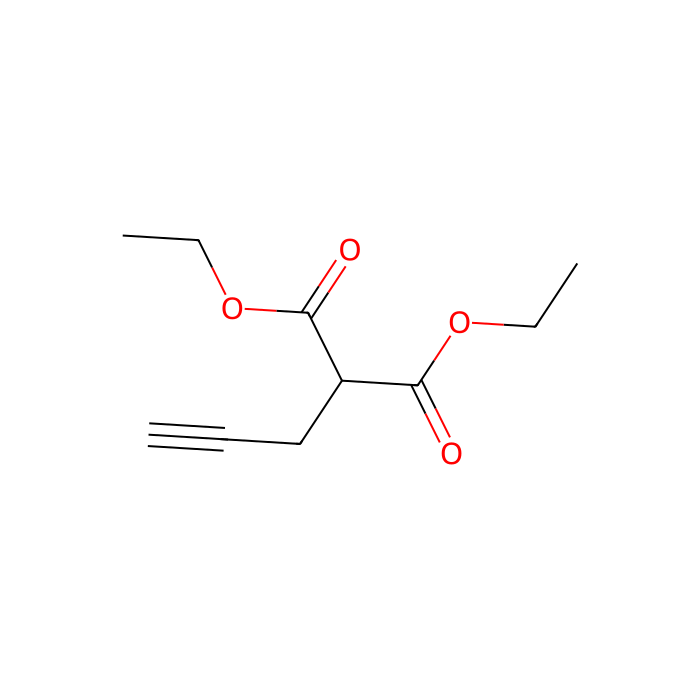
Diethyl 2-Propynylmalonate is a propargyl-substituted malonate diester bearing a terminal alkyne and two ethyl ester groups geminal to a substituted stereogenic center.
Item-specific identifiers (from Product Data)
SKU: D155774
CAS: 17920-23-9
PubChem CID: 28835
InChIKey: Not specified for this item; refer to CoA/Spec Sheet.
SMILES: Not specified for this item; refer to CoA/Spec Sheet.
Key functional groups: two ethyl ester groups (–CO2Et), one terminal alkyne (–C≡CH), one benzylic-like methine (–CH–) at the malonate α-carbon.
Core scaffold: malonate (1,3-dicarbonyl) with a propargyl substituent at the α-position.
2D structural description (literature): A central tetrahedral carbon (α to both carbonyls) bears: (i) an –CH2–C≡CH substituent (propargyl), (ii) a –CO2Et group, and (iii) another –CO2Et group. The terminal alkyne is linear; the two ester carbonyls are coplanar with their respective alkoxy substituents.
Note: All structural parameters above labeled “literature” are for general reference and are not item-specific specifications.
Synthetic Utility
Functional group leverage (literature)
1,3-Dicarbonyl chemistry: The doubly electron-withdrawing ester groups enable facile α-deprotonation and C–C bond formation. Subsequent hydrolysis/decarboxylation maps to diverse carbonyl compounds.
Terminal alkyne: Engages in cycloadditions (CuAAC, Huisgen), hydrofunctionalizations (hydroboration, hydrosilylation), and metal-catalyzed annulations. Offers modular attachment points for tags and cross-coupling precursors.
Retrosynthetic value
Serves as a masked acyl anion equivalent. After C–C bond formation at the α-carbon, sequential transformations (saponification, decarboxylation, reduction) yield substituted acetic acids, ketones, or alcohols bearing a propargyl unit.
Orthogonal derivatization: Perform enolate alkylation first, then click-functionalize the alkyne, or vice versa, enabling convergent route design.
Named reactions and strategies
Knoevenagel condensation with aldehydes to access activated olefins, followed by Michael additions or cyclizations.
Malonic ester synthesis: alkylation under basic conditions; thermal decarboxylation after hydrolysis.
CuAAC to generate 1,2,3-triazole-containing malonates or, after decarboxylation, triazole-substituted acetic acids.
Practical tips
Avoid over-alkylation by controlling base equivalents and temperature.
Protect or deliberately engage the alkyne depending on downstream steps; copper residues from CuAAC may poison later catalysts—include metal scavenging.
Target Specificity
Not applicable. This product is a small-molecule organic reagent and does not possess biological target specificity such as an antibody, enzyme inhibitor selectivity profile, or nucleic acid hybridization data in the context of this catalog entry.
Frequently Asked Questions
What is the purity of this product?
This product is supplied at ≥96% purity (chemical assay). Lot-specific values are stated on the Certificate of Analysis.
How should this product be stored?
Store at 2–8 °C. Refrigerated storage is required to maintain the specified shelf life.
How is this product shipped?
This product ships chilled on wet ice. Unpack on arrival and transfer it to the storage condition stated above.
What are the CAS number, molecular formula and molecular weight?
The CAS Number is 17920-23-9, the molecular formula is C10H14O4, and the molecular weight is 198.22 g/mol. InChIKey FKXOELIKVUIBLP-UHFFFAOYSA-N.
What documentation is provided?
Available product documentation, including Certificates of Analysis (COA), Safety Data Sheets (SDS), and specification sheets, is shown in the product document area. Document availability and access follow the current site policy.
We use cookies to ensure the website functions properly and, where permitted, to improve your experience. You can manage your preferences at any time in Settings. Learn more in our Cookie Policy.
Shall we send you a message when we have discounts available?
Remind me later
Thank you! Please check your email inbox to confirm.
Products are supplied to verified businesses, institutions, and qualified professionals for research and development use only. Not for use in humans, animals, diagnosis, or therapy.

 J2331291