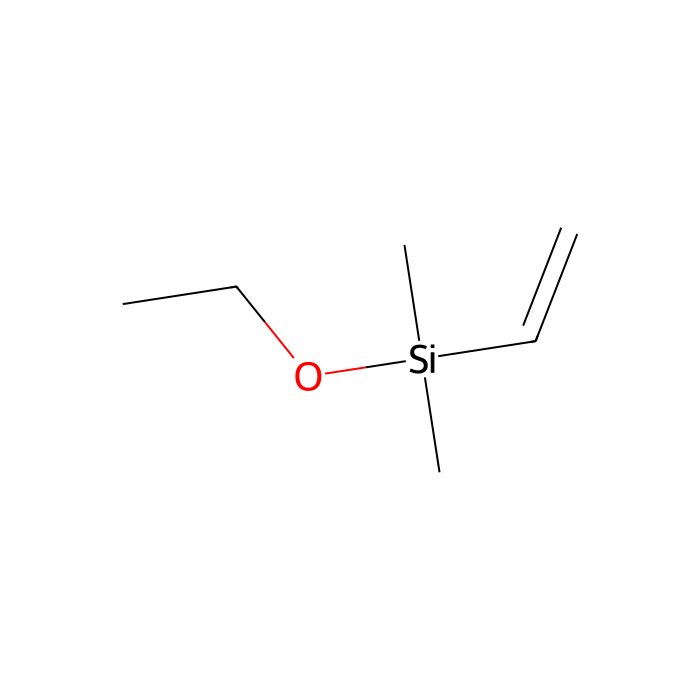
Dimethylethoxyvinylsilane - ≥98%(GC) , CAS No.5356-83-2

CAS: 5356-83-2 Cat. No.: D155112 Formula: C6H14OSi Molecular Weight: 130.26 Beilstein Registry Number: 4(4)4079 EC Number: 226-341-7
AVAILABLE TO ORDER
GRADE & PURITY ≥98%(GC)
Synonyms
Dimethyl(vinyl)silyl ethyl ether #|Dimethyl(ethenyl)silyloxyethane|Silane, ethenylethoxydimethyl-|Ethoxy(dimethyl)vinylsilane|Ethoxydimethyl(vinyl)silane|ETHENYLETHOXYDIMETHYL SILANE|ethenyl-ethoxy-dimethylsilane|Silane, ethoxydimethylvinyl-|Dimethylethoxyvinylsilane|Ethoxydimethylvinylsilane|Vinyldimethylethoxysilane
Storage
Room temperature,Argon charged
Shipped In
Normal
★
Size
USA
Germany (EU)*
Price
Qty
1g
D155112-1g
3 In stock
—

$9.90

$14.90
Save $5.00 (33.56%)
5g
D155112-5g
3 In stock
—

$14.90

$22.90
Save $8.00 (34.93%)
25g
D155112-25g
Made to order · 8–12 wks

$24.90

$37.90
Save $13.00 (34.30%)
100g
D155112-100g
2 In stock
—

$79.90

$119.90
Save $40.00 (33.36%)
500g
D155112-500g
1 In stock
—

$298.90

$448.90
Save $150.00 (33.42%)
Enter a quantity for the sizes you want to add.

Specifications

Synonyms
Dimethyl(vinyl)silyl ethyl ether # | Dimethyl(ethenyl)silyloxyethane | Silane, ethenylethoxydimethyl- | Ethoxy(dimethyl)vinylsilane | Ethoxydimethyl(vinyl)silane | ETHENYLETHOXYDIMETHYL SILANE | ethenyl-ethoxy-dimethylsilane | Silane, ethoxydimethylvinyl- | Dimethylethoxyvinylsilane | Ethoxydimethylvinylsilane | Vinyldimethylethoxysilane
Specifications & Purity
≥98%(GC)
Storage
Room temperature,Argon charged
Shipped In
Normal
Purity
≥98%(GC)
Names and Identifiers
Pubchem Sid
Pubchem Sid Url
https://pubchem.ncbi.nlm.nih.gov/substance/504755364
SMILES
CCO[Si](C)(C)C=C
IUPAC Name
ethenyl-ethoxy-dimethylsilane
InChIKey
JEWCZPTVOYXPGG-UHFFFAOYSA-N
InChI
1S/C6H14OSi/c1-5-7-8(3,4)6-2/h6H,2,5H2,1,3-4H3
Isomeric SMILES
CCO[Si](C)(C)C=C
UN Number
1993
Packing Group
II
Molecular Weight
130.26
Beilstein
4(4)4079
Reaxys
1743477
Reaxys-RN_link_address
https://www.reaxys.com/reaxys/secured/hopinto.do?context=S&query=IDE.XRN=1743477&ln=

Advanced Data

Taxonomic Classification

Taxonomy Tree

KingdomOrganic compounds
SuperclassOrganometallic compounds
ClassOrganometalloid compounds
SubclassOrganosilicon compounds
Intermediate Tree Nodes Not available
Direct ParentSilyl ethers
Alternative Parents Organoheterosilanes  Organic metalloid salts  Organooxygen compounds  Hydrocarbon derivatives  
Molecular FrameworkAliphatic acyclic compounds
Substituents Silyl ether - Organoheterosilane - Organic metalloid salt - Organic oxygen compound - Hydrocarbon derivative - Organic salt - Organooxygen compound - Aliphatic acyclic compound
DescriptionThis compound belongs to the class of organic compounds known as silyl ethers. These are organic compounds containing a silicon atom covalently bonded to an alkoxy group. They have the general formula R1R2R3Si-O-R4 (R4 = aryl, alkyl).
External Descriptors Not available
3D Structure
Interactive Chemical Structure Model


Certificates (CoA,COO,BSE/TSE and Analysis Chart)
C of A & Other Certificates(BSE/TSE, COO):
Analytical Chart:

Find and download the COA for your product by matching the lot number on the packaging.

9 results found

Lot NumberCertificate TypeDateItem
K2230620K2230620Certificate of AnalysisSep 02, 2026 D155112
K2230641K2230641Certificate of AnalysisSep 02, 2026 D155112
K2230665K2230665Certificate of AnalysisSep 02, 2026 D155112
K2230757K2230757Certificate of AnalysisSep 02, 2026 D155112
F2528076F2528076Certificate of AnalysisNov 03, 2022 D155112
G2508052G2508052Certificate of AnalysisNov 03, 2022 D155112
K2230684K2230684Certificate of AnalysisNov 03, 2022 D155112
H1828142H1828142Certificate of AnalysisJun 24, 2022 D155112
H1828141H1828141Certificate of AnalysisJun 23, 2022 D155112
Chemical and Physical Properties
SensitivityMoisture sensitive.
Refractive Index1.398
Flash Point3°C
Boil Point100°C
Molecular Weight130.26
XLogP3
Hydrogen Bond Donor Count0
Hydrogen Bond Acceptor Count1
Rotatable Bond Count3
Exact Mass130.081 Da
Monoisotopic Mass130.081 Da
Topological Polar Surface Area9.200 Ų
Heavy Atom Count8
Formal Charge0
Complexity78.600
Isotope Atom Count0
Defined Atom Stereocenter Count0
Undefined Atom Stereocenter Count0
Defined Bond Stereocenter Count0
Undefined Bond Stereocenter Count0
The total count of all stereochemical bonds0
Covalently-Bonded Unit Count1
Safety and Hazards(GHS)
Pictogram(s)
GHS02,   GHS07
Signal
Danger
Hazard Statements

H225:Highly Flammable liquid and vapor

H315:Causes skin irritation

H319:Causes serious eye irritation

H335:May cause respiratory irritation

Precautionary Statements

P210:Keep away from heat, hot surface, sparks, open flames and other ignition sources. - No smoking.

P233:Keep container tightly closed.

P240:Ground/bond container and receiving equipment.

P241:Use explosion-proof [electrical/ventilating/lighting/.../] equipment.

P242:Use only non-sparking tools.

P243:Take precautionary measures against static discharge.

P261:Avoid breathing dust/fume/gas/mist/vapors/spray.

P264:Wash hands [and …] thoroughly after handling.

P271:Use only outdoors or in a well-ventilated area.

P280:Wear protective gloves/protective clothing/eye protection/face protection.

P321:Specific treatment (see ... on this label).

P302+P352:IF ON SKIN: wash with plenty of water.

P303+P361+P353:IF ON SKIN (or hair): Take off Immediately all contaminated clothing. Rinse SKIN with water [or shower].

P304+P340:IF INHALED: Remove person to fresh air and keep comfortable for breathing.

P305+P351+P338:IF IN EYES: Rinse cautiously with water for several minutes. Remove contact lenses if present and easy to do - continue rinsing.

P362+P364:Take off contaminated clothing and wash it before reuse.

P370+P378:In case of fire: Use ... to extinguish.

P405:Store locked up.

P403+P233:Store in a well-ventilated place. Keep container tightly closed.

P403+P235:Store in a well-ventilated place. Keep cool.

P501:Dispose of contents/container to an approved waste disposal plant.

P264+P265:Wash hands [and …] thoroughly after handling. Do not touch eyes.

P337+P317:If eye irritation persists: Get medical help.

P332+P317:If skin irritation occurs: Get medical help.

P319:Get medical help if you feel unwell.

Reaxys
1743477
Reaxys-RN_link_address
https://www.reaxys.com/reaxys/secured/hopinto.do?context=S&query=IDE.XRN=1743477&ln=
Class
3
Citations of This Product
Solution Calculators
Reviews

Customer Reviews

Application Protocols

No assay or immunoassay protocols apply to this small-molecule organosilane. For practical use, see the Reaction Conditions and Synthetic Utility sections for literature-style procedures and optimization pointers relevant to cross-coupling, metathesis, and electrophilic additions.

Biological Roles

This product is a small-molecule organosilane building block intended for chemical synthesis. It does not have a known intrinsic biological role or endogenous metabolic function.

  • Biological activity and pathways: Not typically applicable; vinylsilanes are used as synthetic handles rather than as biochemical probes by themselves.
  • Biocompatibility/toxicity: Organosilanes are generally handled as standard organic reagents; specific toxicological profiles vary and are not provided here. Consult the SDS for hazard assessment.
  • Use context: In life sciences labs, such reagents may be used to assemble small molecules, labels, or materials that subsequently interface with biological systems; however, this product is supplied strictly for research use and not for diagnostic or therapeutic applications.

Item-specific biological information: Not specified for this item; refer to CoA/Spec Sheet if any biological testing data are provided.

Buffer Applications

Not typically applicable. Dimethylethoxyvinylsilane is a hydrophobic, moisture-sensitive organosilane used in organic synthesis. It is not used to prepare aqueous buffers or as a buffering agent. For laboratory work involving this reagent, see Reaction & Applications, Synthetic Utility, and Reaction Conditions for relevant, non-aqueous handling guidance.

Green Alternatives

Consider greener choices along two axes: (1) the coupling partner type, and (2) the solvent/catalyst systems used with dimethylethoxyvinylsilane.

  • Alternative vinyl donors (literature/general):

    • Vinylboronates (e.g., vinyl-Bpin): Broadly water-tolerant Suzuki couplings; generally low toxicity and well-established recycling protocols for boron waste. Trade-off: Sometimes less stable toward protodeboronation under strongly acidic conditions.
    • Vinylzincs/Vinylmagnesiums: Highly reactive but moisture/air sensitive; generate more hazardous waste streams; often less green overall.
    • Vinyltrifluorosilanes/silanols: More coupling-active forms of vinylsilanes (vs alkoxy), reducing the need for large fluoride loadings.
  • Greener solvent choices in typical transformations:

    • Replace chlorinated solvents with 2-MeTHF, CPME, EtOAc, or toluene when catalyst compatibility allows.
    • For metathesis, toluene or 2-MeTHF can substitute for DCM/CHCl3 in many cases.

Comparison snapshot (literature/general):

  • Vinylsilane (this item) vs Vinylboronate
    • Toxicity/Waste: Vinylsilanes and boronates both relatively benign; fluoride activation for silanes can generate problematic F− waste. Boron waste typically less hazardous.
    • Stability: Alkoxyvinylsilanes are quite stable but hydrolyze slowly; boronates can be sensitive to bases/heat.
    • Water tolerance: Boronates superior; silanes often need activation and drier conditions.

Process tips:

  • If using fluoride activation, minimize F− load (e.g., TBAF in catalytic amounts with oxidants or use KF/phase-transfer) or explore base-activated Hiyama variants to reduce fluoride waste.
  • Select catalysts compatible with greener solvents and lower loadings to improve E-factor.
Pharmaceutical Uses

This product is supplied for research use only and is not intended for human or veterinary use.

Formulation/excipient context (literature/general):

  • Organosilanes such as vinylsilanes may be used in medicinal chemistry campaigns as synthetic intermediates to access analogs via cross-coupling, olefin metathesis, or oxidative unmasking to carbonyls. They are not pharmaceutical excipients in conventional formulations.
  • In materials contexts, alkoxy silanes can undergo hydrolysis/condensation to form siloxane networks or surface modifications, which may be relevant to device coatings or immobilization chemistries during drug discovery workflows.

Regulatory status and pharmacopeial monographs: None known for this specific compound. No compendial (USP/Ph.Eur./JP) excipient status is indicated.

Item-specific pharmaceutical/excipient specifications: Not specified for this item; refer to CoA/Spec Sheet.

Physical Properties
  • Appearance (item-specific): Not specified for this item; refer to CoA/Spec Sheet.
  • Grade/Purity (item-specific): Not specified for this item; refer to CoA/Spec Sheet.
  • Molecular formula (literature): C6H14OSi.
  • Molecular weight (literature): ~130.1 g/mol.
  • Boiling point, melting point, density, refractive index, vapor pressure, UV cutoff, water/peroxide/metal specifications (item-specific): Not specified for this item; refer to CoA/Spec Sheet.

General/literature notes relevant to handling and use:

  • Vinyl/alkoxy organosilanes of this class are typically low-viscosity, colorless liquids with moderate volatility and densities below 1 g/mL (literature/general trend for dialkylalkoxyvinylsilanes). Exact values vary by isomer and purity and must be confirmed on the CoA.
  • Solubility (literature/general): Miscible with many nonpolar and moderately polar organic solvents (e.g., hexanes, toluene, ethers, esters); immiscible with water and slowly hydrolyzed in aqueous media.
  • Reactivity (literature/general): Hydrolyzable Si–OEt bond; vinyl group undergoes typical alkene reactions under appropriate catalytic/initiating conditions.

Important: For process and safety calculations (e.g., vapor management, heat loads), do not use generalized literature trends; obtain lot-specific data from the CoA/SDS or measure under your conditions.

Quality & Grades
  • Item-specific grade/purity: Not specified for this item; refer to CoA/Spec Sheet.

Guidance on grades (general):

  • For organosilane coupling/building-block applications, common grades include:
    • Reagent grade: Suitable for most synthetic uses; typical residual volatiles and trace hydrolysis products may be present.
    • High-purity/anhydrous grade: Tighter controls on moisture and hydrolytic impurities; recommended for air/moisture-sensitive catalysis (e.g., metathesis, cross-coupling after activation).
    • GC/HPLC assay reporting: When provided, indicates compositional purity by chromatographic analysis; low UV background is less critical for non-chromatographic uses but may matter for in situ monitoring.
  • Stabilizers: Many alkoxy- and vinylsilanes are shipped with inert gas headspace (as noted for this item) rather than chemical stabilizers to minimize premature hydrolysis/condensation.
  • What to check on the CoA for your application:
    • Assay (%), identity (GC/MS or NMR), water content (Karl Fischer), hydrolysis byproducts (silanols/siloxanes), acidity, and inhibitor/stabilizer status.
    • Residual solvent profile and trace metal content if using in metal-catalyzed reactions.

Practical tip: For air/moisture-sensitive or catalytic processes, perform a quick check by 1H NMR for vinyl integrals and absence of silanol signals (broad ~2–5 ppm in protic solvents) before scale-up.

Reaction & Applications

Dimethylethoxyvinylsilane is a versatile vinylsilane building block. The vinyl group enables alkene chemistry, while the silane enables post-functionalization or activation.

Key application families (literature/general):

  • Hiyama-type cross-coupling (after activation): The ethoxy substituent can be hydrolyzed to the corresponding vinylsilanol, which, under fluoride or base activation, couples with aryl/vinyl halides or pseudohalides to forge C–C bonds. Advantage: low toxicity and high stability of silane reagents relative to stannanes.
  • Olefin metathesis: The vinylsilane participates in cross-metathesis with alkenes (e.g., using Ru-carbene catalysts), enabling installation of the –SiMe2OEt motif at defined positions. Subsequent oxidative transformations (Tamao–Fleming oxidation) can convert the C–Si unit into a carbonyl.
  • Electrophilic additions and β-silyl effect: Protonation/halogenation across the C=C can proceed with β-silyl stabilization, enabling regioselective formation of β-functionalized products that can be further elaborated (e.g., to aldehydes/ketones after oxidation of C–Si).
  • Radical and anion chemistry: The β-silyl effect stabilizes adjacent radicals/anions, allowing conjugate additions or radical cyclizations that incorporate a vinylsilane handle for later diversification.
  • Hydrosilylation of other alkenes (as partner): While this reagent lacks Si–H, its vinyl unit can engage as the alkene substrate in Pt-, Karstedt-, or Speier-catalyzed hydrosilylation with a separate Si–H silane to introduce silicon-containing motifs into molecules/polymers.

Use cases:

  • Installing a masked carbonyl via vinylsilane followed by Tamao–Fleming oxidation.
  • Serving as a vinyl donor in cross-coupling sequences where lower toxicity and bench stability are priorities.
  • Preparing surface modifiers or siloxane precursors after controlled hydrolysis/condensation.
Reaction Conditions

The following are literature/general guidance examples; optimize for your substrate and catalyst system. Item-specific conditions are not specified for this product.

  • Cross-metathesis (CM) of vinylsilane with terminal alkene:

    • Catalyst: 2–5 mol% Grubbs II or Hoveyda–Grubbs II.
    • Solvent: Toluene, DCM, or 2-MeTHF (anhydrous).
    • Temperature: 25–60 °C.
    • Time: 1–12 h.
    • Notes: Remove ethylene by sweeping with inert gas or applying slight vacuum to drive conversion. Vinylsilanes often exhibit good CM reactivity and can preserve alkene geometry with suitable conditions.
  • Hiyama coupling after hydrolysis to silanol:

    • Pre-activation: Hydrolyze Si–OEt to silanol with controlled aqueous workup or acidic quench, isolate or generate in situ.
    • Electrophile: Aryl/vinyl iodides/bromides or triflates.
    • Activator: TBAF (0.5–2.0 equiv) or KF/CsF with phase transfer; base-activated variants (e.g., NaOH) reported with specific catalysts.
    • Catalyst: Pd(0/II) systems (e.g., Pd(PPh3)4 1–5 mol%).
    • Solvent: THF, dioxane, or toluene with co-solvent; sometimes aqueous mixtures for fluoride-activated systems.
    • Temp: 25–80 °C.
    • Notes: Fluoride minimization via KF/18-crown-6 or PTC is possible; ensure water content is controlled to balance activation vs premature hydrolysis/polymerization.
  • Electrophilic addition (e.g., HCl, Br2) leveraging β-silyl effect:

    • Solvent: DCM or hexanes at 0–25 °C.
    • Notes: Regioselective β-functionalization is common; subsequent Tamao–Fleming oxidation can convert the C–Si-bearing center to carbonyl.

Always assess catalyst poisons (water, acids/bases, peroxides) and pre-dry the reagent/solvents. Monitor by GC or NMR to track vinylsilane consumption and byproduct siloxane formation.

Safety & Handling
  • GHS classification, signal word, pictograms, H-statements (item-specific): Not specified for this item; refer to SDS.
  • Storage (from Product Data): Room temperature, Argon charged. Ship: Normal.

General safety guidance (literature/general for vinyl/alkoxy organosilanes):

  • Likely to be a flammable organic liquid; keep away from ignition sources. Use only in well-ventilated fume hoods.
  • Moisture-reactive: Si–OEt groups can hydrolyze, releasing ethanol and forming silanols/siloxanes. Prevent contact with water, acids, bases, and protic reagents unless intentional.
  • Personal protective equipment: Safety glasses or face shield, lab coat, and appropriate chemical-resistant gloves (e.g., nitrile). Use splash protection when transferring bulk quantities.
  • Incompatibilities: Strong acids/bases (catalyze hydrolysis/condensation), strong oxidizers (may oxidize organics), moisture/humidity.
  • First aid (overview; defer to SDS):
    • Inhalation: Move to fresh air; seek medical attention if symptoms persist.
    • Skin: Wash with soap and water; remove contaminated clothing.
    • Eyes: Rinse cautiously with water for several minutes; remove contacts if present and easy; seek medical attention.
    • Ingestion: Rinse mouth; do not induce vomiting; seek medical advice.
  • Spill/Fire response: Absorb small spills with inert material (vermiculite), collect in compatible container. For fire, use dry chemical, CO2, or foam; avoid water streams that can spread flammable liquids and promote hydrolysis.
  • Waste: Collect as halogen-free organic waste; segregate from aqueous acidic/basic wastes that could induce hydrolysis/gelation. Follow institutional and regulatory requirements.

Always consult the product-specific SDS for authoritative hazard and emergency information.

Solvent Selection

This product is a reactive organosilane building block rather than a working laboratory solvent.

  • Applicability: Solvent selection here pertains to choosing media for reactions or handling of dimethylethoxyvinylsilane, not to using it as a solvent.

General guidance (literature/general):

  • Polarity/miscibility: Expected to dissolve well in nonpolar to moderately polar aprotic solvents (hexanes, heptane, toluene, CPME, MTBE, THF, Et2O, EtOAc). Avoid aqueous/protic media unless hydrolysis is intended.
  • For moisture-sensitive operations: Use rigorously dried solvents (e.g., 3 Å molecular sieves for ethers/esters; distillation over Na/K for hydrocarbons/THF as appropriate). Maintain inert atmosphere (argon recommended, aligns with Product Data).
  • Catalytic cross-coupling or metathesis:
    • Olefin metathesis: Toluene, DCM, or 2-MeTHF are common; ensure inhibitor-free conditions as needed.
    • Fluoride-activated Hiyama-type couplings after hydrolysis to silanol: Mixed aqueous/organic systems (THF/H2O) are typical, but pre-hydrolysis outside the coupling step can be used to keep the substrate in anhydrous media until activation.
  • Processing considerations: For extractions, partition into hydrocarbons or ethers. Minimize contact with alcohol/water phases to suppress hydrolysis of Si–OEt.

When to choose alternatives: If water compatibility or direct aqueous-phase handling is required, consider more robust vinyl donors (e.g., vinylboronates) that tolerate water better.

Storage & Reconstitution
  • Storage conditions (from Product Data): Store at room temperature under an argon atmosphere (argon-charged). Ship: Normal conditions.

Handling and stability (literature/general):

  • Keep container tightly closed to minimize moisture ingress; alkoxy silanes slowly hydrolyze to silanols/siloxanes, releasing ethanol.
  • Use dry, inert gas (argon preferred) for headspace and during transfers. Employ air-free techniques (syringe/Schlenk) for sensitive applications.
  • If material viscosity increases or gelation/precipitation is observed, hydrolysis/condensation may have occurred. Verify integrity by 1H NMR/GC before critical uses.
  • Do not freeze aqueous mixtures or expose to repeated moisture cycling; for neat reagent, ambient storage under inert gas is suitable as indicated by Product Data.

Reconstitution: Not applicable (neat liquid reagent). If dilution is required for dosing or storage aliquots, prepare under dry inert atmosphere using anhydrous solvents (e.g., toluene, hexanes, dry ether). Label aliquots with solvent, concentration, and date; store under argon and use promptly.

Research Use Note: For research use only.

Structure & Identity

Dimethylethoxyvinylsilane is a vinyl-functional trialkoxyorganosilane analogue bearing two methyl groups and one ethoxy substituent on silicon.

  • Product identifiers (from Product Data)

    • SKU: D155112
    • Product Name: Dimethylethoxyvinylsilane
    • CAS: 5356-83-2
    • PubChem CID: 79315
    • InChIKey: Not specified for this item; refer to CoA/Spec Sheet.
    • SMILES: Not specified for this item; refer to CoA/Spec Sheet.
  • Structure (literature/general)

    • Common name corresponds to the connectivity: vinyl–Si(CH3)2–OEt (i.e., a silicon atom substituted with a vinyl group, two methyls, and an ethoxy group).
    • Typical condensed formula (literature): CH2=CH–Si(CH3)2–OCH2CH3.
    • Functional groups: vinyl (alkenyl) substituent, ethoxy (alkoxy) substituent, and two methyl substituents on silicon; tetravalent Si, no formal stereocenters.
    • Molecular formula (literature): C6H14OSi.
    • Molecular weight (literature): ~130.1 g/mol.
    • 2D description (words): An sp2-hybridized vinyl carbon-carbon double bond is bonded at the terminal carbon to a tetrahedral silicon center. Silicon bears two equivalent methyl groups and one Si–O–CH2–CH3 ethoxy chain. No rings or chiral elements are present.
  • Structural features & implications (literature/general)

    • The β-silyl effect of the vinylsilane stabilizes adjacent carbocations/radicals, enabling electrophilic additions and radical transformations.
    • The Si–OEt bond is susceptible to hydrolysis, producing silanols/siloxanes; the vinyl moiety participates in cross-coupling, olefin metathesis, and oxidative transformations after suitable activation.
Synthetic Utility

Functional group synopsis (literature/general):

  • Vinyl group (C=C): Engages in cross-metathesis, hydrofunctionalizations (e.g., hydroboration, hydrosilylation as the alkene partner), radical additions, and electrophilic additions mediated by the β-silyl effect.
  • Si–OEt (alkoxy) handle: Hydrolyzable to silanol under controlled conditions, enabling Hiyama-type cross-coupling upon activation with fluoride or base. Can further condense to siloxanes for materials applications.
  • Si–C (vinyl and methyl) bonds: Oxidatively transformable via Tamao–Fleming oxidation to convert the C–Si-bearing carbon into a carbonyl (after appropriate substitution patterns), allowing vinylsilane to serve as a masked carbonyl equivalent.

Strategic applications:

  • Masked functionality: Install the vinylsilane, perform transformations leveraging its stability (e.g., selective hydrogenations or conjugate additions), then unmask to carbonyl functionality via Tamao–Fleming conditions.
  • C–C bond construction: Use as a vinyl donor in cross-coupling sequences after converting to silanol or a more reactive silane derivative (e.g., trifluorosilane), providing access to styrenes, enynes, and substituted alkenes with defined geometry.
  • Stereocontrol: The β-silyl effect can influence Markovnikov/anti-Markovnikov selectivity and stabilize β-carbocations or radicals, enabling regioselective functionalization adjacent to silicon.

Practical tips:

  • Maintain anhydrous conditions until the activation/hydrolysis step is desired.
  • Monitor reactions by 1H NMR; vinyl protons (typically 5–7 ppm, solvent-dependent) and Si–CH3 singlets (~0–0.5 ppm) provide convenient handles.
  • For metathesis, avoid coordinating impurities and confirm catalyst compatibility with vinylsilanes to suppress undesired isomerization.
Target Specificity

Not applicable. This product is a small-molecule organosilane, not a biological macromolecule or affinity reagent. No target specificity, antigen, clone, or species reactivity data apply.

Frequently Asked Questions

What is the purity of this product, and how is it determined?
This product is supplied at ≥98% purity, determined by gas chromatography (GC). Lot-specific values are stated on the Certificate of Analysis.
How should this product be stored?
Store at room temperature under argon. It is supplied under an argon blanket; reseal under inert gas after each use.
How is this product shipped?
This product ships under standard ambient conditions. No temperature-controlled packaging is required.
What are the CAS number, molecular formula and molecular weight?
The CAS Number is 5356-83-2, the molecular formula is C6H14OSi, and the molecular weight is 130.26 g/mol. InChIKey JEWCZPTVOYXPGG-UHFFFAOYSA-N.
What documentation is provided?
Available product documentation, including Certificates of Analysis (COA), Safety Data Sheets (SDS), and specification sheets, is shown in the product document area. Document availability and access follow the current site policy.

Shall we send you a message when we have discounts available?

Remind me later

Thank you! Please check your email inbox to confirm.

Oops! Notifications are disabled.