GRADE & PURITYMoligand™?Moligand™ — Aladdin's line of ligands and bioactive small molecules. Use for receptor, pathway, and binding studies needing defined small-molecule tools.10 mM in DMSO
Determine the necessary mass, volume, or concentration for preparing a solution.
Dilution Calculator
Determine the dilution needed to prepare a stock solution.
Reconstitution Calculator
Reviews
Customer Reviews
Application Protocols
No tested application protocols are provided for this item. As general guidance for small-molecule screening (not item-specific):
Biochemical assays
Prepare serial dilutions (e.g., 10-point, 3-fold) in DMSO; back-dilute into assay buffer maintaining constant vehicle percentage.
Include positive/negative controls and counterscreens to identify assay interference.
Cell-based assays
Confirm compound compatibility with serum and plasticware; pre-wet tips and use low-bind plates to reduce adsorption.
Titrate to determine cellular potency and cytotoxicity; include vehicle controls.
Data quality
Monitor for aggregation (e.g., detergent sensitivity, DLS) and optical interference (compound fluorescence/absorbance).
Biological Roles
Item-specific biological characterization is not provided in the Product Data.
General, literature-oriented context (not a medical claim, not item-specific)
DMP-543 has been cited in the literature as a bioactive small molecule used in neuropharmacology research. Researchers have explored related chemotypes to modulate neuronal ion channel activity and neurotransmission in vitro. For precise target annotation, binding constants, and selectivity profiles for DMP‑543, consult primary publications associated with CAS 160588-45-4 and the PubChem record (CID: 9887884).
Typical research uses for comparable ligands include target engagement studies, electrophysiological recordings, and pathway interrogation in cell lines or primary neurons.
Important
For this catalog item, no target specificity, potency, or selectivity data are provided. Verify suitability in your system through pilot assays and orthogonal confirmation methods (e.g., electrophysiology, radioligand binding, or proteomics-based target deconvolution as applicable).
Buffer Applications
This product is a discrete small-molecule ligand rather than a buffering agent. It is not typically used to prepare biological buffers or to control pH.
Practical note (assay handling)
When dosing into buffered systems, prepare concentrated DMSO stocks and dilute into the desired buffer (e.g., HBSS, PBS, HEPES-buffered media) maintaining a consistent final DMSO percentage across all conditions (commonly ≤0.5–1% v/v). Include vehicle controls to account for co-solvent effects.
Green Alternatives
Green chemistry considerations are generally applied to solvents and bulk reagents rather than to discrete screening compounds like DMP-543. As such, there are no direct “greener substitutes” for the active molecule itself.
However, you can enhance the sustainability profile of your workflows by focusing on the surrounding process:
Solvent choices for handling and assays
Prefer lower-toxicity solvents (e.g., ethanol, water with minimal DMSO) when compatible with assay performance.
Minimize DMSO volumes and adopt microplate formats that reduce solvent consumption.
Procurement and use
Use concentrated stocks and miniaturized assay volumes (uHTS) to limit material and solvent waste.
Plan experiments to minimize repeated freeze–thaw cycles and associated disposables.
Waste management
Segregate halogenated vs non-halogenated organic waste; collect DMSO-containing waste per institutional policy.
Trade-offs
Greener co-solvents may reduce solubility or alter assay readouts; always balance EHS benefits with data quality requirements and validate replacements empirically.
Pharmaceutical Uses
Regulatory/compendial status: Not pharmacopeial; supplied strictly for research use only.
Typical role in R&D (general): As a reference or screening compound within discovery programs (e.g., target validation, lead identification). It is not intended for human or veterinary use, diagnostic procedures, or as an excipient.
Formulation notes for research (not for human use):
Prepare assay-ready solutions in DMSO and dilute into compatible media immediately before use to minimize precipitation and degradation.
For in vivo research in animals (if permitted by your institution), formulation development must be performed de novo with appropriate controls; no guidance is provided here for dose or vehicle—consult your IACUC and institutional policies.
Physical Properties
Item-specific specifications are not provided in the Product Data. The following fields are therefore left intentionally unspecified and should be confirmed on the CoA/Spec Sheet for this lot:
Appearance: Not specified for this item; refer to CoA/Spec Sheet.
Melting point: Not specified for this item; refer to CoA/Spec Sheet.
Boiling point: Not specified for this item; refer to CoA/Spec Sheet.
Density: Not specified for this item; refer to CoA/Spec Sheet.
Solubility: Not specified for this item; refer to CoA/Spec Sheet.
LogP/logD: Not specified for this item; refer to CoA/Spec Sheet.
pKa: Not specified for this item; refer to CoA/Spec Sheet.
Refractive index/optical rotation: Not applicable/not specified for this solid small molecule; refer to CoA/Spec Sheet if provided.
General guidance (literature/practice, not item-specific)
Screening libraries commonly formulate comparable small molecules at 10–50 mM in anhydrous DMSO for storage and dilution into aqueous buffers containing co-solvent (e.g., 0.1–1% DMSO). Verify compound-specific solubility and stability experimentally before use.
If hygroscopicity or polymorphism are concerns, control ambient humidity and consult thermal analysis data (DSC/TGA) on the CoA.
Quality & Grades
Grade: Moligand™
Moligand™ indicates inclusion in a curated small‑molecule/compound library suitable for biochemical, target-engagement, and cell-based screening workflows. Emphasis is placed on identity confirmation and fitness for discovery assays rather than on chromatographic solvent specifications.
What this means in practice
Identity/quality controls typically include orthogonal structure confirmation (e.g., 1H NMR, HRMS) and an assay-ready format. Exact tests and acceptance criteria for this lot are Not specified for this item; refer to CoA/Spec Sheet.
Purity reporting (e.g., HPLC area%) and residual solvent limits, when provided, are defined on the accompanying CoA; values are Not specified for this item; refer to CoA/Spec Sheet.
Stabilizers or salt form: Not specified for this item; refer to CoA/Spec Sheet.
Fit-for-purpose notes
Moligand™ materials are intended for research use only and are not formulated for clinical, diagnostic, or GMP applications.
For sensitive biophysical techniques (SPR, MST, ITC) or photo/oxidation-prone chemotypes, verify UV absorbance profile and stability per your assay conditions.
Reaction & Applications
This product is supplied as a research small molecule (Moligand™) and is not typically used as a synthetic reagent or solvent. Consequently, classical synthetic reaction guidance (e.g., coupling partners, bases, catalysts) is not generally applicable.
Research applications (general, literature-based context; not item-specific)
Small-molecule screening: Suitable for inclusion in biochemical or cell-based assay panels to probe target engagement, pathway modulation, or phenotypic outcomes.
SAR development: Can serve as a reference chemotype within medicinal chemistry campaigns for structure–activity relationship comparisons, contingent on your internal benchmarks.
Biophysical profiling: Evaluate ligandability using SPR, DSF, MST, or thermal shift assays, with attention to compound aggregation and optical interference controls.
Practical considerations
Prepare fresh DMSO stocks for screening and minimize freeze–thaw cycles.
Include counter-screens to detect assay artifacts (fluorescence interference, redox cycling, or colloidal aggregation); use detergents and dynamic light scattering controls as appropriate.
Reaction Conditions
Not typically applicable. DMP-543 is supplied as a research small molecule rather than a reagent or substrate for synthetic transformations.
General handling conditions for assay use (not item-specific)
Stock preparation: 10–50 mM in anhydrous DMSO; store aliquots at ultra‑low temperature to avoid repeated freeze–thaw.
Working solutions: Dilute into assay buffer or culture media to the desired concentration while keeping DMSO ≤0.5–1% v/v (or per your assay tolerance).
Light/oxidation sensitivity: When in doubt, protect from light and air; use amber vials and inert headspace for long-term storage of solutions.
Safety & Handling
GHS classification: Not specified for this item; refer to SDS.
Signal word / pictograms / H-statements: Not specified for this item; refer to SDS.
General laboratory precautions (good practice):
Wear appropriate PPE: lab coat, safety glasses, and suitable gloves (e.g., nitrile). Work in a fume hood to avoid inhalation of dust or aerosols.
Avoid skin/eye contact and ingestion; wash thoroughly after handling.
Prevent dust generation; handle microgram–milligram quantities with antistatic tools and weigh boats.
Storage incompatibilities: Keep segregated from strong oxidizers and strong acids/bases unless compatibility is confirmed (general precaution for organic small molecules). Use inert, airtight containers to limit moisture/oxygen exposure when applicable.
First aid (overview; defer to SDS):
Inhalation: Move to fresh air; seek medical attention if symptoms persist.
Skin/eye contact: Rinse with plenty of water for at least 15 minutes; remove contaminated clothing; seek medical attention if irritation persists.
Ingestion: Rinse mouth; do not induce vomiting; seek medical attention.
Spill/accidental release: Avoid dust; collect with inert absorbent; dispose of as hazardous chemical waste per institutional guidelines.
Waste: Dispose according to local regulations and your institution’s hazardous waste program.
Always consult the official SDS provided with the shipment for authoritative hazard classifications and response measures.
Solvent Selection
Because item-specific solubility data are not provided, select solvents based on general best practices for small-molecule screening and your assay modality:
Primary stock solvent (general practice, not item-specific):
Anhydrous DMSO is the standard for 10–50 mM master stocks due to broad solvency and assay compatibility at ≤0.5–1% v/v in biological media.
DMF or NMP for challenging chemotypes in biophysical assays (consider cytotoxicity on dilution).
Ethanol or isopropanol for certain biochemical assays where DMSO is undesirable; evaluate solubility and enzyme tolerance.
Aqueous media
Direct dissolution in aqueous buffers is often limited for hydrophobic discovery compounds; co-solvent strategies (0.1–1% DMSO + nonionic surfactant like 0.01% Tween-20) may improve delivery. Validate that additives do not interfere with readouts.
Practical tips
Warm gently (room temperature) and vortex/sonicate briefly to aid dissolution; avoid prolonged heating.
Filter stock solutions (PTFE or PVDF, 0.22 µm) if particulates persist; confirm no analyte loss to membrane.
Document final co-solvent concentration in assays to ensure reproducibility.
Storage & Reconstitution
Storage conditions (item-specific from Product Data): Store at -80°C.
Shipping (item-specific): Shipped on dry ice packs + cold packs to maintain ultra‑low temperature.
Container handling
Keep tightly sealed under dry, inert conditions where possible. Allow vials to equilibrate to room temperature in a desiccator before opening to minimize condensation.
Reconstitution (general guidance, not item-specific)
Prepare concentrated stocks in anhydrous DMSO. Example: 10–50 mM. Mix by gentle vortexing or brief sonication.
If aqueous formulations are required, add DMSO stock to buffer slowly with vigorous mixing to avoid precipitation; verify clarity and stability.
Aliquoting
Divide into single-use aliquots to avoid repeated freeze–thaw. Record freeze–thaw count for each aliquot.
Solution stability
Absent item-specific data, use freshly prepared working solutions and discard after use. For longer storage, keep frozen at -80°C in amber vials; confirm stability by analytical QC (e.g., LC‑MS) before critical experiments.
Research use only: Not for human or veterinary use.
Molecular formula: Not specified for this item; refer to CoA/Spec Sheet.
Molecular weight: Not specified for this item; refer to CoA/Spec Sheet.
InChIKey: Not specified for this item; refer to CoA/Spec Sheet.
SMILES: Not specified for this item; refer to CoA/Spec Sheet.
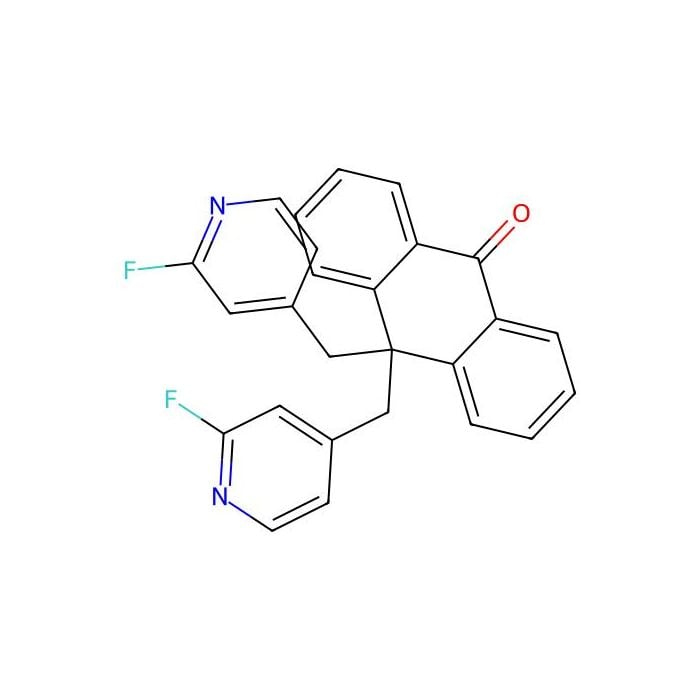
Structural features (general, literature): Reported in the literature as a small-molecule ligand used in neurobiology research. Detailed 2D structure, ring systems, and substituent pattern are not specified here; consult the CoA/Spec Sheet or primary literature linked to the CAS/CID for exact structural representation.
Stereochemistry: Not specified for this item; refer to CoA/Spec Sheet.
Notes
The above contains both catalog facts (SKU, name, CAS) and literature cross-references (CID). For definitive structural identifiers for this batch, rely on the CoA/Spec Sheet supplied with the product.
Synthetic Utility
DMP-543 is provided as a finished small molecule within the Moligand™ collection and is not typically employed as a reagent, catalyst, or building block in synthetic chemistry.
If derivatization is desired for PROTACs, photoaffinity probes, or biotinylated analogs in chemical biology, consider the following general strategies (literature/practice, not item-specific):
Identify non-critical positions (based on SAR from primary literature) suitable for installation of linkers (e.g., aliphatic amines, azides, or alkynes) without abolishing activity.
Use modular coupling chemistry (amide coupling, CuAAC, or SNAr if an activated aryl/heteroaryl position is present) to append handles.
Validate that modifications preserve target engagement via orthogonal assays.
Note: No reactive handle locations or functional group compatibilities are specified for this item; consult primary literature for DMP‑543 before attempting semi-synthesis.
Target Specificity
Not specified for this item; refer to CoA/Spec Sheet and primary literature. No target, binding constant, or selectivity panel data are provided in the Product Data for DMP‑543.
Need help choosing the grade?
Our grade selection guide covers purity, stabilizer status, and application suitability for all variants in our catalog.
We use cookies to ensure the website functions properly and, where permitted, to improve your experience. You can manage your preferences at any time in Settings. Learn more in our Cookie Policy.
Shall we send you a message when we have discounts available?
Remind me later
Thank you! Please check your email inbox to confirm.
Products are supplied to verified businesses, institutions, and qualified professionals for research and development use only. Not for use in humans, animals, diagnosis, or therapy.