
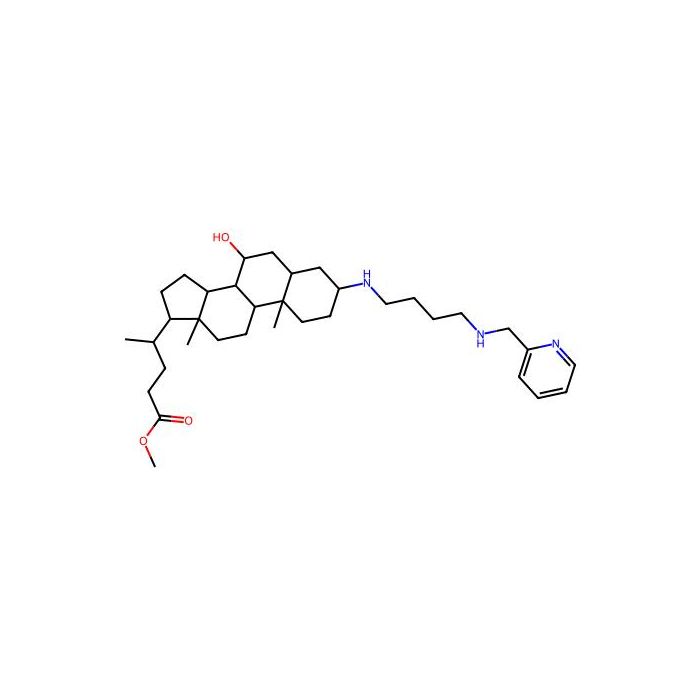
Determine the necessary mass, volume, or concentration for preparing a solution.
DPM-1001 - ≥95% , CAS No.1471172-27-6
AVAILABLE TO ORDER
GRADE & PURITY ≥95%
Storage
Store at -20°C
Shipped In
Ice chest + Ice pads
≥95% for sensitive chromatographic and analytical workflows requiring minimal baseline interference.
Store at -20°C Ships Ice chest + Ice pads Check lot-specific COA for exact specifications.
SDS, COA, datasheet, and spec sheet available for download. Lot-specific COA accessible via lot number lookup.
Cited in 0 peer-reviewed publications across chromatography, organic synthesis, and cross-coupling reactions.
DPM-1001 is a potent, specific, orally active and non-competitive inhibitor of protein-tyrosine phosphatase (PTP1B) with an IC 50 of 100 nM. DPM-1001 is an analog of the specific PTP1B inhibitor MSI-1436. DPM-1001 has anti-diabetic property
In Vitro
DPM-1001 inhibits the short form of PTP1B reversibly, whereas PTP1B(1–405) remained inactive over an extended period of time. DPM-1001 is against PTP1B(1–405) with no pre-incubation, the IC 50 value for PTP1B(1–405) is 600 nM. However, after a 30-min pre-incubation, the potency is improved to 100 nM. In contrast, there is no obvious time-dependent change in the IC 50 value for PTP1B(1–321). MCE has not independently confirmed the accuracy of these methods. They are for reference only.
In Vivo
DPM-1001 (oral or intraperitoneal administration; 5 mg/kg; once daily; 50 days) inhibits diet-induced obesity in mice by improving insulin and leptin signaling. DPM-1001-treated, high-fat diet-fed mice starts losing weight within 5 days of treatment. The weight loss continues for approximately 3 weeks, after which no further decrease in body weight is observed . MCE has not independently confirmed the accuracy of these methods. They are for reference only. Animal Model: 18 weeks of age, high-fat diet (HFD)-fed obese male mice (C57bl6/J) Dosage: 5 mg/kg Administration: Oral or intraperitoneal administration; 5 mg/kg; once daily; 50 days Result: Led to an 5% decrease in body weight. Improved glucose tolerance and insulin sensitivity in glucose tolerance and insulin tolerance in vivo .
Form:Solid
IC50& Target:IC50: 100 nM (PTP1B)
| Canonical Smiles | CC(CCC(=O)OC)C1CCC2C1(CCC3C2C(CC4C3(CCC(C4)NCCCCNCC5=CC=CC=N5)C)O)C |
|---|---|
| IUPAC Name | methyl (4R)-4-[(3R,5R,7R,8R,9S,10S,13R,14S,17R)-7-hydroxy-10,13-dimethyl-3-[4-(pyridin-2-ylmethylamino)butylamino]-2,3,4,5,6,7,8,9,11,12,14,15,16,17-tetradecahydro-1H-cyclopenta[a]phenanthren-17-yl]pentanoate |
| InChIKey | RVANDQULNPITCN-MCVYBXALSA-N |
| INCHI | 1S/C35H57N3O3/c1-24(10-13-32(40)41-4)28-11-12-29-33-30(15-17-35(28,29)3)34(2)16-14-26(21-25(34)22-31(33)39)37-20-8-7-18-36-23-27-9-5-6-19-38-27/h5-6,9,19,24-26,28-31,33,36-37,39H,7-8,10-18,20-23H2,1-4H3/t24-,25-,26-,28-,29+,30+,31-,33+,34+,35-/m1/s1 |
| PubChem CID | 139291002 |
| Molecular Weight | 567.85 |
Comprehensive hazard, handling, storage, and regulatory compliance document.
Download SDS →Lot-specific quality data. Enter your lot number to retrieve the exact COA.
Look up COA →Full quality attributes and acceptance criteria for this grade.
View spec sheet →| Solubility | DMSO : 100 mg/mL (176.10 mM; ultrasonic and warming and heat to 60°C) |
|---|