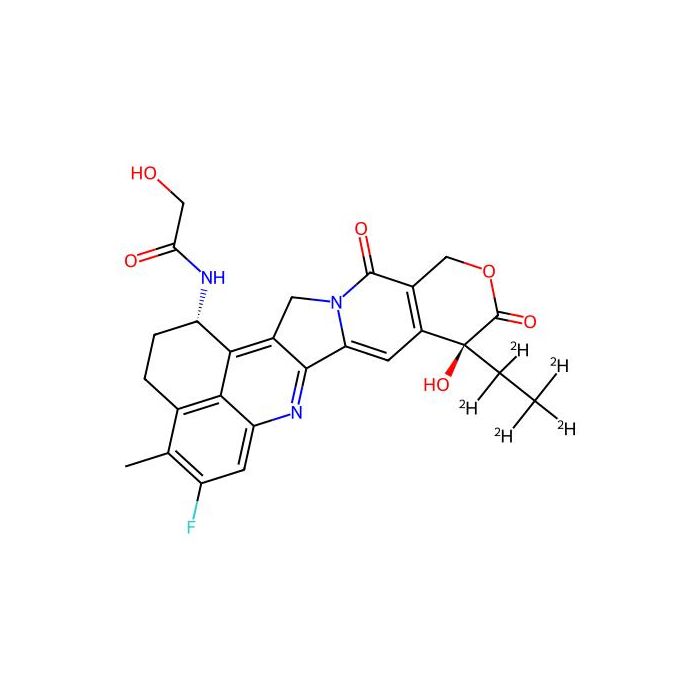
10mM in DMSO for sensitive chromatographic and analytical workflows requiring minimal baseline interference.
🌡
Storage & shipping
Protected from light,Desiccated,Store at -80°C Ships Dry ice packs + Cold packs Check lot-specific COA for exact specifications.
📋
Quality documents
SDS, COA, datasheet, and spec sheet available for download. Lot-specific COA accessible via lot number lookup.
📚
Literature proof
Cited in 0 peer-reviewed publications across chromatography, organic synthesis, and cross-coupling reactions.
Overview
Dxd-d 5 is a deuterium labeled Dxd. Dxd is a potent DNA topoisomerase I inhibitor, with an IC50 of 0.31 μM, used as a conjugated drug of HER2-targeting ADC (DS-8201a) .
IC50& Target:Topoisomerase I 0.31 μM (IC 50 )
In Vitro:Stable heavy isotopes of hydrogen, carbon, and other elements have been incorporated into drug molecules, largely as tracers for quantitation during the drug development process. Deuteration has gained attention because of its potential to affect the phar
Biological Activity:Dxd-d 5 is a deuterium labeled Dxd. Dxd is a potent DNA topoisomerase I inhibitor, with an IC50 of 0.31 μM, used as a conjugated drug of HER2-targeting ADC (DS-8201a) .
Specifications
Specifications & Purity
10mM in DMSO
Storage
Protected from light,Desiccated,Store at -80°C
Shipped In
Dry ice packs + Cold packs
This product requires cold chain shipping. Ground and other economy services are not available.
Determine the necessary mass, volume, or concentration for preparing a solution.
Dilution Calculator
Determine the dilution needed to prepare a stock solution.
Reconstitution Calculator
Reviews
Customer Reviews
Application Protocols
No item-specific, tested application protocols are provided in the Product Data. The following outlines a general, literature-based workflow for using a d5-labeled internal standard in LC–MS bioanalysis. Adapt and validate for your method.
General LC–MS internal standard workflow (example)
Stock preparation: Prepare a verified concentration stock (e.g., 1–5 mM) in DMSO or MeOH. Aliquot and store at −80 °C, protected from light. Record mass and purity to enable gravimetric back-calculation.
Working IS solution: Dilute the stock into ACN or MeOH to a convenient IS concentration (e.g., 10–100 ng/mL for plasma assays; adjust to analyte sensitivity).
Sample spiking: Add a fixed volume of IS working solution to all samples, calibrators, and QCs prior to extraction.
Sample prep: Perform protein precipitation (e.g., 3–4 volumes of ACN), centrifuge, and transfer supernatant. Alternatively, use SPE if cleaner extracts are required.
LC–MS/MS: Optimize MRM transitions for analyte and d5 IS; ensure chromatographic co-elution and absence of cross-talk. Use matrix-matched calibration.
QC: Evaluate recovery, matrix effect, and stability (bench-top, autosampler, freeze–thaw).
Note: Concentrations, volumes, and matrices should be optimized empirically. This is a general template and not specific to Dxd-d5 without a provided structure.
Biological Roles
Item-specific biological/biochemical roles are not provided in the Product Data. The following context is general and literature-based for deuterated analogs of small molecules (research use only):
Isotopically labeled standards (e.g., d5) are not intended to alter biological mechanisms; rather, they mirror the parent molecule’s physicochemical behavior closely while enabling mass-spectrometric discrimination via a +5 Da shift.
In omics and bioanalytical workflows, deuterated standards support accurate quantitation of target analytes in complex matrices (plasma, serum, tissue, cell lysates) by compensating for matrix effects and handling losses.
Deuterium substitution can subtly affect metabolic kinetics (kinetic isotope effect); however, for internal standards this effect is typically inconsequential because the labeled standard is introduced post-collection or at the start of sample preparation, not as a pharmacological probe.
Typical deployment includes spiking a fixed amount of the d5 standard into all samples, calibrators, and QCs, enabling calculation of analyte-to-internal-standard peak area ratios for robust quantitation.
Because the exact identity of “Dxd-d5” is not confirmed here, do not infer any specific target, pathway, or mode of action from this entry. For any intended biological experiments beyond analytical quantitation, obtain the full structural identity and safety information from the CoA/SDS and evaluate institutional approvals accordingly.
Buffer Applications
This product is not presented as a buffering reagent. No item-specific pKa or buffer capacity data are provided.
General guidance
If used in bioanalytical workflows, buffers (e.g., ammonium formate/acetate at low millimolar concentrations) may be employed in LC–MS mobile phases to improve ionization and peak shape of the analyte and its d5 internal standard. Buffer choice and pH should be optimized empirically for the parent analyte’s ionization mode (ESI+ or ESI−).
Avoid high ionic strength buffers for stock solutions; prepare the analyte/d5 standard in organic solvents (DMSO, MeOH, or ACN) and dilute into volatile, MS-compatible mobile phases (e.g., water/ACN with 0.1% formic acid) immediately prior to analysis.
For true buffering applications (biochemical assays), use dedicated buffer systems (HEPES, PBS, TRIS, MOPS) as appropriate. This item is not typically used to establish or maintain pH.
Green Alternatives
Item-specific green chemistry attributes are not provided. For analytical standards, solvent and workflow choices typically dominate the environmental footprint. The following points are general, literature-based guidance.
Greener solvent considerations (general)
Prefer ACN or MeOH (LC–MS grade) over chlorinated solvents. Where solubility permits, ACN/H2O mobile phases with low additive levels reduce hazardous waste.
Consider 2-propanol (IPA) as a co-solvent to improve solubility/peak shape while maintaining relatively favorable EHS properties compared with DMF/DMAC.
For sample prep, protein precipitation with ACN/MeOH generates less hazardous waste than LLE with halogenated solvents.
Miniaturization and waste reduction
Adopt microflow or capillary LC where feasible to cut solvent consumption by 5–20×.
Use 96-well or 384-well SPE/precipitation formats to minimize per-sample solvent volumes.
Stability and re-use
Prepare concentrated master stocks and aliquot to extend shelf life and minimize repeated thaw cycles, thereby reducing material waste.
Illustrative comparison (general)
DMSO vs MeOH for stock solutions: DMSO maximizes solubility but is higher boiling and harder to remove; MeOH is more volatile and generally greener, but may offer lower solubility. Choose based on the compound’s solubility and your LC–MS method requirements.
Note: No item-specific green certifications or metrics are available; consult institutional sustainability guidelines.
Pharmaceutical Uses
No pharmacopeial status, excipient role, or formulation details are provided for this item. Do not construe this listing as suitable for human or veterinary use.
General, non-clinical context (research only)
Deuterated analogs are commonly used as internal standards for bioanalytical method development and validation supporting research studies (e.g., sample analysis from in vitro systems or preclinical matrices). They aid in constructing calibration curves, assessing accuracy/precision, recovery, matrix effects, and stability.
For manufacturing or QC contexts, certified reference materials (CRM) with traceable assay values may be required. If such certification is needed, verify whether a certified concentration, uncertainty budget, and traceability are documented on the CoA—none are provided here.
If the intent is to support regulated bioanalysis, ensure:
Verified identity (orthogonal methods), purity, isotopic enrichment, and stability data.
Documented storage conditions and expiry/retest dates.
Suitability of the solvent system (if supplied in solution) for your analytical platform and compliance requirements.
This product is supplied strictly for research use only, as stated in the Product Data.
Physical Properties
Item-specific properties
Appearance: Not specified for this item; refer to CoA/Spec Sheet.
Grade/Purity: Not specified for this item; refer to CoA/Spec Sheet.
Molecular Weight: Not specified for this item; refer to CoA/Spec Sheet.
Density, refractive index, logP/logD, pKa, solubility, melting point, boiling point: Not specified for this item; refer to CoA/Spec Sheet.
Storage/transport (from Product Data)
Storage: Store at −80 °C, desiccated, protected from light.
Shipping: Dry ice packs + cold packs.
Interpretive notes (general/literature)
Deuterated small molecules supplied for LC–MS workflows are commonly provided neat as solids or as frozen DMSO solutions at defined concentrations. The listing includes “(DMSO)” in the CAS line, which may indicate a DMSO-based format; however, this is not confirmed for this specific item—verify on the product label or CoA.
If provided as a DMSO stock, typical working concentrations range from 0.1–10 mM (literature practice), with aliquots maintained frozen and protected from moisture and light to minimize degradation and evaporation.
In the absence of measured thermophysical data, do not infer values from the unlabeled analog; deuteration can slightly shift spectroscopic and volatility properties. Always consult the CoA/SDS for definitive specifications needed for method validation or stability studies.
Quality & Grades
Item-specific quality
Grade/Purity: Not specified for this item; refer to CoA/Spec Sheet.
Any stabilizers, counterions, salt form, or exact concentration (if solution): Not specified for this item; refer to CoA/Spec Sheet.
Guidance on typical grades for isotopically labeled standards (general)
Analytical/Reference Standard Grade: Emphasizes identity confirmation (NMR, MS, HRMS) and high chemical purity to support quantitative LC–MS/MS. Often accompanied by a certified concentration when supplied in solution and a stated uncertainty.
Isotopic Enrichment: For d5 materials, percent deuterium incorporation and isotopic distribution (e.g., d4/d5/d6 content) are critical. Look for an isotopic purity specification on the CoA.
Residual solvents, water content, and counterion identity (if a salt) materially affect mass balance and quantitation; high-end reference materials provide these data.
What this means for this item
Because item-specific grade, purity, and enrichment are not disclosed here, consult the CoA before use in regulated or quantitative studies. Verify:
Chemical purity (% area by HPLC/UPLC)
Isotopic enrichment profile
Residual solvent/water content and any stabilizers
Exact concentration and solvent if pre-dissolved
For trace analysis and calibration curves, prepare gravimetrically from a verified assay value to ensure accurate back-calculation of analyte concentrations.
Reaction & Applications
Item-specific application claims are not provided in the Product Data. Based on the name and typical use of d5-labeled small molecules, the following are general, literature-based applications (not item-specific; verify fitness-for-purpose with the CoA and your method requirements):
Analytical/quantitative applications (general)
Internal standard for LC–MS/MS: d5 analogs co-elute closely with the unlabeled analyte, correcting for ionization suppression/enhancement, extraction efficiency, and injection variability.
Recovery and stability tracking: Parallel monitoring of the d5 standard provides real-time checks on extraction loss and degradation during sample prep.
Calibration and QC: Prepare matrix-matched calibration curves with fixed d5 internal standard concentrations to improve accuracy and precision.
Bioanalytical contexts (general, for research use only)
ADME and metabolism studies: Track the parent analyte while using the d5 analog as the internal standard across plasma, tissue homogenate, or microsomal incubations.
Conjugate or payload monitoring: When the unlabeled analyte is a complex small molecule (e.g., a drug-like moiety), the d5 version supports quantitation in complex biological matrices following protein precipitation or SPE.
Practical notes
Confirm mass transitions (precursor/product m/z) and isotopic purity to avoid channel overlap.
Evaluate chromatographic co-elution; minor retention shifts may occur depending on labeling sites.
Verify stability in chosen solvents and at autosampler temperature; maintain light protection if the item is photosensitive (storage note suggests light sensitivity).
Reaction Conditions
Not typically applicable. This product is expected to be used as a reference/internal standard rather than as a reagent or substrate in preparative reactions.
General notes for analytical deployment (literature-based)
Stock solutions: Often prepared at 0.1–10 mM in DMSO, MeOH, or ACN (verify item-specific solvent and concentration on CoA/label). Store frozen in aliquots to avoid multiple freeze–thaw cycles.
LC–MS conditions: Mobile phases commonly include water with 0.1% formic acid (A) and ACN with 0.1% formic acid (B) for ESI+; ammonium acetate/formate buffers (2–10 mM) are frequently used to tailor retention/ionization. Gradients and column chemistries (C18, phenyl-hexyl) are chosen to co-elute the d5 standard with the analyte.
MS parameters: Choose MRM/SRM transitions separated by +5 m/z (or appropriate exact mass shift) and verify the absence of isotopic overlap or in-source H/D exchange.
If you intend to use this material in a chemical reaction, obtain the complete structure and labeling information from the CoA/SDS; otherwise, specific catalysts, temperatures, or yields cannot be responsibly recommended for this item.
Safety & Handling
Item-specific hazard data
Signal Word: Not specified for this item; refer to SDS.
H-Statements: Not specified for this item; refer to SDS.
GHS Classification/Pictograms: Not specified for this item; refer to SDS.
Handling guidance (general; defer to SDS)
Work in a chemical fume hood with appropriate PPE: lab coat, safety glasses, and chemically resistant gloves (e.g., nitrile). Avoid inhalation, ingestion, and skin or eye contact.
Given the storage note “protected from light, desiccated, −80 °C,” treat the material as light- and moisture-sensitive. Minimize exposure to ambient humidity. Warm only briefly to thaw; immediately reclose/realquot to limit freeze–thaw cycles.
If supplied in DMSO, remember DMSO enhances dermal absorption of solutes. Prevent skin contact and promptly clean any spills with appropriate absorbents; dispose as hazardous waste.
Incompatibilities (general): strong oxidizers and acids/bases may cause decomposition for many organic small molecules; verify item-specific incompatibilities on the SDS.
First aid (general)
Skin/eye contact: Rinse with plenty of water for at least 15 minutes; remove contaminated clothing; seek medical attention.
Inhalation: Move to fresh air; monitor breathing; seek medical attention.
Ingestion: Rinse mouth; do not induce vomiting; obtain medical attention immediately.
Spill/leak (general)
Contain with inert absorbent, avoid dust/aerosol generation, and place in a sealed container for disposal consistent with institutional and local regulations.
Solvent Selection
Item-specific solvent recommendations
Not specified for this item; refer to CoA/Spec Sheet. The listing hints at “(DMSO)” but this is not confirmed.
General guidance for deuterated small-molecule standards
Primary solvents: DMSO and acetonitrile (ACN) are commonly used due to broad solubility and LC–MS compatibility.
Aqueous miscibility: DMSO and ACN are both miscible with water, enabling direct preparation of working solutions in mobile phases (e.g., water/ACN with 0.1% formic acid) while minimizing precipitation.
Alternative solvents: Methanol (MeOH) offers strong solvating power and is LC–MS friendly; DMF can dissolve challenging analytes but is less volatile and less preferred for routine LC–MS.
Selection tips (general)
Start with a concentrated stock (e.g., 1–10 mM) in DMSO or MeOH, then dilute into ACN/H2O to mitigate adsorption and solubility limits.
For adsorption-prone analytes, include 0.1% formic acid or 0.2% ammonium formate (LC–MS grade) to improve recovery (method-dependent).
Avoid buffered saline at high stock concentrations to prevent salting-out and ion suppression in MS.
Quick comparison (general)
DMSO: maximal solubility, excellent for master stocks; high boiling point; enhances dermal absorption (handle carefully).
ACN: volatile, MS-friendly, good for dilutions and calibration levels.
MeOH: good solvency, widely used; can affect ionization differently than ACN—optimize for your method.
Storage & Reconstitution
Item-specific instructions (from Product Data)
Storage conditions: Store at −80 °C, desiccated, protected from light.
Shipping: Dry ice packs + cold packs.
Reconstitution (item-specific details not provided)
Solvent, concentration, and appearance: Not specified for this item; refer to CoA/Spec Sheet.
General best practices for small-molecule (d5) standards
If supplied as a solid: Equilibrate briefly to room temperature in a desiccator before opening. Reconstitute in anhydrous DMSO, MeOH, or ACN to prepare a concentrated master stock (e.g., 1–10 mM). Mix gently to dissolve; avoid vigorous vortexing if foaming or adsorption is a concern.
If supplied as a frozen DMSO solution: Thaw on ice or at 4 °C protected from light. Mix by gentle inversion. Immediately aliquot into low-bind, amber vials to minimize future freeze–thaw cycles.
Light/moisture protection: Use amber vials and inert gas backfill (e.g., argon) for long-term storage when feasible. Maintain desiccant in secondary containment.
Stability monitoring: Track preparation date, storage temperature, and any observed precipitation or color change. For quantitative work, periodically verify concentration by an orthogonal assay (e.g., qNMR or calibrated LC–MS).
Always defer to the product label and CoA for authoritative, item-specific reconstitution and stability information.
Structure & Identity
Item-specific identifiers for this listing are limited. The compound name suggests an isotopically labeled analog (d5) of “Dxd,” but no definitive structural data are provided in the Product Data.
Item-specific facts (from Product Data)
SKU: D661678
Product Name: Dxd-d5
CAS: D661678(DMSO) (catalog placeholder; not a verified CAS number)
InChIKey: Not specified for this item; refer to CoA/Spec Sheet.
SMILES: Not specified for this item; refer to CoA/Spec Sheet.
Molecular Formula: Not specified for this item; refer to CoA/Spec Sheet.
Molecular Weight: Not specified for this item; refer to CoA/Spec Sheet.
Interpretive notes (general/literature)
“d5” typically denotes incorporation of five deuterium atoms, most often at metabolically labile C–H positions to create a mass shift of +5 Da relative to the unlabeled analog. This facilitates use as an LC–MS/MS internal standard due to co-elution with chromatographic separation and minimal isotopic interference (general concept; not item-specific without a provided structure).
Structural features of the parent “Dxd” cannot be described here without a verified structure; consult the CoA/SDS for the exact identity, substitution pattern, and labeling sites.
2D structure description (not item-specific)
Without a confirmed structure, ring systems, functional groups, and stereochemistry cannot be detailed. If this material is intended as a bioanalytical standard for a known small molecule (e.g., a payload, metabolite, or probe), the d5 analog generally mirrors the parent framework, with deuterium replacing selected hydrogens.
Synthetic Utility
This product appears to be an isotopically labeled small molecule standard rather than a synthetic building block. As such, it is generally not used as a reagent in multi-step synthesis.
General considerations (literature-based)
Deuterated analogs can aid mechanistic investigations by enabling kinetic isotope effect studies and tracking of hydrogen/deuterium exchange. However, without a defined structure and labeling map, such use cannot be prescribed for this item.
In analytical chemistry, the primary “utility” is as a mass-differentiated surrogate of the parent analyte for quantitative LC–MS, not as a synthon.
If a labeled building block is required
Select deuterated reagents with defined labeling positions (e.g., d5-aryl halides, d6-benzene derivatives, d3-methyl reagents) to ensure the label survives subsequent transformations. Confirm labeling stability under planned reaction conditions (acid/base, redox, metal-catalyzed steps) to avoid H/D scrambling.
Conclusion
Treat Dxd-d5 as a reference/trace analysis tool unless the CoA indicates otherwise. For synthetic incorporation or tracer studies, obtain the exact structure, labeling pattern, and stability profile from the manufacturer’s documentation.
Target Specificity
No target, antigen, epitope, clone, or isotype information is applicable. This product is a small molecule (isotopically labeled) standard and is not an antibody, protein, or biological targeting reagent.
Item-specific data: Not specified for this item; refer to CoA/Spec Sheet.
Frequently Asked Questions
How should this product be stored?
Store at ?80 °C, protected from light, desiccated. Keep the container tightly closed with desiccant — the material is moisture-sensitive.
How is this product shipped?
This product ships frozen with dry ice and cold packs. Unpack on arrival and transfer it to the storage condition stated above; handle dry ice with insulated gloves in a ventilated area.
What are the CAS number, molecular formula and molecular weight?
The CAS Number is D661678(DMSO), the molecular formula is C26H19D5FN3O6, and the molecular weight is 498.51 g/mol.
What documentation is provided?
Available product documentation, including Certificates of Analysis (COA), Safety Data Sheets (SDS), and specification sheets, is shown in the product document area. Document availability and access follow the current site policy.
We use cookies to ensure the website functions properly and, where permitted, to improve your experience. You can manage your preferences at any time in Settings. Learn more in our Cookie Policy.
Shall we send you a message when we have discounts available?
Remind me later
Thank you! Please check your email inbox to confirm.
Products are supplied to verified businesses, institutions, and qualified professionals for research and development use only. Not for use in humans, animals, diagnosis, or therapy.