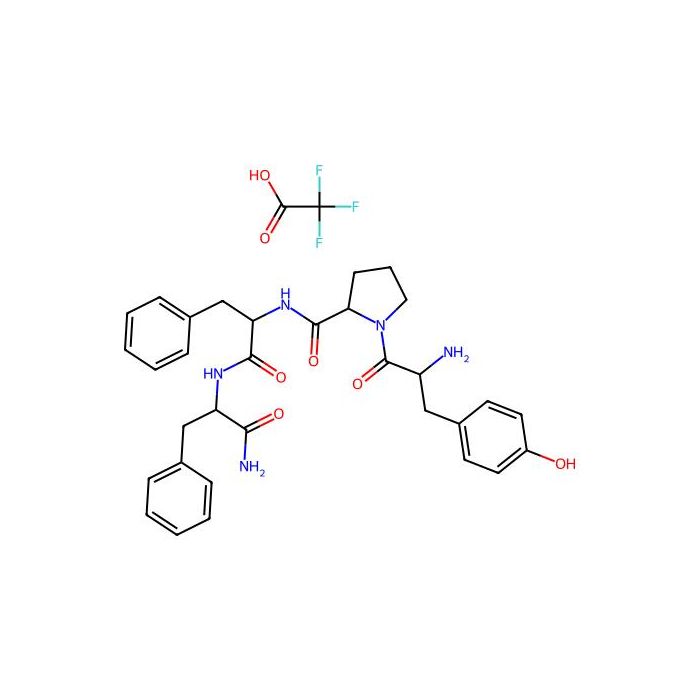
Endomorphin 2 TFA, a high affinity, highly selective agonist of the μ-opioid receptor , displays reasonable affinities for kappa 3 binding sites, with K i value between 20 and 30 nM
Endomorphin 2 TFA, a high affinity, highly selective agonist of the μ-opioid receptor , displays reasonable affinities for kappa 3 binding sites, with K i value between 20 and 30 nM.
Storage
Desiccated,Store at -80°C
Shipped In
Dry ice packs + Cold packs
This product requires cold chain shipping. Ground and other economy services are not available.
Action Type
AGONIST
Names and Identifiers
PubChem CID
137700452
Molecular Weight
685.69
Advanced Data
Certificates (CoA,COO,BSE/TSE and Analysis Chart)
C of A & Other Certificates(BSE/TSE, COO):
Analytical Chart:
Solution Calculators
Molarity Calculator
Determine the necessary mass, volume, or concentration for preparing a solution.
Dilution Calculator
Determine the dilution needed to prepare a stock solution.
Reconstitution Calculator
Reviews
Customer Reviews
Application Protocols
Item-specific (Product Data)
Tested applications, recommended dilutions, and positive controls: Not specified for this item; refer to CoA/Spec Sheet.
General remarks
Because no validated protocols are provided for this SKU, users should adapt standard receptor binding or functional assay procedures from peer‑reviewed literature, validating concentration ranges, buffers, and incubation times in their specific system.
Biological Roles
Literature/general background (no clinical claims)
Endomorphin‑2 is a tetrapeptide (Tyr–Pro–Phe–Phe‑NH2) proposed as an endogenous ligand in mammalian opioid systems. It is frequently studied for its high functional selectivity and affinity toward μ‑opioid receptors (MOR) relative to δ/κ subtypes, enabling dissection of MOR‑mediated signaling pathways.
Sequence–function relationships: the N‑terminal Tyr is critical for receptor engagement; Pro at position 2 influences backbone conformation; the two Phe residues provide hydrophobic/aromatic interactions within the MOR binding pocket. C‑terminal amidation is important for potency and metabolic stability (literature).
Metabolic considerations: peptidases (e.g., aminopeptidases, endopeptidases) can degrade Endomorphin‑2; stabilization strategies studied in vitro include D‑residue substitution, N‑terminal protection, or cyclization. Such analogs are often compared directly against Endomorphin‑2 as a reference.
Signaling frameworks: used to probe G‑protein versus β‑arrestin pathways, receptor internalization, and biased agonism, with readouts including cAMP inhibition, [35S]GTPγS binding, ERK phosphorylation, and β‑arrestin recruitment assays.
Item-specific note
Target specificity, potencies, and assay performance parameters are not specified for this item; refer to CoA/Spec Sheet and SDS for any additional details the manufacturer may provide.
This product is intended strictly for laboratory research on opioid receptor biology and related biochemical mechanisms.
Buffer Applications
This compound is not a buffering agent. However, proper buffer preparation is essential for assay reliability when working with peptide standards.
Applicability
Not typically used to prepare buffer systems. Instead, it is dissolved into pre‑made buffers for biochemical/pharmacological assays.
Practical guidance (general)
Stock preparation: dissolve in water, dilute acid, or DMSO; then dilute into assay buffer (e.g., PBS, HEPES, or Tris buffered saline) ensuring final pH and ionic strength match assay requirements.
pH control: maintain physiological pH (e.g., 7.2–7.4) for receptor assays unless otherwise specified by the protocol; verify that the small amount of TFA introduced from stocks does not materially shift pH.
Minimizing adsorption: include low levels of carrier protein (e.g., 0.05–0.1% BSA) or non‑ionic surfactant (e.g., 0.01% Tween‑20) if consistent with assay design to reduce surface loss at low concentrations.
Filtration: use low‑protein‑binding filters (PVDF/PTFE) for sterilization of working solutions when required; avoid cellulose acetate if adsorption is observed.
Specifications
No buffer capacity, pKa, or related parameters are specified for this item; refer to assay‑specific SOPs for buffer recipes and performance criteria.
Green Alternatives
Context
Endomorphin 2 TFA is a peptide salt; the primary “green” considerations are counterion choice, solvent systems, and waste minimization rather than alternative chemicals for the same function.
Greener choices (literature/general)
Counterion: acetate or formate salts are more benign than TFA for downstream bioassays and mass spectrometry, reducing halogenated waste and potential assay interference.
Solvents: prioritize water‑based buffers; when organic co‑solvent is needed, use ethanol or isopropanol in small fractions over acetonitrile where assay‑compatible. For LC, low‑TFA or TFA‑free mobile phases (e.g., 0.1% formic acid) improve MS efficiency.
Process: prepare higher‑concentration stocks to reduce container count and rinse volumes; employ micro‑aliquoting to cut freeze–thaw related waste.
Trade‑offs
TFA enhances RP‑HPLC peak shape for many peptides but can suppress MS signal; acetate/formate are greener but may broaden peaks and slightly reduce chromatographic resolution.
DMSO is effective for dissolution but is not benign; minimize volume and replace with aqueous buffer where possible once dissolved.
Acetate/formate salt: greener counterion; improved MS compatibility; may require minor optimization of dissolution and chromatography.
Pharmaceutical Uses
Item-specific (Product Data)
No pharmacopeial grade or excipient role is specified for this item; refer to CoA/Spec Sheet.
Research Use Only: This product is not intended for human or veterinary use, diagnostic procedures, or as a drug substance/excipient.
Literature/general context (non-clinical)
Endomorphin‑2 and analogs are commonly used as research standards in preclinical discovery to study opioid receptor pharmacology, stability, and delivery strategies. Typical roles include: reference agonist in receptor assays, comparator in SAR campaigns, and calibration standard in analytical methods.
Formulation studies (research stage): dissolution into aqueous buffers, evaluation of stability vs. pH/temperature, and assessment of adsorption to containers are common preformulation exercises for reliable in vitro data.
Compliance note
No GMP status, pharmacopeial monograph, or clinical application is claimed or implied for this catalog item. Any use in manufacturing or regulated studies requires independent qualification and documentation by the end user.
Physical Properties
Item-specific (Product Data)
Appearance: Not specified for this item; refer to CoA/Spec Sheet.
Molecular weight: Not specified for this item; refer to CoA/Spec Sheet.
Other specifications (mp, bp, density, UV cutoff, metals, residual solvents, water): Not specified for this item; refer to CoA/Spec Sheet.
Literature/general properties (for guidance only; salt stoichiometry affects values)
Physical state: typically a white to off‑white amorphous solid or lyophilized powder (peptide TFA salts, literature).
Solubility strategy (literature): readily soluble in water, dilute acids (e.g., 0.1% TFA, 0.1 M HCl), and polar aprotic solvents like DMSO; initial dissolution may be aided by small volumes of DMSO before dilution with aqueous buffer.
pH considerations: as a TFA salt of a peptide with a basic N‑terminus and phenolic Tyr, solutions are mildly acidic; final solution pH will depend on buffer and TFA content.
Hygroscopicity: peptide TFA salts can be hygroscopic; moisture uptake can alter mass balance and apparent purity.
Aggregation: aromatic, hydrophobic residues (Phe/Phe) may promote aggregation at higher concentrations or near neutral pH; sonication or small % organic cosolvent can help.
Typical extinction data: no universal peptide UV–vis molar absorptivity; Tyr and Phe absorb at ~280 nm (Tyr) and ~257 nm (Phe) (literature). Quantification is often by amino acid analysis, gravimetry, or HPLC with standards.
Note: Do not treat literature values as specifications. Always consult the item’s CoA/Spec Sheet for definitive physical data.
Quality & Grades
Item-specific (Product Data)
Grade/Purity: Not specified for this item; refer to CoA/Spec Sheet.
How to interpret peptide quality (general guidance)
Peptide purity descriptors: "crude," "desalted," ">80%, >90%, >95%, >98% (HPLC)", or "analytical standard" typically refer to area % by RP‑HPLC with UV detection. Mass accuracy is confirmed by MS.
Counterion content: TFA counterion stoichiometry can vary with workup and lyophilization conditions; CoA will typically report counterion content or provide calculated MW with assumed TFA equivalents.
Water and residual solvents: peptide lyophilizates may contain bound water/volatile content. Karl Fischer and residual solvent data, if provided, are item‑specific. Not specified for this item; refer to CoA/Spec Sheet.
Endotoxin/bioburden: for research‑grade peptides, these are usually not controlled to GMP standards unless explicitly stated. Not specified for this item; refer to CoA/Spec Sheet.
UV profile: HPLC‑grade peptides often minimize TFA remnants for LC–MS compatibility, but TFA salts are common for stability/handling.
Practical implications
Choose purity based on application: receptor binding and cell signaling studies often prefer ≥95% HPLC purity to reduce off‑target effects; analytical calibration may require certified reference standards.
Request CoA: For this item, consult the CoA/Spec Sheet for exact purity, assay method(s), counterion content, and analytical chromatograms.
Reaction & Applications
Item-specific (Product Data)
Manufacturer Applications: Not specified for this item; general research use only.
Research applications (literature/general; no medical claims)
Receptor pharmacology: widely used as a reference ligand/standard for μ‑opioid receptor (MOR) studies in binding assays, G‑protein activation, β‑arrestin recruitment, and downstream signaling readouts.
Neuroscience biochemistry: tool compound for probing endogenous opioid peptide pathways, receptor selectivity, and structure–activity relationships (SAR) vs. Endomorphin‑1 and other opioid peptides.
Analytical standards: used to validate/benchmark LC–MS/MS methods for peptide detection/quantification; serves as a retention time and fragmentation reference in targeted proteomics/peptidomics workflows.
Practical tips (general)
Stock solutions: prepare concentrated stocks (e.g., 1–10 mM) in DMSO or water with mild acid, aliquot, and store at −80°C. Avoid repeated freeze–thaw.
Adsorption losses: aromatic peptides may adsorb to glass/plastics at low nM–µM levels; pre‑rinse vials with dilute peptide or add 0.1% carrier protein (e.g., BSA) if compatible with the assay.
Light and oxidation: protect from strong light; although lacking Met/Cys, Tyr can undergo oxidation—minimize air exposure, consider degassed buffers for sensitive work.
Note: The above are literature/practice‑based uses. This product is supplied strictly for research use only.
Reaction Conditions
Classical organic reaction conditions are not typically applicable to this finished peptide. Instead, focus on solution preparation and handling parameters relevant to bioassays.
Solution preparation (general guidance)
Stock solutions: 1–10 mM in water, dilute acid, or DMSO; filter sterilize through 0.22 µm low‑binding membranes if required.
Working concentrations: application‑dependent (nM–µM range in many receptor assays, literature). Optimize empirically.
Temperature: maintain on ice during setup for sensitive assays; avoid prolonged exposure >25–30°C in solution.
Light/oxygen: protect from strong light; use freshly prepared, degassed buffers for oxidation‑sensitive experiments.
Stability (general)
pH sensitivity: extreme pH (<2 or >9) may accelerate hydrolysis or side‑chain modification; neutral to mildly acidic conditions are generally preferable for storage solutions.
Freeze–thaw: aliquot to single‑use vials; avoid repeated cycles.
Specifications
No item‑specific reaction or assay conditions are provided by the manufacturer for this SKU. Refer to your lab’s SOPs and the primary literature for protocol‑specific parameters.
Safety & Handling
Item-specific (Product Data)
GHS classification, signal word, pictograms, H‑statements: Not specified for this item; refer to SDS.
Storage: Desiccated, Store at −80°C; shipped on dry ice packs + cold packs.
Research use: For research use only.
General safety guidance for peptides/TFA salts (literature/best practice)
PPE: laboratory coat, safety glasses, and suitable gloves (e.g., nitrile). Avoid inhalation of powders and contact with skin/eyes. Handle in a clean, dry environment; use a fume hood when weighing fine powders.
Incompatibilities: strong oxidizers and bases may degrade peptides; avoid prolonged exposure to elevated temperature, moisture, and light. TFA residues can be corrosive/irritant.
Dust control: peptide powders can become airborne; minimize by gentle tapping and antistatic measures. Consider weighing boats with covers.
First aid (overview; defer to SDS): rinse eyes/skin with water for several minutes if contacted; remove contaminated clothing; if inhaled, move to fresh air; if ingested, rinse mouth. Seek medical attention if symptoms persist.
Spill response: avoid raising dust; collect with damp disposable wipes or HEPA vacuum designed for fine powders. Dispose according to institutional and local regulations.
Stability: repeated freeze–thaw cycles can promote degradation; store in aliquots.
Always consult the product‑specific SDS for authoritative hazard classification and response procedures.
Solvent Selection
Endomorphin 2 TFA is a small, aromatic tetrapeptide salt. Solvent choice should balance initial dissolution, aggregation control, and compatibility with the downstream assay.
Polarity and miscibility (general/literature)
Class: highly polar, ionizable peptide salt; readily miscible with water once dissolved.
Preferred solvents: water, aqueous buffers, dilute acids (e.g., 0.1% TFA or 0.01–0.1 M HCl), and DMSO. Methanol or acetonitrile (with water) can aid co‑solubilization for HPLC.
Practical dissolution sequence (general guidance)
Hydration first: wet the lyophilized material with a small volume of water or minimal DMSO (e.g., 5–10% of final volume), gently vortex/sonicate, then bring to volume with buffer.
pH strategy: if aggregation occurs near neutral pH, start in mildly acidic medium and adjust to assay pH after full dissolution.
Concentration limits: aromatic peptides can self‑associate at high concentration; if turbidity appears, increase ionic strength slightly, add 5–20% ACN, or warm gently (≤30°C) briefly.
Compatibility notes (general)
Avoid strong bases and long exposure to pH >9 to prevent base‑catalyzed hydrolysis or Tyr side‑chain reactions.
For LC–MS prep, consider exchanging TFA for volatile formate/acetate buffers after dissolution to improve MS sensitivity.
When to choose alternatives
If TFA is problematic in bioassays (receptor sensitivity to residual TFA), consider exchanging to the acetate salt by brief ion‑exchange/desalting (literature practice).
Storage & Reconstitution
Item-specific (Product Data)
Storage conditions: Desiccated, Store at −80°C.
Shipping: Dry ice packs + Cold packs.
Reconstitution (general best practice; not item‑specific specifications)
Allow the sealed vial to equilibrate to room temperature in a desiccator before opening to prevent moisture condensation.
Reconstitute initially in sterile water, dilute acid (e.g., 0.1% TFA or 0.01–0.1 M HCl), or minimal DMSO, then bring to final volume with assay buffer. Mix gently; brief sonication can aid dissolution.
Prepare single‑use aliquots, snap‑freeze, and store at −80°C. Avoid repeated freeze–thaw cycles.
Working solutions are best kept on ice and used the same day. For longer storage (days to weeks), validate stability at −20°C to −80°C in your matrix.
Container/material notes (general)
Use low‑binding polypropylene or silanized glass to reduce adsorption, particularly at low µM–nM concentrations.
Specifications not provided for this item
Concentration limits, exact solvent preferences, and stability time courses are not specified; refer to the CoA/Spec Sheet and establish stability under your specific conditions.
Research Use Only: Not for human or veterinary use.
Structure & Identity
Brief overview: Endomorphin 2 TFA is the trifluoroacetate salt of the tetrapeptide Endomorphin‑2, commonly formulated as the amidated C‑terminus peptide Tyr‑Pro‑Phe‑Phe‑NH2 with TFA counterion(s).
Item-specific (Product Data)
SKU: E656137
Product name: Endomorphin 2 TFA
CAS: 1276124-00-5
Storage: Desiccated, Store at −80°C; shipped on dry ice packs + cold packs
SMILES: Not specified for this item; refer to CoA/Spec Sheet.
InChIKey: Not specified for this item; refer to CoA/Spec Sheet.
Molecular formula: Not specified for this item; refer to CoA/Spec Sheet.
Molecular weight: Not specified for this item; refer to CoA/Spec Sheet.
Literature/general identity notes
Common sequence: Tyr–Pro–Phe–Phe–NH2 (YPFF‑NH2). The C‑terminus is amidated; the N‑terminus is free (typically protonated in TFA salt).
Counterion: Trifluoroacetate (TFA−); overall composition depends on salt stoichiometry (often 1–2 equiv TFA per peptide, literature).
Structural features: four L‑amino acids; aromatic rings on Tyr and Phe side chains; secondary amide backbones; phenolic OH on Tyr; cyclic secondary amine in Proline.
2D description: A linear tetrapeptide backbone (N–Cα–C(O))4 with side chains: Tyr (p‑hydroxybenzyl), Pro (pyrrolidine ring tethered to backbone N), and two Phe (benzyl). The C‑terminal carboxyl is converted to CONH2.
Stereochemistry (literature)
Naturally aligned L‑configurations at all chiral centers (Tyr, Pro, Phe, Phe), unless otherwise specified by vendor documentation.
Synthetic Utility
This product is a finished peptide standard rather than a general synthetic building block. Nevertheless, it can have utility in synthesis and analysis contexts.
Analytical/synthetic roles (general)
Calibration/benchmarking: use as a defined standard to validate peptide coupling efficiency, HPLC purification methods, and analytical methods (LC–MS/MS, HRMS) during peptide synthesis campaigns.
Reference for SAR: serves as a parent scaffold against which modified analogs (D‑residues, N‑terminal caps, cyclization, non‑natural residues) are compared to quantify structure–activity changes.
Degradation pathway mapping: a convenient substrate to test peptidase inhibitors or to profile forced degradation (acid/base, oxidative) and optimize protective formulations.
Not typically applied in
Cross‑coupling, organometallic transformations, or general reagent roles; peptide functionality is sensitive to harsh conditions and is used downstream as a bioactive control rather than a synthon.
Practical notes
If derivatization is desired (e.g., fluorescent labeling), N‑terminus or Tyr phenol can be targeted under mild conditions; however, this transforms the identity relative to the supplied product and should be undertaken on separate material.
Target Specificity
Item-specific (Product Data)
Target, affinity, species reactivity, and related specificity parameters: Not specified for this item; refer to CoA/Spec Sheet.
Note
While Endomorphin‑2 is widely studied in the literature for μ‑opioid receptor interactions, any quantitative parameters (Ki, EC50, bias factors, etc.) are not provided for this catalog listing and should not be inferred. Users should establish assay‑specific performance independently.
We use cookies to ensure the website functions properly and, where permitted, to improve your experience. You can manage your preferences at any time in Settings. Learn more in our Cookie Policy.
Shall we send you a message when we have discounts available?
Remind me later
Thank you! Please check your email inbox to confirm.
Products are supplied to verified businesses, institutions, and qualified professionals for research and development use only. Not for use in humans, animals, diagnosis, or therapy.